
From my perspective as a researcher deeply immersed in bio-inspired robotics, the flight of the butterfly represents one of nature’s most elegant yet perplexing aerodynamic puzzles. Unlike most insects that rely on high-frequency, low-amplitude wingbeats, butterflies employ a distinct strategy characterized by low frequency, large amplitude flapping, and a pronounced coupling between wing and body motion. This unique flight modality, operating at a Reynolds number regime between $$10^3$$ and $$10^4$$, offers a compelling blueprint for a new class of micro aerial vehicles. The pursuit of a truly agile and efficient flying butterfly drone is not merely an exercise in mimicry; it is a fundamental investigation into alternative principles of flight at small scales, challenging conventional aerospace paradigms and pushing the boundaries of materials, actuation, and control.
The core fascination lies in the paradoxical nature of butterfly flight. Their wingbeat frequency is remarkably low, typically around 10 Hz, compared to 25–400 Hz for other insects like bees or flies. Their wings have a low aspect ratio and large surface area, and they flap through an extreme angle, often approaching 180°. This motion is not isolated; it induces and is influenced by significant pitch oscillations of the thorax and concomitant swinging motions of the abdomen. Despite this apparent complexity and body oscillation, butterflies achieve remarkable agility, precise point-to-point navigation, and even undertake migratory journeys spanning thousands of kilometers. Unraveling this synergy is the key to engineering a flying butterfly drone with unparalleled maneuverability and efficiency.
1. The Foundational Principles of Butterfly Flight Mechanics
Understanding the flight of butterflies requires a multi-faceted approach, combining detailed observation, aerodynamic analysis, and dynamic modeling. Their flight is a symphony of coordinated movements where wings, thorax, and abdomen act as a coupled system.
1.1 Kinematics: The Language of Motion
Butterfly flight kinematics are defined by three primary, coupled degrees of freedom:
- Wing Flapping (Flapping Angle, φ): The primary up-and-down oscillation of the wings about the root. The motion is often asymmetric, with the downstroke being faster and more vertical than the upstroke.
- Thorax Pitching (Pitch Angle, θ_t): The periodic nose-up/nose-down rotation of the main body segment (thorax) to which the wings are attached. This is largely a passive response to inertial and aerodynamic forces from the large flapping wings.
- Abdomen Swinging (Swing Angle, θ_a): The dorso-ventral swinging of the abdomen relative to the thorax. This motion can be passive or actively controlled and plays a crucial role in adjusting the center of mass and influencing pitch dynamics.
These motions are highly synchronized. A simplified mathematical representation of this coupled kinematics can be described using harmonic functions:
$$ \phi(t) = \Phi \cos(2\pi f t) $$
$$ \theta_t(t) = \Theta_t \cos(2\pi f t + \psi_t) $$
$$ \theta_a(t) = \Theta_a \cos(2\pi f t + \psi_a) $$
where $$ \Phi, \Theta_t, \Theta_a $$ are the respective amplitudes, $$ f $$ is the flapping frequency, and $$ \psi_t, \psi_a $$ are the phase shifts relative to the wing flapping. The phase relationship, particularly the anti-phase swing of the abdomen, is critical for stability.
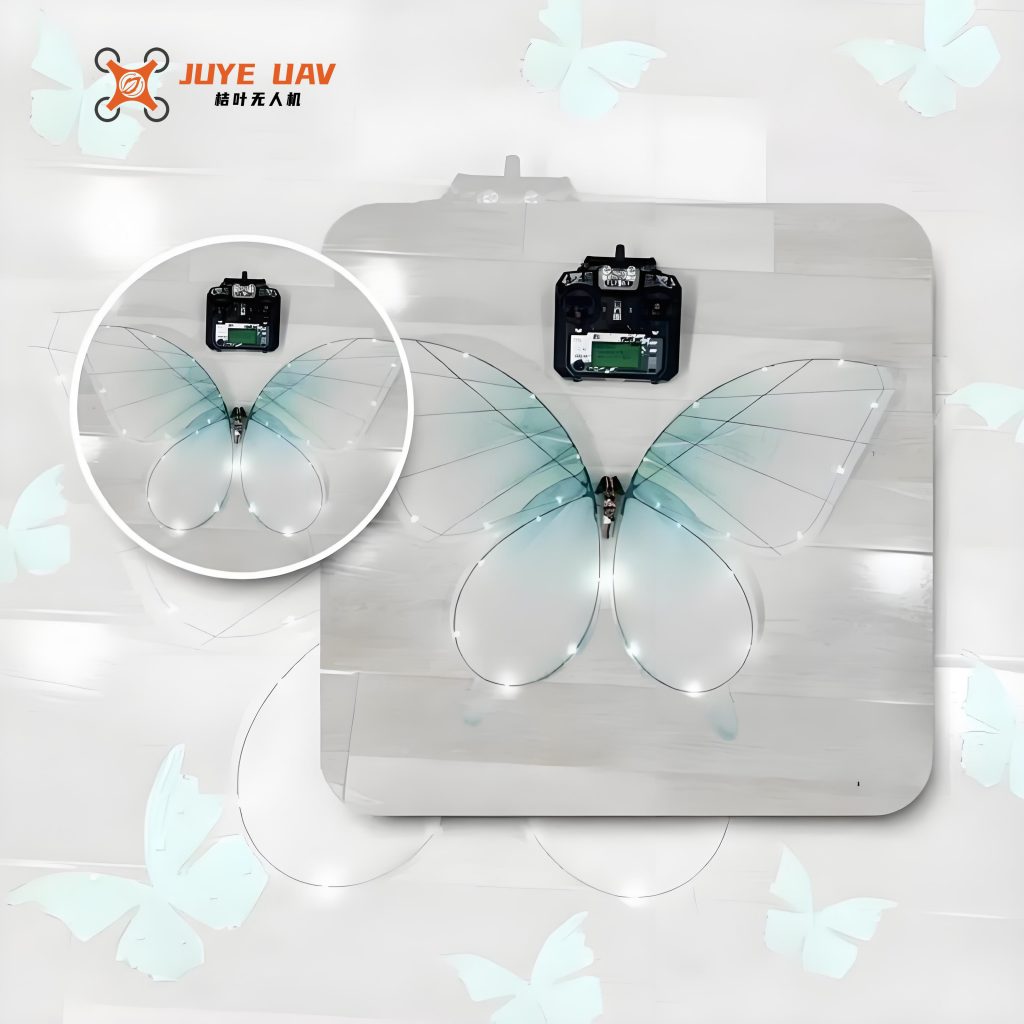
Furthermore, the wings themselves are not rigid plates. They undergo significant spanwise bending and chordwise twisting (feathering) during a stroke cycle. The forewings also exhibit a lead-lag motion, sweeping forward during the downstroke and backward during the upstroke. This complex, multi-degree-of-freedom motion profile is the first major hurdle in designing a functional flying butterfly drone.
1.2 Aerodynamic Mechanisms: Generating Forces at Low Re
At the Reynolds numbers relevant to butterfly flight, viscous forces are significant, and unsteady aerodynamic mechanisms dominate. Butterflies exploit several such mechanisms to generate sufficient lift and thrust:
| Mechanism | Description | Phase | Role in flying butterfly drone Design |
|---|---|---|---|
| Clap-and-Peel | At the end of the upstroke, the wings clap together dorsally and then rapidly peel apart at the start of the downstroke. This creates a strong starting vortex and enhances lift. | Downstroke Initiation | Critical for high-lift generation during takeoff and slow flight. Requires precise wing kinematics and flexibility. |
| Leading Edge Vortex (LEV) | A stable vortex forms and remains attached to the leading edge of the wing during the downstroke, creating a low-pressure region on the upper wing surface. | Mid-Downstroke | A primary lift-generation mechanism. Wing flexibility and specific planform shape help stabilize the LEV. |
| Rotational Circulation & Wake Capture | Lift is augmented by wing rotation at stroke reversals. The wing also intercepts the vortical wake generated in the previous stroke. | Stroke Reversal | Enhances overall aerodynamic efficiency. Timing and rate of wing rotation are key control parameters for a flying butterfly drone. |
| Drag-Based Thrust | During the downstroke, the wing acts almost as a paddle pushing against the air, using aerodynamic drag to produce both lift and forward thrust. | Downstroke | Particularly important for the low-frequency, large-amplitude flapping of butterflies. Influences optimal wing stiffness. |
The interplay of these mechanisms means that the net aerodynamic force $$ \vec{F}_{aero} $$ on a flapping wing is a highly nonlinear function of the instantaneous kinematic state and its history:
$$ \vec{F}_{aero}(t) = f(\phi(t), \dot{\phi}(t), \ddot{\phi}(t), \alpha(t), \text{Deformation}, \text{Re}, …) $$
where $$ \alpha $$ is the instantaneous angle of attack. Capturing this complexity in a tractable model is essential for simulating and controlling a flying butterfly drone.
1.3 Dynamics and Stability: The Coupled Body-Wing System
Modeling a butterfly as a simple flapping-wing system with a static body is insufficient. The large wings constitute a significant portion of the body mass, and their flapping induces substantial inertial forces. A more accurate representation is a multi-rigid-body system. A common simplified model treats the butterfly as three coupled bodies: the thorax (with wings), the abdomen, and sometimes the wings as separate inertias.
The equations of motion are derived from Lagrangian mechanics. The kinetic energy (T) and potential energy (V) of the system are formulated based on the generalized coordinates (e.g., body pitch, abdomen angle, forward speed). For a 2D longitudinal model, the Lagrangian $$ \mathcal{L} = T – V $$ leads to equations of the form:
$$ \frac{d}{dt}\left(\frac{\partial \mathcal{L}}{\partial \dot{q}_i}\right) – \frac{\partial \mathcal{L}}{\partial q_i} = Q_i^{aero} + Q_i^{control} $$
where $$ q_i $$ are the generalized coordinates (pitch, heave, etc.), and $$ Q_i $$ are the generalized forces from aerodynamics and any actuation. Research using such models has yielded critical insights: the abdomen swing acts as a fast, short-period damping mechanism for pitch disturbances, while wing kinematics (like modulating the lead-lag motion) provide longer-term stability and control. This separation of control timescales is a vital biological inspiration for stabilizing a tailless flying butterfly drone.
2. The State of Butterfly-Inspired Flapping-Wing Robots
The journey from biological observation to functional robot is fraught with challenges. Scaling laws, material limitations, and actuator technologies impose severe constraints. The development of a flying butterfly drone has progressed through two main avenues: insect-scale prototypes and larger, electrically driven robotic platforms.
2.1 Insect-Scale Prototypes: Mimicking Size and Frequency
Early efforts focused on creating passive, miniature models to study aerodynamics. These were often driven by elastic bands or simple crank mechanisms, achieving free but uncontrolled flight. Key lessons emerged:
- Wing Flexibility is Essential: Rigid wings failed to generate sufficient lift or stability. Incorporating flexible membranes that mimic the clap-and-peel and passive twisting was crucial.
- Abdomen Motion Matters: Prototypes with a passive swinging abdomen demonstrated improved pitch damping compared to rigid-bodied versions.
However, these models lacked onboard power, control, and autonomy, highlighting the gap between a physical model and a true flying butterfly drone.
2.2 Electrically Driven Robotic Platforms
Advances in micro-servos, lightweight batteries, and composite materials have enabled the development of larger, radio-controlled prototypes. These represent the current forefront of flying butterfly drone technology. The primary design configurations are:
| Design Architecture | Actuation Strategy | Advantages | Disadvantages & Challenges | Example Performance |
|---|---|---|---|---|
| Single-Motor with Crank-Rocker | One motor drives a mechanical linkage to flap all four wings synchronously. | Simple, lightweight, mechanically robust. | No independent wing control. Requires separate control surfaces (e.g., tails) for maneuvering, deviating from true butterfly inspiration. | Mass: ~50g, Freq: 1-5 Hz, Endurance: ~5 min, Uncontrolled/Simple steering. |
| Dual-Servo Direct Drive | Two servos independently drive the left and right wing pairs (fore and hind wings coupled). | Enables differential thrust for yaw control and amplitude modulation for roll/pitch. Closer to biological control. | Higher weight, complex transmission to link fore and hind wings. Servo bandwidth may limit flapping frequency. | Mass: 35-45g, Freq: 2-4 Hz, Endurance: 3-5 min, Achieves controlled turning and pitch. |
| Four-Wing Independent Drive | Four actuators (e.g., smart composite microstructures) independently control each wing’s flapping. | Maximum kinematic control authority. Can theoretically replicate lead-lag, differential fore/hind wing motion. | Extremely complex control synthesis. High power demand, weight penalty. Currently at the research/conceptual stage. | |
| Integrated Wing-Body-Abdomen Actuation | Combines wing flapping servos with a dedicated servo to actively swing the abdomen. | Explicitly incorporates the biological stability mechanism. Provides an additional control input for pitch regulation. | Added mechanical complexity and weight. Control law for coordinating wing and abdomen motion is non-trivial. | Demonstrated improved longitudinal stability and controlled climb/descent in prototypes. |
The force and torque generation for a flying butterfly drone can be approximated by summing the contributions from each wing. The net lift (L) and thrust (T) over a cycle are functions of the flapping parameters:
$$ L \approx \frac{1}{2} \rho S C_L(\alpha_{eff}) \bar{V}^2 $$
$$ T \approx \frac{1}{2} \rho S C_T(\alpha_{eff}, \phi_{asym}) \bar{V}^2 $$
where $$ \rho $$ is air density, $$ S $$ is wing area, $$ \bar{V} $$ is the average wingtip velocity, $$ C_L $$ and $$ C_T $$ are cycle-averaged force coefficients dependent on effective angle of attack $$ \alpha_{eff} $$ and flapping asymmetry $$ \phi_{asym} $$. For maneuverability, differential forces between left and right wings create rolling ($$ \Delta L $$) and yawing ($$ \Delta T $$) moments:
$$ M_{roll} \approx \Delta L \cdot y_{cp} $$
$$ M_{yaw} \approx \Delta T \cdot y_{cp} $$
where $$ y_{cp} $$ is the lateral distance to the center of pressure. Achieving precise, real-time modulation of these forces through wing kinematics is the core control challenge for an agile flying butterfly drone.
3. Critical Technological Hurdles and Research Frontiers
Despite promising prototypes, a significant performance gap remains between robotic and biological butterflies. Closing this gap requires breakthroughs in several key areas.
3.1 Power and Actuation: The Core Bottleneck
The low flapping frequency of butterflies is deceptive; moving large wings through a wide arc requires substantial torque, especially at stroke reversals. Current electromagnetic micro-servos lack the power density and efficiency of insect flight muscles. The specific power (power output per unit mass) of a biological wing muscle far exceeds that of a micro-servo. Future flying butterfly drone platforms may need to adopt:
- Resonant Actuation: Tuning the mechanical system to operate at its natural frequency to minimize energy input.
- Artificial Muscles: Exploring materials like shape memory alloys (SMAs), dielectric elastomer actuators (DEAs), or piezoelectric composites that offer higher strain and better biomimetic performance, albeit with control challenges.
- Efficient Transmission: Designing lightweight, low-friction linkages that can transform rotary motor motion into the complex flapping trajectory while storing and releasing elastic energy.
3.2 Wing Design and Fabrication
The wing is not a simple actuator; it is an aero-structural element. Its design involves a multi-objective optimization:
$$ \text{Maximize: } \eta_{aero} = \frac{C_L^{3/2}}{C_D} \text{ (for endurance)}, \quad \text{Maximize: } \frac{C_L}{C_D} \text{ (for range)} $$
$$ \text{Subject to: } m_{wing} < \text{budget}, \quad \text{Stiffness Distribution } EI(s) \text{ for desired deformation}. $$
Modern fabrication uses laser-cut carbon fiber veins laminated with ultra-thin polyester or polyimide films. Research focuses on actively or passively controlling spanwise and chordwise stiffness gradients to promote beneficial deformations that enhance lift and efficiency, moving closer to the performance of a real butterfly wing for the flying butterfly drone.
3.3 Flight Dynamics and Control
The dynamics of a flying butterfly drone are inherently unstable, nonlinear, and underactuated (fewer independent controls than degrees of freedom). A typical longitudinal model state vector might be:
$$ \mathbf{x} = [u, w, q, \theta, x, z]^T $$
(forward velocity, vertical velocity, pitch rate, pitch angle, horizontal position, altitude).
The control inputs, $$ \mathbf{u} $$, could be asymmetries in left/right wing stroke amplitude ($$ \Delta \Phi $$) for roll/yaw, and symmetric changes in wingbeat frequency or abdomen angle for pitch/speed. Developing controllers for this system is an active area of research. Strategies include:
- Nonlinear Model Predictive Control (NMPC): To handle constraints and nonlinearities directly.
- Bio-Inspired Central Pattern Generators (CPGs): Generating rhythmic wingbeat patterns with modifiable parameters (amplitude, frequency, offset) that can be smoothly adjusted by higher-level feedback loops.
- Robust/Adaptive Control: To cope with unmodeled aerodynamic effects and manufacturing variations.
The control law must coordinate all actuators. For example, a simplified pitch damping law might be:
$$ \theta_{abdomen\_cmd} = -K_p \theta – K_d q $$
while a roll command to turn might be:
$$ \Phi_{left} = \Phi_0 – \Delta \Phi, \quad \Phi_{right} = \Phi_0 + \Delta \Phi. $$
4. Future Trajectory: Towards Autonomous, Agile Flying Butterfly Drones
The roadmap for the next generation of flying butterfly drone technology points toward greater biomimicry, intelligence, and autonomy. The convergence of several disciplines will drive this progress.
4.1 Deep Biomimicry and Co-Design
Future designs will move beyond superficial mimicry to deeper functional integration:
- Morphing Wings: Wings that can actively change camber, area, or sweep in response to flight conditions, perhaps using smart materials.
- Mass Distribution Optimization: Deliberately designing the mass properties (moments of inertia, center of mass location) to work in concert with aerodynamic forces, mirroring the butterfly’s body plan.
- Full Fluid-Structure Interaction (FSI) Optimization: Using high-fidelity CFD coupled with structural solvers to co-optimize wing shape, material properties, and kinematic patterns for specific mission profiles (e.g., endurance, agility).
4.2 Integration of Sensing and Autonomy
A truly useful flying butterfly drone must perceive and navigate its environment. This requires the miniaturization and integration of:
| Sensor Type | Purpose | Challenge for flying butterfly drone |
|---|---|---|
| Inertial Measurement Unit (IMU) | Attitude and rate estimation. | Vibration rejection from flapping. Sensor fusion algorithms. |
| Vision Sensors (Event Cameras) | Obstacle avoidance, terrain following, navigation. | Extreme weight/power constraints. Processing onboard video streams. |
| Airflow Sensors (Hairs, MEMS) | Detecting stall, gusts, or proximity to surfaces for feedback control. | Durability, calibration, and integration into wing surface. |
Onboard processing will leverage ultra-low-power neuromorphic computing to run bio-inspired algorithms for stabilization and navigation, enabling fully autonomous operation of the flying butterfly drone.
4.3 Application Horizons
The unique advantages of the butterfly flight paradigm open up specific niches where a flying butterfly drone could excel:
- Covert Surveillance: The low acoustic signature and erratic, biologistic flight pattern make it difficult to detect and classify as a threat.
- Indoor/Confined Space Operations: The ability to fly slowly, hover transiently, and recover from collisions (due to flexible wings) is ideal for inspection in complex industrial or disaster environments.
- Environmental Monitoring: Long, efficient gliding phases interspersed with flapping could enable long-duration missions for data collection in sensitive ecosystems.
- Swarm Behaviors: Simple, low-cost flying butterfly drone units could operate in large swarms for distributed sensing or communication relay, inspired by collective insect behavior.
In conclusion, the study of butterfly flight mechanics and the development of butterfly-inspired drones represent a profound dialogue between biology and engineering. Each prototype built and each simulation run deepens our understanding of unsteady aerodynamics and embodied intelligence. The challenges—in actuation, materials, control, and integration—are formidable. Yet, the potential reward is a new generation of aerial robots that are not merely smaller versions of existing aircraft, but fundamentally different machines, capable of silent, efficient, and agile operation in the complex, unstructured world for which nature designed the butterfly. The journey to realize a fully autonomous, insect-scale flying butterfly drone remains a long one, but it is a path paved with scientific discovery and engineering innovation, promising to reshape our capabilities in micro-scale flight.