
As a researcher focused on agricultural technology, I have been investigating the efficacy of modern crop spraying drones in managing rice diseases and pests. Rice (Oryza sativa L.) is a staple crop critical to global food security, but its productivity is often compromised by pests like rice planthoppers and rice leaf rollers, as well as diseases such as sheath blight. Traditional methods, including manual spraying with power sprayers, face challenges like inefficiency and environmental concerns. In contrast, spraying UAVs offer advantages such as high operational efficiency, uniform spray distribution, and reduced chemical usage. This study aims to evaluate the performance of a crop spraying drone compared to a conventional power sprayer in field conditions, emphasizing key metrics like control efficacy and operational costs.
Rice cultivation is susceptible to various threats that can significantly impact yield. For instance, rice planthoppers, including brown planthopper (Nilaparvata lugens), white-backed planthopper (Sogatella furcifera), and small brown planthopper (Laodelphax striatellus), cause issues like yellowing and stunted growth, while rice leaf rollers (Cnaphalocrocis medinalis) lead to leaf rolling and reduced photosynthesis. Sheath blight, caused by Rhizoctonia solani, can result in yield losses of up to 40% or more. Historically, farmers relied on methods like chemical sprays with electric sprayers, which often led to over-application and ecological disruption. However, the advent of spraying UAVs has revolutionized this domain by enabling precise application, thanks to technologies like multi-spectral sensors and electrostatic spraying that enhance droplet deposition and minimize drift.
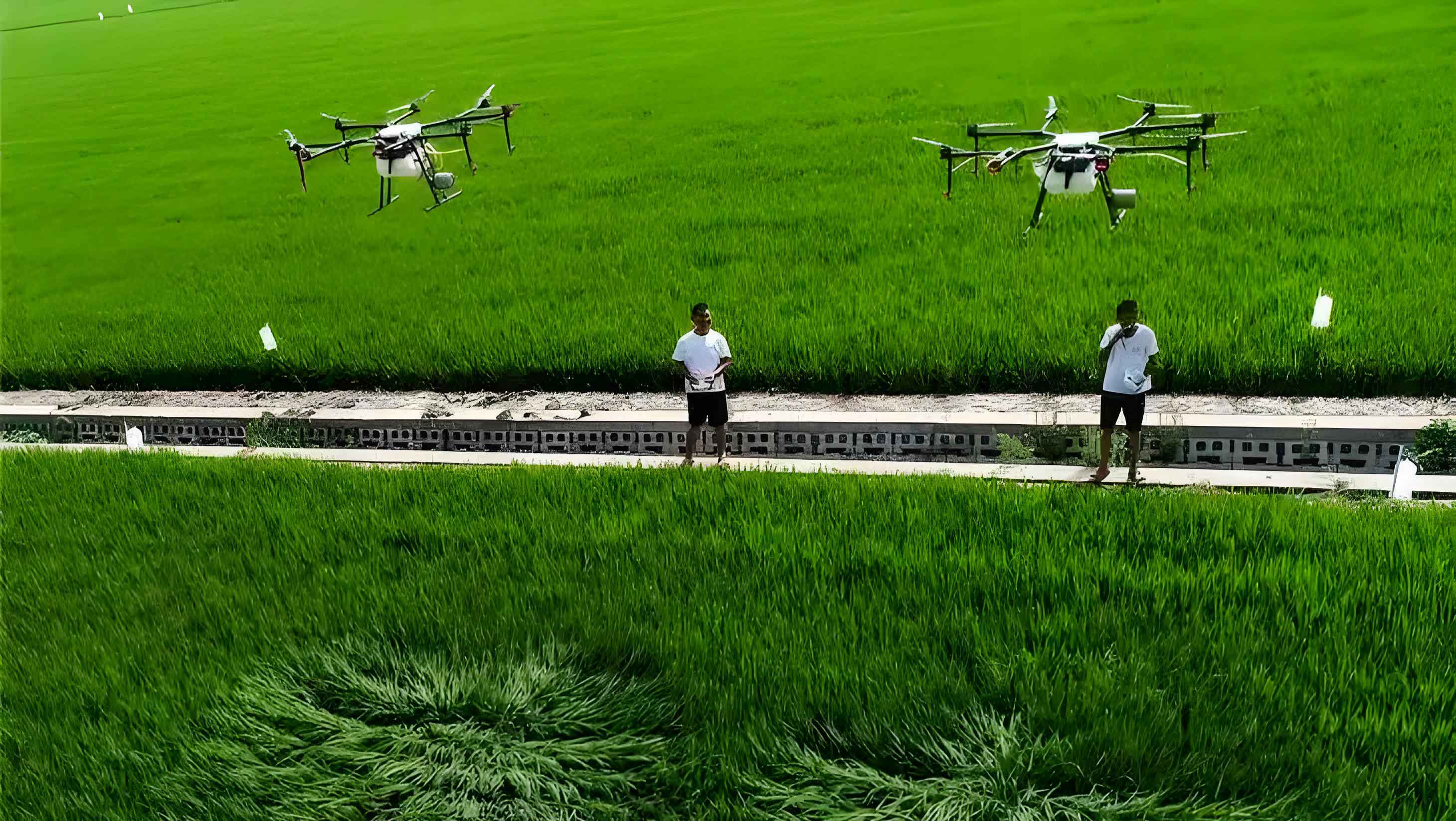
In my experiment, I selected the rice cultivar ‘Taiyou 390’ and conducted trials in a controlled field environment. The study compared three treatments: a blank control (CK), a treatment using a crop spraying drone (T1), and one using a power sprayer (T2). The crop spraying drone employed was a model with a 20 L tank capacity, operating at a flight speed of 5 m/s and height of 3 m, with an effective spray width of 5 m. This spraying UAV was configured to apply pesticides at a rate of 2 L per 667 m², while the power sprayer used 36 L per 667 m² for the same area. The pesticides included 25% pymetrozine wettable powder for planthoppers, 20% chlorantraniliprole suspension for leaf rollers, and 30% benzyl-propiconazole emulsion for sheath blight. All applications were timed to coincide with peak pest activity, and data were collected before and after treatment at intervals of 3, 7, and 14 days.
The methodology involved systematic sampling to assess pest populations and disease severity. For rice planthoppers, I used a parallel jump method to count live insects, calculating the insect population reduction rate and relative control efficacy using the formulas below. Similarly, for rice leaf rollers, I recorded the number of live larvae and rolled leaves, while for sheath blight, I evaluated disease incidence based on a standard grading scale from 0 to 9. The formulas applied in the analysis are as follows:
Insect population reduction rate: $$ \text{Reduction Rate} = \frac{\text{Pre-treatment count} – \text{Post-treatment count}}{\text{Pre-treatment count}} \times 100\% $$
Relative control efficacy: $$ \text{Efficacy} = \left[1 – \frac{\text{Treated post-count} \times \text{Control pre-count}}{\text{Treated pre-count} \times \text{Control post-count}}\right] \times 100\% $$
Leaf rolling rate: $$ \text{Rolling Rate} = \frac{\text{Number of rolled leaves}}{\text{Total leaves}} \times 100\% $$
Disease index: $$ \text{Disease Index} = \frac{\sum (\text{Number of diseased plants} \times \text{Grade value})}{\text{Total plants surveyed} \times 9} \times 100 $$
Control effect for diseases: $$ \text{Control Effect} = \left[1 – \frac{\text{Treated post-index} \times \text{Control pre-index}}{\text{Treated pre-index} \times \text{Control post-index}}\right] \times 100\% $$
These formulas allowed for a quantitative comparison between the crop spraying drone and the power sprayer. The use of a spraying UAV in T1 demonstrated rapid action due to its ability to generate downward airflow, which directs droplets to the lower and middle parts of rice plants where pests like planthoppers reside. In contrast, the power sprayer in T2 primarily targets the upper canopy, which may explain differences in initial efficacy. The integration of these mathematical models highlights the precision of spraying UAVs in agricultural applications.
The results for rice planthoppers showed that the crop spraying drone achieved a higher reduction rate and efficacy shortly after application. For example, at 3 days post-treatment, T1 had a reduction rate of 67.16% and efficacy of 89.31%, outperforming T2. This aligns with the advantage of spraying UAVs in delivering pesticides more efficiently to pest habitats. Over time, both methods reached similar high efficacy levels, as summarized in the table below.
| Treatment | Pre-treatment Count | Post-3d Count | Reduction Rate (%) | Efficacy (%) | Post-7d Count | Reduction Rate (%) | Efficacy (%) | Post-14d Count | Reduction Rate (%) | Efficacy (%) |
|---|---|---|---|---|---|---|---|---|---|---|
| T1 (Spraying UAV) | 67 | 22 | 67.16 | 89.31 | 2 | 97.01 | 99.02 | 0 | 100 | 100 |
| T2 (Power Sprayer) | 84 | 47 | 44.05 | 81.79 | 2 | 97.62 | 99.22 | 0 | 100 | 100 |
| CK (Control) | 55 | 169 | -207.27 | — | 167 | -203.64 | — | 174 | -216.36 | — |
For rice leaf rollers, the power sprayer initially showed a slightly higher reduction rate at 3 days post-treatment, but the crop spraying drone caught up by day 7, achieving a 100% reduction rate. The leaf rolling rate was lowest in T1 at 14 days, indicating the long-term benefits of using a spraying UAV. This can be attributed to the uniform droplet distribution and better coverage provided by the drone’s airflow, which penetrates the crop canopy effectively.
| Treatment | Pre-treatment Count | Post-3d Count | Reduction Rate (%) | Efficacy (%) | Post-7d Count | Reduction Rate (%) | Efficacy (%) | Post-14d Rolling Rate (%) |
|---|---|---|---|---|---|---|---|---|
| T1 (Spraying UAV) | 47 | 31 | 34.04 | 27.86 | 0 | 100 | 100 | 0.28 |
| T2 (Power Sprayer) | 44 | 27 | 38.64 | 32.88 | 0 | 100 | 100 | 0.33 |
| CK (Control) | 35 | 32 | 8.57 | — | 32 | 8.57 | — | 5.04 |
In the case of sheath blight, the crop spraying drone demonstrated superior control, reducing the disease index by 59.09% compared to 37.50% for the power sprayer. The disease index calculation incorporated the grading scale, where higher values indicate severe infection. The spraying UAV’s ability to deposit fungicides on both sides of leaves and stem bases contributed to this enhanced performance, as shown in the table below.
| Treatment | Plants Surveyed | Pre-treatment Disease Index | Post-14d Disease Index | Reduction in Disease Index (%) | Control Effect (%) |
|---|---|---|---|---|---|
| T1 (Spraying UAV) | 342 | 1.1 | 0.45 | 59.09 | 92.33 |
| T2 (Power Sprayer) | 356 | 2.0 | 1.25 | 37.50 | 88.29 |
| CK (Control) | 352 | 1.55 | 8.27 | — | — |
Beyond efficacy, I evaluated the operational efficiency and cost-effectiveness of the crop spraying drone. The spraying UAV achieved an average work rate of 1,140 m² per minute, significantly higher than the power sprayer’s 8,004 m² per day (based on an 8-hour workday). This efficiency is crucial for timely interventions during pest outbreaks. Moreover, the cost of application with the crop spraying drone was approximately $10 per 667 m², half that of the power sprayer at $20 per 667 m². These economic benefits, combined with the environmental advantages of reduced pesticide drift, make spraying UAVs a sustainable choice for large-scale farming.
In discussing these findings, I considered the mechanisms behind the spraying UAV’s performance. The downward airflow generated by the drone’s rotors ensures that pesticides reach the lower plant parts, which is essential for pests like planthoppers. This contrasts with power sprayers, which often overspray the upper canopy. Additionally, the electrostatic technology in some spraying UAVs enhances droplet adhesion, reducing waste and environmental impact. However, I observed minor leaf curling in areas where the drone changed direction or paused, likely due to localized over-spraying. This issue can be mitigated by optimizing flight parameters, such as speed and height, through advanced algorithms like genetic algorithms and neural networks, which improve path planning for crop spraying drones.
The implications of this study extend beyond rice cultivation. Spraying UAVs can be adapted for other crops like corn and wheat, offering a versatile solution for integrated pest management. Future research should focus on refining drone technologies, such as incorporating real-time monitoring with multispectral sensors to dynamically adjust spraying strategies. This would further enhance the precision of crop spraying drones, reducing chemical usage by over 30% as suggested in prior studies. The integration of smart algorithms not only boosts efficiency but also supports sustainable agriculture by minimizing ecological footprints.
In conclusion, my investigation confirms that crop spraying drones provide rapid, effective, and economical control of rice diseases and pests compared to traditional methods. The use of a spraying UAV resulted in quicker pest reduction, better disease management, and lower operational costs, making it ideal for large-scale applications. As agricultural practices evolve, the adoption of spraying UAVs will likely expand, driven by their ability to address food security challenges while promoting environmental stewardship. I recommend further field trials to explore variations in drone models and pesticides, ensuring that this technology reaches its full potential in global agriculture.