
In recent years, the proliferation of low, slow, and small (LSS) drones has posed significant challenges to public safety and security. As a researcher focused on counter-unmanned aerial vehicle (UAV) technologies, I have observed an increasing need for effective police anti-drone systems. These systems must address the unique threats posed by drones that operate at low altitudes, have small radar cross-sections, and move at relatively slow speeds. In this article, I will delve into the critical requirements for designing and deploying such anti-drone systems, drawing from technical analyses and operational scenarios. The goal is to provide a detailed framework that can guide the development of robust solutions to mitigate drone-related risks.
The emergence of affordable and accessible drones has led to incidents ranging from airspace violations to more sinister activities like smuggling and surveillance. Therefore, understanding the operational patterns and capabilities of these drones is essential for crafting effective countermeasures. I will explore the typical mission profiles of drones, their performance characteristics, and the subsequent demands placed on anti-drone systems. Through this first-person perspective, I aim to synthesize technical insights into practical requirements, emphasizing the integration of detection, tracking, and neutralization components. The term “anti-drone” will be frequently used to underscore the focus on counter-UAV measures, as it encapsulates the overarching objective of these systems.
To begin, let’s consider the typical mission profile of a drone. Most drones follow a predictable sequence: takeoff, climb, cruise, mission execution (which may involve hovering or maneuvering over a target area), return, descent, and landing. This profile is crucial for anti-drone strategies because it reveals vulnerabilities that can be exploited. For instance, during the cruise and mission phases, drones often maintain communication links with ground control stations, emitting signals that can be detected. By analyzing this profile, I can derive timing and distance parameters that inform the design of anti-drone systems. The following equation represents the total time \( T \) available for response from detection to neutralization:
$$ T = T_{\text{detection}} + T_{\text{tracking}} + T_{\text{confirmation}} + T_{\text{intervention}} $$
Where \( T_{\text{detection}} \) is the time required for initial detection, \( T_{\text{tracking}} \) for stable tracking, \( T_{\text{confirmation}} \) for target verification, and \( T_{\text{intervention}} \) for applying countermeasures such as jamming. This breakdown highlights the need for rapid, seamless coordination among anti-drone components.
Now, let’s examine the performance characteristics of LSS drones. Through analysis of over 70 models, including multi-rotor and fixed-wing types, I have compiled statistical data on their capabilities. The table below summarizes key parameters that influence anti-drone system design:
| Drone Type | Takeoff Weight (kg) | Payload Capacity (kg) | Dimensions (Length × Width in m) | Max Speed (m/s) | Max Climb Rate (m/s) | Service Ceiling (m) | Endurance (min) | Control Range (km) |
|---|---|---|---|---|---|---|---|---|
| Multi-rotor I | ≤10 | ≤2 | ≤0.5 × 0.5 | ≤30 | ≤6 | ≤6000 | 30 | ≤10 |
| Multi-rotor II | ≤20 | ≤5 | ≤1.5 × 1.5 | ≤30 | ≤12 | ≤6000 | 60 | ≤20 |
| Fixed-wing | ≤40 | ≤10 | Wingspan ≤3 | ≤50 | N/A | ≤6000 | 120 | ≤100 |
These characteristics directly impact the requirements for anti-drone sensors. For example, the radar cross-section (RCS) of a typical quadcopter with dimensions 0.4 m × 0.4 m is approximately 0.01 m², while a small fixed-wing drone with a 3 m wingspan may have an RCS of 0.2 m². Such small RCS values necessitate high-sensitivity detection methods in anti-drone systems. The variability in materials and shapes further complicates detection, underscoring the need for multi-sensor approaches in anti-drone solutions.
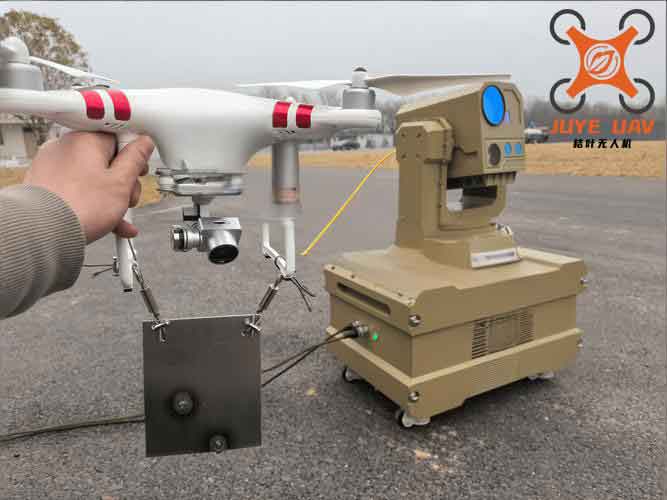
Moving to the core of anti-drone system requirements, I will analyze the workflow, defense parameters, and technical specifications. An effective anti-drone system typically involves a coordinated sequence: detection via radar or spectrum reconnaissance, target tracking and identification, confirmation using electro-optical sensors, and finally, intervention through electronic jamming. This integrated workflow ensures that threats are neutralized before they reach protected zones. The following figure illustrates a conceptual anti-drone system deployment, highlighting the synergy between components:
Defense height is a critical parameter for anti-drone systems. Based on typical drone mission altitudes, which range from 20 to 1000 meters, with common operational heights between 100 and 300 meters, I recommend that anti-drone systems cover this full spectrum. This ensures protection against both low-altitude intrusions and higher-flying drones. The required elevation coverage \( \Phi \) can be calculated using trigonometric relations. For a drone at a horizontal distance \( D \) and height \( H \), the elevation angle is given by:
$$ \Phi = \arctan\left(\frac{H}{D}\right) $$
To account for varying scenarios, I have tabulated elevation angles for different heights, assuming a reference horizontal distance of 400 meters (derived from typical drone observation ranges):
| Drone Height \( H \) (m) | Elevation Angle \( \Phi \) (degrees) |
|---|---|
| 20 | 2.86 |
| 200 | 26.57 |
| 400 | 45.00 |
| 600 | 56.31 |
| 800 | 63.43 |
| 1000 | 68.20 |
These angles inform the design of radar and electro-optical sensors in anti-drone systems, ensuring they can track targets across necessary elevations. For instance, radar beams must be steerable to cover low angles for early detection and high angles for overhead threats. This multi-angle capability is a hallmark of advanced anti-drone technology.
Defense distance is another vital aspect. I derive requirements by considering the time needed for each anti-drone action. Let’s assume a drone approaches at a speed \( V \) of 30 m/s (typical for multi-rotor drones). The total response time \( T_{\text{total}} \) includes: radar detection and track establishment time \( T_{\text{radar}} \), spectrum reconnaissance time \( T_{\text{recon}} \), servo slewing time for electro-optical and jamming devices \( T_{\text{slew}} \), target confirmation time \( T_{\text{confirm}} \), and human reaction time \( T_{\text{human}} \). Mathematically:
$$ T_{\text{total}} = T_{\text{radar}} + T_{\text{recon}} + T_{\text{slew}} + T_{\text{confirm}} + T_{\text{human}} $$
Based on typical values: \( T_{\text{radar}} \) varies with scan period (e.g., 1 to 12 seconds for track initiation), \( T_{\text{recon}} \approx 5 \) seconds for direction finding, \( T_{\text{slew}} \approx 6 \) seconds for 180-degree azimuth and elevation adjustment, \( T_{\text{confirm}} \approx 5 \) seconds, and \( T_{\text{human}} \approx 5 \) seconds. Thus, the minimum detection range \( R_{\text{detect}} \) to ensure interception before a drone enters a protected zone of radius \( R_{\text{zone}} = 400 \) m is:
$$ R_{\text{detect}} = R_{\text{zone}} + V \times T_{\text{total}} $$
For different radar scan periods \( T_{\text{scan}} \), I compute \( R_{\text{detect}} \) as shown in the table below. This highlights how anti-drone systems must balance detection range with update rates:
| Radar Scan Period \( T_{\text{scan}} \) (s) | Total Response Time \( T_{\text{total}} \) (s) | Required Detection Range \( R_{\text{detect}} \) (m) |
|---|---|---|
| 1 | 22 | 1060 |
| 3 | 34 | 1420 |
| 6 | 49 | 1870 |
| 10 | 69 | 2470 |
| 12 | 79 | 2770 |
These ranges dictate the performance of radar and spectrum reconnaissance sensors in anti-drone systems. Notably, spectrum reconnaissance can often provide earlier warning than radar due to passive signal detection, extending the effective defense perimeter. For jamming components, the effective range \( R_{\text{jam}} \) must at least match \( R_{\text{detect}} \) to disrupt drone communications promptly. This interplay underscores the integrated nature of anti-drone solutions.
Frequency coverage for reconnaissance and jamming is a key technical requirement. Drones primarily use radio frequencies for control and data links. Based on regulatory allocations and market analysis, common bands include 2.400–2.483 GHz and 5.725–5.875 GHz for consumer drones. However, to ensure comprehensive anti-drone capability, systems should cover a broader spectrum from 30 MHz to 6 GHz, encompassing over 20 sub-bands used by various UAV models. The table below summarizes essential frequency ranges for anti-drone operations:
| Frequency Band (MHz) | Typical Use | Relevance to Anti-Drone Systems |
|---|---|---|
| 840.5–845 | Uplink or downlink for UAVs | Critical for signal interception and jamming |
| 1430–1444 | Downlink telemetry | Important for intelligence gathering |
| 2408–2440 | Control and data transmission | Primary target for disruption in anti-drone measures |
| 2400–2483 | ISM band, widely used by drones | High priority for jamming in anti-drone systems |
| 5725–5875 | ISM band, common for HD video | Key for neutralizing surveillance capabilities |
Additionally, anti-drone systems must consider navigation signal jamming (e.g., GPS, GLONASS, BeiDou, Galileo) to disrupt drone positioning. However, this requires careful control to avoid collateral effects. The jamming-to-signal ratio (JSR) is a critical metric for electronic attack effectiveness. For a drone at distance \( R_{\text{drone}} \) from the jammer and \( R_{\text{control}} \) from its ground station, the JSR should exceed a threshold to ensure reliable disruption. A simplified model for required JSR \( \Gamma \) is:
$$ \Gamma = \frac{P_{\text{jam}} \cdot G_{\text{jam}} \cdot \lambda^2}{(4\pi R_{\text{drone}})^2} \div \frac{P_{\text{control}} \cdot G_{\text{control}} \cdot \lambda^2}{(4\pi R_{\text{control}})^2} = \left( \frac{P_{\text{jam}} G_{\text{jam}}}{P_{\text{control}} G_{\text{control}}} \right) \left( \frac{R_{\text{control}}}{R_{\text{drone}}} \right)^2 $$
Where \( P \) denotes power, \( G \) antenna gain, and \( \lambda \) wavelength. For typical scenarios where \( R_{\text{control}} \) is much larger than \( R_{\text{drone}} \), a JSR of 20:1 or higher is recommended for anti-drone jamming systems. This ensures that drone commands are overwhelmed, forcing behaviors like landing or return-to-home. Achieving this ratio informs the power output and antenna design of jamming components in anti-drone systems.
Elevation coverage for sensors is derived from drone approach dynamics. Using the same response times, I calculate the required elevation angles for radar and spectrum reconnaissance to maintain track from initial detection to confirmation. For a drone at height \( H \) and speed \( V \), the angle \( \theta \) at time \( t \) after detection is:
$$ \theta(t) = \arctan\left( \frac{H}{R_{\text{detect}} – V t} \right) $$
By evaluating this at key time points, I can specify angular ranges for anti-drone sensors. For example, if \( H = 200 \) m and \( R_{\text{detect}} = 1600 \) m, with \( t \) varying from 0 to 30 seconds, \( \theta \) ranges from about 7° to 90°. This necessitates wide elevation coverage in anti-drone radar systems, typically from near-horizontal to zenith. The table below provides sample values for different drone heights, assuming a constant approach:
| Time After Detection \( t \) (s) | Elevation Angle \( \theta \) for \( H=200 \) m (degrees) | Elevation Angle \( \theta \) for \( H=400 \) m (degrees) |
|---|---|---|
| 0 | 7.13 | 14.04 |
| 10 | 9.46 | 18.43 |
| 20 | 12.68 | 24.23 |
| 30 | 17.35 | 32.01 |
These angles guide the mechanical and electronic scanning capabilities of anti-drone sensors, ensuring continuous tracking throughout engagement. Moreover, electro-optical devices must have sufficient zoom and field-of-view adjustability to visually identify drones at these angles, a crucial step before initiating jamming in anti-drone protocols.
Integration challenges in anti-drone systems cannot be overlooked. The synergy between radar, electro-optical, spectrum reconnaissance, and jamming units requires sophisticated command-and-control software. This software must perform real-time data fusion, threat assessment, and resource allocation. From my perspective, an effective anti-drone system should employ algorithms for track correlation, priority assignment, and automated response sequencing. For instance, upon detecting a drone signature, the system might calculate a threat score \( S \) based on factors like speed, proximity, and behavior:
$$ S = w_1 \cdot \frac{V}{V_{\text{max}}} + w_2 \cdot \frac{1}{R} + w_3 \cdot I_{\text{anomaly}} $$
Where \( w_1, w_2, w_3 \) are weighting coefficients, \( V_{\text{max}} \) is the maximum expected speed, \( R \) is the distance, and \( I_{\text{anomaly}} \) is an indicator of abnormal flight patterns. High scores trigger immediate jamming, while lower scores may lead to enhanced monitoring. This dynamic prioritization is essential for managing multiple threats in urban anti-drone deployments.
Furthermore, anti-drone systems must adapt to evolving drone technologies, such as swarm operations or autonomous navigation. This necessitates advancements in sensor resolution and jamming bandwidth. For example, dealing with drone swarms requires high-update-rate radar and wide-area jamming techniques. The power density \( \rho \) needed to jam multiple drones simultaneously can be approximated as:
$$ \rho = \frac{N \cdot P_{\text{drone}}}{A_{\text{beam}}} $$
Where \( N \) is the number of drones, \( P_{\text{drone}} \) is the jamming power required per drone, and \( A_{\text{beam}} \) is the effective beam area. This highlights the scalability requirements for anti-drone jammers in complex scenarios.
In conclusion, the design of police anti-drone systems hinges on a thorough understanding of drone capabilities and mission profiles. Through this analysis, I have outlined key requirements: defense heights of 20–1000 meters, detection ranges extending to several kilometers, wide elevation coverage, broad frequency interception and jamming, and sufficient jamming-to-signal ratios. The integration of multiple sensors and effectors is paramount, with real-time processing enabling swift neutralization of threats. As drone technology advances, so too must anti-drone systems, incorporating machine learning for pattern recognition and adaptive jamming strategies. Ultimately, a proactive, layered approach to anti-drone defense will be crucial for safeguarding critical infrastructure and public spaces. The continuous refinement of these requirements will ensure that anti-drone solutions remain effective against emerging threats, upholding security in an increasingly automated world.
To encapsulate, the anti-drone paradigm is not static; it demands ongoing research and development. By focusing on the requirements discussed—spanning detection, identification, and disruption—law enforcement agencies can deploy robust anti-drone systems that mitigate risks effectively. I encourage further exploration into cost-effective and scalable anti-drone technologies, as their importance will only grow in the coming years. The journey toward comprehensive anti-drone capabilities is complex, but with precise requirements as a guide, it is undoubtedly achievable.