
In recent years, the rapid expansion of the low altitude economy has positioned it as a transformative force in global economic development. As a key component of this emerging sector, unmanned aerial vehicles (UAVs) and autonomous ground vehicles (AGVs) are revolutionizing logistics and transportation systems. I believe that the integration of these technologies through collaborative transport models holds immense potential for enhancing efficiency, reducing costs, and addressing complex urban and rural delivery challenges. However, this integration is fraught with obstacles, including safety risks, technical limitations, social concerns, and regulatory gaps. In this article, I will explore the characteristics, advantages, challenges, and strategies for drone and autonomous vehicle协同运输 within the low altitude economy, emphasizing the need for innovative solutions to foster sustainable growth.
The low altitude economy encompasses economic activities conducted in airspace below 1,000 meters, primarily involving UAVs and other low-altitude aircraft. This sector has gained momentum due to supportive policies and technological advancements, such as the inclusion of low-altitude operations in national transportation plans and the enactment of regulations for unmanned aircraft management. For instance, the “Interim Regulations on Flight Management of Unmanned Aircraft” has provided a framework for safe and efficient operations, paving the way for widespread adoption in logistics, surveillance, and emergency response. The low altitude economy is not just about flying vehicles; it represents a paradigm shift towards intelligent, interconnected systems that can reshape urban infrastructure and rural connectivity. As I delve into this topic, I will highlight how协同运输 between drones and autonomous vehicles can optimize resource allocation, improve service delivery, and contribute to the broader goals of the low altitude economy.
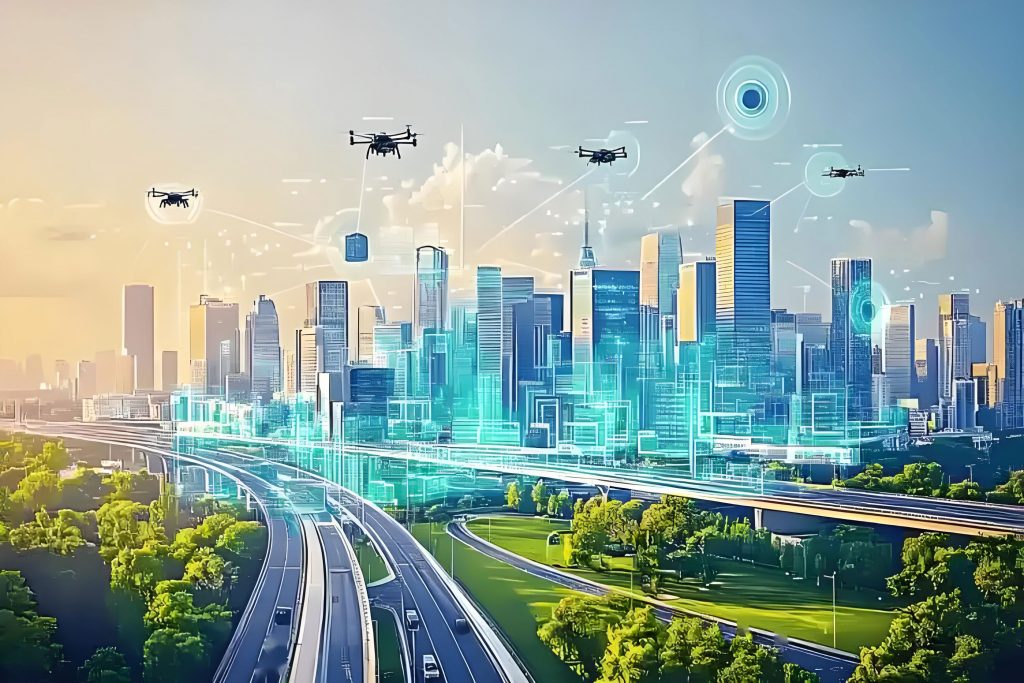
To understand the synergy in collaborative transport, it is essential to analyze the distinct features of drones and autonomous vehicles. Drones, or UAVs, excel in aerial mobility, offering unparalleled flexibility in navigating complex environments. They can bypass ground traffic congestion, access remote areas, and perform tasks with high precision. For example, in agricultural settings, drones can monitor crops, apply pesticides, and transport harvested goods from mountainous regions to collection points, significantly reducing transit times and spoilage. Autonomous vehicles, on the other hand, specialize in ground-based logistics, with higher payload capacities and the ability to operate in diverse weather conditions. They are ideal for last-mile deliveries in urban centers, where they can leverage advanced sensors and AI-driven routing to ensure timely and safe arrivals. The following table summarizes key characteristics of both technologies, illustrating their complementary roles in the low altitude economy.
| Feature | Drone (UAV) | Autonomous Vehicle (AGV) |
|---|---|---|
| Flexibility and Obstacle Avoidance | High; uses visual and radar systems for real-time navigation | Moderate; relies on ground-based sensors and mapping |
| Payload Capacity | Limited; typically under 10 kg for most models | High; can carry up to 1000 kg in industrial applications |
| Cost Efficiency | Reduces labor costs but requires investment in tech | Lowers operational expenses through automation |
| Environmental Adaptability | Effective in varied terrains and weather, with some limitations | Stable in adverse conditions like rain or snow |
| Application Scenarios | Logistics, agriculture, surveillance, emergency response | Urban delivery, industrial transport, passenger services |
Mathematically, the efficiency of drone operations can be modeled using formulas that account for flight time, payload, and energy consumption. For instance, the delivery time for a drone can be expressed as $$ T_d = \frac{D}{V_d} + T_{hover} $$ where \( D \) is the distance, \( V_d \) is the drone’s velocity, and \( T_{hover} \) is the time spent hovering during delivery. Similarly, for autonomous vehicles, the travel time might include factors like traffic density and route complexity: $$ T_v = \frac{D}{V_v} \times (1 + \alpha \cdot C_t) $$ where \( V_v \) is the vehicle speed, \( \alpha \) is a congestion factor, and \( C_t \) represents traffic conditions. These equations highlight how协同运输 can optimize overall logistics by combining the speed of drones with the reliability of ground vehicles, ultimately enhancing the low altitude economy’s productivity.
The advantages of collaborative transport between drones and autonomous vehicles are manifold, particularly in terms of rapid response and seamless integration. By leveraging drones for aerial segments and autonomous vehicles for ground operations, businesses can achieve a holistic logistics network that minimizes delays and maximizes coverage. For example, in e-commerce, a drone might transport goods from a warehouse to a suburban hub, where an autonomous vehicle takes over for final delivery to the customer’s doorstep. This approach not only reduces delivery times but also lowers carbon emissions by optimizing routes and reducing idle periods. Moreover, the low altitude economy benefits from such synergies by fostering innovation in smart city infrastructure, where real-time data sharing between air and ground systems enables dynamic adjustments to traffic flow and resource allocation.
Another significant advantage is the optimization of human resources. Traditional logistics often rely heavily on manual labor, leading to inefficiencies and higher costs. In contrast,协同运输 automates many tasks, allowing companies to reallocate personnel to more strategic roles. The cost savings can be quantified using a simple formula: $$ C_{savings} = (L_h \times W_h) – (L_a \times W_a) $$ where \( L_h \) and \( W_h \) represent the labor hours and wages for human workers, and \( L_a \) and \( W_a \) denote the automated system’s operational costs. Studies indicate that autonomous systems can reduce delivery times by up to 60% and cut overall costs by a similar margin, making the low altitude economy more competitive and scalable. Additionally, customers enjoy enhanced convenience, as they can track shipments in real-time and receive personalized delivery options, thereby increasing satisfaction and loyalty.
However, the path to widespread adoption of协同运输 in the low altitude economy is fraught with challenges. Safety concerns top the list, as the integration of air and ground operations introduces risks of collisions, hacking, and data breaches. In low-altitude airspace, drones must navigate around obstacles like buildings and power lines, while autonomous vehicles face threats from cyberattacks that could compromise sensor data or control systems. The probability of an incident can be modeled as $$ P_{incident} = 1 – (1 – P_{collision}) \times (1 – P_{cyber}) $$ where \( P_{collision} \) and \( P_{cyber} \) are the probabilities of physical and cyber threats, respectively. This underscores the need for robust safety protocols in the low altitude economy.
| Challenge Category | Specific Issues | Impact on Low Altitude Economy |
|---|---|---|
| Safety and Security | Mid-air collisions, data theft, system malfunctions | Erodes public trust and increases liability costs |
| Technical Limitations | Communication delays, GPS inaccuracies, sensor failures | Reduces operational efficiency and reliability |
| Social Concerns | Privacy invasion, noise pollution, public acceptance | Hinders community support and adoption rates |
| Legal and Regulatory Gaps | Unclear liability laws, inconsistent standards | Creates uncertainty and slows innovation |
Technical issues further complicate协同运输, particularly in communication and navigation. Drones operating beyond visual line of sight depend on stable data links, which can be disrupted by urban interference or limited bandwidth. The signal strength \( S \) in such environments might follow a decay model: $$ S = S_0 \cdot e^{-\beta d} $$ where \( S_0 \) is the initial strength, \( \beta \) is an attenuation coefficient, and \( d \) is the distance. Similarly, autonomous vehicles require high-definition maps and real-time updates to avoid obstacles, but current AI systems struggle with unpredictable elements like debris or road repairs. These limitations highlight the need for advancements in 5G networks and AI algorithms to support the low altitude economy.
Social and legal challenges also pose significant barriers. Privacy concerns arise from drones equipped with cameras that could inadvertently capture sensitive information, leading to public backlash. In terms of equality, the benefits of the low altitude economy must be distributed fairly to avoid exacerbating digital divides. Legally, the absence of comprehensive regulations creates ambiguities in liability and insurance. For instance, if a drone damages property during a collaborative delivery, determining responsibility between the drone operator, vehicle owner, and software provider becomes complex. This can be represented as a risk function: $$ R_{legal} = f(L_{ambiguity}, I_{coverage}) $$ where \( L_{ambiguity} \) is the level of legal uncertainty and \( I_{coverage} \) is insurance adequacy. Addressing these issues is crucial for building a resilient low altitude economy.
To overcome these challenges, I propose several strategies centered on innovation and regulation. First, building a real-time monitoring system that integrates technologies like GPS,北斗 (BeiDou), and ADS-B can enhance situational awareness and control. Such a system would enable continuous tracking of all assets in the low altitude economy, reducing the risk of accidents. The effectiveness of monitoring can be expressed as $$ E_{monitor} = \frac{N_{detected}}{N_{total}} \times 100\% $$ where \( N_{detected} \) is the number of threats identified and \( N_{total} \) is the total potential threats. Additionally, encrypting data transmissions and implementing redundancy in critical components can safeguard against cyber threats, ensuring that the low altitude economy remains secure and trustworthy.
Second, advancing technological management through智慧化 (smartization) is vital. By incorporating 5G communication, IoT sensors, and AI-driven analytics,协同运输 systems can achieve higher efficiency and adaptability. For example, AI algorithms can optimize flight and driving paths in real-time, minimizing energy consumption and delays. A performance metric for this could be $$ P_{efficiency} = \frac{T_{ideal}}{T_{actual}} $$ where \( T_{ideal} \) is the optimal time and \( T_{actual} \) is the achieved time. Furthermore, designing fail-safe mechanisms for autonomous vehicles, such as audible alarms and emergency stops, can enhance public safety and acceptance in the low altitude economy.
Third, optimizing the协同运输 mechanism requires addressing privacy and operational hurdles. By carefully planning drone flight paths to avoid sensitive areas and limiting data collection to essential purposes, companies can mitigate privacy concerns. For autonomous vehicles, using anonymized data and strict access controls can protect user information. The privacy protection level \( L_{privacy} \) might be modeled as $$ L_{privacy} = 1 – \frac{D_{collected}}{D_{total}} $$ where \( D_{collected} \) is the data gathered and \( D_{total} \) is the total available data. Moreover, standardizing protocols for air-ground coordination can streamline operations, making the low altitude economy more efficient and scalable.
| Strategy | Key Actions | Expected Outcomes |
|---|---|---|
| Real-Time Monitoring | Deploy integrated systems like北斗 and ADS-B; encrypt data | Improved safety and reduced incident rates |
| Technological智慧化 | Adopt 5G, AI, and IoT for smart management | Higher efficiency and better resource allocation |
| Mechanism Optimization | Plan routes to respect privacy; standardize protocols | Enhanced public trust and operational harmony |
| Regulatory Framework | Develop specialized laws and promote international cooperation | Clear guidelines and accelerated innovation |
Finally,完善ing the regulatory framework is essential for long-term growth. Governments should enact laws that specifically address the unique aspects of the low altitude economy, such as airspace management for drones and liability rules for autonomous vehicles. International cooperation can harmonize standards, facilitating cross-border operations. The regulatory impact can be assessed using a compliance index: $$ I_{compliance} = \frac{R_{adhered}}{R_{total}} $$ where \( R_{adhered} \) is the number of regulations followed and \( R_{total} \) is the total applicable regulations. By fostering a supportive legal environment, the low altitude economy can attract investment and drive sustainable development.
In conclusion, the low altitude economy represents a frontier of innovation, with协同运输 between drones and autonomous vehicles offering transformative potential for logistics and beyond. As I have discussed, overcoming the associated challenges requires a multifaceted approach that combines technological advancements, strategic planning, and regulatory support. By embracing these strategies, stakeholders can unlock the full benefits of the low altitude economy, creating a more connected, efficient, and equitable future. The journey ahead demands collaboration across sectors, but the rewards—in terms of economic growth and societal progress—are well worth the effort.