
The rapid expansion of the civilian drone industry, fueled by economic growth and progressive low-altitude airspace policies, has created an unprecedented demand for skilled professionals. In response, vocational education systems globally have introduced specialized programs in drone training. The core mission of these programs is to bridge the significant gap between the dynamic, technology-driven industry and the traditionally slower-paced educational structures. An effective drone training curriculum must therefore be agile, practical, and deeply integrated with real-world applications to produce graduates who are immediately valuable to the workforce. This article explores the construction of such a curriculum from the perspective of an educator involved in its development, analyzing prevalent challenges and presenting a framework for a holistic, application-oriented drone training system.
Critical Challenges in Current Drone Training Paradigms
The evolution of drone training curricula has often struggled to keep pace with the industry itself. Several systemic issues can hinder the effectiveness of these programs, leading to a mismatch between graduate competencies and employer expectations.
| Challenge | Root Cause | Consequence for Students |
|---|---|---|
| Theory-Practice Imbalance | Limited access to flight environments and hardware; historical emphasis on textbook learning. | Difficulty grasping abstract concepts; low engagement; lack of operational proficiency and troubleshooting skills. |
| Rapid Knowledge Obsolescence | Long publishing cycles for textbooks; bureaucratic curriculum revision processes. | Learning outdated technologies and regulations; reduced competitiveness upon graduation. |
| Industry-Education Disconnect | Insufficient communication channels with enterprises and associations; lack of collaborative frameworks. | Unfamiliarity with real work processes and tools; skills misaligned with actual job requirements. |
The first and most significant hurdle is the lack of practical and applied learning. Drone training is intrinsically hands-on. Mastering flight dynamics, payload operation, and maintenance requires repetitive, supervised practice. When courses are overly theoretical, students, especially those in vocational streams who often thrive in kinetic learning environments, become disengaged. They may memorize formulas for lift without ever feeling the controller response in a crosswind. This creates a fundamental gap: employers seek candidates with proven, practiced skills, but the curriculum delivers only theoretical understanding. The pedagogical priority must shift to “doing to learn” and “learning by doing.”
Secondly, the velocity of knowledge decay in the drone sector is extraordinary. New platforms, sensors, flight control algorithms, and—crucially—regulatory frameworks emerge continuously. Traditional educational materials, bound by lengthy writing, editing, and approval phases, are frequently outdated upon release. A curriculum covering a communication protocol or a safety regulation that was standard two years prior may already be obsolete. This lag leaves students vulnerable, as their certified knowledge may not reflect current industry standards or technological capabilities, directly impacting their employability. The curriculum must be designed as a living framework, not a static document.
Finally, there is often a profound disconnect from industry needs. This stems from a lack of structured collaboration between educational institutions and the commercial drone ecosystem. Without direct input from manufacturers, service providers, and operators, curriculum designers operate in an echo chamber, making assumptions about necessary skills. For instance, a course might over-emphasize a specific type of aerial photography while under-preparing students for the realities of automated mission planning for industrial inspection or the nuances of agricultural data analysis. Closing this gap requires intentional, formal partnerships that feed real-time industry requirements directly into the drone training program’s objectives and content.
Core Philosophies for a Modern Drone Training Curriculum
To address these challenges, a new paradigm for drone training is required. It must be integrative, responsive, and comprehensive. The following core philosophies form the foundation for such a curriculum.
| Pillar | Description | Key Implementation Methods |
|---|---|---|
| Theory-Practice Fusion | Seamlessly blending conceptual understanding with immediate physical application. | Integrated lab sessions; real-scenario simulations; project-based learning. |
| Industry Alignment | Continuously synchronizing course content with technological and market trends. | Advisory boards; guest instructors; live industry projects; internship mandates. |
| Holistic Competency Development | Cultivating soft skills and cognitive abilities alongside technical prowess. | Team-based projects; case study analysis; client communication exercises. |
1. Deep Integration of Theory and Practice
The curriculum should be designed as a single, cohesive journey where theory informs practice and practice illuminates theory. Classroom sessions on aerodynamics, for example, should be immediately followed by simulator or actual flight exercises that demonstrate stall characteristics. The learning model can be represented as a reinforcing loop:
$$ \text{Theoretical Input} \xrightarrow{\text{Conceptual Understanding}} \text{Practical Application} \xrightarrow{\text{Experiential Feedback}} \text{Deepened Theory} $$
This is achieved through Real-Scenario, Integrated Teaching. Instead of a discrete “lecture block” and a separate “lab hour,” sessions are structured around tangible objectives. A module on “Mission Planning for Photogrammetry” would start with the relevant mathematics of image overlap (forward and side lap, calculated using ground sampling distance):
$$ \text{Forward Lap (\%)} = \left(1 – \frac{\text{Distance between shots along flight line}}{\text{Image width on ground}}\right) \times 100 $$
$$ \text{Side Lap (\%)} = \left(1 – \frac{\text{Distance between adjacent flight lines}}{\text{Image length on ground}}\right) \times 100 $$
Students would then apply these formulas using mission planning software, generate a flight plan, execute it with a drone (or high-fidelity simulator), and finally process the captured images into a 3D model or orthomosaic. This end-to-end, objective-driven approach ensures every theoretical concept has a clear, practical anchor.
2. Dynamic Industry Synchronization
A modern drone training program cannot be an island. It must be a node within the broader industry network. Establishing formal partnerships with leading manufacturers, service companies, and regulatory bodies is non-negotiable. These partnerships enable several critical flows:
- Knowledge Inflow: Industry experts serve as guest lecturers, provide updates on the latest hardware/software, and co-develop mini-modules on emerging applications (e.g., LiDAR scanning, thermal analytics for solar farms).
- Experience Outflow: Structured internships, apprenticeships, and live project work place students directly into professional environments. There is no substitute for performing a pre-flight check on a drone being used for a real infrastructure inspection.
- Validation Loop: An industry advisory board regularly reviews curriculum outcomes, graduate portfolios, and skill sets, providing direct feedback to ensure the drone training remains relevant.
3. Cultivation of Holistic Professional Competence
Technical skill in isolation is insufficient. The modern drone professional must be a problem-solver, communicator, and collaborator. Therefore, the curriculum must intentionally engineer situations that develop these meta-skills. Team projects mimic real-world workflows: one student acts as the mission commander/visual observer, another as the remote pilot, a third as the data processing specialist, and a fourth as the client liaison. They must jointly plan a mission, manage risks, execute the flight, analyze results, and present findings to a “client” (instructor or industry partner).
The overarching educational objective can be modeled as a function of multiple competencies:
$$ \text{Graduate Readiness} = f(T, P, C, A) $$
where:
$$ T = \text{Technical Knowledge Depth} $$
$$ P = \text{Practical Proficiency} $$
$$ C = \text{Communication \& Collaboration Skill} $$
$$ A = \text{Analytical \& Problem-Solving Ability} $$
Maximizing this function requires a balanced, integrated approach to drone training that assigns significant weight to \(C\) and \(A\), not just \(T\) and \(P\). Case studies of failed missions or maintenance issues force students to analyze logs, diagnose root causes, and propose systematic solutions, building critical thinking.
Practical Framework for Curriculum Implementation
Translating these philosophies into action requires concrete steps in infrastructure, pedagogy, and evaluation. The following framework outlines the operationalization of a comprehensive drone training program.
1. Development of a Tiered Training Infrastructure
A safe, progressive, and realistic training environment is paramount. This involves creating a layered facility:
- Foundation Labs: Equipped with computer-based simulators (e.g., DJI Flight Simulator, AeroSIM RC) and drone disassembly/assembly stations. This is where students make mistakes cost-free, learn component functions, and build muscle memory for basic controls.
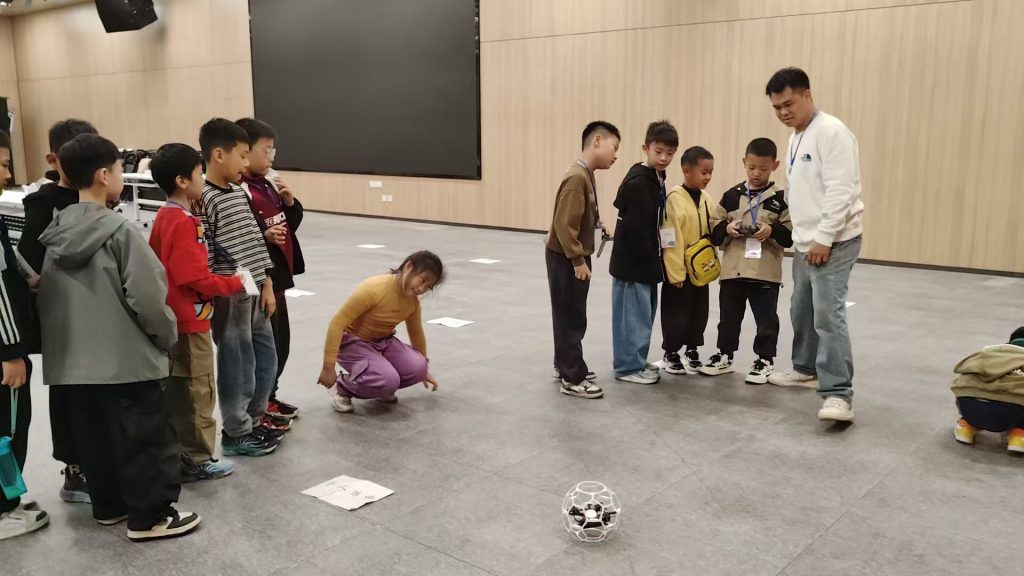
- Indoor Flight Arena: A netted or high-bay space for practicing manual piloting skills, automated take-off/landing procedures, and introductory mission execution in a GPS-denied environment.
- Specialized Application Zones: Dedicated areas simulating different application scenarios. This could include a small “agricultural field” plot for spraying practice (using water), a structural mock-up for inspection training, and a marked area for photogrammetry calibration and practice.
2. Project-Based, Spiral Curriculum Design
The course content should be organized not as a list of subjects, but as a series of increasingly complex projects that spiral back to core principles. Each project integrates knowledge from multiple domains.
| Stage | Sample Project | Integrated Skills & Knowledge | Tools & Environment |
|---|---|---|---|
| Beginner | Precision Hover & Basic Maneuvering | Aerodynamics (pitch, roll, yaw), Radio control theory, Battery management. | Simulator, Indoor arena with mini drones. |
| Intermediate | Automated Grid Survey for Mapping | Mission planning software, Photogrammetry principles, Georeferencing, Data import/export. | Mapping drone (e.g., Phantom 4 RTK, Mavic 3E), Ground Control Points, Processing software (Pix4D, Metashape). |
| Advanced | Thermal Inspection of a Simulated Power Facility | Thermography science, Anomaly detection, Regulatory compliance for BVLOS (concepts), Client report writing. | Thermal drone (e.g., Mavic 2 Enterprise Advanced), Reporting templates, Safety case development. |
3. Embedded Certification and Assessment
Given the regulatory environment, preparation for official certification (e.g., FAA Part 107 in the US, or similar national aviation authority certifications) must be woven into the curriculum, not treated as an add-on. The theoretical knowledge sections for regulations, airspace, weather, and loading directly align with certification syllabi. Practical assessments should mirror the operational standards expected by industry and regulators. Assessment itself must be multifaceted:
$$ \text{Final Competency Score} = w_1(\text{Theory Exam}) + w_2(\text{Practical Flight Test}) + w_3(\text{Project Portfolio}) + w_4(\text{Peer/Instructor Evaluation}) $$
with \( \sum_{i=1}^{4} w_i = 1 \) and significant weights assigned to \(w_2\), \(w_3\), and \(w_4\).
This multi-criteria evaluation ensures a holistic view of student capability, assessing not just what they know, but what they can do and how they work.
4. Sustained Industry Pipeline via “Dual-System” Collaboration
The most effective drone training adopts a “dual-system” model, alternating between school-based learning and company-based application. This is formalized through:
- Co-Developed Modules: Specific advanced modules (e.g., “Drone Deployment in Precision Agriculture” or “LiDAR Data Processing for Surveying”) are developed and delivered in partnership with a leading firm in that niche.
- Mandatory Internships: A semester or year of supervised work placement is a core credit-bearing component. Students apply their skills, learn company-specific workflows, and build professional networks.
- Capstone Projects with Industry Sponsors: Final-year students tackle real, small-scale problems presented by partner companies, delivering a complete solution from planning to analysis.
Conclusion: Training for a Dynamic Future
The field of drone training stands at a critical juncture. The demand for skilled operators and technicians is clear and growing. However, meeting this demand requires a decisive move away from static, theory-heavy educational models. The future of effective drone training lies in agile, integrated curricula that are co-created with industry, centered on immersive practical experience, and designed to foster the complete professional—a individual who is not only technically adept but also adaptable, communicative, and innovative. By implementing a framework built on the pillars of theory-practice fusion, dynamic industry alignment, and holistic competency development, vocational institutions can ensure their graduates are not merely certified, but are truly capable and confident contributors ready to navigate and shape the exciting future of the unmanned aerial systems industry. The success of this educational model will be measured not in test scores, but in the seamless transition of its graduates into roles where they immediately apply their comprehensive drone training to solve real-world challenges.