
In the rapidly evolving field of bionic robotics, achieving precise control over complex flight maneuvers has become a central research focus. From a multidisciplinary fusion perspective, this article systematically analyzes the flight kinematics and dynamics characteristics of the bionic butterfly drone, proposing a composite wing motion control mechanism based on flapping, twisting, and swinging. Through control system modeling, feedback mechanism optimization, and multimodal sensor integration, a comprehensive motion control framework is constructed. Simultaneously, multi-level optimization strategies are proposed from various dimensions such as material design, energy management, intelligent control algorithms, and aerodynamic efficiency. The research results provide theoretical support and technical pathways for enhancing the performance and practicality of bionic flying robots, and future trends in miniaturization, intelligence, and cooperative control are envisioned. The keyword “bionic butterfly drone” is central to this exploration, reflecting its significance in advancing aerial robotics.
The study of bionic systems draws inspiration from nature, and the butterfly, with its exceptional flight efficiency and maneuverability, serves as an ideal model. The flight of a butterfly is not merely simple up-and-down flapping; it involves intricate and coordinated wing motion patterns, subtle aerodynamic effects, and unique biomechanical properties. Specifically, butterflies utilize a “drag-based principle” for flapping flight, where both lift to balance body weight and thrust to overcome drag are provided by wing drag. Lift is primarily generated during the downstroke via drag, while the upstroke, coupled with body inclination, provides thrust. This complex interplay underscores the need for a multidisciplinary approach in replicating such capabilities in a bionic butterfly drone.
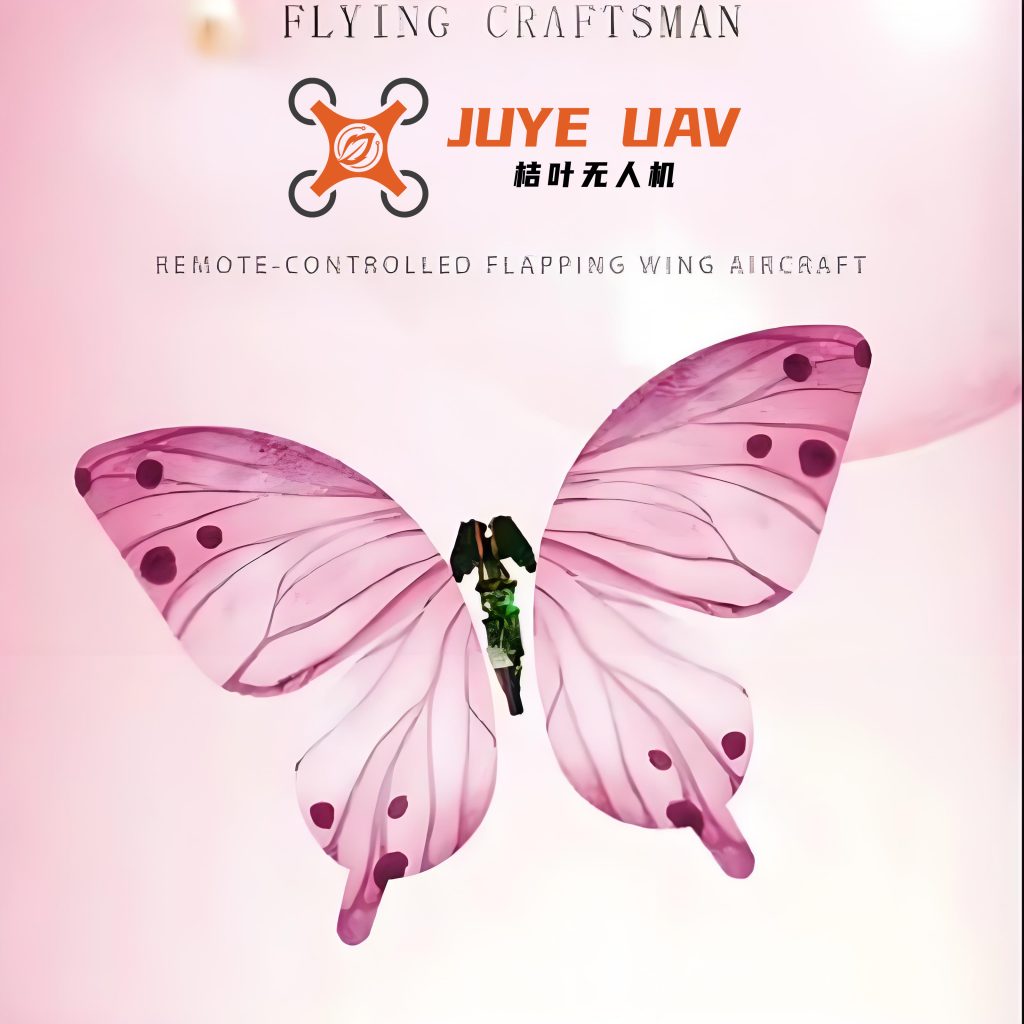
The wings of a butterfly exhibit remarkable flexibility and adaptability, enabling maneuvers like hovering, rapid turning, and efficient altitude control. Research indicates that butterfly flight involves interactions between wing bending, twisting, and overall flapping motions. By precisely altering the frequency, amplitude, and phase of these actions, butterflies can control flight direction, speed, and attitude. Key motion modes include: flapping motion for lift and propulsion; twisting motion for dynamic angle of attack adjustment and leading-edge vortex optimization; and swinging/pitching motion for fine-tuning lift, thrust, stability, and maneuverability. Emulating these in a bionic butterfly drone requires integrating insights from biology, mechanics, materials science, and control engineering.
Flight Mechanics and Design Principles of the Bionic Butterfly Drone
Bionics is an interdisciplinary field that studies natural biological structures, functions, and behaviors to mimic and apply them to artificial systems. For the bionic butterfly drone, understanding butterfly flight mechanics is foundational. The flight process involves complex wing kinematics and unsteady aerodynamics, where forces are generated through drag and vortical structures. The design principles for a bionic butterfly drone must prioritize biomimicry, lightweight construction, and multi-degree-of-freedom motion replication.
Biomimetic Wing Structure
The wing design of a bionic butterfly drone should closely mimic the structural and compliant properties of butterfly wings. Traditional rigid materials are insufficient for deformation and aerodynamic coupling needs; thus, flexible or composite materials like carbon fiber-reinforced polymer (CFRP), liquid crystal elastomers (LCE), or polyester films are employed. These materials must offer high flexibility, fatigue strength, and lightweight characteristics to support high-frequency flapping with responsive speed, stable deformation, and durability. Additionally, micro-textures resembling butterfly wing scales can be incorporated to improve airflow attachment, reduce drag, and enhance lift. For instance, a bionic butterfly drone with dimensions of 70 cm by 40 cm and a weight of only 66.5 g demonstrates the feasibility of such lightweight designs.
Replication of Biomimetic Motion Patterns
The key to butterfly flight lies in multi-degree-of-freedom wing motions. A bionic butterfly drone must achieve composite motions including flapping, twisting, and swinging. This necessitates sophisticated actuation and transmission systems capable of precisely controlling independent motion parameters for each wing, such as flapping frequency, amplitude, twist angle, and swing angle. The control system design must incorporate multi-degree-of-freedom kinematic models to ensure flexible adjustment of flight posture and trajectory. The integration of these motions allows the bionic butterfly drone to perform complex aerial tasks.
Lightweight and Strength Balance
Butterfly wings are exceptionally light yet withstand aerodynamic pressures and high-frequency vibrations. Similarly, the bionic butterfly drone must minimize overall mass to maximize lift-to-drag ratio and flight efficiency, while ensuring sufficient strength and stiffness for maneuvers and disturbance resistance. This balance is achieved through careful material selection, structural layout, and connection design. The goal is to create a robust yet agile bionic butterfly drone capable of sustained operation in diverse environments.
Motion Control Mechanisms of the Bionic Butterfly Drone
The motion control of a bionic butterfly drone relies on accurate modeling and real-time adjustment of wing dynamics. This involves kinematic and dynamic modeling, wing motion pattern control, and flight attitude stabilization.
Kinematic and Dynamic Modeling
The kinematic model of a bionic butterfly drone must describe the multi-degree-of-freedom wing motions. Each wing’s movement includes independent degrees of freedom such as flapping angle $\phi(t)$ and twisting angle $\theta(t)$. Using rotation and transformation matrices, the position, orientation, angular velocity, and velocity of the wings during different flight phases can be computed. For example, the wing tip position in a body-fixed coordinate system can be expressed as:
$$
\mathbf{r}_{\text{tip}}(t) = \mathbf{R}_z(\psi) \mathbf{R}_y(\phi) \mathbf{R}_x(\theta) \mathbf{r}_0
$$
where $\mathbf{r}_0$ is the initial position vector, and $\mathbf{R}_z, \mathbf{R}_y, \mathbf{R}_x$ are rotation matrices for yaw, pitch, and roll, respectively. This kinematic foundation supports dynamic analysis.
The dynamic modeling of the bionic butterfly drone involves complex unsteady aerodynamic effects. Forces such as lift $L$, thrust $T$, and drag $D$ are influenced by wing-air interactions, including leading-edge vortices (LEVs). A simplified dynamic model can be derived using quasi-steady approximations or computational fluid dynamics (CFD) simulations. The equations of motion for the drone’s center of mass are:
$$
m \frac{d\mathbf{v}}{dt} = \sum \mathbf{F}_{\text{aero}} + \mathbf{F}_{\text{gravity}}
$$
$$
\mathbf{I} \frac{d\boldsymbol{\omega}}{dt} = \sum \mathbf{M}_{\text{aero}}
$$
where $m$ is mass, $\mathbf{v}$ is velocity, $\mathbf{F}_{\text{aero}}$ are aerodynamic forces, $\mathbf{F}_{\text{gravity}}$ is gravitational force, $\mathbf{I}$ is the inertia tensor, $\boldsymbol{\omega}$ is angular velocity, and $\mathbf{M}_{\text{aero}}$ are aerodynamic moments. These models help predict flight trajectories and inform control strategies for the bionic butterfly drone.
Wing Motion Pattern Control
Flight control in a bionic butterfly drone primarily depends on precise regulation of wing flapping motion. By adjusting flapping frequency $f$, flapping amplitude $\Phi$, and flapping plane inclination $\alpha$, the control system can modulate vertical lift and horizontal thrust for speed and altitude changes. For instance, lift force can be approximated as:
$$
L = \frac{1}{2} \rho C_L A v^2
$$
where $\rho$ is air density, $C_L$ is lift coefficient (dependent on wing kinematics), $A$ is wing area, and $v$ is relative air velocity. Thrust is similarly derived from drag components during upstroke and downstroke.
Twisting and swinging motions are crucial for efficiency and stability. Twist control adjusts the angle of attack $\alpha_w$ during the flapping cycle to optimize LEV formation and airflow attachment, enhancing lift and managing drag. Swing/pitching control alters the effective sweep angle and attack angle for fine-tuned force generation. The dynamic adjustment of these multi-mode motions enables the bionic butterfly drone to adapt to real-time environmental changes. A logical representation of the control code is shown in the following table, summarizing the relationship between motion parameters and flight outcomes for the bionic butterfly drone.
| Motion Type | Control Parameter | Effect on Flight | Optimal Range |
|---|---|---|---|
| Flapping | Frequency $f$ (Hz) | Lift and thrust magnitude | 5–20 Hz |
| Flapping | Amplitude $\Phi$ (rad) | Force generation scale | 30–60° |
| Twisting | Angle $\theta$ (rad) | Lift optimization via LEV | ±20° |
| Swinging | Angle $\beta$ (rad) | Stability and maneuverability | ±15° |
Flight Attitude and Stability Control
The bionic butterfly drone achieves attitude control—pitch, yaw, and roll—by differentially adjusting wing motions. For example, differential flapping frequency or amplitude between left and right wings generates differential lift or thrust, causing pitch (nose up/down) or yaw (turning). Roll control (rotation about longitudinal axis) is managed by relative wing tilt or twist differences. The attitude dynamics can be described by Euler’s equations:
$$
I_{xx} \dot{p} – (I_{yy} – I_{zz}) q r = M_x
$$
$$
I_{yy} \dot{q} – (I_{zz} – I_{xx}) r p = M_y
$$
$$
I_{zz} \dot{r} – (I_{xx} – I_{yy}) p q = M_z
$$
where $p, q, r$ are roll, pitch, and yaw rates; $I_{xx}, I_{yy}, I_{zz}$ are moments of inertia; and $M_x, M_y, M_z$ are control moments from wing differentials.
To maintain stability in complex environments, the bionic butterfly drone incorporates feedback from multimodal sensors. This allows real-time perception of external disturbances like wind gusts, with rapid adjustments to wing motion parameters to ensure stable flight trajectory and attitude. A robust control loop is essential for the bionic butterfly drone to operate reliably in dynamic conditions.
Optimization Strategies and Performance Enhancement Pathways for the Bionic Butterfly Drone
Enhancing the performance of a bionic butterfly drone requires a multi-faceted optimization approach. Strategies span materials, energy, control algorithms, aerodynamics, and sensing systems, all aimed at improving efficiency, endurance, and adaptability.
Material and Structural Optimization
Wings should use lightweight, high-strength flexible composites like CFRP or polymer films with hyperelastic alloys to balance stiffness and flexibility. This enables passive deformation and aeroelastic coupling during high-frequency flapping, boosting lift efficiency and durability. Geometric and micro-texture designs mimicking butterfly wing folds, veins, and scales can improve airflow attachment, suppress boundary layer separation, reduce drag and vibration, and enhance lift. Modular designs with miniaturized, highly integrated actuators facilitate assembly, maintenance, and functional expansion. The table below summarizes key material optimization aspects for the bionic butterfly drone.
| Material Type | Properties | Benefits for Bionic Butterfly Drone | Challenges |
|---|---|---|---|
| Carbon Fiber Reinforced Polymer (CFRP) | High strength-to-weight ratio, flexibility | Durable, efficient flapping | Cost, manufacturing complexity |
| Liquid Crystal Elastomers (LCE) | Programmable deformation, lightweight | Adaptive wing shaping | Actuation control |
| Polyester Films with Micro-textures | Low drag, enhanced lift | Improved aerodynamics | Wear resistance |
Energy Management Optimization
Efficient energy use is critical for the bionic butterfly drone. Miniature drive units such as brushless DC motors or high-power-density piezoelectric actuators reduce power consumption. Intelligent power allocation algorithms, based on task intensity perception, optimize energy output for different flight states like hovering and high-speed cruising. Energy harvesting mechanisms, such as piezoelectric vibration harvesting from wings or micro solar cells, combined with high-energy-density lithium-polymer batteries, extend operational endurance. The energy balance equation can be expressed as:
$$
E_{\text{total}} = E_{\text{battery}} + \int P_{\text{harvest}}(t) dt – \int P_{\text{consumption}}(t) dt
$$
where $E_{\text{total}}$ is available energy, $P_{\text{harvest}}$ is harvested power, and $P_{\text{consumption}}$ is consumption power from actuators and electronics. Optimizing this balance prolongs flight time for the bionic butterfly drone.
Control Algorithm Optimization
A multi-objective, hierarchical intelligent control system enhances the bionic butterfly drone’s responsiveness and flexibility. The low level employs PID or robust control algorithms for precise wing motion control, ensuring attitude stability. The high level incorporates fuzzy logic, model predictive control (MPC), or reinforcement learning (RL) for path planning, obstacle avoidance, and environmental adaptation. Deep learning models like recurrent neural networks or Transformers can predict flight trajectory data, improving anticipation of airflow disturbances, energy trends, and flight strategies. Adaptive control algorithms enable real-time learning and parameter adjustment to varying conditions. For instance, an RL-based controller might optimize a policy $\pi(a|s)$ to maximize cumulative reward $R = \sum \gamma^t r_t$, where $s$ is state (e.g., attitude, wind speed), $a$ is action (wing parameters), and $\gamma$ is a discount factor. This continuous optimization boosts the performance of the bionic butterfly drone.
Aerodynamic Efficiency Optimization
Aerodynamic efficiency is key for flight performance. CFD simulations iteratively analyze wing motion parameters (flapping frequency, twist angle, amplitude, lead-lag angle) and wing flexibility to quantify lift-to-drag ratio and energy consumption, identifying optimal aerodynamic configurations. Asymmetric flapping strategies, inspired by butterfly maneuvering, enhance agility and turning efficiency by differentially controlling left and right wing parameters. Utilizing wing material flexibility for beneficial passive deformation adaptively optimizes angle of attack and airfoil shape, increasing lift efficiency and stability. The aerodynamic efficiency metric $\eta$ can be defined as:
$$
\eta = \frac{\text{Lift} \times \text{Forward Velocity}}{\text{Power Input}}
$$
Maximizing $\eta$ through parameter optimization is a core goal for the bionic butterfly drone. The following table outlines key aerodynamic parameters and their impact.
| Parameter | Symbol | Effect on Aerodynamics | Optimization Method |
|---|---|---|---|
| Flapping Frequency | $f$ | Increases lift and thrust, but raises power demand | CFD simulation to find trade-off |
| Twist Angle | $\theta$ | Enhances LEV formation, improving lift coefficient | Experimental tuning |
| Wing Flexibility | $E$ (modulus) | Passive shape adaptation reduces drag | Material selection |
| Asymmetric Ratio | $\Delta f / f$ | Enables rapid turns and maneuvers | Control algorithm adjustment |
Multimodal Sensing and Adaptive Regulation
A multi-source fused sensor system is vital for environmental perception and state estimation in the bionic butterfly drone. Integrating visual sensors, inertial measurement units (IMU), barometers, optical flow sensors, and micro force/pressure sensors, with fusion algorithms like Kalman filtering, enhances perception completeness and robustness. Based on this, a closed-loop control system with multi-source feedback enables environmental adaptive regulation. For example, when encountering crosswinds, the bionic butterfly drone automatically adjusts flapping or twist parameters to maintain stability. The state estimation can be formulated as:
$$
\hat{\mathbf{x}}_{k|k} = \hat{\mathbf{x}}_{k|k-1} + \mathbf{K}_k (\mathbf{z}_k – \mathbf{H} \hat{\mathbf{x}}_{k|k-1})
$$
where $\hat{\mathbf{x}}$ is the estimated state (e.g., position, attitude), $\mathbf{z}$ is sensor measurement, $\mathbf{H}$ is observation matrix, and $\mathbf{K}$ is Kalman gain. This adaptive capability ensures the bionic butterfly drone operates reliably in dynamic settings like gusty winds or obstacle-dense areas.
Conclusion and Future Perspectives
From a multidisciplinary fusion perspective, this article systematically constructs a multi-degree-of-freedom motion control system for the bionic butterfly drone, providing theoretical support for composite wing motion mechanisms, dynamic modeling, and attitude control methods. Multi-level optimization strategies encompassing materials, energy, intelligent control, and aerodynamic efficiency are proposed, highlighting their core role in achieving efficient and stable flight. Looking ahead, with ongoing breakthroughs in materials, artificial intelligence, microsystems, and actuation technologies, the bionic butterfly drone is poised for advances in miniaturization, intelligence, long endurance, and swarm cooperation. Potential applications span agricultural monitoring, environmental reconnaissance, disaster rescue, and beyond, demonstrating significant research value and application potential. The development of the bionic butterfly drone offers new思路 and technical pathways for bionic flying robots and intelligent systems, paving the way for more sophisticated aerial platforms inspired by nature.
In summary, the bionic butterfly drone represents a convergence of biology and engineering, where mimicking butterfly flight leads to innovative robotics solutions. Through integrated motion control and optimization, this technology promises to revolutionize areas requiring agile, efficient, and autonomous flight. Future work will focus on refining these strategies to realize the full potential of the bionic butterfly drone in real-world scenarios.