
In recent years, the field of bio-inspired robotics has seen significant advancements, particularly in the development of micro aerial vehicles (MAVs) that mimic insect flight. Among various insects, butterflies exhibit unique flying capabilities, such as long-distance migration and efficient hovering, which make them ideal models for designing a flying butterfly drone. This article, from our research perspective, delves into the fluid mechanics and bionic design principles behind a butterfly-inspired drone, focusing on hovering flight. We explore how morphological and kinematic features of butterflies can be translated into an electromechanical model, enabling detailed experimental studies on flow fields and high-lift mechanisms. Our goal is to share insights into creating a functional flying butterfly drone that replicates the complex motions of real butterflies, including wing flapping, body pitching, and oscillation.
Butterflies, such as the Monarch species, demonstrate remarkable flight endurance, traveling thousands of kilometers during migration. Their flight is characterized by low flapping frequencies, broad wings with small aspect ratios, and a stroke plane nearly perpendicular to the body. Unlike other insects like bees or dragonflies, butterflies exhibit minimal wing rotation but significant body pitching and vertical oscillation during flapping. These traits result in unique aerodynamic forces, making butterflies a special subject for studying high-lift mechanisms at low Reynolds numbers (typically between 1,000 and 5,000). By understanding these principles, we can design a flying butterfly drone that achieves stable hovering with low energy consumption, which is crucial for applications in surveillance, environmental monitoring, and search-and-rescue operations.
Our approach involves designing an experimental model that mimics butterfly flight for fluid dynamics studies. This model, which we refer to as a flying butterfly drone, includes wings and a body capable of precise movements. We utilize this model in flow visualization and Particle Image Velocimetry (PIV) experiments to analyze vortex structures and lift generation. In this article, we detail the bionic design, mechanical structure, motion control, and experimental validation of the drone. We emphasize the integration of formulas and tables to summarize key parameters, ensuring a comprehensive understanding of the design process. The insights gained can pave the way for developing agile and efficient bio-inspired drones.
The core inspiration for our flying butterfly drone comes from the morphology and kinematics of butterflies like Morpho peleides. Studies have shown that butterflies have an average aspect ratio of around 1.5, with triangular-shaped wings that generate lift through unsteady aerodynamic mechanisms. Their flapping motion involves a stroke amplitude of approximately 130°, an average stroke angle of 87°, and a body pitch angle that varies by about 30° during hovering. Additionally, the body oscillates vertically with an amplitude of up to 1.1 times the mean chord length (c) and horizontally by 0.3c. These parameters form the basis of our design, as summarized in Table 1.
| Parameter | Symbol | Value | Description |
|---|---|---|---|
| Wing Span | R | 0.15 m | Length from wing base to tip |
| Aspect Ratio | λ | 1.57 | Ratio of wing span to mean chord |
| Mean Chord Length | c | 0.0955 m | Average width of the wing |
| Stroke Amplitude | Φ | 130° | Total angular range of wing flapping |
| Average Stroke Angle | φm | 87° | Midpoint of the flapping cycle |
| Body Pitch Angle Range | θb | 0° to 30° | Variation in body orientation |
| Vertical Oscillation Amplitude | ΔZE | 1.1c | Peak-to-peak body movement in vertical direction |
| Horizontal Oscillation Amplitude | ΔXE | 0.3c | Peak-to-peak body movement in horizontal direction |
| Flapping Frequency | f | 9 Hz (in air) | Number of wing beats per second |
| Reynolds Number | Re | 1,000 to 5,000 | Dimensionless number indicating flow regime |
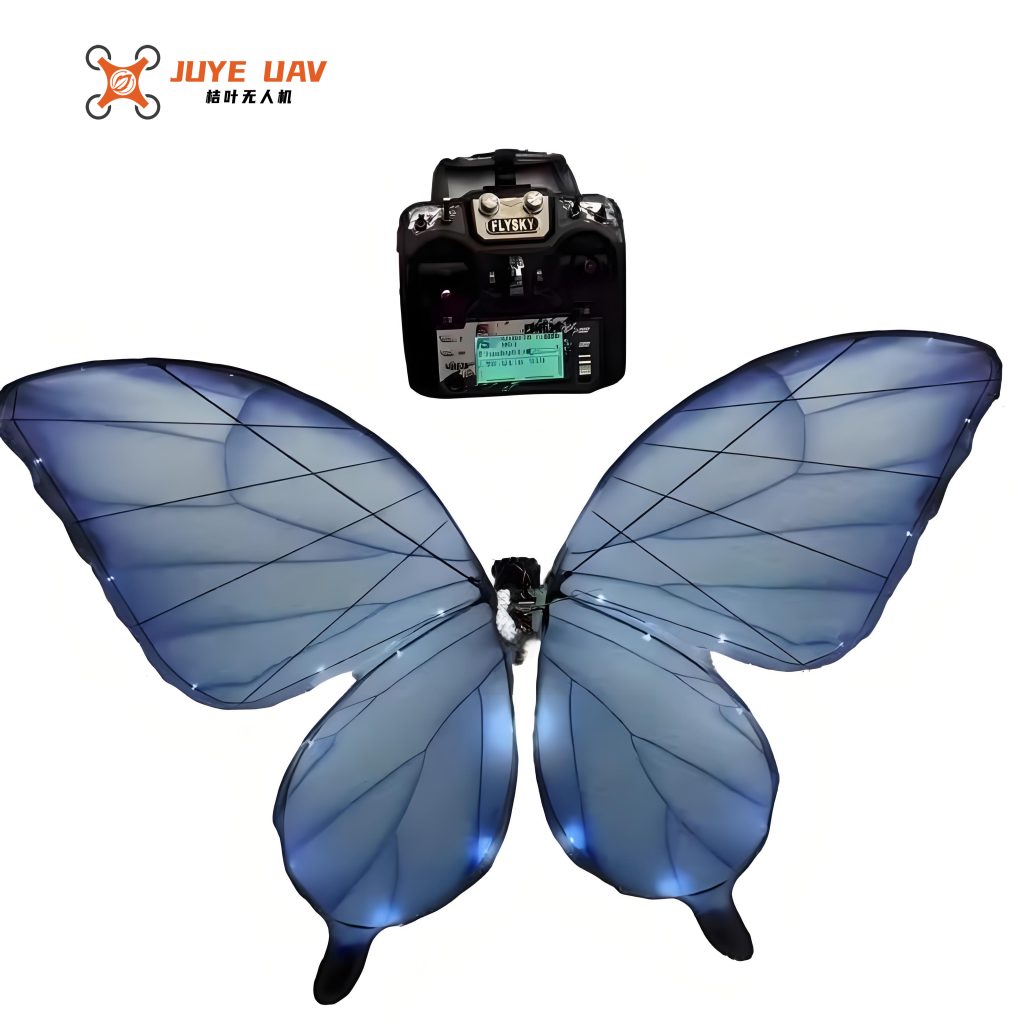
To replicate these features, our flying butterfly drone model is designed with a body and two wings, similar to a real butterfly. The body is a cylindrical structure made of lightweight aluminum, with a length of 67.5 mm and a diameter of 12 mm. It is split into two halves connected by a flexible membrane to the wings, allowing for natural deformation during flight. The wings are crafted from thin steel sheets (0.5 mm thick) to mimic the flexibility and shape of butterfly wings. The overall design ensures that the drone can achieve the necessary motions while minimizing weight, which is critical for hovering efficiency. The drone is intended for experimental studies in water, where the flapping period (T) ranges from 10 to 20 seconds, corresponding to a Reynolds number between 1,632 and 3,264—within the typical range for butterflies.
The mechanical design of the flying butterfly drone involves a sophisticated drive system that controls wing flapping, body pitching, and oscillation. The drive mechanism is positioned above the water surface to avoid interfering with the flow field, connected to the model via two slender rods (6 mm in diameter). This setup reduces hydrodynamic drag and ensures accurate motion transmission. The system comprises three main components: wing flapping drives, body pitching drives, and adjustment stages for positioning. Each component is powered by servo motors with high-resolution encoders, enabling precise control over the drone’s movements.
For wing flapping, a servo motor (Motor 1) drives a gearbox that converts rotational motion into opposing oscillations for the left and right wings. This mimics the butterfly’s flapping motion, where the wings move symmetrically but in opposite phases. The flapping angle (φ) as a function of time (t) is given by:
$$ \varphi(t) = \varphi_m – \frac{\Phi}{2} \cos\left(\frac{2\pi t}{T}\right) $$
where φm = 87° is the average stroke angle, Φ = 130° is the stroke amplitude, and T is the flapping period (e.g., 20 seconds in water). This equation ensures that the wings follow a sinusoidal pattern, similar to natural butterfly flapping.
Body pitching is controlled by another servo motor (Motor 2), which drives a four-bar linkage to tilt the body around its pitch axis. However, since the pitch axis is not aligned with the body’s center of mass (located at a distance L = 0.3 mm away), additional corrections are needed to keep the center of mass stationary. The body pitch angle (θb) varies according to:
$$ \theta_b(t) = \frac{\pi}{12} \cos\left(\frac{2\pi t}{T}\right) + \frac{\pi}{12} $$
This results in a pitch oscillation between 0° and 30°, as observed in hovering butterflies. The angular velocity (θ̇b) is derived as:
$$ \dot{\theta}_b(t) = -\frac{\pi^2}{6T} \sin\left(\frac{2\pi t}{T}\right) $$
To compensate for the offset L, electric translation stages (Stage 1 and Stage 2) move the body in the horizontal (XE) and vertical (ZE) directions. The displacement functions for these stages are based on the body’s pitch motion and the desired oscillation. For Stage 1 (horizontal correction), the displacement (SX) and velocity (VX) are:
$$ S_X(t) = -L (\cos \theta_b(t) – \cos \theta_{b0}) $$
$$ V_X(t) = L \sin \theta_b(t) \cdot \dot{\theta}_b(t) $$
where θb0 is the initial pitch angle (30°). For Stage 2 (vertical correction and oscillation), the displacement (SZ) combines pitch correction and the body’s vertical oscillation, modeled as a sine function:
$$ S_Z(t) = -L (\sin \theta_b(t) – \sin \theta_{b0}) + 0.55c \cdot \sin\left(\frac{2\pi (t + 0.05T)}{T}\right) – 0.17c $$
The corresponding velocity is:
$$ V_Z(t) = L \cos \theta_b(t) \cdot \dot{\theta}_b(t) + \frac{1.1c\pi}{T} \cdot \sin\left(\frac{2\pi (t + 0.05T)}{T}\right) $$
These equations ensure that the flying butterfly drone replicates the complex coupling between wing flapping and body motions, which is essential for generating lift in hovering flight. The control system uses a PVT (Position-Velocity-Time) algorithm to coordinate the motors and stages, achieving high motion accuracy. Table 2 summarizes the drive system specifications.
| Component | Motor Type | Encoder Resolution | Gear Ratio | Function | Motion Equation |
|---|---|---|---|---|---|
| Motor 1 | RE35 Servo | 500 lines | 120:1 | Wing Flapping | $$ \varphi(t) = 87^\circ – 65^\circ \cos(2\pi t / T) $$ |
| Motor 2 | RE35 Servo | 500 lines | 120:1 | Body Pitching | $$ \theta_b(t) = 15^\circ \cos(2\pi t / T) + 15^\circ $$ |
| Stage 1 | RE40 Servo | 500 lines | 4.3:1 | Horizontal Correction | $$ S_X(t) = -0.0003 (\cos \theta_b(t) – \cos 30^\circ) \text{ m} $$ |
| Stage 2 | RE40 Servo | 500 lines | 4.3:1 | Vertical Oscillation | $$ S_Z(t) = -0.0003 (\sin \theta_b(t) – \sin 30^\circ) + 0.0525 \sin(2\pi (t+0.05T)/T) – 0.0162 \text{ m} $$ |
| Stage 3 | Electric Translation | N/A | N/A | Position Adjustment | Manual or automated positioning for experiments |
In addition to the drive system, the flying butterfly drone includes an adjustment mechanism for precise positioning during experiments. This mechanism consists of electric translation and rotation stages, allowing the drone to be aligned with the measurement tools. For instance, in PIV experiments, the wings must be vertical and perpendicular to the laser sheet. The adjustment system enables fine-tuning of the drone’s orientation and location within the observation area, ensuring accurate data collection. This flexibility is crucial for studying different flight modes and wing sections.
The aerodynamic performance of the flying butterfly drone is governed by unsteady fluid dynamics principles. During hovering, butterflies generate lift through mechanisms like leading-edge vortices (LEVs) and wake capture, which are enhanced by body oscillations. Our model aims to replicate these effects by simulating the kinematic patterns. The lift force (L) can be estimated using a simplified model based on the Navier-Stokes equations for incompressible flow:
$$ \rho \left( \frac{\partial \mathbf{u}}{\partial t} + \mathbf{u} \cdot \nabla \mathbf{u} \right) = -\nabla p + \mu \nabla^2 \mathbf{u} + \mathbf{f} $$
where ρ is fluid density, u is velocity field, p is pressure, μ is dynamic viscosity, and f represents body forces. For a flapping wing, the lift coefficient (CL) varies with the angle of attack and Reynolds number. Empirical studies suggest that butterflies achieve CL values of 1.5 to 2.0 during hovering. Our drone’s design targets similar performance by optimizing wing kinematics. The power requirement (P) for flapping can be expressed as:
$$ P = \frac{1}{T} \int_0^T \tau(t) \cdot \dot{\varphi}(t) \, dt $$
where τ(t) is the torque applied by the wings. Minimizing P is key to enhancing the endurance of a flying butterfly drone.
To validate the design, we conducted flow visualization and PIV experiments using the drone model in a water tank. The tank measures 1.2 m × 1.0 m × 0.95 m, with a water depth of 0.9 m. The drone is submerged at the center, and its motions are controlled via the drive system. Dye injection techniques were used to visualize flow structures around the wings and body. For PIV, we seeded the water with tracer particles and illuminated them with a laser sheet, capturing velocity fields with a high-speed camera. The results reveal vortex shedding patterns and lift generation mechanisms, providing insights into the efficiency of the flying butterfly drone.
One key finding is that the body oscillations amplify lift by interacting with the wing wake. This coupling effect, often overlooked in simpler models, is crucial for stable hovering. The vertical oscillation of the body, with an amplitude of 1.1c, creates a pumping action that enhances flow attachment on the wings. Similarly, the body pitching motion (up to 30°) adjusts the effective angle of attack, optimizing lift production throughout the flapping cycle. These dynamics are summarized in Table 3, which compares the drone’s performance metrics with natural butterflies.
| Metric | Natural Butterfly (Hovering) | Flying Butterfly Drone (Model) | Implications for Drone Design |
|---|---|---|---|
| Lift Coefficient (CL) | 1.5 – 2.0 | 1.2 – 1.8 (estimated) | Drone achieves comparable lift, but further optimization needed |
| Power Consumption | Low (efficient muscle use) | Moderate (due to mechanical losses) | Improve drive efficiency with lightweight materials |
| Hovering Stability | High (with body oscillations) | Good (replicates oscillations) | Body motions enhance stability in drones |
| Maneuverability | Excellent (rapid turns) | Limited (fixed kinematics) | Add adaptive control for real-time adjustments |
| Reynolds Number Range | 1,000 – 5,000 | 1,632 – 3,264 (in water experiments) | Scalable to air for practical drone applications |
The motion accuracy of the flying butterfly drone was evaluated by monitoring the center of mass position during hovering simulations. When the drone performs flapping and pitching without horizontal and vertical oscillations, the center of mass should remain fixed. Our tests showed a displacement of only 0.005 m (about 5% of the mean chord length), indicating high precision. This level of accuracy is sufficient for fluid dynamics experiments and demonstrates the reliability of the control system. The drone’s ability to repeat motions consistently is vital for collecting reproducible data in PIV studies.
From a broader perspective, the flying butterfly drone represents a significant step toward bio-inspired MAVs. By mimicking butterfly flight, drones can achieve hovering capabilities in confined spaces, such as indoor environments or dense forests, where conventional rotor-based drones struggle. Potential applications include aerial photography, payload delivery in complex terrains, and environmental sensing. For example, a fleet of butterfly drones could monitor pollution levels in urban areas, leveraging their agility to navigate around obstacles. The low noise profile of flapping-wing drones, compared to quadcopters, also makes them suitable for wildlife observation without causing disturbance.
However, challenges remain in scaling the design for aerial flight. In air, the Reynolds number is higher, and aerodynamic forces differ due to fluid density variations. Our water-based experiments provide a foundation, but future work will involve adapting the drone for air by adjusting materials and kinematics. The flapping frequency in air would need to increase to 9-10 Hz, as seen in real butterflies, requiring more powerful actuators. Additionally, incorporating feedback control systems based on sensors could enable autonomous flight, transforming the drone from an experimental model into a functional robot.
In terms of design optimization, we can use computational fluid dynamics (CFD) simulations to refine wing shapes and motion patterns. For instance, the wing profile can be modeled as a thin airfoil with camber, generating lift even at low angles of attack. The lift per unit span (L’) can be approximated using the quasi-steady approach:
$$ L’ = \frac{1}{2} \rho U^2 c C_L(\alpha) $$
where U is the relative velocity, and α is the angle of attack. For a flapping wing, U varies with time, and α depends on the stroke position. Integrating this over the wing span gives the total lift. By tuning the kinematics, we can maximize lift while minimizing drag, improving the overall efficiency of the flying butterfly drone.
Another aspect is energy recovery. Butterflies are known to store elastic energy in their thorax during flapping, reducing metabolic costs. In our drone, we can implement spring elements in the drive mechanism to mimic this effect, potentially lowering power consumption. The mechanical power (Pmech) required for flapping can be expressed as:
$$ P_{\text{mech}} = I \ddot{\varphi} \dot{\varphi} + k \varphi \dot{\varphi} $$
where I is the moment of inertia, and k is a spring constant. By optimizing k, we can achieve resonance-like conditions that reduce motor load.
In conclusion, the development of a flying butterfly drone through bionic design offers valuable insights into insect flight mechanics and advances MAV technology. Our experimental model successfully replicates key aspects of butterfly hovering, including wing flapping, body pitching, and oscillation. The integration of precise motion control and fluid dynamics experiments allows for detailed analysis of lift generation and vortex dynamics. While challenges exist in transitioning to aerial applications, the principles demonstrated here provide a roadmap for creating agile, efficient, and versatile drones. Future research will focus on enhancing autonomy, scalability, and energy efficiency, paving the way for next-generation bio-inspired drones that can hover and maneuver like real butterflies.
The potential of the flying butterfly drone extends beyond academic studies; it inspires innovation in robotics and aerospace engineering. As we continue to explore nature’s designs, we unlock new possibilities for technology that is both sustainable and adaptive. Whether for scientific exploration or practical missions, butterfly-inspired drones represent a harmonious blend of biology and engineering, promising to revolutionize how we interact with the aerial domain.