
In recent years, the field of bio-inspired flapping-wing aerial vehicles has advanced rapidly, driven by the need for lightweight, high-performance, and high-precision micro air vehicles. Among the various biological models, the butterfly stands out due to its unique flight mechanics, featuring two pairs of membranous wings that enable agile maneuvers and efficient lift generation. This article presents the design and development of a bio-inspired butterfly drone, which aims to replicate the essential kinematics and structural characteristics of a real butterfly while achieving a lightweight platform suitable for practical flight. The proposed butterfly drone employs a dual-servo direct-drive system, a carbon fiber skeleton, and a P31n membrane, resulting in a total mass of only 30 g and a wingspan of 41.4 cm. Extensive tests demonstrate stable flapping frequencies between 8 and 12 Hz, smooth attitude transitions, and reliable wireless control. This work provides a technical reference for the miniaturization and efficient development of bio-inspired flapping-wing drones.
Design Background and Motivation
The study of bio-inspired flapping-wing flight has long been motivated by the exceptional capabilities of natural fliers. Compared to conventional fixed-wing or rotary-wing aircraft, flapping-wing platforms offer superior energy efficiency, maneuverability in confined spaces, and low acoustic signatures. Among the many biological templates, butterflies are particularly attractive for butterfly drone design because of their low wing loading, high passive deformation, and ability to generate both lift and thrust through asymmetric wing motion. Over the past decade, several research groups have developed prototypes, such as the Festo eMotionButterflies, which demonstrated a wingspan of 50 cm and a mass of 32 g. However, challenges remain in balancing lightweight construction, structural strength, and high-precision control. Our butterfly drone aims to address these challenges by adopting a simplified yet effective dual-servo mechanism and optimizing the material selection to reduce weight without compromising aerodynamic performance.
Overall Structure of the Butterfly Drone
Wing Design
The wing structure of the butterfly drone is inspired by the natural butterfly’s wing venation. Each wing consists of a main wing and an auxiliary wing, both constructed from a flexible membrane supported by a carbon fiber skeleton. The skeleton is built using 0.8 mm diameter carbon fiber rods arranged in a radial pattern that mimics the branching veins of a butterfly wing. This configuration provides sufficient rigidity to withstand aerodynamic loads while allowing controlled elastic deformation during flapping. The membrane material is P31n, a lightweight and high-tensile-strength fabric commonly used in kites. The combination of carbon fiber and P31n ensures a high strength-to-weight ratio, crucial for maintaining flight stability. The key parameters of the wing design are summarized in Table 1.
| Parameter | Value |
|---|---|
| Wingspan (full) | 41.4 cm |
| Number of wings | 4 (two pairs) |
| Skeleton material | Carbon fiber rod (diameter 0.8 mm) |
| Membrane material | P31n |
| Wing aspect ratio | ~3.5 |
| Mass per wing | Approx. 3.5 g |
Main Body and Support Structure
The central body of the butterfly drone is designed to house the actuators, control electronics, and power source in a lightweight yet rigid framework. The main support is a single carbon fiber rod with a diameter of 3 mm, which serves as the backbone. Two AF D30T-3.3-MG digital servos are mounted on a custom 3D-printed PLA servo holder, which is fixed to the carbon fiber rod. Each servo directly drives one wing pair, eliminating the need for a complex gear transmission. This direct-drive approach reduces mechanical losses and improves dynamic response. The electronics include an XR502 2.4 GHz receiver and a 200 mAh lithium polymer battery, all integrated onto the carbon fiber rod to minimize additional weight. Table 2 lists the main components and their masses.
| Component | Mass (g) |
|---|---|
| Carbon fiber rod (main beam) | 2.1 |
| Servo holder (PLA) | 1.8 |
| Two AF D30T-3.3-MG servos | 6.6 |
| Wing assemblies (4 wings) | 14.0 |
| Receiver (XR502) | 1.5 |
| Battery (200 mAh, 7.4 V) | 3.8 |
| Wiring and connectors | 0.2 |
| Total | 30.0 |
Control System of the Butterfly Drone
Servo Actuation Unit
The core of the butterfly drone’s motion generation lies in the two AF D30T-3.3-MG digital servos. Each servo has a mass of only 3.3 g and dimensions of 23.2 mm × 12.0 mm × 29.0 mm. It can deliver a continuous torque of 0.18 N·m at 7.4 V, with a peak torque of 0.25 N·m. The response time is 0.06 s for a 60° rotation, allowing the wings to achieve flapping frequencies of up to 300 Hz for small amplitudes. The servos are controlled via pulse width modulation (PWM) signals, and their high precision ensures accurate tracking of the commanded wing trajectories. Important servo specifications are summarized in Table 3.
| Parameter | Value |
|---|---|
| Mass | 3.3 g |
| Dimensions (L×W×H) | 23.2 × 12.0 × 29.0 mm |
| Operating voltage | 7.4 V |
| Continuous torque | 0.18 N·m |
| Peak torque | 0.25 N·m |
| Response time (60°) | 0.06 s |
| Pulse width range | 500 – 2500 μs |
Wireless Communication Module
The butterfly drone uses a compact 2.4 GHz RF communication module based on the nRF24L01+ transceiver chip. This module operates in the 2.4–2.4835 GHz ISM band, supporting GFSK modulation and data rates from 250 kbps to 2 Mbps. The receiver sensitivity is −85 dBm, ensuring stable control within a typical operational range. The module is integrated on a custom PCB that also houses the power management circuitry. The total mass of the communication module is 3.6 g, and its dimensions are 14 mm × 13 mm × 3 mm.
Flight Control Algorithm
The flight control algorithm for the butterfly drone is implemented on an Arduino platform, which reads seven PWM channels from the receiver and maps them into control parameters. The core algorithm generates periodic servo signals using a cosine wave function, as expressed in Equation (1).
$$P = S \pm (A \pm \Delta) \cos(\omega t)$$
where:
- \(P\) is the output pulse width (μs) for a servo,
- \(S\) is the neutral midpoint for the servo (typically 1500 μs),
- \(A\) is the flapping amplitude parameter,
- \(\Delta\) is the differential steering offset,
- \(\omega\) is the angular frequency related to the flapping period, and
- \(t\) is time.
The angular frequency is determined by a step-wise generator with 18 steps per cycle, where each step corresponds to a 10° increment. The flapping frequency is controlled via the third channel of the receiver, mapping a period range from 3500 μs to 10000 μs to actual flapping rates. When the period is less than 9600 μs, the butterfly drone activates its flight mode, and the two servos operate with a 180° phase difference to generate the characteristic butterfly wing motion. Differential steering is achieved by modifying the amplitude offset \(\Delta\) on each wing, enabling yaw control. A fifth channel adjusts the overall amplitude, while a sixth channel provides a mode switch for special maneuvers. Real-time flight parameters are output via the serial monitor for debugging and analysis. This control architecture allows the butterfly drone to perform level flight, turning, and other complex maneuvers.
Prototype Assembly and Testing
After completing the design simulations and control algorithm development, we fabricated a fully functional butterfly drone prototype. The assembly process involved laser cutting the carbon fiber rods to length, 3D printing the servo holder, and carefully attaching the P31n membranes using cyanoacrylate adhesive. The electronic components were soldered to a lightweight PCB and wired to the servos and battery. Figure 1 shows the completed prototype during ground testing.
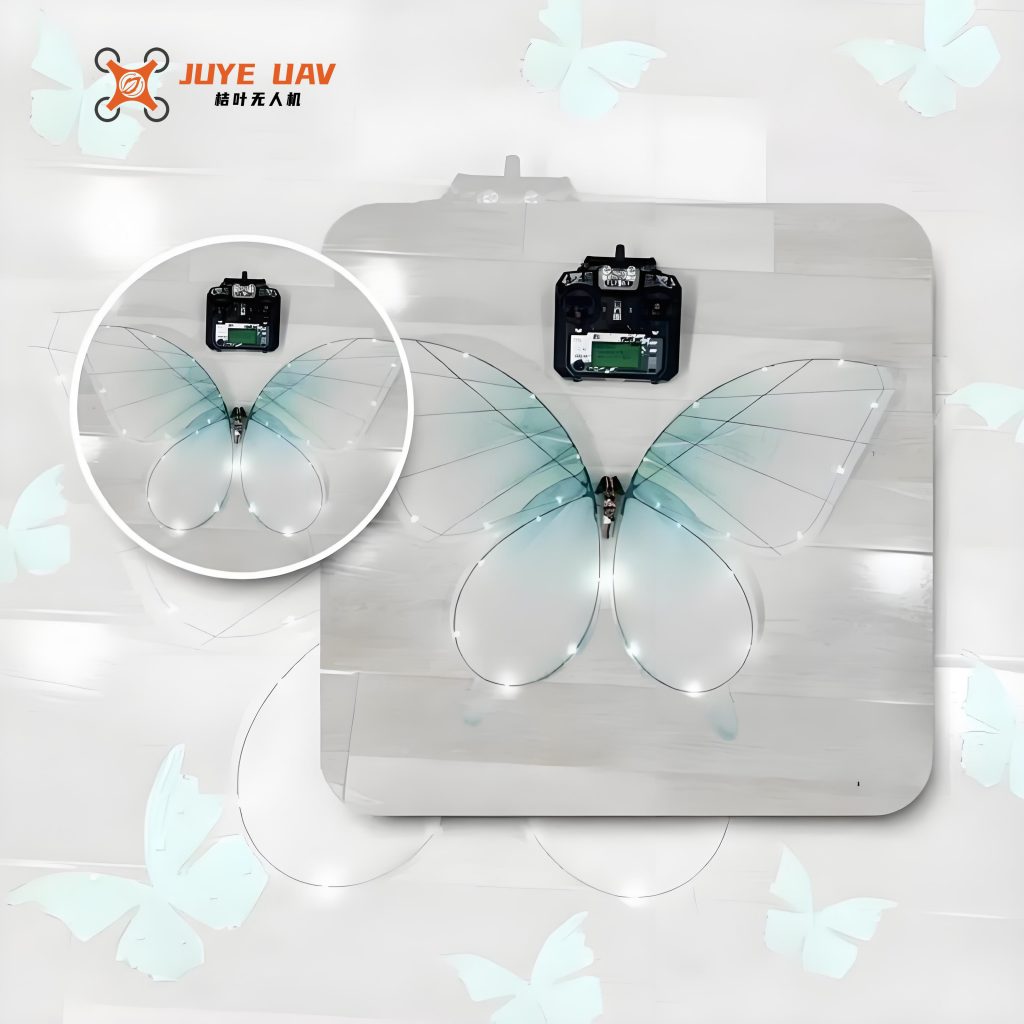
The prototype was then subjected to a series of test flights in an indoor environment. The flapping frequency was measured using a high-speed camera, and the flight performance was evaluated qualitatively. The key results are summarized in Table 4.
| Parameter | Measured Value |
|---|---|
| Flapping frequency range | 8 – 12 Hz |
| Maximum endurance (with 200 mAh battery) | 4.5 min |
| Average flight speed (estimated) | ~1.5 m/s |
| Maximum roll angle (during turns) | ±15° |
| Stability | Good, with smooth transitions |
During flight, the butterfly drone exhibited stable hover-like behavior in the indoor space, with periodic flapping generating sufficient lift to maintain altitude. The dual-servo direct-drive mechanism proved effective in producing the asymmetric wing motion needed for turning. The lightweight design (30 g) allowed for gentle landing and reduced risk of damage. The 4.5-minute endurance met our design target, considering the limited battery capacity. Overall, the prototype validated the feasibility of the proposed dual-servo concept for the butterfly drone.
Conclusion
In this work, we have presented the complete design and development of a bio-inspired butterfly drone. By integrating a carbon fiber skeleton, P31n wing membranes, and a dual-servo direct-drive system, we achieved a total mass of only 30 g with a wingspan of 41.4 cm. The control system, based on an Arduino platform and cosine-wave modulation, enables precise regulation of flapping frequency, amplitude, and differential steering. Flight tests demonstrated stable operation at flapping frequencies of 8–12 Hz and a flight endurance of 4.5 minutes. The butterfly drone’s performance confirms that the dual-servo architecture is a viable alternative to traditional geared transmissions, offering improved dynamic response and simplicity. Future work will focus on integrating flexible materials for wing morphing and enhancing the control algorithm with adaptive feedback for outdoor autonomous flight. The butterfly drone presented here serves as a foundation for the next generation of high-efficiency micro aerial vehicles, with potential applications in environmental monitoring, search-and-rescue, and covert surveillance.