
In recent years, the rapid pace of urbanization and economic development has led to an increase in emergencies, making fire safety situations more severe. Traditional fire rescue methods, limited by operational range, endurance, and communication constraints, often struggle to meet the demands for efficient and precise rescue, especially in scenarios involving high-rise buildings or complex terrains. As a researcher in this field, I believe that exploring new fire rescue technologies is imperative. The tethered fire drone, connected to a ground station via a tether to achieve continuous power supply and communication, overcomes the limitations of traditional drones such as short flight times and restricted communication range. This technology shows broad application potential in fire rescue, providing timely and accurate information support to rescue personnel, thereby enhancing efficiency and safety. In this article, I delve into the application of tethered fire drones in fire rescue, analyzing their technical characteristics, application scenarios, challenges, and solutions, with the aim of fostering innovation and development in fire rescue technology.
Current research in fire rescue has evolved beyond relying solely on firefighters, who often face extreme risks. The advent of drones and unmanned vehicles offers new approaches. Drones, with their rapid deployment and flexible flight capabilities, can quickly reach fire or disaster sites. Fire rescue drones not only transmit high-definition images and data in real-time but can also directly execute firefighting tasks by spraying extinguishing agents onto fire sources. However, traditional drones are constrained by endurance, payload, and communication limitations, hindering their widespread use in rescue operations. The tethered fire drone addresses these issues by using a tether cable connected to a ground power source, ensuring continuous energy supply and stable communication while reducing the drone’s own payload burden. Thus, tethered fire drones provide more reliable and efficient aerial support in rescue fields, offering promising prospects.
To understand the capabilities of tethered fire drones, it is essential to first examine their technical foundation. A tethered fire drone is a specialized form of multi-rotor drone characterized by a tether cable linking it to the ground or another carrier, using ground power as the energy source instead of traditional lithium batteries. This configuration not only enhances endurance but also improves stability and communication reliability, making it ideal for fire rescue missions.
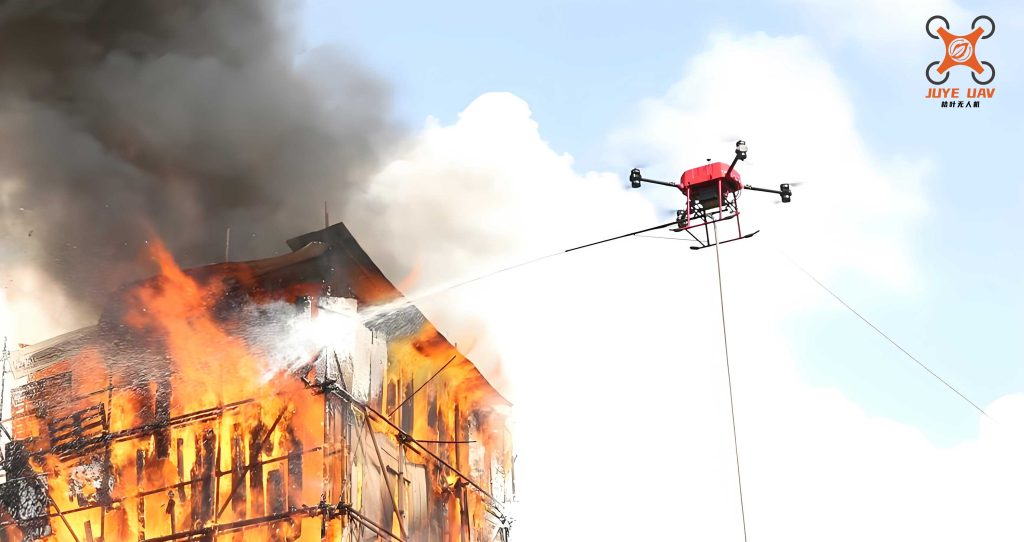
The basic structure of a tethered fire drone system typically consists of four main components: the drone platform, tether technology and equipment, ground control station, and communication system. I have summarized these in Table 1 to provide a clear overview.
| Component | Description | Key Functions |
|---|---|---|
| Drone Platform | Usually a multi-rotor design (e.g., quadcopter) with motors, flight controllers, and payload mounts. | Executes flight tasks; can carry sensors, cameras, or firefighting equipment like extinguisher sprayers. |
| Tether Technology and Equipment | Includes tether cable, winch, power connectors, and interfaces. | Provides continuous power from ground to drone, enhancing endurance and reducing onboard battery load. |
| Ground Control Station | Equipped with computers, displays, joysticks, and wireless transmission devices. | Serves as command center for takeoff, flight control, mission planning, and data processing; allows real-time monitoring and control. |
| Communication System | Combines wired (via tether) and wireless (e.g., Wi-Fi, 4G/5G, satellite) transmission. | Enables real-time data exchange between drone and ground station, ensuring reliable command and feedback. |
From a technical perspective, tethered fire drones offer several advantages critical to fire rescue operations. First, their endurance and load capacity are significantly improved. Since power is supplied from the ground, the fire drone can operate for extended periods without battery limitations. The endurance time \( T \) can be expressed as a function of ground power output \( P_g \) and drone power consumption \( P_d \):
$$ T = \frac{E_g}{P_d} $$
where \( E_g \) is the energy provided by the ground source. This allows the fire drone to sustain long-duration missions, such as continuous monitoring in forest fires. Additionally, the reduced need for onboard batteries increases payload capacity \( L \), which can be modeled as:
$$ L = M_{max} – M_{base} $$
with \( M_{max} \) being the maximum takeoff weight and \( M_{base} \) the base weight of the drone. Second, communication capability is enhanced through hybrid wired-wireless systems, ensuring stable data transmission even in interference-prone environments. The signal-to-noise ratio \( SNR \) for the tethered link can be approximated as:
$$ SNR = \frac{P_t G_t G_r}{(4\pi d)^2 L_f N} $$
where \( P_t \) is transmission power, \( G_t \) and \( G_r \) are antenna gains, \( d \) is distance, \( L_f \) is loss factor, and \( N \) is noise power. This results in high-quality video and sensor data feeds. Third, stability and anti-interference are bolstered by the physical tether connection, which dampens external disturbances like wind gusts. The dynamic stability can be described using a simplified equation of motion:
$$ m \ddot{x} + c \dot{x} + k x = F_{ext} $$
where \( m \) is mass, \( c \) is damping coefficient, \( k \) is stiffness, and \( F_{ext} \) is external force. This stability is crucial for precise operations in harsh conditions.
The applicability of tethered fire drones in fire rescue is evident across various scenarios. In complex terrains like mountains or forests, where traditional vehicles cannot easily access, the fire drone can deploy within minutes, providing aerial reconnaissance with high-definition and thermal imaging cameras. In adverse weather conditions such as heavy rain or strong winds, the tethered fire drone’s robustness allows it to maintain stable flight, thanks to ground power support and built-in safety features like rotor failure protection and communication redundancy. This makes the fire drone a versatile tool for enhancing rescue efficiency and safety.
In my research, I have explored specific applications of tethered fire drones in fire rescue, which can be categorized into several key areas. Each application leverages the unique advantages of the fire drone to address challenges in rescue operations.
First, for fire scene monitoring and reconnaissance, the tethered fire drone serves as an invaluable asset. It can hover over fire zones for prolonged periods, capturing real-time video and thermal data to assess fire spread and intensity. For instance, in urban high-rise fires, the fire drone can provide overhead views that help identify hotspots and trapped individuals. The effectiveness of such monitoring can be quantified using a coverage area model:
$$ A_{cover} = \pi r^2 \cdot \frac{T_{flight}}{T_{scan}} $$
where \( r \) is the sensor range, \( T_{flight} \) is flight time, and \( T_{scan} \) is time per scan cycle. Additionally, with advanced sensors, the fire drone can detect life signs through heat signatures or audio cues, aiding in search and rescue efforts. I summarize these applications in Table 2.
| Application | Description | Key Technologies |
|---|---|---|
| Real-time Monitoring | Continuous aerial surveillance of fire scenes to track dynamics. | HD cameras, infrared thermography, real-time data transmission. |
| Fire Source Localization | Precise identification of ignition points using navigation and obstacle avoidance. | GPS, LiDAR, machine learning algorithms for image analysis. |
| Personnel Search and Rescue | Detection of trapped individuals via thermal or acoustic sensors. | Thermal imaging cameras, microphones, AI-based pattern recognition. |
Second, emergency communication relay is another critical application. In disasters where ground communication infrastructure is damaged, tethered fire drones can act as aerial relays to restore connectivity. The principle involves using the fire drone as a node to extend communication range between source and target nodes. For a multi-hop relay system with \( n \) drones, the total effective range \( R_{total} \) can be expressed as:
$$ R_{total} = \sum_{i=1}^{n} r_i $$
where \( r_i \) is the coverage radius of each fire drone. This enables the establishment of temporary networks for voice, data, and video transmission. The fire drone can carry mobile base stations or satellite links, facilitating coordination among rescue teams and affected populations. Moreover, the fire drone’s stable position allows for low-latency control of other unmanned assets, enhancing operational synergy. The communication throughput \( C \) in such a system can be modeled using Shannon’s formula:
$$ C = B \log_2 \left(1 + SNR\right) $$
where \( B \) is bandwidth. This ensures reliable data exchange even in chaotic environments.
Third, material delivery and personnel transfer represent emerging uses for tethered fire drones. While more complex due to safety considerations, the fire drone’s enhanced load capacity and stability make it feasible for delivering emergency supplies like medicine, food, or equipment to inaccessible areas. The payload mass \( m_{payload} \) that can be delivered depends on the drone’s lift force \( F_{lift} \), given by:
$$ F_{lift} = \rho A v^2 C_L $$
where \( \rho \) is air density, \( A \) is rotor area, \( v \) is airflow velocity, and \( C_L \) is lift coefficient. For personnel transfer, specialized systems such as harnesses or pods could be developed, leveraging the fire drone’s precise hovering capabilities. However, this requires rigorous safety protocols and further technological advancements. I outline these aspects in Table 3.
| Application | Description | Challenges and Solutions |
|---|---|---|
| Material Delivery | Transport of relief goods to disaster zones using the fire drone’s cargo hooks or compartments. | Ensuring accurate drop; solved by GPS-guided release mechanisms and obstacle detection. |
| Personnel Transfer | Evacuation of individuals from hazardous areas via attached carriers. | Safety risks; addressed by redundant stability controls, fail-safe systems, and gradual testing. |
Looking ahead, the future development of tethered fire drones in fire rescue holds exciting prospects. I anticipate advancements in several areas that will further enhance the efficacy of these fire drones. First, high-performance power systems will improve endurance and flight capabilities. Innovations in ground power delivery and energy management could lead to even longer mission times, allowing fire drones to operate for days in sustained rescue efforts. The energy efficiency \( \eta \) of such systems can be optimized using:
$$ \eta = \frac{P_{out}}{P_{in}} \times 100\% $$
where \( P_{out} \) is useful power and \( P_{in} \) is input power. Second, advanced communication relay technologies will enable fire drones to support broader and more resilient networks, incorporating 5G or satellite links for high-bandwidth, low-latency services. This will be crucial for real-time command and data sharing in large-scale disasters. Third, intelligent autonomous flight and obstacle avoidance will become standard, driven by AI algorithms that allow fire drones to navigate complex environments without constant human intervention. The autonomy level can be quantified using a metric like:
$$ A_{level} = \frac{T_{auto}}{T_{total}} $$
with \( T_{auto} \) being time in autonomous mode and \( T_{total} \) total mission time. Additionally, payload diversification will expand, with fire drones carrying an array of sensors—gas detectors, multispectral cameras, or even robotic arms—to gather comprehensive situational data. These trends will solidify the role of tethered fire drones as indispensable tools in modern fire rescue, boosting efficiency and safety.
In conclusion, through my analysis and exploration, I have highlighted the significant potential of tethered fire drones in fire rescue tasks. These fire drones offer unique benefits in endurance, communication, and stability, making them suitable for diverse applications from monitoring to logistics. As technology evolves, I expect fire drones to become even more integrated into rescue workflows, ultimately saving lives and protecting property. My research provides a foundation for further studies, and I encourage continued innovation to unlock new possibilities for fire drones in emergency response. By focusing on practical implementations and addressing challenges, we can harness the full power of tethered fire drones to transform fire rescue operations for the better.