
As a firefighter and researcher in modern rescue operations, I have witnessed the transformative impact of fire UAV technology in tackling chemical fire incidents. Chemical fires pose unique challenges due to the presence of flammable, explosive, and toxic materials, which can lead to rapid escalation, explosions, and severe environmental hazards. Traditional firefighting methods often fall short in such scenarios due to limited access, high risks, and inefficient reconnaissance. In this context, fire UAV systems have emerged as a game-changer, offering unparalleled advantages in speed, flexibility, and data acquisition. This article explores the integration of fire UAV technology into chemical fire rescue, detailing its characteristics, applications, and future trends, with an emphasis on practical insights and technical enhancements.
The core of fire UAV technology lies in its ability to operate autonomously or via remote control, leveraging network information systems for real-time data transmission and precision tasks. Unlike conventional equipment, fire UAVs can navigate complex environments, providing critical support in fire surveillance, emergency communication, material transport, fire suppression, and victim search. This capability significantly boosts rescue efficiency and reduces losses in chemical plants. From my experience, the adoption of fire UAVs is not just an upgrade but a necessity in modern firefighting, and this discussion aims to provide a comprehensive framework for their effective deployment.
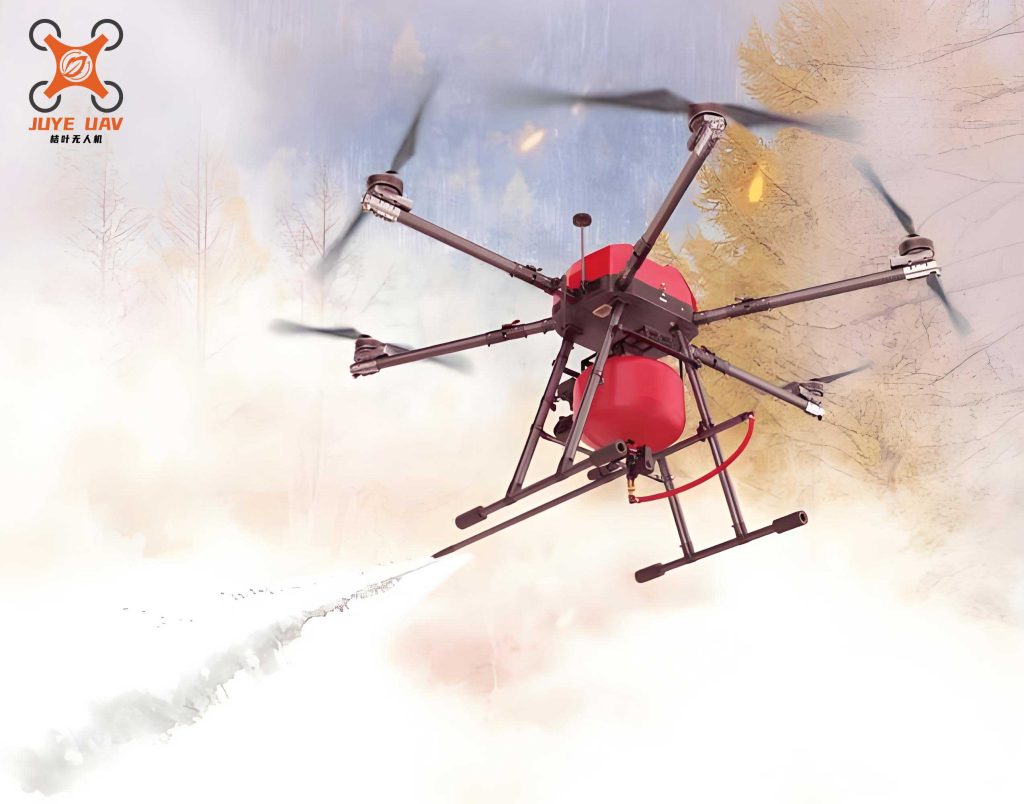
Fire UAVs are characterized by their high environmental adaptability, flexibility, and cost-effectiveness. They typically achieve centimeter-level measurement accuracy and can function in extreme conditions, such as high temperatures or toxic atmospheres, without human intervention. Key features include accurate monitoring data, robust safety profiles, and user-friendly operations, making them ideal for chemical fire scenarios. For instance, the low-altitude flight capability of fire UAVs allows for close-range inspection of hazardous areas, while onboard sensors capture detailed imagery and thermal data. Mathematically, the performance of a fire UAV can be modeled using equations for flight dynamics. For example, the lift force $L$ generated by a multi-rotor fire UAV is given by:
$$L = \frac{1}{2} \rho v^2 S C_L$$
where $\rho$ is air density, $v$ is velocity, $S$ is wing area, and $C_L$ is the lift coefficient. This enables precise control in windy or turbulent conditions common in chemical fires. Additionally, the endurance of a fire UAV, crucial for prolonged missions, can be expressed as:
$$E = \frac{B \cdot \eta}{P}$$
where $E$ is endurance in hours, $B$ is battery capacity in watt-hours, $\eta$ is efficiency factor, and $P$ is power consumption in watts. Such formulas help optimize fire UAV designs for rescue tasks.
Fire UAVs are classified based on various criteria, including platform structure, flight altitude, purpose, and weight. Understanding these classifications aids in selecting the right fire UAV for specific rescue operations. Below is a table summarizing common categories relevant to chemical fire rescue:
| Classification Basis | Type | Key Parameters | Typical Use in Chemical Fires |
|---|---|---|---|
| Platform Structure | Fixed-Wing Fire UAV | Long endurance, high speed | Large-area surveillance and mapping |
| Multi-Rotor Fire UAV | Vertical take-off, hover capability | Close inspection and material delivery | |
| Helicopter Fire UAV | Heavy payload, stability | Transport of bulky equipment | |
| Flight Altitude | Low-Altitude Fire UAV | < 1000 m | Detailed reconnaissance in plant areas |
| Medium-Altitude Fire UAV | 1000-5000 m | Broad overview and communication relay | |
| High-Altitude Fire UAV | > 5000 m | Long-range monitoring | |
| Purpose | Civilian Fire UAV | Customized for rescue tasks | All aspects of firefighting and search |
| Weight (Empty Mass) | Small Fire UAV | < 15 kg | Maneuvering in tight spaces |
| Medium Fire UAV | 15-150 kg | Carrying灭火剂 and sensors |
In chemical fire rescue, medium-sized multi-rotor and fixed-wing fire UAVs are most prevalent due to their balance of payload, agility, and endurance. For example, a multi-rotor fire UAV can carry up to 20 kg of灭火剂, enabling direct fire suppression, while a fixed-wing variant covers vast plant areas for early detection. The choice depends on mission requirements: if rapid intervention in confined spaces is needed, a small fire UAV is ideal; for sustained operations over wide zones, a larger fire UAV with advanced sensors is preferable. This classification system ensures that fire UAV deployments are tailored to maximize efficiency.
The application of fire UAV technology in chemical fire rescue encompasses several critical aspects, each enhancing operational outcomes. From my perspective, these applications are interconnected, forming a cohesive rescue strategy. Below, I delve into key areas with technical details and illustrative formulas.
Fire Scene Reconnaissance: Fire UAVs excel in scouting chemical fire sites, where traditional methods are hindered by obstacles like narrow pathways or toxic fumes. Equipped with high-definition infrared thermal imagers and visible-light cameras, a fire UAV can quickly survey large areas, identifying fire sources, structural damages, and wind patterns. The data transmission occurs in real-time, allowing command centers to assess risks and plan responses. For instance, thermal imaging detects heat signatures through smoke, with temperature $T$ mapped using the Stefan-Boltzmann law:
$$J = \epsilon \sigma T^4$$
where $J$ is radiant emittance, $\epsilon$ is emissivity, $\sigma$ is the Stefan-Boltzmann constant, and $T$ is absolute temperature. This helps pinpoint hotspots in chemical storage tanks. Moreover, specialized fire UAVs with gas sensors perform “sniffing” missions to locate toxic leaks. The concentration $C$ of a chemical can be modeled as:
$$C(x,y,t) = \frac{Q}{4\pi D t} \exp\left(-\frac{(x-x_0)^2 + (y-y_0)^2}{4Dt}\right)$$
where $Q$ is release rate, $D$ is diffusion coefficient, $(x_0,y_0)$ is leak point, and $t$ is time. By integrating such sensors, fire UAVs provide accurate hazard assessments, reducing responder exposure.
Material Transport: In chaotic chemical fire environments, ground routes may be blocked, impeding supply chains. Fire UAVs serve as aerial lifelines, delivering消防装备,灭火剂, and protective gear. The payload capacity $P_{max}$ of a fire UAV is crucial, determined by:
$$P_{max} = m_{total} \cdot g – T$$
where $m_{total}$ is total mass, $g$ is gravitational acceleration, and $T$ is thrust. For example, a medium fire UAV can transport dry powder or foam agents directly to fire zones, enabling rapid containment. The efficiency of such deliveries can be quantified using a logistics model: if $t_d$ is delivery time and $d$ is distance, then the throughput $R$ is:
$$R = \frac{n \cdot p}{t_d}$$
where $n$ is number of trips and $p$ is payload per trip. This highlights how fire UAVs optimize resource allocation in time-sensitive rescues.
Fire Suppression: Fire UAVs actively combat flames by deploying灭火剂 or specialized devices. They can be fitted with long-range water cannons, foam dispensers, or灭火弹, allowing targeted attacks on inaccessible areas like chemical pipelines or reaction towers. The effectiveness of a fire UAV in灭火 can be expressed using a fire spread reduction factor $\alpha$:
$$\alpha = 1 – \frac{A_{extinguished}}{A_{total}}$$
where $A_{extinguished}$ is area extinguished and $A_{total}$ is total fire area. With coordinated swarms, multiple fire UAVs form a matrix system, enhancing coverage. For instance, a group of $N$ fire UAVs working in unison can suppress a fire at rate:
$$\frac{dF}{dt} = -k \sum_{i=1}^{N} f_i(t)$$
where $F$ is fire intensity, $k$ is灭火 efficiency constant, and $f_i(t)$ is effort of fire UAV $i$. This collaborative approach minimizes火势蔓延 and accelerates control.
Search and Rescue of Trapped Victims: Locating survivors in chemical fire debris is paramount. Fire UAVs equipped with thermal and acoustic sensors penetrate rubble, detecting human heat signals or sounds. The detection probability $P_d$ can be modeled as:
$$P_d = 1 – \exp(-\lambda \cdot A \cdot t)$$
where $\lambda$ is sensor sensitivity, $A$ is search area, and $t$ is time. By cruising autonomously, fire UAVs reduce search durations and increase accuracy, especially in low-visibility conditions. Integration with北斗 navigation further enhances定位, enabling precise victim retrieval.
To illustrate these applications, consider a hypothetical chemical fire incident at a plant producing nitrobenzene. Upon ignition, flames spread to solvent storage tanks, creating a high-risk scenario. The rescue team deployed various fire UAVs: multi-rotor units for close reconnaissance, fixed-wing models for aerial mapping, and cargo fire UAVs for material drops. Using thermal imaging, the fire UAVs identified critical hotspots, while gas sensors monitored toxic emissions.灭火剂 was delivered via fire UAVs to contain the blaze, and small fire UAVs with audio sensors scanned for trapped workers. This coordinated effort, devoid of specific identifiers, demonstrates how fire UAV technology streamlines rescue operations, cutting losses and saving lives.
The evolution of fire UAV technology in chemical fire rescue is driven by continuous innovation. Based on my observations, future trends focus on three areas: optimizing device structures, enhancing operator training, and ensuring stable communications.
Optimizing Device Structural Performance: Advances aim to make fire UAVs lighter, stronger, and more energy-efficient. Modular designs allow quick customization for specific tasks, while new power sources like photovoltaic arrays or fuel cells improve endurance. The energy density $E_d$ of a fire UAV battery is key:
$$E_d = \frac{E_{storage}}{m_{battery}}$$
where $E_{storage}$ is stored energy and $m_{battery}$ is battery mass. By boosting $E_d$, fire UAVs can operate longer in intense fires. Additionally, compact智能探测设备 capture 3D火场影像, aiding in decision-making. Structural improvements also involve aerodynamic tweaks to reduce drag $D$:
$$D = \frac{1}{2} \rho v^2 C_D A$$
where $C_D$ is drag coefficient and $A$ is reference area. This enhances flight stability in turbulent化工 environments.
Strengthening Operator Skill Training: Effective fire UAV deployment requires skilled personnel. Training programs should emphasize hands-on simulations of chemical fire scenarios, covering device calibration, payload management, and emergency protocols. Competency can be measured through a proficiency score $S$:
$$S = \sum_{i=1}^{M} w_i \cdot s_i$$
where $w_i$ are weights for skills like navigation or data analysis, and $s_i$ are performance scores. Regular drills ensure operators can handle complex fire UAV fleets, fostering teamwork and rapid response.
Ensuring Stable Communication Transmission: Reliable links are vital for fire UAV control and data relay. Techniques like frequency hopping or spread spectrum mitigate interference in noisy fire zones. The signal-to-noise ratio $SNR$ for a fire UAV communication system is:
$$SNR = \frac{P_t G_t G_r \lambda^2}{(4\pi d)^2 k T B}$$
where $P_t$ is transmit power, $G_t$ and $G_r$ are antenna gains, $\lambda$ is wavelength, $d$ is distance, $k$ is Boltzmann’s constant, $T$ is temperature, and $B$ is bandwidth. Optimizing antenna designs and using AI for dynamic routing can maintain connectivity. For example, autonomous navigation combined with laser communication allows fire UAVs to avoid obstacles and transmit high-bandwidth data, even in dense smoke.
The integration of fire UAV technology into chemical fire rescue represents a significant leap forward in firefighting capabilities. From reconnaissance to suppression, fire UAVs offer speed, precision, and safety that traditional methods cannot match. As I reflect on practical experiences, the versatility of fire UAV systems—whether in transporting物资 or searching for victims—proves indispensable in mitigating化工火灾 risks. Looking ahead, ongoing innovations in design, training, and communication will further elevate their role, making fire UAVs a cornerstone of modern rescue strategies. By embracing these advancements, we can enhance operational efficiency, protect responders, and ultimately save more lives in hazardous chemical incidents.
In summary, this discussion underscores the transformative potential of fire UAV technology. Through detailed analyses, formulas, and tables, I have outlined its applications and future directions, aiming to support ongoing research and implementation. The fire UAV is not just a tool but a pivotal asset in the ever-evolving landscape of fire rescue, and its continued development promises even greater achievements in safeguarding our industrial environments.