
In recent years, the integration of airborne LiDAR technology with unmanned aerial vehicles (UAVs) has revolutionized geospatial data acquisition, enabling efficient and high-density point cloud collection for various mapping applications. Among these platforms, DJI UAV systems, including the DJI drone series, have gained prominence due to their versatility, cost-effectiveness, and advanced sensor capabilities. This study explores the application of the DJI L1 LiDAR sensor, mounted on a DJI UAV, for producing high-resolution digital elevation models (DEMs). We focus on evaluating the accuracy and efficiency of this approach in complex terrain, emphasizing the role of DJI FPV and other DJI drone models in enhancing data quality. The objective is to demonstrate how DJI UAV technology can be leveraged to generate reliable DEMs for large-scale mapping, while addressing challenges such as point cloud classification and error analysis.
Airborne LiDAR systems combine laser scanning, global navigation satellite systems (GNSS), and inertial measurement units (IMU) to capture precise three-dimensional coordinates of surface points. The DJI L1 LiDAR sensor, in particular, offers high measurement accuracy, with a range precision of 3 cm at 100 meters, and supports multiple returns, making it suitable for detailed terrain modeling. In this research, we utilized a DJI Matrice 300 RTK UAV equipped with the Zenmuse L1 LiDAR to collect point cloud data over a university campus. The study area featured diverse land cover types, including vegetation, slopes, paved roads, and artificial surfaces, which allowed for a comprehensive assessment of DEM accuracy across different environments. The integration of DJI UAV platforms with LiDAR sensors facilitates rapid data acquisition, even in dynamic and small-to-medium-scale projects, highlighting the advantages of DJI drone systems in modern surveying.
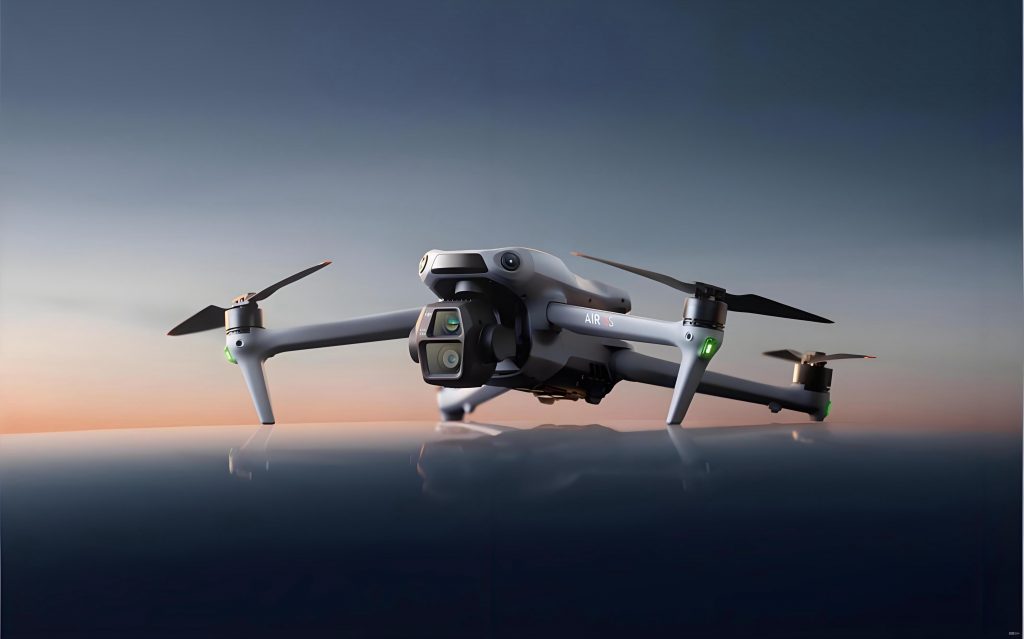
The methodology involved several key steps: data collection, point cloud processing, classification, and DEM generation. First, we planned the flight mission using the DJI UAV, ensuring optimal parameters such as altitude, speed, and overlap rates. The flight was conducted at 89 meters above ground level, with a speed of 10 m/s and a lateral overlap of 55%, exceeding standard requirements to enhance point cloud density. The DJI L1 sensor captured point cloud data with an actual density of approximately 777 points per square meter, resulting in over 779 million points. This high density is characteristic of DJI UAV systems, which provide detailed spatial information for accurate DEM production. Data processing was performed using DJI Terra software for point cloud reconstruction and LIDAR360 for classification and editing. The progressive encryption triangulation network algorithm was employed for filtering ground points, which iteratively calculates distances and angles to distinguish terrain from non-ground features like vegetation and buildings.
Point cloud classification is critical for generating accurate DEMs, as it separates ground points from objects such as trees and structures. We applied Gaussian filtering to reduce noise and manually edited erroneous points, particularly over water bodies where refraction caused artifacts. The classified point cloud consisted of 876,085 ground points, with a density of 1.1 points per square meter. To generate the DEM, we used克里金插值 (Kriging interpolation) in ArcGIS, producing a grid with a resolution of 0.15 meters. The DEM effectively represented the terrain, with clear boundaries between features like rivers and banks. Accuracy assessment was conducted using 170 validation points collected with RTK GPS, distributed across vegetation, slopes, roads, and artificial surfaces. We computed error metrics to evaluate DEM precision, as outlined below.
The accuracy evaluation relied on statistical measures, including mean absolute error (MAE), standard deviation (SD), and root mean square error (RMSE). These formulas are defined as follows:
Mean Absolute Error (MAE): $$MAE = \frac{1}{n} \sum_{i=1}^{n} |e_i|$$ where \(e_i\) is the error between the DEM value and the reference value for each point, and \(n\) is the number of samples.
Standard Deviation (SD): $$SD = \sqrt{\frac{1}{n} \sum_{i=1}^{n} (e_i – \bar{e})^2}$$ where \(\bar{e}\) is the mean error.
Root Mean Square Error (RMSE): $$RMSE = \sqrt{\frac{1}{n} \sum_{i=1}^{n} e_i^2}$$
These metrics provide insights into the consistency and reliability of the DEM derived from DJI UAV LiDAR data. The overall error statistics are summarized in Table 1, while Table 2 breaks down errors by land cover type.
| Metric | Value (cm) |
|---|---|
| Mean Absolute Error (MAE) | 1.84 |
| Standard Deviation (SD) | 1.07 |
| Root Mean Square Error (RMSE) | 2.20 |
| Maximum Error | 5.94 |
| Minimum Error | 0.33 |
The results indicate that the DEM produced using DJI UAV LiDAR data achieves high accuracy, with an MAE of 1.84 cm and an RMSE of 2.20 cm. The low standard deviation of 1.07 cm suggests minimal variability in errors, confirming the robustness of the DJI drone-based approach. These values comply with standards for large-scale mapping, such as those for 1:500 scale products. The point cloud data, visualized in true color and height maps, revealed detailed terrain features, though areas with water surfaces exhibited noise due to laser refraction. After classification, the ground points were effectively isolated, enabling precise DEM generation. The DJI UAV system, including the L1 sensor, demonstrated excellent performance in capturing complex topography, with the DJI FPV capabilities potentially enhancing real-time monitoring in future applications.
| Land Cover Type | MAE (cm) | Max Error (cm) | Min Error (cm) | SD (cm) | RMSE (cm) |
|---|---|---|---|---|---|
| Vegetation | 2.47 | 3.23 | 1.78 | 0.43 | 2.51 |
| Roads | 1.36 | 1.95 | 0.66 | 0.37 | 1.41 |
| Artificial Surfaces | 1.12 | 1.54 | 0.33 | 0.44 | 1.20 |
| Slopes | 3.27 | 5.94 | 1.56 | 1.42 | 3.56 |
Analysis of errors across different land cover types reveals significant variations. Artificial surfaces and roads showed the highest accuracy, with MAEs of 1.12 cm and 1.36 cm, respectively, due to their stable and exposed nature. Vegetated areas had slightly higher errors (MAE of 2.47 cm) because of the penetration limitations of LiDAR through canopy cover. Slopes exhibited the largest errors (MAE of 3.27 cm), attributed to the complexity of terrain geometry and potential data gaps. The RMSE values followed a similar trend, with slopes reaching 3.56 cm. These findings underscore the importance of considering land cover in DEM accuracy assessments when using DJI UAV LiDAR systems. The DJI drone’s ability to maintain stable flight conditions contributed to consistent data quality, though factors like UAV attitude changes and environmental conditions could introduce minor errors.
Discussion of the results highlights several factors influencing DEM accuracy. The DJI UAV’s flight stability played a crucial role; vibrations or attitude deviations during data acquisition can propagate errors through the processing chain. The DJI L1 sensor’s performance, including its point cloud thickness—measured at up to 0.62 meters in some areas—indicates potential for improvement in consistency. Additionally, water bodies posed challenges, as laser refraction generated noise points that required manual removal. This issue is common in LiDAR applications and could be mitigated with advanced algorithms or complementary data from DJI FPV systems for real-time validation. The high point cloud density achieved with the DJI UAV, while beneficial for detail, also increased processing time, suggesting a trade-off between density and efficiency. Future work could explore optimal overlap rates and point cloud thinning to balance accuracy and computational load.
In conclusion, this study demonstrates the effectiveness of DJI UAV LiDAR technology, particularly the DJI L1 sensor, in generating high-precision DEMs for diverse terrains. The accuracy metrics confirm that DJI drone-based systems meet rigorous mapping standards, with overall errors below 2 cm for most land cover types. The integration of DJI UAV platforms with LiDAR sensors offers a scalable solution for small-to-medium-scale projects, outperforming traditional methods in terms of speed and detail. However, challenges such as water-related artifacts and vegetation interference require ongoing attention. We recommend further research into automated classification techniques and the use of DJI FPV for enhanced monitoring. Overall, DJI UAV LiDAR represents a transformative tool in geomatics, with broad applications in environmental monitoring, urban planning, and disaster management. As DJI continues to innovate, future models like the DJI FPV could expand the capabilities of UAV-based mapping, making it more accessible and efficient.
The potential of DJI UAV systems extends beyond DEM generation to real-time data processing and multi-sensor integration. For instance, combining LiDAR with photogrammetric data from DJI drones could improve classification accuracy in vegetated areas. Moreover, the DJI FPV’s agile maneuverability might facilitate data collection in obstructed environments. In terms of mathematical modeling, the error analysis can be extended using more complex statistics, such as confidence intervals: $$CI = \bar{e} \pm z \times \frac{SD}{\sqrt{n}}$$ where \(z\) is the z-score for a given confidence level. This would provide deeper insights into the reliability of DJI UAV-derived DEMs. Ultimately, the adoption of DJI drone technology in surveying is poised to grow, driven by advancements in sensor design and data processing algorithms.