
In recent years, the rapid advancement of science and technology has benefited various industries, and agriculture is no exception. As a major agricultural country, crop production in my region is severely affected by pests and diseases, which compromise both quality and yield, thereby imposing increasingly stringent demands on pest control techniques. Based on this, agricultural UAV spraying technology has gradually been adopted in field crop production, demonstrating significant advantages and achieving commendable results in pest management. In this article, I will elaborate on the application strengths and shortcomings of agricultural UAV spraying technology in field crop production, and subsequently discuss practical application measures, aiming to provide insights for efficient field crop production.
The integration of agricultural UAVs, or unmanned aerial vehicles, into modern farming practices represents a transformative shift from traditional methods. From my perspective, this technology is not merely a tool but a paradigm shift that addresses critical challenges in plant protection. Plant protection is intrinsically linked to food security, ecological stability, and crop yield, serving as a vital guarantee for high agricultural output. With the gradual expansion of agricultural production scale in many regions, there are increasingly strict requirements for plant protection work. Currently, the most widely used and expedient method for pest control is pesticide spraying. Traditional spraying methods predominantly rely on manual labor, which is not only inefficient but also poses significant risks of poisoning due to improper operation. In recent years, agricultural UAV spraying technology has gained widespread application, substantially enhancing operational efficiency. During spraying operations, agricultural UAVs exhibit strong adaptability to various environmental conditions and can effectively improve pesticide utilization rates. Therefore, agricultural UAV spraying technology can safeguard food and food security, marking a major breakthrough in agricultural science and technology and a critical transition from traditional to modern agriculture.
Agricultural UAVs, also referred to as unmanned aircraft systems, primarily consist of a flight platform, navigation flight control systems, and spraying mechanisms. They are operated via ground-based remote control or automatic navigation to perform tasks such as spraying seeds or pesticides on crops. In my experience, agricultural UAVs can be applied across numerous aspects of agricultural and forestry protection. Compared to traditional manual pest control methods, agricultural UAVs offer distinct advantages, including compact overall dimensions, reduced labor costs, and decreased pesticide usage.
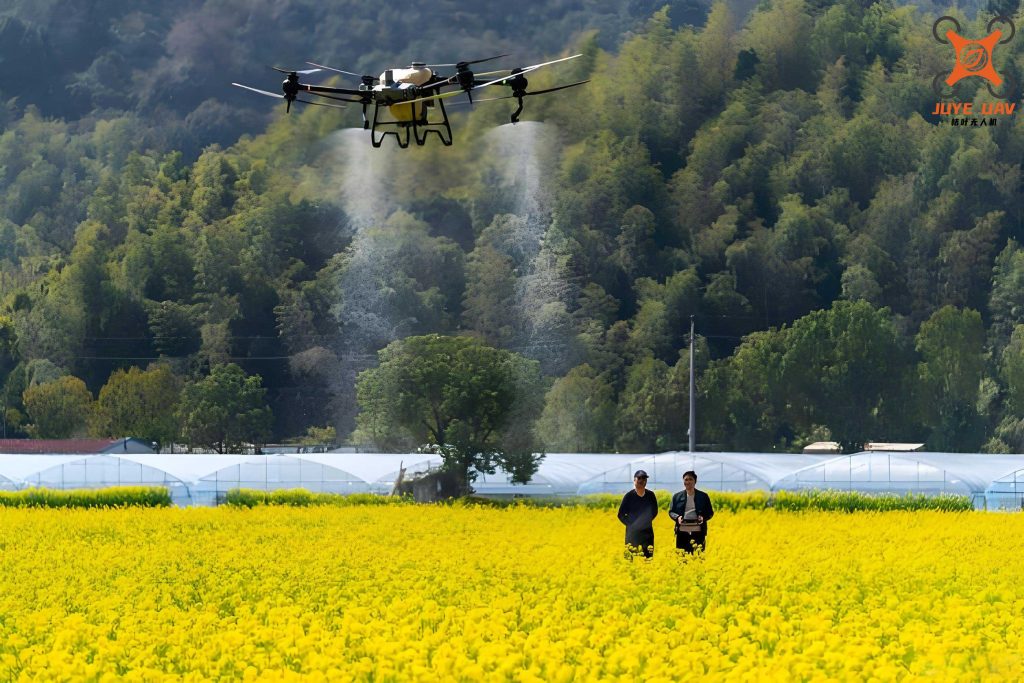
According to surveys I have reviewed, the development of agricultural UAVs in my region is still in its nascent stages. However, in recent years, there has been a noticeable increase in both the number of agricultural UAVs and the total area covered by their operations. Nonetheless, the development framework for agricultural UAVs requires further refinement. Currently, the professional expertise and product performance of agricultural UAVs are inconsistent, with relatively few models capable of meeting the demands of large-scale and high-intensity spraying operations.
In field crop production, the application of agricultural UAV spraying technology offers several notable advantages. Firstly, the operation method is straightforward and easy to learn, effectively preventing operators from inhaling pesticides during spraying. Traditional pesticide spraying methods typically involve manual application, which carries the drawback of operators inhaling excessive pesticides, leading to poisoning and posing threats to their safety. Therefore, to mitigate pesticide inhalation and reduce harm to agricultural workers, I advocate for the proactive adoption of agricultural UAVs in crop pest prevention. Agricultural UAVs feature compact fuselages and lightweight designs. Moreover, their operation is simple, requiring minimal theoretical knowledge, making them suitable for agricultural workers. With basic guidance and explanation, operators can quickly master their use, thereby overcoming the limitations of traditional manual labor and ensuring personnel safety.
Secondly, agricultural UAVs enhance pesticide utilization efficiency and reduce soil contamination from spraying. In field crop production, the spraying efficiency of agricultural UAVs far surpasses that of traditional spraying equipment and manual methods. Based on statistics I have compiled, one agricultural UAV can cover up to 10 hectares of crops per hour, with spraying efficiency up to 80 times that of manual spraying, significantly saving time in pesticide application. Traditional manual spraying often results in pesticides settling only on the tops of crops, leading to substantial waste and soil damage from dripping chemicals. In contrast, agricultural UAV spraying technology enables pesticides to be dispersed as fine mist uniformly across all parts of the plants, thereby improving pesticide utilization. The key technology of agricultural UAVs lies in their ability to distribute pesticides evenly on crops rather than on the soil, avoiding pollution and adverse effects on crop growth.
Thirdly, agricultural UAVs have a small footprint and offer greater flexibility during spraying operations. The deployment of agricultural UAVs for pest control holds profound significance. Due to their compact size and portability, agricultural UAVs can operate without being constrained by terrain, making them widely applicable in agriculture, national ecological conservation, mineral resource exploration, natural disaster monitoring and assessment, and emergency rescue operations. Their versatility has made them highly favored. As an agricultural region with diverse and complex terrains, relying solely on traditional manual pest control consumes considerable time and leads to pesticide waste and soil contamination. Hence, pest control efforts must evolve with the times. The use of agricultural UAVs expands the scope of application, enhancing spraying efficiency, effectively combating pests, and increasing crop yields.
To quantitatively compare the advantages of agricultural UAVs, I have summarized key metrics in the following table:
| Parameter | Manual Spraying | Ground Machinery Spraying | Agricultural UAV Spraying |
|---|---|---|---|
| Spraying Efficiency (hectares/hour) | 0.125 | 2 | 10 |
| Labor Cost (relative units) | High | Medium | Low |
| Pesticide Usage (liters/hectare) | 30 | 25 | 15 |
| Soil Contamination Risk | High | Medium | Low |
| Adaptability to Terrain | Low | Medium | High |
The efficiency of agricultural UAV spraying can be modeled using a simple formula. Let \( E \) represent spraying efficiency in hectares per hour, \( A \) denote the area covered, and \( t \) the time in hours. For an agricultural UAV, the relationship is given by:
$$ E = \frac{A}{t} $$
Assuming an agricultural UAV covers 10 hectares in one hour, then \( E = 10 \, \text{hectares/hour} \). Compared to manual spraying with \( E = 0.125 \, \text{hectares/hour} \), the agricultural UAV is 80 times more efficient, as calculated by:
$$ \text{Efficiency Ratio} = \frac{E_{\text{UAV}}}{E_{\text{manual}}} = \frac{10}{0.125} = 80 $$
Despite these advantages, agricultural UAV technology is still in its early stages of development. Although progress has been rapid, the lack of core technological support means there are several shortcomings in practical applications. Firstly, there is a scarcity of pesticides specifically designed for agricultural UAVs. When performing spraying operations, agricultural UAVs require pesticides that are easy to atomize, evaporation-resistant, dense, and adherent. However, due to the nascent stage of agricultural UAV development, pesticide manufacturers in my region have not yet dedicated efforts to developing products tailored for agricultural UAVs. Consequently, agricultural UAVs are limited to using conventional pesticides, which restricts their effectiveness.
Secondly, there is a lack of standardized regulations and technical specifications compatible with agricultural UAV technology. Currently, there are no specific professional standards for agricultural UAV operations, leading to issues such as uneven pesticide distribution, insufficient spraying volumes, and pesticide drift. Additionally, there are no unified operational guidelines for agricultural UAV pilots, resulting in inconsistent workflows and uneven speed control during actual operations. The absence of standardized systems undermines the scientific effectiveness, regularity, and uniformity of operations.
To illustrate these shortcomings, I have compiled a table highlighting key challenges:
| Challenge Category | Specific Issue | Impact on Agricultural UAV Performance |
|---|---|---|
| Pesticide Compatibility | Lack of specialized pesticides for UAVs | Reduced spraying efficacy and increased waste |
| Technical Standards | Absence of uniform operational protocols | Inconsistent results and safety risks |
| Operator Training | Insufficient skilled pilots | Decreased efficiency and potential accidents |
| Research and Development | Limited core technology innovation | Slow adaptation to diverse pest scenarios |
The deposition of pesticide droplets from agricultural UAVs can be described using mathematical models. For instance, the distribution of droplet density \( D(x,y) \) over a crop canopy can be approximated by a Gaussian function:
$$ D(x,y) = \frac{Q}{2\pi\sigma_x\sigma_y} \exp\left(-\frac{(x-\mu_x)^2}{2\sigma_x^2} – \frac{(y-\mu_y)^2}{2\sigma_y^2}\right) $$
where \( Q \) is the total pesticide volume, \( (\mu_x, \mu_y) \) is the center of the spray swath, and \( \sigma_x, \sigma_y \) are the standard deviations representing droplet spread. Without standardized pesticides and techniques, parameters like \( \sigma_x \) and \( \sigma_y \) may vary widely, leading to uneven coverage.
To address these issues, several application measures can be implemented for agricultural UAV spraying technology in field crops. Firstly, relevant authorities should establish unified safety standards for agricultural UAV usage. To promote the standardized and orderly development of UAVs, regulatory bodies have issued notifications and provisional regulations on UAV pilot management. However, standards specifically for agricultural UAVs remain lacking. For instance, there are no unified safety standards for flight altitude limits, speed restrictions, operational temperatures, or maintenance protocols. Moreover, since the primary purpose of agricultural UAVs is pesticide application, the development of compatible pesticides lags behind, with dosage standards still based on manual or ground machinery spraying. In response, government departments should collaborate with agricultural cooperatives and agricultural UAV manufacturers to formulate scientific operational standards, ensuring that agricultural UAVs work under regulated conditions to avoid unnecessary complications during promotion.
Secondly, it is essential to develop specialized pesticides and spraying techniques tailored to agricultural UAVs. Current pesticide manufacturers have not yet focused on creating products suited for agricultural UAVs, forcing operators to use conventional pesticides that do not fully leverage the capabilities of agricultural UAVs. The pesticide formulations and spraying techniques required for agricultural UAV operations differ fundamentally from those used in manual or ground-based applications. Simultaneously, the effectiveness of pest control depends not only on spraying equipment but also on the pesticides and techniques employed. Therefore, relevant departments should establish professional standards for dedicated pesticides and spraying techniques aligned with the characteristics of agricultural UAVs, facilitating their widespread adoption.
Thirdly, enhancing professional training for agricultural UAV operators is crucial. As an emerging technology in its infancy, agricultural UAVs demand skilled pilots proficient in UAV maneuvering. Thus, professional training for UAV pilots can promote broader adoption and lay a solid foundation for the stable and healthy development of the agricultural UAV industry. Plant protection departments and cooperatives should regularly arrange for technical experts to provide guidance to farmers who purchase agricultural UAVs, offering detailed explanations of operational procedures to ensure farmers master the usage流程, thereby improving overall operational efficiency. Additionally, relevant authorities should periodically assess and evaluate the practical skills of UAV operators through technical examinations to ensure compliance with standards, thereby ensuring the practicality and safety of agricultural UAV operations and fostering long-term stable development in agriculture.
Fourthly, increasing research and development investment for the upgrading and transformation of agricultural UAVs is vital. The development of agricultural UAVs in my region started relatively late but has progressed quickly, albeit with a lack of proprietary core technologies. Given the diversity of crop pests and the frequency of pest outbreaks, current agricultural UAVs often fall short of pest control requirements. Therefore, the flight platforms of agricultural UAVs can be upgraded based on existing UAV foundations. The costlier aspects of such upgrades involve operational systems and intelligent control systems, which cannot be solely funded by enterprises. Relevant departments should consider the economic returns that investments in agricultural UAV R&D can bring to agricultural production. Incorporating the research, development, and upgrading of agricultural UAVs into scientific and technological development plans, and establishing specialized research institutions for production, can promote industrialization.
The optimization of agricultural UAV performance can be expressed through improvement functions. Let \( P \) represent the overall performance metric, which depends on factors like spraying accuracy \( A_c \), operational speed \( S \), and pesticide utilization \( U \). A simplified model is:
$$ P = \alpha A_c + \beta S + \gamma U $$
where \( \alpha, \beta, \gamma \) are weighting coefficients. Through R&D investments, these parameters can be enhanced, leading to better \( P \) values.
To summarize the application measures, I have created a table outlining key actions and their expected outcomes:
| Application Measure | Key Actions | Expected Outcome for Agricultural UAVs |
|---|---|---|
| Standardization | Establish flight and safety protocols | Improved safety and interoperability |
| Pesticide Development | Research UAV-specific formulations | Enhanced spraying efficacy and reduced waste |
| Operator Training | Implement certification programs | Increased operational efficiency and safety |
| R&D Investment | Fund technology upgrades and innovation | Advanced features and better pest adaptation |
In conclusion, in current pest control for field crops, agricultural UAVs as emerging plant protection equipment have demonstrated significant technical advantages during agricultural production, such as strong adaptability, high spraying efficiency, reduced pesticide usage, lower labor costs, and minimal labor intensity. Consequently, they have garnered recognition from government agencies, pesticide manufacturers, and agricultural producers, with promising development prospects. However, the development of agricultural UAVs in my region is still in its preliminary stages, with numerous technical and professional challenges to overcome. To optimize agricultural UAV technology, it is imperative to increase their penetration and usage rates. Government departments need to augment economic investments, expand the number of agricultural UAVs, develop compatible specialized pesticides, and train more professional agricultural UAV pilots to promote their widespread application.
From a futuristic viewpoint, the integration of artificial intelligence and IoT with agricultural UAVs could revolutionize precision agriculture. For example, autonomous path planning for agricultural UAVs can be optimized using algorithms that minimize energy consumption while maximizing coverage. The objective function for such path planning might be:
$$ \min \int_{0}^{T} (E(t) + \lambda C(t)) \, dt $$
where \( E(t) \) is energy usage, \( C(t) \) is coverage efficiency, and \( \lambda \) is a balancing factor. As agricultural UAVs evolve, such advanced formulations will become integral to their operation.
In my ongoing work, I continue to explore the potential of agricultural UAVs in diverse cropping systems. The dynamic nature of pest infestations requires adaptive spraying strategies, which can be modeled using differential equations. For instance, the rate of change in pest population \( N \) under agricultural UAV spraying can be described as:
$$ \frac{dN}{dt} = rN \left(1 – \frac{N}{K}\right) – \delta S(t) $$
where \( r \) is the growth rate, \( K \) is the carrying capacity, \( \delta \) is the kill rate due to spraying, and \( S(t) \) is the spraying intensity from the agricultural UAV. By optimizing \( S(t) \) through real-time data from agricultural UAV sensors, pest control can be made more efficient.
Ultimately, the success of agricultural UAV spraying technology hinges on a holistic approach that combines technological innovation, regulatory support, and capacity building. As I reflect on the journey so far, it is clear that agricultural UAVs are not just tools but catalysts for sustainable agriculture. Their ability to reduce environmental footprint while boosting productivity aligns with global goals of food security and ecological balance. Therefore, I am committed to advocating for and contributing to the advancement of agricultural UAV technology, ensuring that it reaches its full potential in field crop production and beyond.