
In the era of smart agriculture, the integration of advanced technologies has revolutionized traditional farming practices. As an enthusiast and researcher in this field, I have dedicated significant effort to exploring the applications of agricultural UAVs, particularly in crop protection. These unmanned aerial vehicles offer a promising solution to challenges such as inefficient pesticide spraying, labor-intensive tasks, and uneven resource distribution. This article delves into the comprehensive design, hardware, software, and algorithmic aspects of agricultural UAVs, aiming to provide a detailed perspective on their role in enhancing agricultural productivity and sustainability. Throughout this discussion, the term ‘agricultural UAV’ will be emphasized repeatedly to underscore its centrality in modern farming systems.
The adoption of agricultural UAVs aligns with global initiatives like the “十四五计划” in China, which prioritizes rural revitalization and agricultural modernization. Traditional methods often struggle with factors like crop height and terrain, limiting the use of large machinery. Manual operations not only reduce efficiency but also lead to issues like uneven pesticide application and water wastage. By leveraging automation, image processing, and deep learning, agricultural UAVs can address these problems, enabling precise and uniform spraying, even in mixed-crop fields. This article proposes a method based on deep learning, incorporating strapdown inertial navigation systems, Kalman filtering algorithms, and PID control to ensure stable performance, along with convolutional neural networks (CNN), clustering analysis, and cognitive computing for image and data processing.
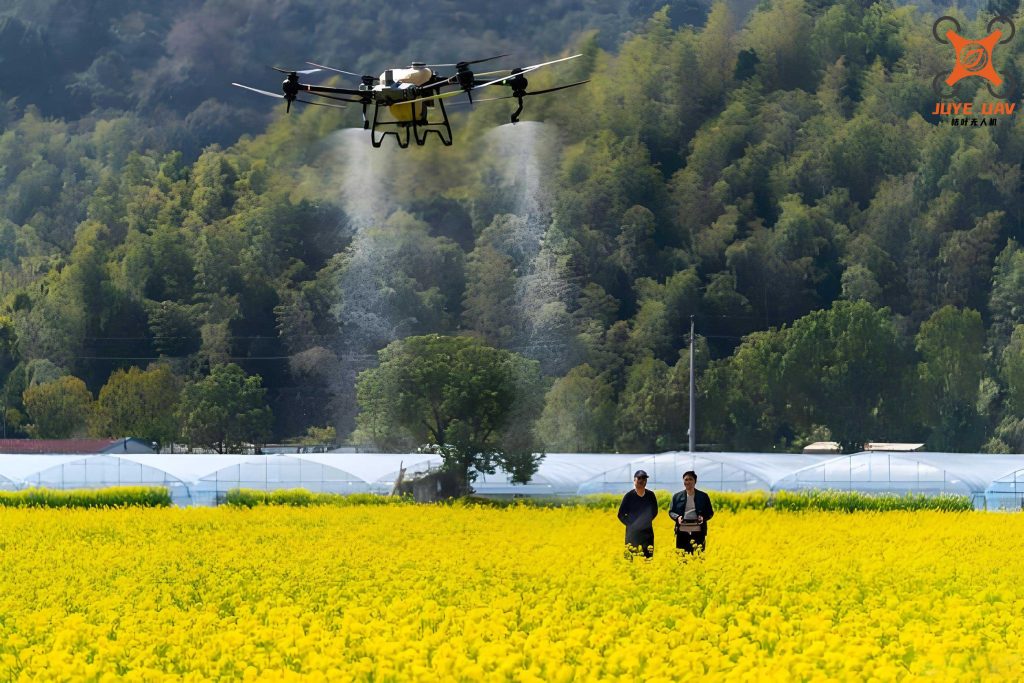
The performance of an agricultural UAV is determined by its flight control system (avionics) and airframe characteristics, which are fundamental for safe and efficient operation. When selecting an agricultural UAV, factors such as payload capacity, flight duration, speed, and maneuverability must be considered. Common configurations include multi-rotor, fixed-wing, and helicopter drones, each with unique advantages based on task requirements. For instance, multi-rotor agricultural UAVs excel in hovering and precise maneuvering, making them ideal for targeted spraying, while fixed-wing models offer longer flight times for large-area coverage. The design of an agricultural UAV system involves multiple interconnected modules, as summarized in Table 1.
| Module | Description | Function in Agricultural UAV |
|---|---|---|
| Flight Control System | Includes main control unit, sensors (e.g., IMU, GPS), and algorithms for stable flight. | Ensures precise positioning, hovering, and autonomous navigation for accurate pesticide application. |
| Power System | Comprises motors, ESCs, batteries, and propellers. | Provides the necessary thrust and endurance for the agricultural UAV to operate in fields. |
| Mission Payload System | Equipment like sprayers, cameras, and sensors tailored to agricultural tasks. | Enables spraying, monitoring, and data collection, defining the agricultural UAV’s functionality. |
| Soil Moisture Monitoring | Uses wireless sensors and communication for real-time soil analysis. | Supports irrigation management by providing humidity data, integrated into the agricultural UAV’s data stream. |
| Farm Management System | Involves land, labor, capital, and management components. | Coordinates agricultural UAV operations with overall farm planning for optimized resource use. |
| Data Link System | Intelligent communication for remote control, telemetry, and data transmission. | Facilitates real-time adjustment of agricultural UAV parameters based on environmental conditions. |
| Integrated Support System | Maintenance and management solutions for UAV upkeep. | Ensures reliability and longevity of the agricultural UAV through regular servicing. |
| Spraying System | Includes nozzles, tanks, and control mechanisms for pesticide application. | Executes precise spraying actions directed by the agricultural UAV’s control system. |
Each module plays a critical role in the overall functionality of the agricultural UAV. For example, the flight control system relies on high-precision sensors such as three-axis gyroscopes, accelerometers, magnetometers, and barometers. These components work together to calculate the agricultural UAV’s attitude and position, enabling stable flight even in windy conditions. The power system, on the other hand, must balance weight and energy efficiency; lithium-polymer batteries with high discharge rates are commonly used in agricultural UAVs to meet the high current demands during spraying missions. The mission payload system is particularly vital, as it directly impacts the agricultural UAV’s effectiveness—for instance, thermal cameras can detect crop stress, while multispectral sensors assess plant health.
In terms of hardware design, the agricultural UAV consists of several key components: the flight controller, communication links, motors, propellers, electronic speed controllers (ESCs), batteries, airframe, and payloads. These can be grouped into five main categories: the power system (battery, ESC, motor, propeller), flight control system (flight controller, GPS, auxiliary modules for altitude hold and obstacle avoidance), communication system (remote controller, data link, ground station), airframe, and payload. The flight controller integrates sensors and microprocessors to execute control algorithms. For instance, the GPS module provides geolocation data, while the magnetometer corrects gyroscope drift to maintain heading stability. Communication links, operating at frequencies like 2.4 GHz, include transmitters, receivers, and ground stations for real-time monitoring and control of the agricultural UAV.
The software design for agricultural UAVs encompasses image recognition, control algorithms, and data processing. Image recognition algorithms, such as template matching, are used to identify target areas for spraying. However, these methods have limitations when dealing with scale or rotational changes. To address this, sliding window techniques and feature-based approaches like OpenCV’s matchTemplate function are employed. The matchTemplate function uses methods such as squared difference or correlation to compute similarity between images, with algorithms ranging from simple to complex for higher accuracy. For example, the normalized cross-correlation method can be expressed mathematically as:
$$ R(x,y) = \frac{\sum_{x’,y’} (T(x’,y’) \cdot I(x+x’, y+y’))}{\sqrt{\sum_{x’,y’} T(x’,y’)^2 \cdot \sum_{x’,y’} I(x+x’, y+y’)^2}} $$
where \( T \) is the template image, \( I \) is the input image, and \( R(x,y) \) is the correlation result. This allows the agricultural UAV to autonomously detect crops or pests, enabling targeted spraying. Additionally, deep learning techniques like convolutional neural networks (CNN) enhance image analysis by learning features from large datasets. A CNN can be represented as:
$$ y = f(W * x + b) $$
where \( x \) is the input image, \( W \) represents the convolutional weights, \( b \) is the bias, \( * \) denotes convolution, and \( f \) is an activation function. This enables the agricultural UAV to classify images with high accuracy, such as distinguishing between healthy and diseased plants.
Control algorithms are fundamental to the stability and performance of agricultural UAVs. The strapdown inertial navigation system (SINS) combined with Kalman filtering provides robust state estimation. The Kalman filter algorithm predicts and updates the state vector based on sensor measurements, reducing noise and errors. Its equations are:
Prediction step:
$$ \hat{x}_{k|k-1} = F_k \hat{x}_{k-1|k-1} + B_k u_k $$
$$ P_{k|k-1} = F_k P_{k-1|k-1} F_k^T + Q_k $$
Update step:
$$ K_k = P_{k|k-1} H_k^T (H_k P_{k|k-1} H_k^T + R_k)^{-1} $$
$$ \hat{x}_{k|k} = \hat{x}_{k|k-1} + K_k (z_k – H_k \hat{x}_{k|k-1}) $$
$$ P_{k|k} = (I – K_k H_k) P_{k|k-1} $$
where \( \hat{x} \) is the state estimate (e.g., position, velocity), \( P \) is the error covariance, \( F \) is the state transition matrix, \( B \) is the control input matrix, \( u \) is the control vector, \( Q \) is the process noise covariance, \( H \) is the measurement matrix, \( R \) is the measurement noise covariance, \( K \) is the Kalman gain, and \( z \) is the measurement. This ensures that the agricultural UAV maintains accurate navigation even in GPS-denied environments.
PID (Proportional-Integral-Derivative) control is another critical algorithm for agricultural UAVs, used to adjust motor speeds and maintain desired attitudes. The PID controller output is given by:
$$ u(t) = K_p e(t) + K_i \int_0^t e(\tau) d\tau + K_d \frac{de(t)}{dt} $$
where \( e(t) \) is the error between the desired and actual state, and \( K_p \), \( K_i \), and \( K_d \) are tuning parameters. For agricultural UAVs, this algorithm helps in stabilizing flight during spraying, ensuring uniform pesticide distribution. Advanced variations, such as fuzzy PID or adaptive PID, can further enhance performance under varying loads or environmental conditions.
Data processing in agricultural UAVs also involves clustering analysis and cognitive computing. Clustering algorithms, like k-means, group similar data points for tasks like field segmentation. The k-means objective function minimizes:
$$ J = \sum_{i=1}^{k} \sum_{x \in C_i} \| x – \mu_i \|^2 $$
where \( C_i \) are clusters and \( \mu_i \) are cluster centroids. This helps the agricultural UAV identify homogeneous zones for differentiated treatment. Cognitive computing integrates machine learning and reasoning to make decisions, such as adjusting spray rates based on real-time sensor data. These technologies collectively enable the agricultural UAV to operate autonomously, learning from past missions to improve efficiency.
The application of agricultural UAVs extends beyond spraying to include soil monitoring, crop scouting, and data analytics. For instance, soil moisture sensors mounted on agricultural UAVs provide real-time data that can be used to optimize irrigation schedules. The soil moisture monitoring system uses wireless communication to transmit data to a central server, where it is analyzed to generate actionable insights. This integration of IoT (Internet of Things) with agricultural UAVs creates a smart farming ecosystem, as summarized in Table 2.
| Application | Technology Used | Benefit |
|---|---|---|
| Precision Spraying | CNN, PID control, GPS guidance | Reduces pesticide use by up to 30%, minimizes environmental impact. |
| Crop Health Monitoring | Multispectral imaging, clustering analysis | Early detection of diseases, improves yield by 10-20%. |
| Soil Analysis | Moisture sensors, data link systems | Enables precise irrigation, conserves water resources. |
| Field Mapping | Photogrammetry, cognitive computing | Generates high-resolution maps for better farm management. |
| Autonomous Navigation | Kalman filtering, SINS, obstacle avoidance | Enables 24/7 operation, reduces labor costs. |
In practice, the agricultural UAV’s performance is validated through field tests. For example, a study on citrus orchards showed that agricultural UAVs could achieve droplet deposition uniformity with less than 15% variation, outperforming traditional methods. The use of RBF-PID algorithms has been proposed to enhance flight control under windy conditions, with the radial basis function (RBF) network approximating nonlinear dynamics. The RBF-PID controller can be modeled as:
$$ u(t) = K_p e(t) + K_i \int e(t) dt + K_d \frac{de(t)}{dt} + f_{RBF}(x) $$
where \( f_{RBF}(x) \) is the RBF network output that compensates for disturbances. This innovation highlights the ongoing evolution of agricultural UAV technology.
Moreover, fault-tolerant control systems are being developed for agricultural UAVs to handle actuator failures. Fractional-order model reference adaptive control (FO-MRAC) methods have been explored, using fractional calculus to improve robustness. The fractional-order derivative is defined as:
$$ D^\alpha f(t) = \frac{1}{\Gamma(1-\alpha)} \frac{d}{dt} \int_0^t \frac{f(\tau)}{(t-\tau)^\alpha} d\tau $$
where \( \alpha \) is the fractional order. This allows the agricultural UAV to maintain stability even in the event of motor or sensor failures, ensuring continuous operation during critical spraying missions.
The economic and environmental impacts of agricultural UAVs are significant. By reducing chemical usage and labor, agricultural UAVs can lower production costs by 20-40%. Additionally, precision application minimizes runoff and soil contamination, contributing to sustainable agriculture. In mixed-crop fields, agricultural UAVs use image recognition to spray only target plants, reducing herbicide drift and protecting non-target species. This level of precision is unmatched by conventional machinery, making agricultural UAVs a cornerstone of precision agriculture.
Looking ahead, the integration of AI and IoT will further enhance agricultural UAV capabilities. For instance, swarm robotics could enable multiple agricultural UAVs to collaborate on large farms, communicating via data links to coordinate tasks. Machine learning algorithms will allow agricultural UAVs to predict crop yields based on historical data, optimizing resource allocation. The use of blockchain technology for data security in agricultural UAV networks is also being explored, ensuring tamper-proof records of spraying activities.
In conclusion, the agricultural UAV represents a transformative technology in smart farming, addressing key challenges through automation and intelligence. By leveraging deep learning, advanced control algorithms, and robust hardware, agricultural UAVs can achieve stable performance and precise operations. The methods discussed—from Kalman filtering and PID control to CNN and cognitive computing—provide a comprehensive framework for developing efficient agricultural UAV systems. As research progresses, agricultural UAVs will become even more autonomous, adaptable, and integral to global food security efforts. Their ability to learn and improve over time promises a future where farming is not only more productive but also more sustainable and environmentally friendly. The continued innovation in agricultural UAV technology will undoubtedly drive the next wave of agricultural modernization, benefiting farmers and ecosystems alike.