
In my experience as a practitioner in geospatial technologies, the integration of lightweight unmanned aerial vehicles (UAVs), or drones, has fundamentally reshaped the methodologies employed in annual land change and cadastral surveys. This paradigm shift is driven by the compelling convergence of accessibility, high-resolution data fidelity, and operational agility. Drones are no longer mere novelties but have become indispensable tools for capturing the dynamic nature of terrestrial landscapes. However, the very attributes that make them powerful—their ease of deployment and data richness—also introduce significant challenges related to data processing scalability, regulatory adherence, and, most critically, the competency of the personnel operating them. This article presents a detailed, first-person perspective on the technical applications, quantifiable benefits, and systemic challenges, placing a particular emphasis on the foundational role of comprehensive drone training in realizing the full potential of this technology.
The core value proposition of drones in annual surveys can be distilled into a set of quantifiable advantages over traditional ground-based or manned aerial surveys. The efficiency gain is not merely anecdotal; it is a function of several variables including coverage area (A), ground sampling distance (GSD), and operational time (T). A drone’s productivity can be modeled in terms of area covered per unit time, often surpassing ground teams by an order of magnitude.
| Parameter | Traditional Ground Survey | Manned Aerial Survey | Lightweight UAV Survey |
|---|---|---|---|
| Spatial Resolution | Very High (Point-based) | Low to Moderate (>15 cm) | Very High (1-5 cm) |
| Area Coverage Rate | Low (Linear) | Very High | High |
| Operational Flexibility | Low (Terrain dependent) | Very Low (Flight plans, airspace) | Very High (On-demand) |
| Initial Cost | Low | Extremely High | Moderate |
| Data Richness | Attribute-focused | 2D Imagery | 2D, 3D, Multispectral, Thermal |
| Safety Profile | Variable (Field hazards) | Inherent risk | High (Removed operator) |
The technical workflow in a drone-based land change survey is a multi-stage pipeline, each stage contributing to the final accuracy. It begins with mission planning, where parameters like forward and side overlap (often 70%-80%) are set to ensure complete stereoscopic coverage and successful 3D reconstruction. The Ground Sampling Distance (GSD), which determines the smallest object distinguishable in the imagery, is a critical planning metric calculated as:
$$ GSD = \frac{H \times s}{f} $$
where \( H \) is the flight altitude above ground, \( s \) is the sensor pixel size, and \( f \) is the lens focal length. For instance, to achieve a 2 cm GSD for detailed cadastral mapping, the flight altitude must be precisely calibrated based on the specific camera sensor. Following data acquisition, the photogrammetric processing pipeline uses Structure from Motion (SfM) algorithms to solve for camera positions and generate dense 3D point clouds. The accuracy of this output is often validated using Root Mean Square Error (RMSE) calculations against known ground control points (GCPs):
$$ RMSE = \sqrt{\frac{\sum_{i=1}^{n}(X_{measured,i} – X_{control,i})^2}{n}} $$
A low RMSE value, typically expected to be within 1-3 times the GSD, is indicative of high geospatial accuracy.
Advanced Applications in Land Change Analysis
High-Resolution Data Acquisition and Photogrammetry
My work consistently relies on drones equipped with RGB, multispectral, and increasingly, LiDAR sensors. The primary application is the creation of ultra-high-resolution orthomosaics and digital surface models (DSMs). An orthomosaic provides a geometrically corrected “map view” essential for visual interpretation and 2D measurements. The DSM, derived from the point cloud, encodes elevation information crucial for change detection. For example, unauthorized construction or earthworks manifest as volumetric changes detectable by comparing DSMs from two epochs. The volume of change (\( \Delta V \)) between surfaces can be computed using a raster difference method:
$$ \Delta V = \sum_{i=1}^{n} (Z_{t2,i} – Z_{t1,i}) \times A_{cell} $$
where \( Z_{t1} \) and \( Z_{t2} \) are elevations at time 1 and 2, and \( A_{cell} \) is the area of each grid cell.
Automated Feature Extraction and Change Detection
Manual digitization of features like plot boundaries, buildings, or road networks is prohibitively time-consuming. I now employ machine learning algorithms, specifically convolutional neural networks (CNNs), trained on sample data to automate this task. A model can be trained to identify land cover classes (e.g., forest, water, built-up, farmland) from the orthomosaic. Change detection then becomes an algorithmic comparison of classified maps from different years. The process involves calculating change matrices and metrics like the Kappa coefficient to assess classification agreement and change significance. For boundary identification, edge-detection algorithms pre-process the imagery before vectorization, significantly speeding up the cadastral update process.
| Sensor Type | Primary Data Output | Key Application in Land Change | Typical Platform |
|---|---|---|---|
| RGB Camera | High-res Orthomosaic, DSM | Visual interpretation, 2D/3D mapping, volume calculation | DJI Phantom 4 RTK, SenseFly eBee X |
| Multispectral (e.g., 5-band) | Reflectance Maps (NDVI, NDRE) | Crop health monitoring, vegetation stress detection, land use classification | DJI P4 Multispectral, Parrot Bluegrass |
| LiDAR Scanner | 3D Point Cloud (Canopy & Ground) | Digital Terrain Model (DTM) under vegetation, forestry inventory, infrastructure modeling | DJI Matrice 300 with Zenmuse L1 |
| Thermal Camera | Thermal Radiant Map | Heat loss detection, water body mapping, search & rescue support | DJI Mavic 2 Enterprise Advanced |
Precision Topographic Mapping and Volumetric Analysis
For engineering-grade surveys, such as monitoring stockpiles or calculating cut-and-fill volumes for land development, drone-derived data is exceptionally reliable. By collecting data before and after a project, I can generate precise differential models. The accuracy of these volumetric reports hinges entirely on the georeferencing accuracy discussed earlier. Using RTK (Real-Time Kinematic) or PPK (Post-Processed Kinematic) drones that correct GPS signals in real-time or post-flight has become standard practice to achieve centimeter-level absolute accuracy without dense GCP networks, streamlining fieldwork considerably.
The Central Pillar of Success: Comprehensive and Continuous Drone Training
In my assessment, the most significant bottleneck and risk factor in scaling drone operations is not the technology itself, but the human element. Operating a drone for professional surveying is vastly different from recreational flying. A robust drone training regimen is non-negotiable and must extend far beyond basic flight controls. My recommended framework for effective drone training encompasses several core modules.
First, Regulatory and Safety Compliance forms the mandatory foundation. Pilots must be thoroughly drilled in national and local aviation regulations (e.g., FAA Part 107 in the U.S., EASA regulations in Europe), including airspace classifications, altitude restrictions, and operational limitations over people. Risk assessment, emergency procedures (e.g., lost link, motor failure), and thorough pre-flight checklists are critical components of this drone training.
Second, Mission Planning and Aeronautics is the strategic layer. Effective drone training teaches pilots to plan for optimal data collection. This involves understanding how battery capacity, wind speed, and payload weight affect flight time; calculating the required overlap and GSD for the project’s accuracy needs; and using specialized software to design efficient, autonomous flight paths that ensure complete coverage and camera triggering at the correct locations.
Third, Geospatial and Payload Fundamentals are what separate a pilot from a surveyor. Operators need drone training on basic photogrammetry principles, coordinate systems (WGS84, UTM), datums, and the function of different sensors. They must understand how to establish and survey in ground control points properly, and the impact of sun angle and weather on image quality for RGB and multispectral sensors.
Finally, Data Management and Basic Processing competency ensures the value of the collected data is realized. While expert analysts may handle complex processing, pilots should receive drone training to perform initial data checks, run basic processing workflows to verify coverage and quality in the field, and manage data securely from SD card to storage server.
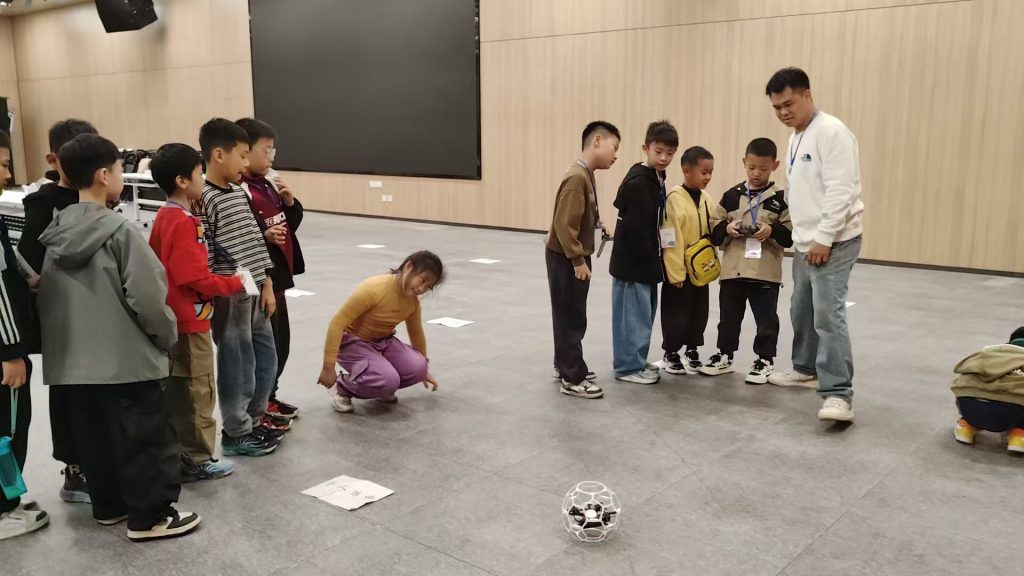
| Training Module | Key Learning Objectives | Delivery Method | Assessment Metric |
|---|---|---|---|
| 1. Core Regulation & Safety | Airspace law, weather analysis, risk mitigation, emergency protocols. | Classroom, Online Theory, Simulators | Written Exam, Simulated Emergency Drills |
| 2. Flight Proficiency & Systems | Advanced manual flight, platform maintenance, payload configuration. | Field Sessions, Simulators | Practical Flight Test, System Diagnostics |
| 3. Mission Planning for Surveying | Software use, GSD/overlap calculation, autonomous mission design. | Software Labs, Scenario Planning | Creation of a Compliant & Efficient Flight Plan |
| 4. Geospatial Data Acquisition | GCP setup, sensor-specific best practices, in-field QA/QC. | Field Practicum | Successful collection of a dataset meeting specified accuracy targets. |
| 5. Data Handling & Intro to Processing | Data offload, organization, cloud processing basics, report generation. | Computer Labs | Production of a simple orthomosaic and accuracy report. |
Data Integrity, Security, and Evolving Regulatory Landscapes
Beyond flight operations, two pervasive challenges are data management and evolving regulations. The volume of data generated is immense; a single day’s flight can produce hundreds of high-resolution images and gigabytes of point cloud data. Efficient storage, backup, and processing workflows are essential. Furthermore, the captured imagery often contains sensitive information. Adhering to data privacy laws (like GDPR) necessitates implementing robust data governance policies, including encryption, access controls, and clear data retention and anonymization protocols.
Regulatory frameworks are also in constant flux. Operational approvals for Beyond Visual Line of Sight (BVLOS) flights, which would dramatically increase efficiency for large-area surveys, are still complex to obtain in many regions. Navigating this landscape requires dedicated legal and operational expertise, which should be integrated into advanced drone training programs.
Future Trajectories and Concluding Synthesis
The future of drones in land change surveys is geared towards greater automation, integration, and intelligence. We are moving towards seamless multi-sensor fusion (e.g., RGB + LiDAR on a single platform), real-time onboard processing for immediate change detection, and the integration of drone data with other geospatial feeds like satellite imagery within GIS and Digital Twin platforms. Swarm robotics, where multiple drones collaborate autonomously on a single survey task, looms on the horizon for unprecedented speed.
However, this technological march forward will be futile without a parallel investment in human capital. The sophistication of future systems will demand an even higher level of operator skill and analytical understanding. Therefore, continuous, adaptive drone training is the cornerstone upon which the reliability, legality, and scientific value of drone-based land change surveying rests. It is the critical bridge transforming powerful tools into actionable, trustworthy insights for sustainable land governance. In my practice, prioritizing this human-centric development is as important as upgrading the hardware or software, ensuring that the technology is not only deployed but mastered.