
As a researcher focused on modern naval defense, I have observed the rapid evolution of unmanned aerial vehicle (UAV) swarm tactics, which pose a significant challenge to existing air defense systems. Inspired by historical strategies like human-wave tactics or wolf-pack submarine warfare, UAV swarms leverage large numbers of low-cost, small drones to overwhelm targets through coordinated attacks. Projects such as the U.S. CODE, LOCUST, “Gremlins,” and “Perdix” highlight this trend, pushing the development of anti-UAV swarm operations. In this article, I will explore the concept of UAV swarm warfare, analyze its weaknesses, and propose comprehensive countermeasures from a first-person perspective, emphasizing the critical need for anti-UAV technologies. The discussion will incorporate tables and formulas to summarize key points, aiming to provide a detailed overview exceeding 8000 tokens.
UAV swarm warfare involves dozens to hundreds of small, multi-functional drones operating in autonomous or semi-autonomous groups to perform tasks like reconnaissance, attack, or deception. These drones are typically launched from platforms like ships or aircraft, with limited range (under 300 km), speed (under 250 km/h), and altitude (under 3000 m). They rely on data links for communication and use inertial guidance or small warheads for strikes. The core advantage lies in creating localized numerical superiority, enabling networked precision strikes that embody dynamic energy aggregation and release. For instance, the U.S. Navy’s LOCUST project uses “Coyote” drones that fold for launch and deploy mid-air, weighing about 5.9 kg with a 1-hour endurance. This approach shifts paradigms from traditional air combat to swarm-based, low-cost attrition.
However, UAV swarm operations face inherent technical and operational weaknesses that can be exploited in anti-UAV strategies. From my analysis, the key technical challenges include artificial intelligence limitations, where drones still depend on remote control stations, leading to latency and vulnerability in decision-making. The AI required for real-time coordination demands high computational power and energy, which strains resources. Additionally, handling unexpected scenarios—like sudden target surrender—remains problematic, as AI may fail to adapt compared to human-in-the-loop control. Communication is another critical issue; swarms rely on secure, high-speed networks for intra-swarm and command links, making them susceptible to jamming or hacking. Energy storage constraints also limit mobility, as batteries for small drones trade off between capacity, cost, and performance, often resulting in short operational ranges.
Operationally, UAV swarms exhibit several disadvantages. Their slow speeds make them easy targets for fighter jets or helicopters, and short flight ranges expose launch platforms to counterattacks. Limited air combat capability means they cannot effectively engage manned aircraft, and higher flight altitudes for surveillance increase detectability by radar systems. Environmental factors like fog, rain, or strong winds further degrade performance. Moreover, the dense clustering of drones and reliance on communications create vulnerabilities for concentrated attacks. These weaknesses form the basis for developing anti-UAV swarm concepts, which must prioritize cost-effectiveness, wide coverage, and high efficiency to counter large numbers of low-value threats.
To address these threats, I propose a multi-layered anti-UAV swarm defense framework categorized into regional denial, soft-kill measures, area-denial weapons, and point-defense systems. This approach ensures comprehensive coverage from long-range to close-in engagements, leveraging both mature and emerging technologies. The following sections detail each category, with formulas and tables to quantify effectiveness.
First, regional denial strategies aim to prevent swarm deployment by targeting their sources. This includes destroying launch platforms (e.g., ships or aircraft) before drones are released, and neutralizing control stations or communication nodes like satellites. Mathematically, the probability of successful denial can be modeled using an exponential decay function based on detection range and response time. For example, if a swarm launch platform must approach within a distance \( d \) (e.g., 300 km for drone range), and defenders have a detection radius \( R \) (e.g., 400 km for radar), the time window for interception \( t \) is given by:
$$ t = \frac{R – d}{v_p} $$
where \( v_p \) is the platform speed. The likelihood of destruction increases with improved early warning systems. Similarly, targeting control stations involves signal intelligence to locate emissions, with success probability \( P_{cs} \) expressed as:
$$ P_{cs} = 1 – e^{-k \cdot I} $$
Here, \( k \) is a constant related to electronic warfare capabilities, and \( I \) is the intelligence gathering rate. Regional denial is cost-effective but requires advanced surveillance and strike assets.
Second, soft-kill defenses exploit communication and navigation vulnerabilities through electronic means. These include jamming radio links and GPS signals, hijacking control channels to take over drones, and using radar decoys to mislead swarm targeting. The effectiveness of jamming can be quantified by the signal-to-interference ratio (SIR). If a drone requires a minimum SIR threshold \( \theta \) to maintain control, the jamming power \( J \) needed at distance \( r \) is:
$$ J \geq \frac{P_t \cdot G_t \cdot G_r}{r^2 \cdot \theta \cdot L} $$
where \( P_t \) is the transmitter power, \( G_t \) and \( G_r \) are antenna gains, and \( L \) is path loss. Systems like the British AUDS or Russian “Rose” electronic warfare suite demonstrate this in practice. Control hijacking involves injecting malicious code, with success rate dependent on encryption strength and network latency. Decoy tactics, such as using fake radar signals, reduce the probability of swarm attacks on real assets by creating false targets, modeled as:
$$ P_{decoy} = \frac{N_d}{N_d + N_r} $$
where \( N_d \) is the number of decoys and \( N_r \) is real radars. Soft-kill methods are highly efficient and low-cost, making them ideal for initial anti-UAV layers.
Third, area-denial weapons provide broad coverage to engage multiple drones simultaneously. These include high-power microwave (HPM) systems that fry electronics, counter-swarm drones for aerial combat, large-radius防空 missiles with fragmenting warheads, and net-based interceptors. HPM weapons, like the U.S. Phaser, emit pulses that damage drone circuits over a wide area. The effective radius \( R_{HPM} \) depends on power density \( \Phi \) and frequency, with damage threshold \( D_{th} \):
$$ R_{HPM} = \sqrt{\frac{P_{avg}}{4\pi \cdot D_{th}}} $$
where \( P_{avg} \) is average power. Counter-swarm tactics involve deploying own drone swarms for interception, where engagement outcomes can be modeled using Lanchester’s laws for attrition. For two swarms of sizes \( N_a \) (defender) and \( N_b \) (attacker), the change over time is:
$$ \frac{dN_a}{dt} = -\beta N_b, \quad \frac{dN_b}{dt} = -\alpha N_a $$
with \( \alpha \) and \( \beta \) as combat coefficients. Missiles with shrapnel or graphite warheads offer cost-effective strikes, while net systems like Sky Wall 100 physically capture drones. The cost-benefit ratio (CBR) for area weapons is crucial:
$$ CBR = \frac{C_d}{C_u \cdot N_u} $$
where \( C_d \) is defense cost, \( C_u \) is per-drone cost, and \( N_u \) is drones neutralized. Low CBR values indicate favorable economics.
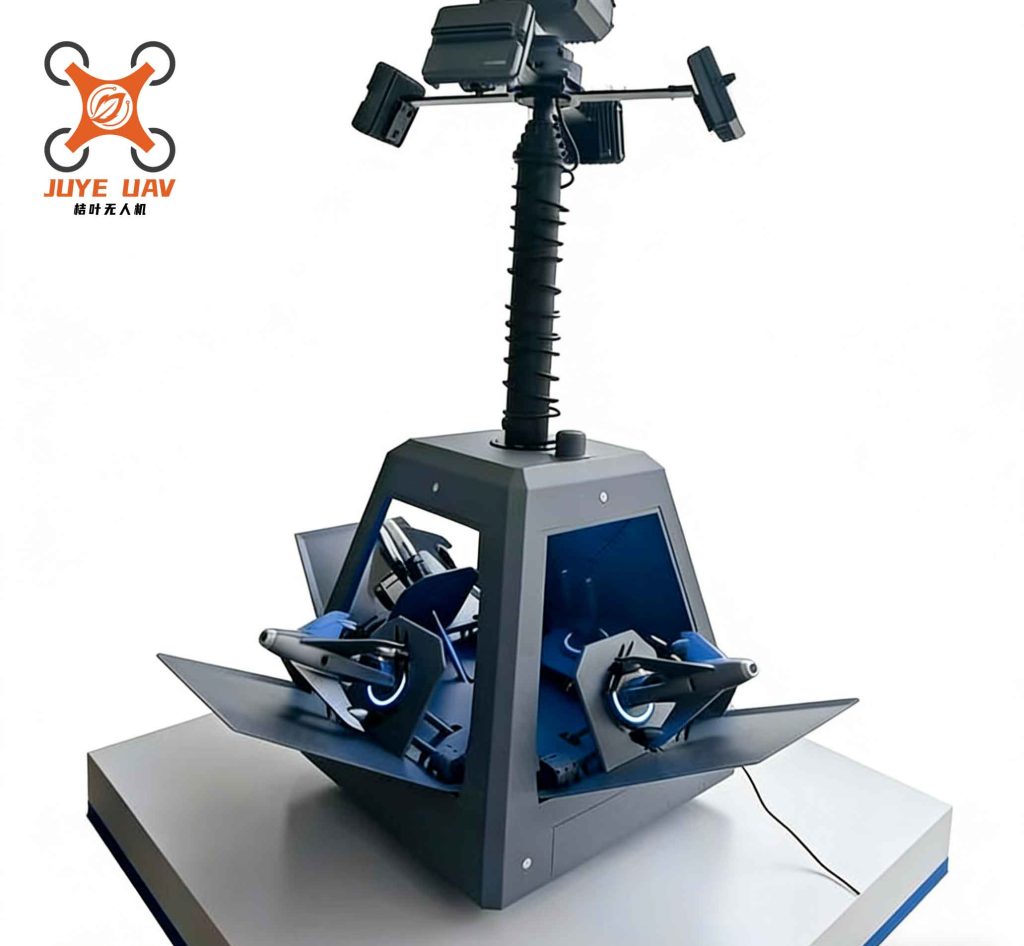
Fourth, point-defense systems focus on precise engagement of individual drones at close range. These include helicopter-mounted cannons, directed-energy weapons like lasers, electromagnetic railguns, close-in weapon systems (e.g., Phalanx), and water cannons. Lasers, such as Boeing’s LWS, use thermal energy to disable drones, with engagement time \( t_{laser} \) given by:
$$ t_{laser} = \frac{E_{req}}{P_{laser} \cdot \eta} $$
where \( E_{req} \) is energy required to damage, \( P_{laser} \) is laser power, and \( \eta \) is efficiency. Electromagnetic guns fire projectiles at high speeds, with hit probability \( P_{hit} \) modeled as:
$$ P_{hit} = 1 – e^{-\sigma \cdot \rho \cdot v_r \cdot t} $$
where \( \sigma \) is cross-section, \( \rho \) is drone density, \( v_r \) is relative velocity, and \( t \) is engagement time. Water cannons, though short-ranged, are effective by short-circuiting electronics. These systems excel in terminal defense but may struggle against massive swarms due to limited fire rates.
To synthesize these concepts, I present a comprehensive table comparing anti-UAV swarm measures based on range, cost, efficacy, and maturity. This table expands on the original material, incorporating quantitative metrics to guide defense planning.
| Category | Specific Measure | Operational Range | Cost-Effectiveness (Scale: Low/Med/High) | Efficacy vs. Swarms (Scale: Low/Med/High) | Technology Maturity | Key Formula/Note |
|---|---|---|---|---|---|---|
| Regional Denial | Destroy Launch Platforms | >300 km | Medium | High | Mature | $$ t = \frac{R – d}{v_p} $$ |
| Neutralize Control Stations | >300 km | Medium | High | Mature | $$ P_{cs} = 1 – e^{-k \cdot I} $$ | |
| Soft-Kill Defense | Electronic Jamming | >300 km | High | High | Mature | $$ J \geq \frac{P_t \cdot G_t \cdot G_r}{r^2 \cdot \theta \cdot L} $$ |
| Control Hijacking | >300 km | High | Medium | Emerging | Depends on encryption | |
| Radar Decoys | Varies (e.g., 10-100 km) | High | Medium | Mature | $$ P_{decoy} = \frac{N_d}{N_d + N_r} $$ | |
| Area-Denial Weapons | High-Power Microwave | Up to 200 km | Medium | High | Emerging | $$ R_{HPM} = \sqrt{\frac{P_{avg}}{4\pi \cdot D_{th}}} $$ |
| Counter-Swarm Drones | >200 km | Medium | High | Emerging | Lanchester: $$ \frac{dN_a}{dt} = -\beta N_b $$ | |
| Large-Radius Missiles | >200 km | Medium | High | Mature | CBR: $$ CBR = \frac{C_d}{C_u \cdot N_u} $$ | |
| Net-Based Interceptors | 100 m to 50 km | High | Medium | Emerging | Physical capture | |
| Point-Defense Systems | Helicopter Cannons | >200 km | Medium | Medium | Mature | Kinetic engagement |
| Directed-Energy Lasers | >35 km | Medium | High | Emerging | $$ t_{laser} = \frac{E_{req}}{P_{laser} \cdot \eta} $$ | |
| Electromagnetic Guns | >10 km | Medium | High | Emerging | $$ P_{hit} = 1 – e^{-\sigma \cdot \rho \cdot v_r \cdot t} $$ | |
| Close-In Weapons (e.g., Phalanx) | ~3 km | Medium | Medium | Mature | High rate of fire | |
| Water Cannons | ~1 km | High | Low-Medium | Mature | Short-range, environmental |
The integration of these anti-UAV measures into a cohesive defense体系 is essential for maritime operations. From my perspective, the optimal strategy involves layered deployment: use regional denial to keep threats at bay, soft-kill methods to disrupt swarm cohesion, area weapons for bulk neutralization, and point defenses for leakers. This approach maximizes the probability of swarm defeat while minimizing costs. For example, the overall system efficacy \( E_{sys} \) can be approximated as:
$$ E_{sys} = 1 – \prod_{i=1}^{n} (1 – P_i) $$
where \( P_i \) is the success probability of each layer, and \( n \) is the number of layers. Incorporating real-time data fusion and AI-driven command and control can enhance responsiveness, though this adds complexity. The future of anti-UAV swarm warfare will likely see increased automation, with autonomous systems making rapid engagement decisions based on swarm behavior models.
In conclusion, UAV swarm warfare represents a disruptive threat that demands innovative anti-UAV solutions. By leveraging a mix of denial, soft-kill, area, and point defenses, naval forces can counter swarm advantages in numbers and cost. Key to success is early detection and interdiction, as well as investing in versatile technologies like directed energy and electronic warfare. As UAV swarms evolve, so must anti-UAV tactics, with continuous research into swarm intelligence and counter-swarm algorithms. This holistic approach ensures robust defense in an era of unmanned combat, safeguarding assets against emerging asymmetric threats.