
In recent years, I have been deeply engaged in studying the rapid evolution of unmanned aerial vehicle (UAV) swarm technology and its implications for security. As a researcher focused on defense systems, I find that UAV swarms, inspired by collective behaviors in nature such as bee colonies, represent a paradigm shift in distributed aerial applications. Unlike traditional single-UAV operations, these swarms enable multiple UAVs to communicate, share information, and collaborate on tasks, offering unprecedented flexibility and efficiency. However, this advancement brings significant security threats, necessitating a thorough exploration of anti-UAV swarm technologies to safeguard public safety. In this article, I will analyze the threats posed by UAV swarms and delve into the countermeasures, emphasizing the critical role of anti-UAV systems in modern defense.
The development of UAV swarm technology is driven by advances in micro-electromechanical systems, wireless communication, and artificial intelligence. From my perspective, these swarms have matured to enable autonomous networking, information sharing, and task coordination, finding applications in military reconnaissance, logistics delivery, and disaster relief. Yet, incidents worldwide, such as swarm disruptions at airports or sensitive data theft, highlight the limitations of traditional point-defense methods against “numerous, fast, and highly coordinated” swarm attacks. Notably, the militarization of UAV swarms exacerbates asymmetric warfare, posing severe challenges to existing air defense systems. Therefore, I argue that researching swarm threat characteristics and developing targeted anti-UAV countermeasures is essential for national security, social stability, and technological balance. This study aims to contribute to that effort by providing a comprehensive analysis.
To understand the urgency of anti-UAV measures, I first examine the threats posed by UAV swarms. These threats can be categorized into several key aspects, as summarized in the table below.
| Threat Category | Description | Impact |
|---|---|---|
| Suddenness and Stealth | Individual UAVs are small with low radar cross-sections (e.g., ~0.01 m²), enabling low-altitude flight and terrain masking. Swarms approach from multiple directions, making attacks unpredictable. | Reduced early warning and response times for defenders, leading to surprise assaults. |
| Destructive Power | Leveraging numbers and协同, swarms carry explosives or weapons to target critical infrastructure like power grids or military assets. | Widespread damage, such as blackouts or degraded military capabilities, disrupting societal functions. |
| Information Interference and Theft | Swarms use jamming signals to disrupt communications and radar, or employ sensors to collect intelligence on targets. | Compromised electronic systems, flight delays, and breaches of confidential data in both military and civilian domains. |
| Difficulty in Defense and Tracking | High numbers and协同 overwhelm traditional interceptors; cost disparities (e.g., missiles vs. cheap UAVs) and adaptive swarm behaviors reduce interception success. | Low interception rates in simulations, allowing sustained attacks despite defensive efforts. |
From my analysis, the stealth of UAV swarms stems from their minimal radar cross-section, which can be modeled using the radar equation for detection probability. For a single UAV, the received signal power \(P_r\) at a radar is given by:
$$P_r = \frac{P_t G_t G_r \lambda^2 \sigma}{(4\pi)^3 R^4 L}$$
where \(P_t\) is transmitted power, \(G_t\) and \(G_r\) are antenna gains, \(\lambda\) is wavelength, \(\sigma\) is radar cross-section, \(R\) is range, and \(L\) is loss factor. With \(\sigma\) as low as 0.01 m² for small quadcopters, \(P_r\) diminishes rapidly, complicating detection. In swarms, the collective \(\sigma\) may increase, but distributed low-altitude flight still challenges traditional radars. This underscores the need for enhanced anti-UAV detection methods.
In response to these threats, I have investigated various anti-UAV technologies, which can be broadly classified into detection, interference, interception, and swarm control techniques. Each category plays a vital role in comprehensive anti-UAV defense systems. Below, I detail these technologies, incorporating formulas and tables to summarize key aspects.
Detection is the first line of defense in anti-UAV operations. I explore radar, electro-optical, and acoustic methods. For radar, multiple-input multiple-output (MIMO) radar improves detection of low-altitude, slow-moving targets by transmitting orthogonal signals. The detection range \(R_d\) can be estimated as:
$$R_d = \left( \frac{P_t G_t G_r \lambda^2 \sigma_{eff}}{(4\pi)^3 k T_0 B F_n (S/N)_{min}} \right)^{1/4}$$
where \(\sigma_{eff}\) is the effective cross-section of a swarm, \(k\) is Boltzmann’s constant, \(T_0\) is noise temperature, \(B\) is bandwidth, \(F_n\) is noise figure, and \((S/N)_{min}\) is minimum signal-to-noise ratio for detection. Synthetic aperture radar (SAR) enhances tracking through imaging, but both face jamming in complex electromagnetic environments. Electro-optical detection relies on infrared or visible sensors; for instance, infrared detectors identify heat signatures from UAV motors. The signal-to-noise ratio for infrared detection is:
$$\text{SNR} = \frac{\Phi \cdot A_d \cdot \tau}{\sqrt{NEP^2 \cdot \Delta f}}$$
where \(\Phi\) is radiant flux, \(A_d\) is detector area, \(\tau\) is transmittance, \(NEP\) is noise-equivalent power, and \(\Delta f\) is bandwidth. However, adverse weather like fog degrades performance. Acoustic detection uses microphone arrays to locate UAVs via noise patterns, with accuracy dependent on array geometry and signal processing. The time-difference of arrival (TDOA) between sensors \(i\) and \(j\) for source localization is:
$$\Delta t_{ij} = \frac{\|\mathbf{r}_i – \mathbf{s}\| – \|\mathbf{r}_j – \mathbf{s}\|}{c}$$
where \(\mathbf{r}_i\) and \(\mathbf{r}_j\) are sensor positions, \(\mathbf{s}\) is UAV position, and \(c\) is speed of sound. Environmental noise remains a challenge. To compare these methods, I present a table summarizing their characteristics.
| Detection Technology | Principles | Advantages | Limitations |
|---|---|---|---|
| Radar (MIMO/SAR) | Emits radio waves to detect reflections; uses signal processing for imaging. | Long-range detection (several km), effective for low-altitude swarms. | Vulnerable to electronic jamming; requires抗干扰 algorithms. |
| Electro-Optical (Infrared/Visible) | Senses heat or visual features via cameras; employs AI for recognition. | High sensitivity in clear conditions, accurate identification. | Weather-dependent (e.g., fog, rain); needs adaptive image enhancement. |
| Acoustic | Captures UAV noise with microphone arrays; uses TDOA for localization. | Effective in urban areas, works for low-speed UAVs up to hundreds of meters. | Susceptible to ambient noise; requires advanced filtering. |
Interference technologies form the core of many anti-UAV systems, aiming to disrupt UAV control and navigation. I focus on radio frequency (RF), laser, and GPS干扰. RF干扰 involves transmitting signals at specific frequencies to jam communication links. The jamming-to-signal ratio (J/S) critical for effective干扰 is:
$$\frac{J}{S} = \frac{P_j G_j R_s^2 B_s}{P_s G_s R_j^2 B_j}$$
where \(P_j\) and \(P_s\) are jammer and signal powers, \(G_j\) and \(G_s\) are antenna gains, \(R_j\) and \(R_s\) are distances, and \(B_j\) and \(B_s\) are bandwidths. Directional jammers can target individual UAVs at ranges of hundreds of meters, while vehicular systems cover kilometers. Laser干扰 uses high-energy beams to blind optical sensors, with energy density \(E\) at range \(R\) given by:
$$E = \frac{P_l \cdot \tau_l}{\pi \left( \frac{\theta R}{2} \right)^2}$$
where \(P_l\) is laser power, \(\tau_l\) is atmospheric transmittance, and \(\theta\) is beam divergence. This method is precise but weather-sensitive. GPS干扰 exploits signal spoofing by broadcasting false navigation data. The required干扰 power \(P_{gps}\) to overcome legitimate GPS signals is:
$$P_{gps} = P_{gps0} \cdot \left( \frac{R}{R_0} \right)^2 \cdot 10^{(A/10)}$$
with \(P_{gps0}\) as reference power, \(R_0\) as reference distance, and \(A\) as atmospheric attenuation. Handheld and fixed systems offer varying coverage. As UAVs develop anti-jamming capabilities, continuous optimization of干扰 strategies is vital for anti-UAV efficacy. Below, a table contrasts these interference approaches.
| Interference Technology | Mechanism | Effective Range | Challenges |
|---|---|---|---|
| RF干扰 | Jams control and data links via定向 or broad-spectrum signals. | Up to several km for vehicular systems. | Requires frequency agility to counter evolving UAV protocols. |
| Laser干扰 | Disables optical sensors with focused beams, causing temporary or permanent damage. | Long-range (km-scale) in clear conditions. | Degraded by weather (e.g., dust, rain); needs adaptive tracking. |
| GPS干扰 | Overwrites satellite signals with false data, misleading UAV navigation. | Hundreds of meters for handheld, km for fixed systems. | Dependent on GPS reliance; may affect collateral systems. |
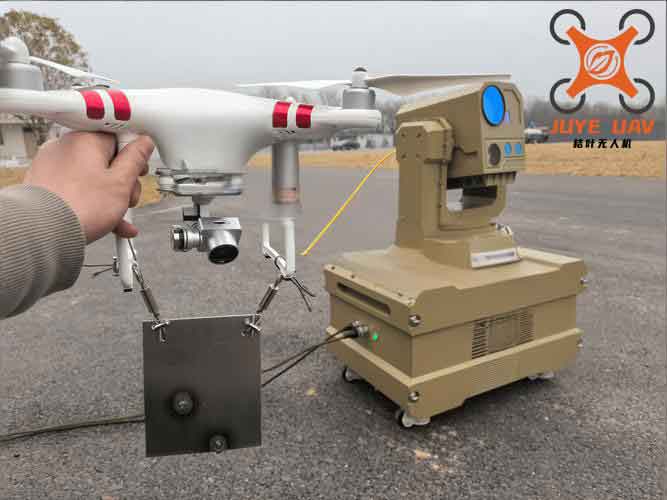
Interception technologies provide physical neutralization of UAV swarms, complementing干扰 in anti-UAV architectures. I examine net-capture, counter-UAV drones, and gun/missile systems. Net-capture involves launching lightweight nets to entangle UAVs, suitable for low-altitude, slow targets. The kinetic energy \(E_k\) of a net projectile is:
$$E_k = \frac{1}{2} m v^2$$
where \(m\) is mass and \(v\) is velocity. While safe for surrounding infrastructure, range limitations necessitate integration with other methods. Counter-UAV drones are dedicated anti-UAV platforms equipped with tools like electric guns or nets. They operate autonomously or via control, offering flexibility. For instance, a counter-drone may use pursuit-evasion algorithms modeled as:
$$\frac{d\mathbf{x}_c}{dt} = v_c \mathbf{u}_c, \quad \frac{d\mathbf{x}_u}{dt} = v_u \mathbf{u}_u$$
where \(\mathbf{x}_c\) and \(\mathbf{x}_u\) are positions of counter-drone and UAV, \(v_c\) and \(v_u\) are speeds, and \(\mathbf{u}_c\) and \(\mathbf{u}_u\) are control vectors. However, these drones risk being targeted themselves. High-rate guns and missiles serve as last-resort defenses; guns provide dense firepower, while missiles offer precision. The cost-effectiveness ratio \(C\) for intercepting a swarm is:
$$C = \frac{N_m \cdot C_m}{N_u \cdot C_u}$$
where \(N_m\) and \(N_u\) are numbers of missiles and UAVs, and \(C_m\) and \(C_u\) are respective costs. With \(C_m\) potentially orders of magnitude higher, this highlights the economic incentive for layered anti-UAV solutions. A summary table is provided below.
| Interception Technology | Description | Applicability | Drawbacks |
|---|---|---|---|
| Net-Capture | Deploys nets via launchers to physically capture UAVs without collateral damage. | Low-altitude, slow-moving UAVs; urban environments. | Limited range and speed; ineffective against high-altitude swarms. |
| Counter-UAV Drones | Uses specialized drones to engage threats via干扰 or physical means. | Flexible response in complex terrains; can operate in协同. | Vulnerable to countermeasures; requires robust communication. |
| Guns and Missiles | Employs rapid-fire cannons or guided missiles for kinetic destruction. | Large-scale, high-intensity attacks; protection of critical assets. | High cost per engagement; potential overkill for cheap UAVs. |
Swarm control technologies target the协同 nature of UAV swarms, a frontier in anti-UAV research. I investigate集群干扰, deceptive干扰, and intelligent对抗.集群干扰 aims to disrupt swarm communication protocols. By analyzing control algorithms,干扰 signals can be designed to induce chaos. For example, if swarm coordination relies on consensus algorithms like:
$$\dot{x}_i = \sum_{j \in N_i} (x_j – x_i)$$
where \(x_i\) is the state of UAV \(i\) and \(N_i\) is its neighbors, injecting noise can destabilize the system. Deceptive干扰 sends false commands or GPS data to mislead swarms. Success depends on understanding protocol encryption, with effectiveness measured by误引 rate \(\eta\):
$$\eta = \frac{N_{deceived}}{N_{total}}$$
where \(N_{deceived}\) is number of UAVs fooled. Intelligent对抗 leverages AI to predict swarm behaviors and automate responses. Machine learning models, such as deep neural networks, can classify threats and recommend actions. The decision function \(f(\mathbf{s})\) for an anti-UAV system might be:
$$f(\mathbf{s}) = \arg\max_{a \in A} Q(\mathbf{s}, a)$$
where \(\mathbf{s}\) is state vector (e.g., swarm size, velocity), \(A\) is set of countermeasures, and \(Q\) is learned value function. However, this requires vast data and faces adversarial attacks. Integrating these approaches enhances holistic anti-UAV capabilities. The table below outlines key aspects.
| Swarm Control Technology | Approach | Advantages | Research Needs |
|---|---|---|---|
| 集群干扰 | Jams swarm-specific communications to break协同. | Can incapacitate entire swarms if protocols are compromised. | Continuous updates to match evolving swarm encryption. |
| Deceptive干扰 | Feeds false navigation or control signals to redirect swarms. | High impact if successful; non-destructive. | Deep protocol analysis; real-time signal adaptation. |
| Intelligent对抗 | Uses AI for real-time monitoring, prediction, and automated countermeasures. | Adaptive and autonomous; suitable for dynamic environments. | Robust algorithms against欺骗; extensive training data. |
In conclusion, my research underscores that UAV swarms, as an emerging technological force, present both innovative applications and serious challenges to security and defense. Their sudden attacks, destructive potential, information warfare capabilities, and resilience against tracking render traditional防护 inadequate. Thus, I advocate for proactive development and innovation in anti-UAV swarm technologies. From detection to interception, each layer must evolve to address swarm-specific threats. The future will likely see an ongoing arms race between UAV swarms and anti-UAV systems, driven by advancements in AI, materials, and networking. As a researcher, I believe that持续 investment in these areas is crucial to ensure public safety, national security, and societal stability. By fostering interdisciplinary collaboration and testing in realistic scenarios, we can enhance the effectiveness of anti-UAV measures and mitigate the risks posed by adversarial swarms.