
The evolutionary trajectory of military unmanned platforms is a direct reflection of the profound transformation in the character of war. The paradigm has shifted from early experiments in manned-unmanned teaming to the validation of swarm saturation attacks, and further to the emergence of a full-spectrum unmanned battlefield landscape. This progression starkly reveals the critical vulnerabilities of traditional, platform-centric air defense systems when confronted with intelligent, distributed, and cooperative anti-drone threats. The core challenge of modern anti-drone warfare lies in countering low-cost, intelligent swarms that can overwhelm defenses through sheer quantity and coordinated autonomy. In this context, operations within the cyber and electromagnetic spectrum (CEMS) domains present a potentially high-efficiency, cost-effective solution. This article, from a first-person analytical perspective, explores the inherent vulnerabilities of drone swarms and articulates a comprehensive framework for cyber-electromagnetic countermeasures, emphasizing integrated system-of-systems defeat over point-defense attrition.
I. Critical Vulnerability Analysis of Drone Swarm Architectures
The perceived resilience of a drone swarm is often undermined by fundamental dependencies and physical limitations. A successful anti-drone strategy must be predicated on exploiting these inherent weaknesses.
1.1 Communication Dependency
Swarm cohesion and function are critically dependent on robust intra-swarm (UAV-to-UAV) and command (Ground Control Station-to-UAV) links. These links are characterized by finite bandwidth and are susceptible to latency, which directly impacts swarm agility and the OODA (Observe, Orient, Decide, Act) loop. While encryption secures data, it adds overhead. The primary anti-drone vulnerability lies in the electromagnetic domain: both line-of-sight and satellite-relay channels are highly vulnerable to jamming, spoofing, and intrusion, which can lead to command loss, swarm disintegration, or hijacking.
The effectiveness of a jamming attack can be modeled by the Signal-to-Interference-plus-Noise Ratio (SINR) at the receiver of a target drone:
$$ \text{SINR} = \frac{P_r}{J + N} = \frac{P_t G_t G_r \lambda^2}{(4\pi d)^2 L (J + N)} $$
where \(P_r\) is received signal power, \(J\) is jamming power, \(N\) is noise power, \(P_t\) is transmit power, \(G_t, G_r\) are antenna gains, \(\lambda\) is wavelength, \(d\) is range, and \(L\) is system loss. Effective jamming for anti-drone operations requires \(J\) to be sufficiently high to drive SINR below the receiver’s decoding threshold.
1.2 Control Complexity & Algorithmic Fragility
Distributed swarm control relies on complex algorithms for flocking, collision avoidance, and task allocation. These algorithms operate in a dynamic balance sensitive to environmental perturbations and adversarial actions. An anti-drone approach can target this fragility. Localized failures—whether induced by electronic attack, kinetic strike, or deceptive input—can propagate through the swarm’s interaction network, leading to cascading collisions or mission logic failure. This necessitates robust fault-tolerant algorithms, which themselves may introduce exploitable predictability or latency.
1.3 Navigation Precision Vulnerability
Most commercial and military drones rely heavily on Global Navigation Satellite Systems (GNSS) like GPS, GLONASS, or BeiDou for positioning and timing. This is a cornerstone vulnerability for anti-drone operations. GNSS signals are extremely weak and susceptible to:
- Jamming: Overpowering the signal with noise in the GNSS frequency band.
- Spoofing: Broadcasting counterfeit GNSS signals to mislead the drone’s receiver, causing navigation drift or controlled redirection.
While Inertial Navigation Systems (INS) provide a backup, their error accumulates over time without GNSS correction:
$$ \theta_{\text{drift}}(t) = \theta_0 + \int_{0}^{t} \omega_{\text{bias}} \, d\tau + \int_{0}^{t} \int_{0}^{\tau} \eta(\xi) \, d\xi d\tau $$
where \(\theta_{\text{drift}}\) is the angular error, \(\theta_0\) is initial alignment error, \(\omega_{\text{bias}}\) is gyro bias, and \(\eta\) is random walk noise. Anti-drone spoofing can exploit this by creating a consistent but false position fix.
1.4 Platform Physical Limitations
Small drones, particularly micro- and mini-UAVs, are constrained by the laws of physics. Limited battery energy density (\(E_{bat}\) in Wh/kg) directly constrains endurance (\(T\)): \(T \propto E_{bat} / P_{\text{avg}}\) where \(P_{\text{avg}}\) is average power consumption. Small payload capacity limits sensor sophistication and lethal effect. Furthermore, their low radar cross-section (RCS) and slow speed, while challenging for detection, also make them vulnerable to simple kinetic countermeasures and adverse weather. Carrier-based “mothership” deployment schemes increase the signature and value of a forward asset, creating a lucrative anti-drone target for disrupting the entire swarm deployment cycle.
| Vulnerability | Anti-Drone Exploitation Method | Potential Effect |
|---|---|---|
| Communication Dependency | Targeted/Barrage Jamming, Protocol Exploitation | Swarm Disintegration, Loss of Control |
| Navigation Precision | GNSS Spoofing/Jamming, Magnetic Field Distortion | Navigation Error, Controlled Diversion |
| Algorithmic Fragility | Sensor Spoofing, Data Injection, Adversarial AI | Cascading Failure, Erratic Behavior |
| Energy/Payload Limit | Prolonged Engagement, Directed Energy Weapons | Attrition, Mission Abort |
1.5 Data and Network Security
Swarm ad-hoc networks (e.g., modified MANETs) prioritize dynamic connectivity over robust security. Traditional encryption and authentication mechanisms may be too slow or computationally expensive for rapid node turnover. This exposes the data link to multiple threats: malicious code injection, routing table poisoning, and man-in-the-middle attacks. An anti-drone cyber operation could hijack a single node and propagate corrupted data or commands throughout the swarm, leading to systemic paralysis.
II. Core Cyber-Electromagnetic Capabilities for Counter-Swarm Operations
To leverage the vulnerabilities outlined above, a multi-layered cyber-electromagnetic anti-drone capability must be developed, integrating sensing, disruption, and destruction.
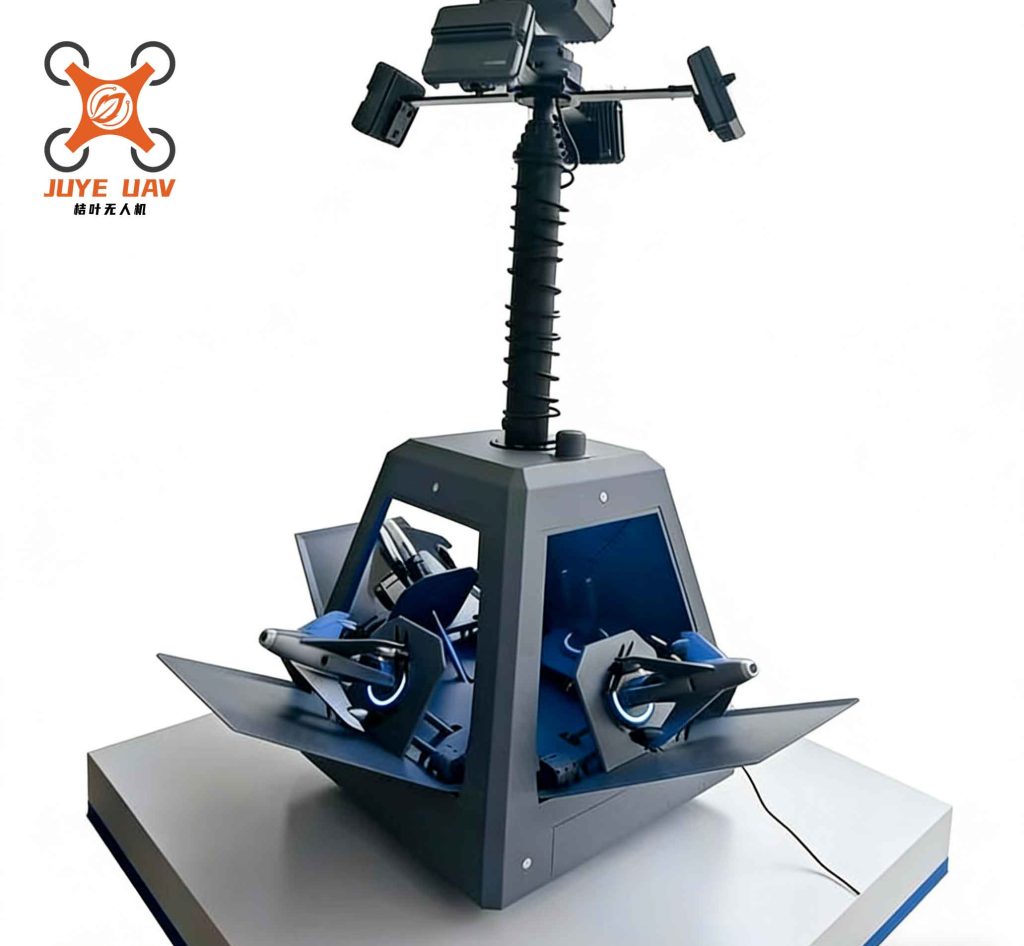
2.1 Integrated Electromagnetic Situational Awareness
Detection and tracking form the foundational layer of any anti-drone system. A multi-domain, heterogeneous sensor network is required to overcome low-observability challenges.
- Radar: A layered network using low-frequency (VHF/UHF) surveillance radars for long-range detection, and higher-frequency (X/Ku-band) AESA radars for precise tracking and fire control, particularly in cluttered low-altitude environments.
- RF Sensing: Passive electronic support measures (ESM) systems that detect and characterize drone command, control, and telemetry signals across a wide bandwidth (e.g., L-band to X-band). These systems provide non-kinetic “fingerprinting” for identification and targeting.
- Electro-Optical/Infrared (EO/IR): Provides positive visual identification, tracking, and potential laser designation. Multi-spectral imaging helps discriminate drones from birds or other clutter.
- Acoustic Sensors: Can detect and classify drones based on the unique acoustic signature of their motors and propellers, useful for passive, short-range perimeter defense.
Data fusion from these disparate sources is critical. A simplified fusion confidence score \(C_f\) for a track might be expressed as:
$$ C_f = 1 – \prod_{i=1}^{N} (1 – w_i \cdot c_i) $$
where \(c_i\) is the confidence from sensor \(i\), and \(w_i\) is its dynamically adjusted weight based on environmental conditions and target type.
2.2 Electromagnetic Spectrum Warfare Systems
This constitutes the “soft-kill” pillar of anti-drone warfare, aiming to disrupt, deceive, or deny the swarm’s functionality without physical destruction.
| Anti-Drone Technique | Mechanism | Targeted Subsystem |
|---|---|---|
| Communications Jamming | Emits high-power RF noise on drone control & data link frequencies (e.g., 2.4 GHz, 5.8 GHz, ISM bands, C-band). | Command & Control (C2) Link, Intra-Swarm Network |
| GNSS Jamming | Emits noise in GNSS frequency bands (e.g., ~1575 MHz for GPS L1). | Navigation & Positioning System |
| GNSS Spoofing | Generates sophisticated counterfeit GNSS signals to provide false position/time data. | Navigation & Positioning System |
| Protocol Exploitation | Reverse-engineers swarm communication protocols to inject false commands or data (e.g., “go home”, “land”, “collide”). | Swarm Network Logic |
| Sensor Deception | Uses advanced RF/EO/IR decoys to spoof drone’s onboard sensors (e.g., radar altimeter, video tracking). | Autonomous Guidance & Obstacle Avoidance |
2.3 Directed Energy and Kinetic Layered Defense
The “hard-kill” layer physically neutralizes threats that penetrate the soft-kill envelope.
- High-Power Microwave (HPM): Emits short, powerful pulses of microwave energy. The rapidly changing electric field (\(E\)-field) can induce damaging currents in a drone’s electronic circuits, causing upset or permanent damage (burn-out). The peak power density \(S\) at range \(R\) is key: \(S = \frac{P_{peak} G}{4\pi R^2}\), where \(P_{peak}\) is peak power and \(G\) is antenna gain. HPM offers a wide-area, magazine-deep effect against multiple targets, ideal for anti-drone swarm defense.
- High-Energy Laser (HEL): Focuses coherent optical energy on a small spot. The dwell time (\(t_{dwell}\)) required to disable a target depends on laser power (\(P_{laser}\)), spot size (\(A_{spot}\)), and target material properties. The governing thermal equation can be simplified as: \(P_{laser} \cdot t_{dwell} = m c_p \Delta T + m L\), where \(m\) is mass ablated, \(c_p\) is specific heat, \(\Delta T\) is temperature rise, and \(L\) is latent heat of fusion/vaporization. HEL provides precise, low-cost-per-shot engagement but is affected by atmospheric conditions.
- Kinetic Systems: Includes traditional anti-aircraft artillery, missiles, and specialized micro-missiles. These remain essential for high-speed, long-range, or hardened targets, and as a last-layer defense (e.g., close-in weapon systems).
III. Integrated Cyber-Electromagnetic Employment Strategies
Capabilities must be orchestrated through coherent strategies to create synergistic and adaptive anti-drone effects.
3.1 Strategy 1: Construct a Multi-Domain Reconnaissance and Early Warning Network
The goal is “see first, see clearly, see persistently.” This involves fusing data from ground-based, aerial (manned/unmanned), and space-based sensors into a common operational picture. Artificial intelligence and machine learning (AI/ML) algorithms process this data in real-time to detect, classify, and track drone swarms, even in dense electromagnetic and physical environments. This network provides the essential cueing for all subsequent anti-drone actions.
3.2 Strategy 2: Execute Coordinated Electromagnetic Suppression
This is a multi-pronged attack on the swarm’s electronic nervous system. Operations are synchronized to achieve maximum disruptive effect:
- Simultaneously jam primary C2 and intra-swarm communication frequencies.
- Deploy GNSS jammers to deny positioning or deploy advanced spoofers to divert the entire swarm into a “kill box” or safe area.
- The objective is to “break the net and blind the hive,” causing confusion, loss of coordination, and mission failure before kinetic engagement is necessary.
3.3 Strategy 3: Penetrate and Disintegrate the Swarm Network
This is a cyber-centric anti-drone strategy. It involves:
- Network Reconnaissance: Mapping the swarm’s ad-hoc network topology, identifying node roles (leaders, relays), and analyzing its communication protocols.
- Vulnerability Exploitation: Identifying weaknesses in authentication, encryption, or data validation routines within the swarm’s software.
- Payload Delivery & Attack: Gaining access to the network—potentially via a compromised member drone, a rogue ground node, or a wireless injection from a nearby platform—and deploying malicious payloads. These could be worms that spread through the swarm, logic bombs that trigger at a specific time, or commands that induce self-destructive behavior.
3.4 Strategy 4: Employ Deception and Misdirection
This strategy aims to defeat the swarm by manipulating its perception and decision-making. Key tactics include:
- Electromagnetic Decoys: Deploying systems that mimic the RF signatures of high-value assets (e.g., command posts, radars) to draw swarm attacks away from real targets and toward prepared defenses or empty areas.
- False Swarm Generation: Using expendable emitters to simulate a large incoming swarm, forcing the adversary to commit defensive resources prematurely or against phantom targets.
- Sensor and Navigation Spoofing: As described in Section II.2, directly feeding false data to the drones’ sensors and navigation systems to induce controlled flight into obstacles or engagement zones.
The optimization of decoy placement can be treated as a resource allocation problem. One objective might be to maximize the probability \(P_{deceive}\) that an incoming swarm attacks a decoy over a real asset, given \(N_d\) decoys with effectiveness \(e_i\) and resource cost \(r_i\):
$$ \text{Maximize } P_{deceive} = f(e_1, e_2, …, e_{N_d}, \text{swarm AI parameters}) $$
$$ \text{Subject to } \sum_{i=1}^{N_d} r_i \leq R_{\text{total}} $$
3.5 Strategy 5: Orchestrate Integrated Soft and Hard-Kill Effects
The most effective anti-drone campaign employs all tools in a layered, time-phased sequence. This “defense-in-depth” strategy is illustrated in the following operational flow:
- Layer 1 (Long-Range): Early detection cues long-range electronic attack (EA). GNSS spoofing/jamming and C2 jamming are initiated to disrupt swarm formation and navigation from the maximum possible distance.
- Layer 2 (Mid-Range): As the swarm approaches, focused network cyber-attacks and more powerful/directional jamming are employed. High-Power Microwave (HPM) systems may engage to achieve wide-area “soft-kill” of electronics.
- Layer 3 (Short-Range): Surviving drones are engaged with High-Energy Lasers (HEL) for precise, low-cost destruction.
- Layer 4 (Point Defense): Final layer employs kinetic systems (guns, micro-missiles) as a last resort against any leakers.
This requires a unified command and control (C2) system that can dynamically assign the most efficient effector (soft or hard) to each threat based on cost, probability of kill, and resource availability in real-time.
IV. Foundational Enablers for Enhanced Counter-Swarm Effectiveness
4.1 Adaptive and Modular Equipment Architecture
Anti-drone technology must evolve faster than the threat. Equipment development should focus on:
- Software-Defined Architecture: Systems where waveforms, protocols, and algorithms are defined in software, allowing rapid updates to counter new drone models or swarm tactics.
- Open Modular Design: Enabling plug-and-play integration of new sensors and effectors.
- Cognitive Electronic Warfare (EW): Systems that use AI to learn, reason, and autonomously generate countermeasures against novel signals in real-time.
4.2 AI-Enabled Command, Control, and Information Fusion
The complexity and tempo of swarm attacks overwhelm human-only decision cycles. The C2 system must automate the kill chain: from sensor fusion and threat prioritization to effector selection and battle damage assessment. AI algorithms are crucial for predicting swarm intent, identifying the most vulnerable swarm node (e.g., the “queen” or key relay), and dynamically allocating resources. A simplified optimization for effector allocation might be:
$$ \text{Minimize } \sum_{j=1}^{M} C_j x_j $$
$$ \text{Subject to } \sum_{j=1}^{M} P_{k_{ij}} x_j \geq T_i \quad \forall i \in \text{Threats} $$
where \(C_j\) is the cost of using effector \(j\), \(x_j\) is a binary decision variable, \(P_{k_{ij}}\) is the probability of effector \(j\) killing threat \(i\), and \(T_i\) is the required threat neutralization level.
4.3 Specialized Talent Cultivation and Realistic Training
Personnel are the ultimate enablers. A new breed of warrior—the cyber-electromagnetic operator—needs to be cultivated. Training must move beyond static systems and involve high-fidelity simulations that replicate the chaos of a contested electromagnetic environment against adaptive, intelligent swarm red teams.
| Skill Category | Required Competencies | Training Method |
|---|---|---|
| Technical Proficiency | RF Physics, Network Protocols, Signal Processing, AI/ML Basics | Advanced Technical Courses, Lab Exercises |
| Tactical Employment | Electronic Battle Management, Rules of Engagement, Multi-Domain Integration | Wargaming, Command Post Exercises (CPX) |
| Operational Resilience | Decision-making under EM Stress, System Recovery/Reconstitution | Live, Virtual, & Constructive (LVC) Training in Jammed Environments |
4.4 Continuous Tactics, Techniques, and Procedures (TTP) Innovation
TTPs cannot be static. A dedicated “swarm countermeasures” cell should continuously analyze adversary developments, conduct red-teaming, and experiment with new concepts like “cognitive suppression” (targeting the swarm’s collective AI) or “swarm-on-swarm” anti-drone tactics using defensive autonomous systems. Lessons learned from real-world conflicts and technology demonstrations must be rapidly folded into updated doctrine and training.
V. Conclusion
The drone swarm represents a fundamental shift towards distributed, intelligent, and asymmetric warfare. Its strength—networked coordination—is also its critical vulnerability. An integrated cyber-electromagnetic anti-drone strategy offers a promising path to counter this threat effectively and efficiently. Success hinges on moving beyond isolated “jammers” or “shooters” to fielding a cohesive system-of-systems. This system must seamlessly blend multi-domain sensing, adaptive soft-kill, scalable hard-kill, and AI-driven command and control. The core imperative is to operate inside the adversary’s decision cycle, disrupting the swarm’s OODA loop at the electromagnetic and informational level before it can achieve its tactical objectives. The future of anti-drone defense lies not in building thicker walls, but in mastering the invisible domains of electrons and data to deconstruct hostile swarms from within.