
In recent years, the rapid advancement of unmanned aerial vehicle (UAV) swarm technology has posed an increasingly severe threat to critical areas, assets, and operations. As a researcher focused on countering these emerging dangers, I have dedicated my efforts to developing effective situation awareness strategies for anti-drone swarm operations. This article presents a comprehensive approach to detecting, tracking, and understanding UAV swarms, with the goal of enhancing our defensive capabilities against such coordinated attacks. The proliferation of drone swarms in military conflicts, such as the attacks on bases in Syria and oil facilities in Saudi Arabia, underscores the urgent need for robust anti-drone systems. These swarms leverage group intelligence,协同交互, and饱和攻击 to overwhelm traditional defenses, making early situational awareness paramount for successful interception and neutralization. In this work, I propose a multi-domain detection framework combined with a hierarchical information fusion structure, aiming to provide a holistic solution for anti-drone swarm situational awareness. By integrating various sensor technologies and advanced algorithms, we can better perceive, comprehend, and project the actions of hostile drone clusters, thereby improving our anti-drone response efficacy.
The cornerstone of any effective anti-drone strategy is reliable detection. UAV swarms, often composed of “low, slow, and small” targets, present unique challenges due to their low radar cross-sections, potential for silent flight, and ability to operate in complex environments. To address this, I advocate for a joint multi-domain detection mode that combines long-range and short-range sensors, high-altitude and low-altitude platforms, and echeloned deployment. This approach ensures full-area coverage and resilience against environmental or electronic interference. The primary detection methods include radar, radio frequency (RF) sensing, electro-optical (EO) systems, and acoustic detection, each with distinct advantages and limitations. For instance, radar offers long-range, all-weather capability but may struggle with clutter and small signatures, while RF detection can identify communication signals but fails against silent drones. EO systems provide high resolution and visual confirmation but are weather-dependent. Acoustic sensors serve as a short-range supplement. By fusing data from these heterogeneous sources, we can achieve a more complete picture of the drone swarm’s presence and movements. Below is a summary table comparing these anti-drone detection modalities:
| Detection Method | Key Technologies | Advantages | Limitations | Suitability for Anti-Drone Swarm |
|---|---|---|---|---|
| Radar Detection | Active phased array, low-altitude补盲 radar, holographic radar, passive radar; micro-Doppler feature extraction; clutter suppression algorithms. | Long range, high precision, all-weather operation; can detect silent drones via skin echo. | Susceptible to clutter; difficulty distinguishing drones from birds; requires advanced processing for swarm resolution. | High; essential for early warning and tracking, especially when integrated with bird-discrimination techniques. |
| Radio Frequency Detection | RF spectrum analysis, direction finding, localization; database matching using knowledge graphs or deep learning. | Passive; can identify specific drone types via communication signatures; good for tracking command links. | Ineffective against drones with RF silence; limited range; prone to interference or spoofing. | Moderate; valuable for classification and targeting of control signals, but not standalone for anti-drone defense. |
| Electro-Optical Detection | Visible light, infrared, laser ranging; multi-spectral and polarization sensing. | High resolution, visual confirmation, strong anti-jamming; laser provides precise ranging unaffected by ground clutter. | Weather-dependent (except IR); limited range; no innate ranging for passive EO; laser suffers atmospheric attenuation. | High as complement; crucial for final identification and engagement in anti-drone scenarios, often paired with radar. |
| Acoustic Detection | Audio signature capture, acoustic fingerprinting, array-based localization. | Passive; low cost; effective at close ranges; can detect drones regardless of RF or visual stealth. | Very short range; highly environment-sensitive; background noise interference. | Low; supplementary role in anti-drone systems for perimeter defense or checkpoint monitoring. |
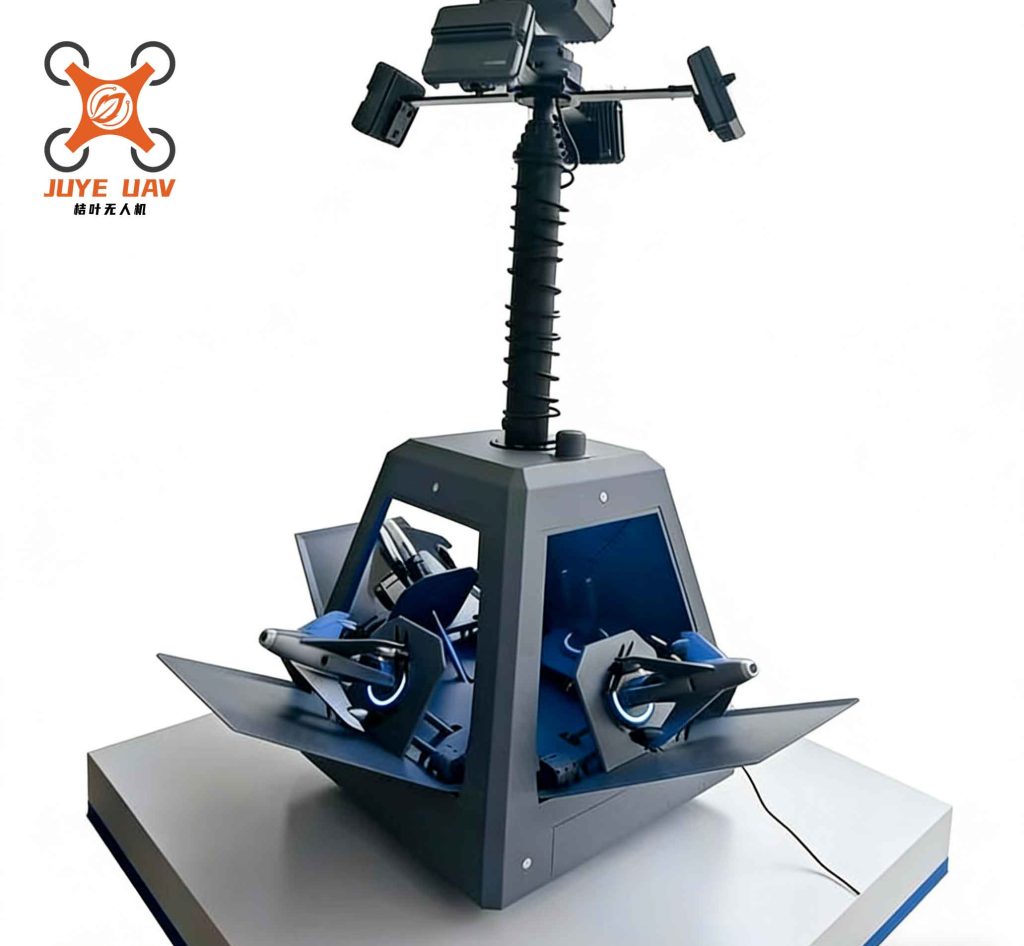
To implement this joint detection network, I propose deploying a mix of fixed and mobile platforms, including ground stations, aerial vehicles, and even our own drone swarms for reconnaissance. These platforms can host sensors like radar or EO pods, forming an agile, networked detection grid. For example, forward-deployed UAVs equipped with sensors can extend our detection range and provide persistent surveillance over key areas. The integration of data from these distributed sources is critical, which leads to the next component: multi-source information fusion. A visual representation of this multi-domain anti-drone detection concept is shown below, illustrating how various sensors work together to cover different altitudes and ranges.
Once detection data is collected, the challenge shifts to processing and interpreting it to build a coherent situational picture. I have developed a hierarchical information fusion structure that operates in two main stages: low-level fusion for target tracking and identification, and high-level fusion for behavior analysis and intent recognition. This structure uses a publish/subscribe middleware to facilitate communication between modules, ensuring scalability and flexibility in anti-drone systems. Sensors publish preprocessed data, while fusion modules subscribe to relevant data streams and produce outputs for decision-making. The low-level fusion focuses on estimating the kinematic states (position, velocity) and attributes (type, identity) of drone swarm members. Given the density and coordination of swarms, traditional multi-target tracking methods often fall short. Therefore, I classify swarm tracking scenarios based on the inter-target spacing and sensor resolution, as outlined in the following table:
| Scenario Type | Description | Tracking Approach | Anti-Drone Implications |
|---|---|---|---|
| Global Dense Swarm Tracking | All swarm members are closely spaced, unresolved by sensors. | Dense group target tracking to estimate centroid trajectory. | Critical for initial swarm detection; provides overall movement direction for anti-drone interception planning. |
| Local Dense + Global Sparse Tracking | Swarm splits into sub-swarms (e.g.,侦察,干扰 groups); internally dense but sub-swarm centroids are spaced apart. | Dense tracking for each sub-swarm centroid; sparse multi-target tracking for centroids. | Enables discrimination of functional groups within the swarm, aiding in prioritized anti-drone targeting. |
| Local Dense + Local Sparse Tracking | Mix of unresolved sub-swarms and resolved individual drones due to attrition or maneuvering. | Combination of dense and sparse tracking algorithms. | Reflects dynamic battlefield evolution; requires adaptive anti-drone responses to handle both clusters and singletons. |
| Global Sparse Tracking | Swarm members are sufficiently spaced for sensor resolution. | Conventional multi-target tracking (e.g., MHT, Kalman filter). | Simpler case; allows direct tracking of each drone, facilitating precise anti-drone engagement. |
For dense swarm tracking, which is most challenging and relevant for anti-drone operations, I employ a framework that includes group detection, separation/merge detection, extended shape estimation, data association, and state filtering. Group detection algorithms partition measurements into subsets belonging to the same swarm. A common distance-based method uses a threshold derived from the measurement noise covariance. Given two measurements \( \mathbf{z}_1^k \) and \( \mathbf{z}_2^k \) at time \( k \), with measurement noise covariance \( \mathbf{R}_k \), they are grouped if:
$$( \mathbf{z}_1^k – \mathbf{z}_2^k )^T \mathbf{R}_k^{-1} ( \mathbf{z}_1^k – \mathbf{z}_2^k ) < \delta_{P_G}$$
where \( \delta_{P_G} \) is a threshold based on probability \( P_G \). For more robust partitioning, especially for neighboring groups, improved methods like sub-partitioning or coordinate mapping can be used. Clustering techniques such as K-means or spectral clustering also offer alternatives. Separation and merge detection handles dynamic changes in swarm structure, such as when a swarm splits into sub-groups or merges with another. I often use an evolving graph model where nodes represent targets and edges represent relationships, with Mahalanobis distance determining splits or merges. To avoid subjective thresholds, machine learning models like kernel Fisher discriminant analysis can automate this process. Extended shape estimation is vital for understanding the swarm’s spatial footprint. I model the swarm shape as an ellipse using random matrices, where the state includes both centroid kinematics and extension parameters. The Bayesian recursion jointly estimates these, with the random matrix approach being popular due to its simplicity and robustness. For more complex shapes, methods like random hypersurface models (RHM) or level-set RHM can approximate arbitrary contours. The state evolution and measurement models often involve linear Gaussian assumptions, with the centroid motion modeled as:
$$\mathbf{x}_k^c = \mathbf{F}_k \mathbf{x}_{k-1}^c + \mathbf{w}_k^c$$
where \( \mathbf{x}_k^c \) is the centroid state (e.g., position, velocity), \( \mathbf{F}_k \) is the state transition matrix, and \( \mathbf{w}_k^c \) is process noise. The extension, represented by a random matrix \( \mathbf{X}_k^e \), might evolve as:
$$\mathbf{X}_k^e = \mathbf{\Gamma}_k \mathbf{X}_{k-1}^e \mathbf{\Gamma}_k^T + \mathbf{W}_k^e$$
where \( \mathbf{\Gamma}_k \) scales the extension and \( \mathbf{W}_k^e \) is noise. Measurements are related to both centroid and extension, leading to a coupled estimation problem.
Data association and filtering in dense swarms are computationally intensive. Traditional methods like multiple hypothesis tracking (MHT) can be used, but I prefer random finite set (RFS) filters that avoid explicit data association. The probability hypothesis density (PHD) filter propagates the intensity function of the RFS, but it has high variance in cardinality estimation. The cardinalized PHD (CPHD) filter improves cardinality accuracy but increases complexity. For labeled tracks, the generalized labeled multi-Bernoulli (GLMB) filter provides trajectories but is also complex. The choice depends on the anti-drone system’s computational resources; for real-time applications, a simplified PHD filter might be suitable, whereas offline analysis could use GLMB. The PHD filter update equation is:
$$v_k(\mathbf{x}) = \int p_{S,k}(\zeta) f_{k|k-1}(\mathbf{x}|\zeta) v_{k-1}(\zeta) d\zeta + \int \beta_{k|k-1}(\mathbf{x}|\zeta) v_{k-1}(\zeta) d\zeta + \gamma_k(\mathbf{x})$$
where \( v_k \) is the PHD, \( p_{S,k} \) is survival probability, \( f_{k|k-1} \) is transition density, \( \beta_{k|k-1} \) is birth intensity, and \( \gamma_k \) is spawn intensity. For Gaussian mixtures, this can be implemented efficiently. These tracking algorithms feed into the high-level fusion module, which aims to recognize swarm behavior and intent—a critical aspect of anti-drone situational awareness.
Intent recognition transforms low-level tracking data into actionable intelligence about the swarm’s objectives, such as reconnaissance, jamming, or attack. Based on my research, I propose a hierarchical Bayesian network (HBN) approach for this task. The model operates at three levels: first, inferring individual sub-swarm behavior from kinematic and status features; second, aggregating temporal behavior sequences to deduce sub-swarm intent; and third, combining sub-swarm intents to infer the overall swarm intent. This structured reasoning handles uncertainties inherent in sensor data and adversarial deception. The behavior features are derived from tracked states and include categories like high-altitude cruise, low-altitude cruise, acceleration, dive, climb, and horizontal turn. Status features include radar on/off, jammer active, weapon launched, and electromagnetic silence. These are discretized into state spaces, as summarized below:
| Behavior/Status Feature | Type | State Space |
|---|---|---|
| Radar Status | Discrete | On, Off |
| Jammer Status | Discrete | On, Off |
| Weapon Launch | Discrete | Yes, No |
| EM Silence | Discrete | Yes, No |
| Altitude Profile | Continuous/Discretized | High, Medium, Low (based on thresholds) |
| Speed Change | Continuous/Discretized | Accelerating, Decelerating, Constant |
Using Bayesian inference, the probability of a sub-swarm intent \( x_w \) given observed behavior sequence \( t \) is computed as:
$$p(x_w | t) = \frac{p(t | x_w) p(x_w)}{\sum_{i=1}^{N} p(t | x_i) p(x_i)}$$
where \( N \) is the number of possible intents. Assuming conditional independence of behavior features given the intent, we have:
$$p(t | x_w) = \prod_{k=1}^{M} p(t_k | x_w)$$
with \( t_k \) being the behavior at time interval \( k \). The prior probabilities \( p(x_w) \) and likelihoods \( p(t_k | x_w) \) are learned from historical data or expert knowledge for anti-drone scenarios. For example, a sequence starting with high-altitude cruise followed by medium-altitude cruise with radar on might indicate reconnaissance intent, while a dive combined with weapon launch suggests strike intent. Once sub-swarm intents \( x_1, x_2, \ldots, x_n \) are inferred, the overall swarm intent \( z \) is derived via conditional probabilities in the HBN:
$$p(z) = p(x_1) \prod_{i=2}^{n} p(x_i | x_{i-1})$$
where \( p(x_i | x_{i-1}) \) represents the likelihood of intent \( x_i \) given \( x_{i-1} \), modeling typical swarm tactics. This probabilistic framework allows us to quantify uncertainty and update beliefs as new data arrives, enhancing the adaptability of anti-drone decision-making.
In conclusion, the anti-drone swarm situation awareness strategy I have presented integrates multi-domain detection with hierarchical information fusion to address the complex threat posed by UAV clusters. The joint detection network leverages complementary sensors to achieve robust coverage, while the fusion system enables precise tracking and intelligent intent recognition. This approach not only improves early warning but also supports targeted countermeasures, such as disrupting communication links or engaging launch platforms. Future work will involve validating this strategy through simulations and real-world experiments, incorporating advanced technologies like large language models for event extraction and reasoning. As drone swarm technology evolves, continuous innovation in anti-drone situational awareness will be essential to maintain defensive superiority. By refining these algorithms and integrating them into cohesive command and control systems, we can develop more effective anti-drone capabilities that safeguard critical infrastructure and operations from emerging aerial threats.