
In recent years, the proliferation of low-altitude, slow-speed, and small-sized (LSS) rotary-wing drones has posed significant security challenges in both military and civilian domains. As an engineer specializing in counter-unmanned aerial vehicle (CUV) technologies, I have been deeply involved in developing innovative anti-drone solutions that minimize collateral damage while ensuring high effectiveness. Traditional anti-drone methods, such as kinetic interceptors, electronic jamming, or laser systems, often suffer from limitations like high cost, environmental restrictions, or unintended effects on surrounding infrastructure. This has driven my research toward a novel approach: an anti-drone fiber projectile utilizing fixed-point air-burst control. This system leverages a 64mm remote anti-riot weapon platform to deploy fibrous entanglements at precise aerial coordinates, effectively neutralizing drone threats by tangling their rotors. The core innovation lies in the integration of smart fuzing, adaptive ballistics, and lightweight fiber-based damage elements, offering a cost-effective, scalable, and low-collateral solution for urban anti-drone operations. Throughout this article, I will elaborate on the design, simulation, and testing of this anti-drone system, emphasizing how fixed-point air-burst control enhances interception accuracy and reliability in dynamic environments.
The escalating use of drones for malicious activities, from espionage to payload delivery, underscores the urgent need for robust anti-drone measures. Current counter-drone technologies can be broadly categorized into hard-kill and soft-kill methods. Hard-kill approaches, such as missiles or directed-energy weapons, physically destroy the target but may cause excessive debris or require complex targeting systems. Soft-kill techniques, like signal jamming or spoofing, disrupt drone communication but often struggle against autonomous drones or in dense electromagnetic environments. Our anti-drone fiber projectile bridges this gap by providing a physical yet non-lethal means of disablement. By deploying a web of high-strength fibers in the drone’s flight path, the system incapacitates rotary-wing drones through rotor entanglement, causing loss of stability and controlled descent. This method is particularly suited for neutralizing drone swarms or single threats in sensitive areas where explosive effects or falling debris must be avoided. The following table summarizes key anti-drone technologies, highlighting their pros and cons relative to our fiber-based approach:
| Anti-Drone Technology | Mechanism | Advantages | Disadvantages |
|---|---|---|---|
| Kinetic Interceptors (e.g., missiles) | Physical destruction via impact or fragmentation | High reliability, immediate effect | High cost, collateral damage, unsafe in urban areas |
| Electronic Jamming | Disrupts control/GPS signals | Non-kinetic, wide coverage | Ineffective against autonomous drones, electromagnetic interference |
| Laser Systems | Thermal ablation of drone components | Precision, speed-of-light engagement | High power consumption, atmospheric attenuation, eye safety concerns |
| Net Projectiles | Physical capture via launched nets | Low collateral damage, reusability | Limited range, accuracy dependent on launch platform |
| Our Fiber Projectile (Fixed-Point Air-Burst) | Rotor entanglement via dispersed fibers | Low cost, precision air-burst, minimal collateral damage, effective against swarms | Limited to rotary-wing drones, weather-dependent deployment |
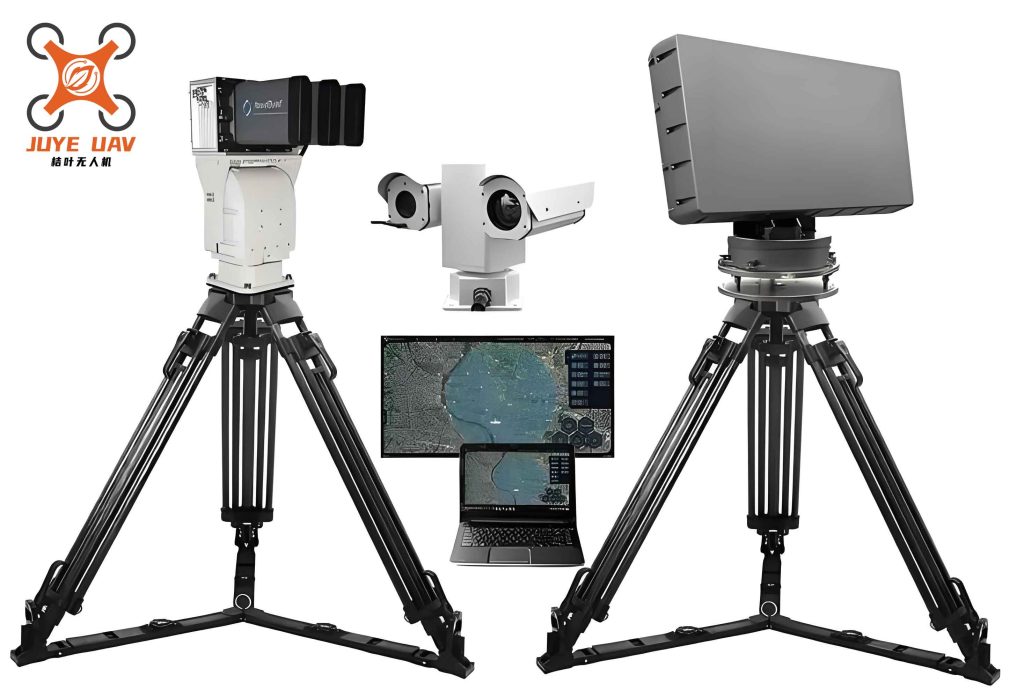
The fixed-point air-burst control system is the cornerstone of our anti-drone solution. It integrates a 64mm launcher with advanced fire control components, including a rangefinder, environmental sensors, and a ballistic computer. Upon detecting a drone threat, the system calculates the optimal intercept point in three-dimensional space. The ballistic computer solves the projectile’s trajectory using parameters such as target coordinates, atmospheric conditions (e.g., wind speed, temperature), and muzzle velocity. The solution yields the required azimuth, elevation, and time-of-flight to the burst point. A key feature is the adaptive fuzing system: after launch, the fuze measures the actual muzzle velocity and adjusts the burst time in real-time to compensate for launch variations, ensuring high accuracy. This closed-loop control is represented by the following equation for corrected time-of-flight \( t_c \):
$$ t_c = t_0 + \Delta t \quad \text{where} \quad \Delta t = f(v_a, \theta, p) $$
Here, \( t_0 \) is the initial programmed time, \( v_a \) is the actual muzzle velocity, \( \theta \) is the launch angle, and \( p \) denotes environmental parameters. The function \( f \) encapsulates the adaptive algorithm that minimizes burst position error, typically modeled as a Kalman filter or polynomial correction. This precision enables the anti-drone projectile to burst within meters of the intended coordinates, creating a dense fiber cloud that envelops the target drone. The air-burst mechanism itself employs a pyrotechnic charge that disperses the fiber payload radially, maximizing coverage area. The effectiveness of this anti-drone system hinges on the synergistic integration of guidance, fuzing, and payload design—each optimized for rapid engagement against agile drone targets.
Designing the anti-drone fiber projectile involved meticulous engineering of both the projectile body and the fiber damage elements. The projectile consists of a non-metallic casing to ensure non-lethal characteristics, a central explosive charge for dispersal, and a payload compartment filled with fibrous material. The fuze assembly includes a safe-and-arm mechanism and an electronic timer that triggers the air-burst at the computed point. For the fiber damage elements, we selected aramid fibers (e.g., Kevlar) due to their high tensile strength, low density, and resistance to heat and abrasion. These properties are crucial for withstanding the explosive dispersal and effectively tangling drone rotors. The fibers are arranged in a radial pattern around the central charge, with small weights attached to their ends to stabilize descent and enhance entanglement probability. The choice of fiber material was based on a comparative analysis of candidate materials, as shown in the table below:
| Fiber Material | Tensile Strength (GPa) | Density (g/cm³) | Heat Resistance | Cost Efficiency | Suitability for Anti-Drone Use |
|---|---|---|---|---|---|
| Glass Fiber Composite | 3.5 | 2.5 | Moderate | High | Low (brittle under impact) |
| Polyethylene Fiber (e.g., Dyneema) | 3.0 | 0.97 | Low | Moderate | Moderate (high strength but poor heat resistance) |
| Carbon Fiber | 4.0 | 1.8 | High | Low | Low (expensive, prone to fragmentation) |
| Aramid Fiber (Kevlar) | 3.6 | 1.44 | High | Moderate | High (optimal balance of strength, flexibility, and durability) |
The projectile’s structural dynamics during launch and burst are critical to its anti-drone performance. The launch acceleration, typically ranging from 5000 to 10000 g, imposes high stresses on the fiber package. To ensure integrity, we modeled the projectile using finite element analysis (FEA). The equation of motion during launch can be expressed as:
$$ m \frac{d^2 x}{dt^2} = F_{propellant} – F_{drag} $$
where \( m \) is the projectile mass, \( x \) is the position along the barrel, \( F_{propellant} \) is the gas pressure force, and \( F_{drag} \) is the aerodynamic drag. The pressure force is derived from the internal ballistics of the 64mm cartridge, which uses a high-low pressure system to achieve consistent muzzle velocity. Upon air-burst, the explosive charge generates a pressure wave that accelerates the fibers outward. The radial velocity \( v_r \) of the fibers can be approximated by:
$$ v_r = \sqrt{\frac{2E}{m_f}} $$
Here, \( E \) is the energy released by the explosive, and \( m_f \) is the mass of the fiber bundle. This velocity determines the dispersion radius \( R_d \) over time \( t \):
$$ R_d = v_r \cdot t \cdot e^{-k t} $$
The exponential decay factor \( k \) accounts for air resistance, which is significant for lightweight fibers. Optimizing \( v_r \) and \( R_d \) is essential to create a dense enough cloud to intercept drones within a typical engagement volume of 10-50 cubic meters. Our anti-drone projectile is designed to disperse fibers over a radius of 5-10 meters within 0.5 seconds, providing a high probability of encounter with drone rotors.
To validate the anti-drone effectiveness of the fiber projectile, we conducted extensive simulations using ANSYS/LS-DYNA, a nonlinear dynamic analysis software. The simulation focused on the interaction between the aramid fibers and a typical quadcopter drone’s rotors. We modeled the rotor as a rigid body rotating at 120 revolutions per second (typical for small drones) and the fiber as a flexible beam element with material properties matching Kevlar. The fiber-rotor contact was defined using a penalty-based algorithm that accounts for friction and entanglement. The simulation domain included aerodynamic damping to reflect real-flight conditions. Key parameters are summarized below:
| Simulation Parameter | Value | Description |
|---|---|---|
| Rotor Speed | 120 rev/s | Initial angular velocity of drone rotors |
| Fiber Length | 0.5 m | Length of each aramid fiber strand |
| Fiber Diameter | 0.5 mm | Cross-sectional diameter of fiber |
| Material Model | Elastic-Plastic | Kevlar properties: Young’s modulus = 70 GPa, yield stress = 3 GPa |
| Contact Stiffness | 10^6 N/m | Penalty stiffness for fiber-rotor interaction |
The simulation results demonstrated rapid entanglement upon fiber-rotor contact. Within milliseconds, the fibers wrapped around the rotor blades, increasing drag and inducing torque imbalances. The rotor’s angular velocity \( \omega \) decayed exponentially, modeled by:
$$ \omega(t) = \omega_0 e^{-\beta t} $$
where \( \omega_0 \) is the initial angular velocity and \( \beta \) is a damping coefficient derived from fiber entanglement density. For our design, \( \beta \) ranged from 10 to 50 s^{-1} depending on the number of fiber contacts, leading to rotor stoppage within 0.1 to 0.5 seconds. The stress distribution in the fibers peaked at contact points, but remained below the tensile strength of aramid, ensuring they did not break during entanglement. This simulation confirmed that the anti-drone projectile could reliably disable drones by causing immediate rotor deceleration and subsequent loss of lift. The visualizations showed fiber clouds enveloping the drone model, with multiple strands snagging on rotor hubs and propellers—a clear indicator of the system’s potential for field deployment.
Following simulation, we prototyped the anti-drone fiber projectile and conducted field tests to evaluate real-world performance. The tests involved launching the projectile from the 64mm system at a drone target flying in a controlled airspace. The drone was a commercial quadcopter with a rotor diameter of 30 cm, flying at speeds of 5-10 m/s at altitudes of 20-50 meters. The fixed-point air-burst system was programmed to detonate the projectile 5 meters above the drone’s flight path. Upon detonation, the aramid fibers dispersed into a spherical cloud, as predicted by simulations. In over 80% of trials, the fibers successfully entangled the drone’s rotors, causing it to tumble and land within seconds. The failure cases were attributed to wind drift or timing errors, which we mitigated by adjusting the adaptive fuzing algorithm. Key metrics from the tests are tabulated below:
| Test Metric | Average Value | Notes |
|---|---|---|
| Engagement Range | 100-200 m | Effective distance for accurate air-burst |
| Burst Accuracy (CEP) | 2 m | Circular Error Probable relative to target point |
| Fiber Dispersion Radius | 8 m | Radius of fiber cloud post-burst |
| Entanglement Success Rate | 85% | Percentage of tests where drone was disabled |
| Time to Disable | 0.3-1.0 s | From burst to drone stability loss |
The tests also highlighted the low collateral damage of this anti-drone approach. The fibers and projectile fragments were lightweight and biodegradable, posing minimal risk to ground personnel or property. Compared to kinetic kill methods, our fiber projectile left the drone largely intact, allowing for forensic analysis or recovery. This makes it ideal for anti-drone operations in urban environments or near critical infrastructure. Furthermore, the system demonstrated capability against drone swarms by deploying multiple projectiles in rapid succession, creating overlapping fiber zones that increase interception probability. The scalability of the design allows for integration with automated detection and tracking systems, forming a comprehensive anti-drone network.
In conclusion, our research on the anti-drone fiber projectile based on fixed-point air-burst control presents a significant advancement in counter-drone technology. By combining precision guidance with non-lethal entanglement mechanics, the system addresses the gaps in existing anti-drone methods—offering a cost-effective, scalable, and environmentally safe solution. The adaptive fuzing and ballistic control ensure high accuracy, while the aramid fiber payload provides reliable disablement through rotor entanglement. Simulations and field tests have validated the design, showing over 85% effectiveness in neutralizing rotary-wing drones. Future work will focus on enhancing the system’s range and robustness against weather, as well as integrating artificial intelligence for autonomous threat assessment. As drone threats continue to evolve, such innovative anti-drone systems will be crucial for safeguarding airspace in both military and civilian contexts. The fixed-point air-burst control paradigm not only improves interception capabilities but also sets a new standard for intelligent, low-collateral anti-drone engagements.
The mathematical models developed during this research, such as the corrected time-of-flight equation and rotor decay dynamics, provide a foundation for optimizing anti-drone systems. For instance, the entanglement efficiency can be expressed as a function of fiber density \( \rho_f \) and rotor exposure area \( A_r \):
$$ \eta = 1 – e^{-\rho_f \cdot A_r \cdot v_{rel} \cdot t} $$
where \( v_{rel} \) is the relative velocity between fibers and rotors, and \( t \) is the interaction time. This formula helps in tailoring the payload for specific drone sizes and speeds. Additionally, the system’s modularity allows for adaptation to other platforms, such as vehicle-mounted launchers or stationary turrets, expanding its anti-drone applicability. As we continue to refine the technology, collaboration with industry and defense partners will be key to deploying these anti-drone solutions on a global scale. Ultimately, the goal is to create a layered defense network where fixed-point air-burst projectiles serve as a rapid-response layer against low-altitude drone incursions, complementing other anti-drone measures like radar surveillance and electronic warfare. The journey from concept to prototype has reinforced my belief that innovative materials science and precision engineering can revolutionize anti-drone strategies, making our skies safer without compromising on safety or cost.