
In modern agriculture, the fight against crop diseases and pests is constant and critical to ensuring food security. My experience in crop protection has evolved dramatically with the advent of precision agricultural technologies. Among these, the agricultural UAV, or Unmanned Aerial Vehicle, has emerged as a transformative tool, particularly for staple crops like wheat. The transition from manual, labor-intensive methods to automated, intelligent spraying represents a significant leap forward. This article details my first-hand perspective on the application, advantages, and future of agricultural UAV technology in wheat disease and pest management, supported by technical data, comparative analyses, and predictive models.
The core challenge in wheat protection lies in the timely and effective application of control measures across vast and sometimes difficult-to-access fields. Traditional methods, whether manual knapsack spraying or tractor-mounted boom sprayers, are often hampered by inefficiency, high labor costs, uneven application, and soil compaction. The introduction of the agricultural UAV addresses these issues directly. From my operational viewpoint, an agricultural UAV is not merely a flying sprayer; it is an integrated system of precision navigation, variable-rate application, and real-time data acquisition. The ability to deploy these systems rapidly has changed the fundamental approach to integrated pest management (IPM).
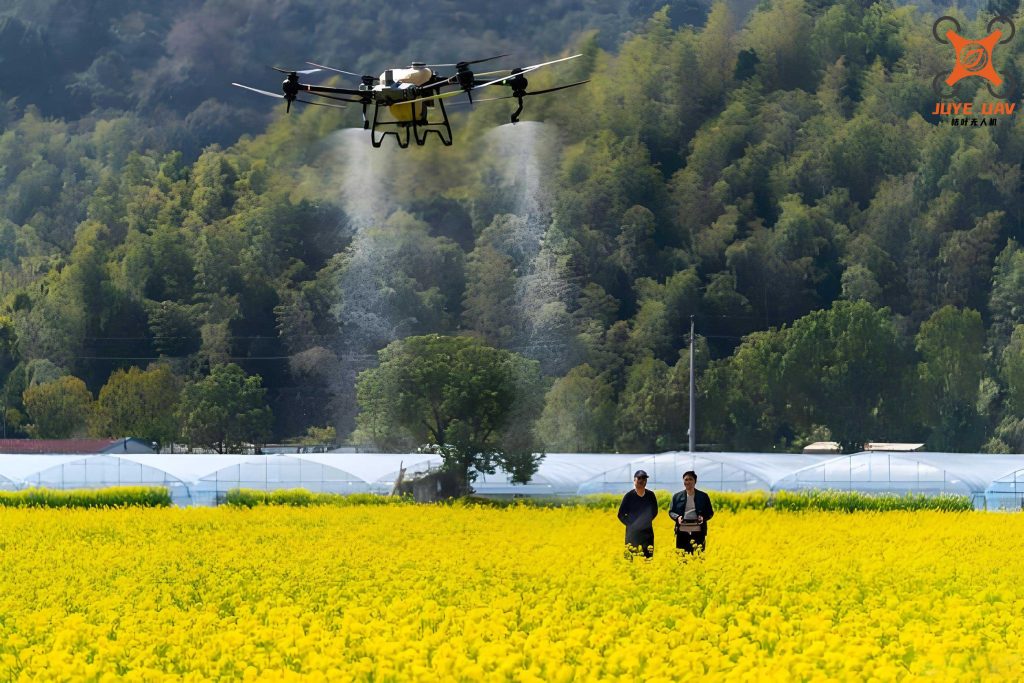
The operational advantages of the agricultural UAV are quantifiable and profound. First, efficiency: a single agricultural UAV can cover an area that would require dozens of workers per day. Second, precision: GPS-guided flight paths ensure complete coverage without overlap or missed spots, a common issue with manual methods. Third, safety: operators control the agricultural UAV from a distance, eliminating direct exposure to chemicals. Fourth, accessibility: drones can easily operate in wet, muddy, or rugged terrain where heavy machinery would be useless or damaging. Finally, resource conservation: targeted spraying reduces pesticide and water volume by 30-50% compared to conventional methods, aligning with sustainable agricultural goals.
To systematically understand the shift, a comparison between traditional and UAV-based plant protection is essential.
| Parameter | Traditional Manual/Knapsack Spraying | Tractor-Mounted Boom Spraying | Agricultural UAV Spraying |
|---|---|---|---|
| Operational Efficiency (ha/hour) | 0.1 – 0.3 | 2 – 4 | 6 – 12 |
| Labor Required (per 100 ha) | 25-35 person-days | 3-5 person-days (driver + helper) | 1-2 person-days (pilot + helper) |
| Water Consumption (L/ha) | 450 – 600 | 200 – 300 | 15 – 30 |
| Chemical Usage Reduction | Baseline (0%) | 10-20% | 30-50% |
| Field Accessibility | Good (but laborious) | Poor (requires dry, firm ground) | Excellent (independent of ground conditions) |
| Application Uniformity (Coefficient of Variation) | High (>40%) | Medium (20-30%) | Low (<15%) |
| Soil Compaction Risk | None | High | None |
The efficiency of an agricultural UAV can be modeled mathematically. The effective area coverage rate \( R \) (in hectares per hour) is a function of several key parameters:
$$ R = \frac{W \cdot V \cdot E}{10000} $$
Where:
- \( W \) = Effective spray swath width (meters)
- \( V \) = Average operational flight speed (meters per hour)
- \( E \) = Operational efficiency factor (accounting for turn-around, refilling; typically 0.7-0.85)
- 10000 = Conversion factor from m² to hectares
For a typical agricultural UAV with a swath width of 5 meters, flying at 18 km/h (5 m/s or 18000 m/h), with an efficiency factor of 0.75, the coverage rate is:
$$ R = \frac{5 \times 18000 \times 0.75}{10000} = 6.75 \text{ ha/hour} $$
This quantifies the dramatic productivity gain.
Wheat is susceptible to a complex of diseases and pests whose management requires precise timing. The major targets for agricultural UAV application include:
| Pest/Disease | Critical Growth Stage for Control | Typical UAV Spray Strategy | Key Advantage of UAV |
|---|---|---|---|
| Wheat Aphid | Heading to Grain Filling | Ultra-low volume (ULV) application of systemic insecticides (e.g., imidacloprid). | Rapid response to localized outbreaks; excellent canopy penetration from above. |
| Powdery Mildew | Stem Extension to Flag Leaf Emergence | Preventative fungicide application (e.g., triazoles) before disease establishment. | Uniform coverage on upper and lower leaf surfaces due to rotor downwash. |
| Fusarium Head Blight (Scab) | Flowering (Anthesis) | Very precise application of fungicides (e.g., tebuconazole, prothioconazole) during a narrow 3-5 day window. | Unmatched timing precision; ability to operate during wet conditions when tractors cannot enter fields. |
| Rusts (Stripe, Leaf) | From Tillering Onwards | Curative or protectant fungicide application upon scouting detection. | Swift area-wide treatment to prevent spore spread across large regions. |
| Armyworms/Cutworms | Seedling to Early Vegetative Stages | Night-time application of insecticides, as larvae are most active. | Ability to operate safely and effectively at night with pre-programmed GPS routes. |
The efficacy of an agricultural UAV spray is heavily dependent on the quality of droplet deposition. The downwash airflow generated by the rotors is a crucial factor. It can be described in relation to canopy penetration and deposition uniformity. The droplet deposition density \( D_d \) (droplets/cm²) at a canopy layer is influenced by the air velocity \( U \) from the rotors and the droplet size spectrum (expressed as Volume Median Diameter, \( D_{v0.5} \)):
$$ D_d \propto \frac{k \cdot Q}{U \cdot D_{v0.5}^2} $$
Where \( Q \) is the application rate (L/ha) and \( k \) is a system constant. This simplified model shows that for a given application rate, stronger downwash (higher \( U \)) and smaller droplets (within effective range) improve penetration and deposition density on lower leaves and stems, which is critical for controlling diseases like rust that start in the lower canopy.
The economic justification for adopting agricultural UAV technology is compelling. Beyond labor savings, the precision leads to direct input savings and indirect yield preservation. A cost-benefit analysis over a 100-hectare wheat farm for one growing season reveals the following:
| Cost/Benefit Category | Traditional Spraying (Tractor) | Agricultural UAV Service | Notes |
|---|---|---|---|
| Fixed Cost (Machine Depreciation) | $1,200 | $2,500 | Higher for UAV due to technology. |
| Variable Cost: Labor | $800 | $300 | Based on local wage rates. |
| Variable Cost: Pesticide | $4,000 | $2,800 | 30% reduction assumed for UAV. |
| Variable Cost: Fuel/Electricity | $400 | $150 | Electric UAVs are cheaper to operate. |
| Total Operational Cost | $6,400 | $5,750 | |
| Potential Yield Loss from Poor Timing/Ineffectiveness | 8% (Valued at $4,800) | 3% (Valued at $1,800) | UAV’s timeliness and efficacy reduce loss. |
| Net Economic Impact (Cost + Avoided Loss) | $11,200 | $7,550 | |
| Savings per 100 ha from UAV Adoption | $3,650 | Significant return on investment. | |
This analysis clearly demonstrates that while the capital cost of an agricultural UAV system is higher, the operational savings and yield protection create a strong economic case for adoption, typically achieving payback within 1-2 growing seasons for a medium-sized farm or service provider.
The technical specifications of modern agricultural UAV platforms are diverse. Selecting the right platform depends on the farm size, topography, and crop type. Here is a comparison of common types used in wheat production:
| UAV Type | Typical Payload Capacity (L) | Battery Endurance (per sortie) | Best Suited For | Key Feature |
|---|---|---|---|---|
| Multi-rotor (Quadcopter) | 5 – 10 | 10-15 minutes | Small, irregular fields; spot treatment. | High maneuverability, lower cost. |
| Multi-rotor (Hexa/Octocopter) | 10 – 20 | 12-20 minutes | Medium-sized fields; standard operations. | Good balance of payload, stability, and cost. |
| Fixed-Wing Hybrid VTOL | 15 – 30 | 30-60 minutes | Large, contiguous flat fields. | Highest coverage efficiency per charge. |
From an operational standpoint, the workflow with an agricultural UAV is systematic. It begins with mission planning using satellite or UAV-derived maps. The field boundaries are digitized, and no-fly zones (e.g., water bodies, houses) are marked. The flight path, altitude (typically 2-3 meters above crop), speed, and application rate are set in the ground control software. The application rate \( AR \) in L/ha is calculated by the software based on nozzle flow rate \( F \) (L/min), speed \( V \), and swath \( W \):
$$ AR = \frac{600 \cdot F}{V \cdot W} $$
After loading the tank with the properly mixed chemical, the mission is uploaded, and the agricultural UAV executes the flight autonomously. The operator monitors telemetry (battery level, liquid level, position) and is ready to intervene if necessary. Post-flight, data logs are saved for record-keeping and analysis, forming the basis for a digital history of field operations.
The future of agricultural UAV technology is intrinsically linked to data and intelligence. The next generation of agricultural UAV platforms are evolving into integrated sensing and treatment systems. They are equipped with multispectral or hyperspectral cameras that can perform remote sensing during the spray mission itself. This allows for the detection of biotic (pest/disease) and abiotic (nutrient, water) stress using vegetation indices like the Normalized Difference Vegetation Index (NDVI):
$$ NDVI = \frac{(NIR – Red)}{(NIR + Red)} $$
Where \( NIR \) is near-infrared reflectance and \( Red \) is red reflectance. Areas with low NDVI within a field may indicate disease patches or pest infestation. The true revolution lies in real-time processing of this data to enable on-the-spot variable rate application (VRA). The agricultural UAV would automatically adjust the spray output over these stressed areas, applying more product only where needed, pushing input savings and environmental benefits even further. This moves practice from calendar-based spraying to true prescription plant protection.
Furthermore, swarm technology is on the horizon, where multiple agricultural UAV units coordinate to cover a field simultaneously, managed by a single operator. The efficiency gain from this is multiplicative. The total area covered by a swarm of \( n \) identical drones in time \( t \) can be modeled as:
$$ A_{swarm} = n \cdot R \cdot t $$
This makes large-scale, ultra-fast response to disease outbreaks (like wheat rust or locust swarms) a practical reality, safeguarding regional food security.
In conclusion, the integration of agricultural UAV technology into wheat production systems is a paradigm shift. It represents the convergence of aerospace engineering, precision agriculture, and integrated pest management. The benefits—quantifiable in terms of efficiency, resource savings, economic return, and environmental stewardship—are undeniable. As the technology continues to advance, becoming more intelligent, autonomous, and integrated with farm management systems, its role will only become more central. For any agricultural region focused on sustainable intensification and resilience, the widespread adoption and skilled operation of agricultural UAV platforms is not merely an option; it is an imperative for the future of food production. The view from the ground, watching an agricultural UAV work its precise pattern over a golden wheat field, is a view into the future of farming itself.