
The advent of precision agriculture has ushered in a new era of efficiency and sustainability. Among its most transformative tools is the agricultural UAV, or unmanned aerial vehicle, which has rapidly evolved from a novel concept to an indispensable asset in modern crop protection. From my professional perspective, the integration of agricultural UAV technology into rice cultivation, specifically for pest and disease control, represents a paradigm shift. This technology addresses critical challenges of labor shortage, environmental impact, and operational precision in one of the world’s most vital staple crops. The core function of an agricultural UAV in this context is the precise, automated application of plant protection agents, but its role extends far beyond mere spraying. It serves as a data collection platform, a decision-support tool, and a catalyst for green farming practices. This article provides a comprehensive analysis of the application effects, strategies, challenges, and future pathways for agricultural UAVs in managing the complex spectrum of rice pests and diseases.
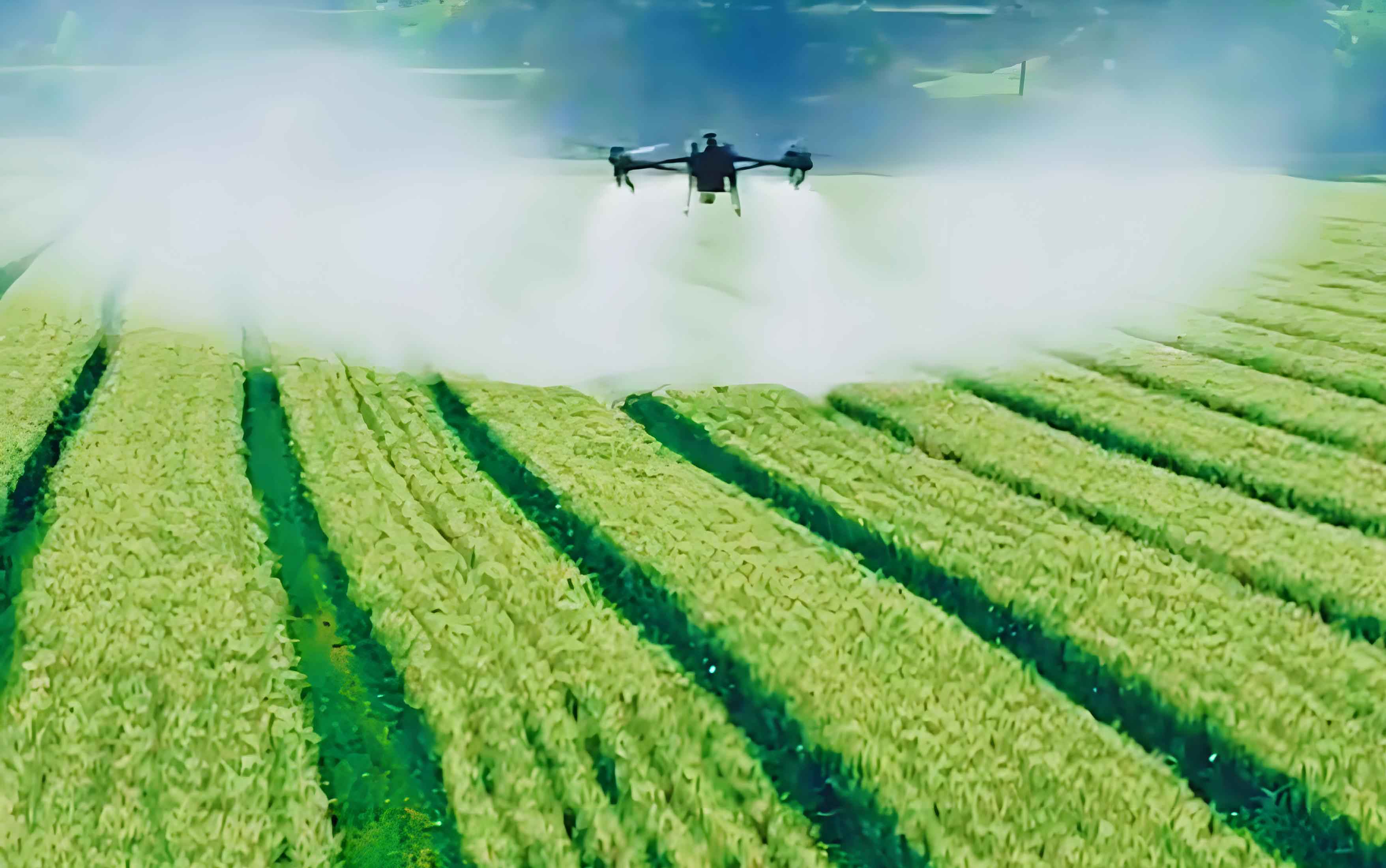
An agricultural UAV is a sophisticated aerial system engineered for farm operations. Typically multi-rotor for superior stability and maneuverability, these drones are equipped with tanks, pumps, and an array of nozzles designed for ultra-low volume (ULV) spraying. The defining operational principle is the generation of a strong downward airflow by the rotors. This downdraft forcefully penetrates the rice canopy, causing leaves to flutter and expose their undersides, while simultaneously atomizing the sprayed liquid into fine droplets that are driven onto all plant surfaces. This results in a uniform and adherent protective film. The intelligence of an agricultural UAV lies in its integrated flight control system, often coupled with Global Navigation Satellite System (GNSS) and Real-Time Kinematic (RTK) positioning, enabling centimeter-level accuracy in autonomous flight path execution. This allows for repeatable, precise application according to pre-programmed maps, eliminating human error and exposure.
Multifaceted Advantages and Quantitative Impact of Agricultural UAVs
The transition from manual and tractor-mounted spraying to agricultural UAV-based application delivers profound advantages across operational, economic, agronomic, and environmental dimensions.
| Aspect | Traditional Methods (Manual/Tractor) | Agricultural UAV Application | Quantitative Improvement / Key Metric |
|---|---|---|---|
| Operational Efficiency | Highly labor-intensive; slow coverage (0.2-0.5 ha/hr per person). | Extremely high; can cover 4-8 ha per hour per unit. | Efficiency increase of 15-40x. Allows for timely intervention during short disease/pest windows. |
| Terrain Adaptability | Limited by ground conditions; inaccessible to wet, muddy, or terraced fields. | Superior; operates independent of ground conditions, ideal for fragmented, wet, or sloped terrain. | Enables protection of 100% of planted area, including previously “no-spray” zones. |
| Resource Utilization | High water volume (300-600 L/ha); significant chemical runoff and drift. | Ultra-Low Volume (ULV) spraying (10-20 L/ha); targeted deposition. | Water savings of 90-95%. Potential chemical reduction of 20-30% while maintaining efficacy. |
| Application Uniformity & Penetration | Inconsistent coverage, especially in lower canopy; high droplet density variance. | High uniformity due to downdraft and precise control; excellent canopy penetration. | Spray deposition coefficient of variation (CV) often below 20%, compared to >40% for manual methods. |
| Safety Profile | High risk of operator exposure to chemicals and heat-related illness. | Operator remains at a safe distance, eliminating direct exposure. | Virtually eliminates occupational pesticide poisoning incidents among applicators. |
| Data & Precision Integration | Limited to subjective visual assessment. | Can be integrated with multispectral sensors for variable-rate application based on crop health maps. | Enables site-specific management, optimizing input use and targeting problem areas precisely. |
The operational superiority can be modeled by comparing the effective work rate. For a manual sprayer:
$$E_{manual} = \frac{A}{t_{manual} \times N_{labor}}$$
where $E_{manual}$ is the efficiency (ha/hour/person), $A$ is area, $t_{manual}$ is time taken, and $N_{labor}$ is number of workers. For an agricultural UAV:
$$E_{UAV} = \frac{A}{t_{flight} + t_{reload}}$$
Here, $E_{UAV}$ is significantly higher as $t_{flight}$ for a single battery/tank cycle is short, and $t_{reload}$ is minimal. The ratio $\frac{E_{UAV}}{E_{manual}}$ typically falls between 15 and 40.
The environmental and economic benefit stems from precise droplet deposition. The downwash airflow ($F_d$) of an agricultural UAV ensures droplets of optimal size (Volume Median Diameter, VMD ~ 100-200 µm) are transported to the target. The deposition efficiency $\eta_d$ can be conceptualized as:
$$\eta_d \propto \frac{F_d \cdot C_{droplet}}{V_{wind} \cdot H_{flight}}$$
where a higher downwash force ($F_d$) and appropriate droplet characteristics ($C_{droplet}$) counteract wind speed ($V_{wind}$) and flight height ($H_{flight}$), maximizing on-target deposition and minimizing drift. This precise targeting is why an agricultural UAV application can achieve equal or better control efficacy with reduced chemical load, directly contributing to sustainable rice production.
Strategic Application Framework for Key Rice Pests and Diseases
Effective deployment of an agricultural UAV is not merely about flying and spraying; it is a systematic process requiring careful planning and parameter optimization. The strategy must be tailored to the specific biology of the target pest or pathogen.
| Target Pest/Disease | Application Strategy & Timing | Recommended UAV Parameters | Agrochemical Considerations |
|---|---|---|---|
| Stem Borers (e.g., Yellow Stem Borer) | Target egg mass and early larval stage before borer enters stem. Critical window: tillering to panicle initiation. | Lower flight height (~1.5-2.0 m) for strong canopy penetration. Slower flight speed (3-4 m/s). | Use systemic insecticides. Ensure high spray volume concentration for residual effect. |
| Leaf Folder/ Roller (e.g., Rice Leaf Roller) | Spray during early larval stages when larvae are exposed. Evening applications can be more effective as pests are active. | Medium height (2.0-2.5 m) to create leaf turbulence. Standard speed (4-5 m/s). | Contact or translaminar insecticides. Fine to medium droplet spectrum for adhesion to rolled leaves. |
| Planthoppers (Brown, White-backed) | Apply at first sighting or based on economic threshold levels. Focus on base of plants where hoppers congregate. | Use strong downwash settings. Flight height 1.8-2.2 m. Consider swath width adjustment for dense canopy. | Systemic insecticides preferred. Tank-mixing with synergists or oils may enhance efficacy through better spreading. |
| Blast (Leaf & Neck) | Preventive application is key. Apply fungicide before forecasted favorable conditions (high humidity, cool temp). | Ensure extremely uniform coverage. Flight height 2.0-2.5 m. Overlap swaths by 30-50%. | Use protective and curative fungicides. Strobilurins and triazoles are common. Adjuvants to improve rainfastness. |
| Sheath Blight | Apply at disease onset, typically during late tillering/early jointing in dense, nitrogen-rich crops. | Focus on lower canopy. Very strong downdraft needed. Lower speed (3-4 m/s) for higher deposition in canopy. | Fungicides with good basipetal movement (systemic). High water volume rates may still be needed despite ULV. |
The core workflow for any agricultural UAV operation involves: 1) Pre-Flight Reconnaissance: Mapping the field boundaries, identifying no-fly zones (water bodies, homes, sensitive crops), and marking obstacles using GNSS. 2) Mission Planning: Using flight planning software to set the autonomous route, swath width ($W_s$), flight speed ($V$), flight height ($H$), and application rate ($Q$). The required flow rate for the nozzles ($R$) is calculated based on these parameters:
$$R = \frac{Q \cdot V \cdot W_s}{600}$$
where $R$ is in mL/min, $Q$ in L/ha, $V$ in m/s, and $W_s$ in meters. 3) Agrochemical Preparation: Employing a two-stage dilution process with compatible, preferably UAV-optimized formulations (e.g., SC, OD, WG) to prevent nozzle clogging. 4) Meteorological Assessment: Operating within strict environmental windows: wind speed < 4 m/s, temperature between 15-30°C, and no imminent rainfall. Flight direction should ideally be parallel to the wind direction to minimize drift. 5) Execution and Monitoring: Launching the agricultural UAV and monitoring its status, battery life, and spray cloud in real-time.
Current Challenges and Limiting Factors
Despite the clear benefits, the widespread adoption and optimal utilization of agricultural UAV technology face several significant hurdles.
1. Technical and Operational Skill Gap: Operating an agricultural UAV proficiently requires a hybrid skill set combining basic agronomy, understanding of pest dynamics, knowledge of spray technology, and technical drone piloting skills. There is a pronounced shortage of such skilled operators. Poor operation leads to issues like improper swath overlap (causing streaks of untreated areas), incorrect height adjustment (leading to drift or poor penetration), and failure to account for wind shifts, ultimately compromising control efficacy and wasting inputs.
2. Lack of Standardization and Regulatory Ambiguity: While the hardware for agricultural UAVs has advanced rapidly, operational standards are still evolving. Key functionalities like “breakpoint continuation” (where the drone automatically resumes spraying from the exact point it left off after a battery change) are not universally reliable. Furthermore, regulatory frameworks for commercial drone operations, including licensing, airspace restrictions, and spray application certification, vary greatly by region and are often unclear or restrictive, hindering professional service provision.
3. Formulation and Adjuvant Incompatibility: Most pesticides are formulated for high-volume dilution with conventional sprayers. When used at the ultra-low volumes typical of agricultural UAVs, issues with phytotoxicity, evaporation of fine droplets, insufficient rainfastness, and inadequate canopy penetration can arise. There is a critical need for dedicated “UAV-formulated” products with optimized surfactants, anti-evaporants, and deposition aids. The physics of droplet evaporation can be described by:
$$t_{evap} \propto \frac{d^2 \rho}{D_v \Delta c}$$
where $t_{evap}$ is evaporation time, $d$ is initial droplet diameter, $\rho$ is density, $D_v$ is diffusion coefficient of vapor, and $\Delta c$ is concentration gradient. UAV formulations aim to increase $t_{evap}$ by modifying droplet surface properties.
4. High Initial Investment and Service Model Fragmentation: The upfront cost of a capable agricultural UAV system, spare batteries, and transport vehicle can be prohibitive for individual smallholder farmers. While service provider models are emerging, they are often fragmented and lack standardized pricing and quality guarantees, creating trust issues among farmers accustomed to controlling their own operations.
Pathways for Enhanced Promotion and Integration
To overcome these challenges and fully unlock the potential of agricultural UAVs, a multi-pronged approach involving stakeholders across the agricultural value chain is essential.
1. Institutionalizing Education and Skill Development: Governments and agricultural universities must integrate agricultural UAV operation and agri-spray technology into vocational and higher education curricula. Certification programs, mandatory for commercial operators, should cover flight skills, agronomy, calibration, maintenance, and safety. Extension services should run frequent hands-on demonstration workshops to build farmer awareness and trust.
2. Fostering Technical Standardization and Regulatory Support: Industry associations and government agencies should collaborate to develop and enforce technical standards for agricultural UAVs used in spraying, mandating features like reliable RTK positioning, breakpoint continuation, and integrated flow calibration. Streamlined, science-based regulations for flight operations in agricultural zones are needed. Subsidy programs should be linked to the purchase of standardized, capable equipment.
3. Accelerating the Development of UAV-Optimized Inputs: Agrochemical companies must prioritize R&D for dedicated UAV formulations. These products should be engineered for high biological efficacy at low application volumes, with built-in adjuvants for deposition, retention, and rainfastness. The efficacy of such a formulation can be modeled as an optimization function:
$$\max f(Efficacy) = g(Deposition, Retention, Uptake) – h(Drift, Evaporation, Photolysis)$$
where the goal is to maximize the functional components ($g$) while minimizing losses ($h$) through tailored physicochemical properties.
4. Building Robust and Accessible Service Ecosystems: To make the technology accessible to all farmers, promoting the growth of professional agricultural UAV service providers (Custom Application Operators) is key. This can be supported by: a) Providing low-interest loans or grants for entrepreneurs to start service businesses. b) Developing digital platforms that connect farmers with nearby certified operators for on-demand service. c) Encouraging cooperative ownership of agricultural UAV equipment among farmer groups. d) Implementing area-based subsidy schemes that incentivize farmers to contract professional spraying services rather than applying chemicals themselves.
In conclusion, the agricultural UAV is far more than a flying sprayer; it is the cornerstone of a new, digitally-enabled approach to crop protection. Its demonstrated ability to enhance efficiency, reduce environmental footprint, improve worker safety, and enable precision application makes it a critical technology for the future of sustainable rice production. The current challenges are not insurmountable but rather signposts for focused investment in human capital, regulatory frameworks, product innovation, and service delivery models. As these elements converge, the agricultural UAV will transition from being a complementary tool to becoming the default standard for plant protection, ensuring food security and environmental stewardship in rice-growing regions worldwide.