
In recent years, the rapid advancement of unmanned aerial vehicle (UAV) technology has revolutionized various fields, with one of the most visually captivating applications being formation drone light shows. These spectacular displays involve multiple drones flying in precise patterns to create dynamic aerial images and animations, often synchronized with music or lighting effects. The success of such performances hinges on robust formation control algorithms that ensure accurate positioning, smooth trajectories, and real-time adaptability. As a researcher deeply involved in this domain, I have explored innovative control strategies to enhance the performance of formation drone light shows, focusing on improving responsiveness, stability, and scalability. This article delves into the intricacies of UAV formation control, presents a novel velocity feedforward-based approach, and demonstrates its efficacy through simulations and practical experiments. The insights shared here aim to contribute to the growing body of knowledge that pushes the boundaries of what is possible in aerial entertainment and beyond.
The essence of a formation drone light show lies in the seamless coordination of multiple drones to form intricate shapes and movements in the sky. Each drone acts as a pixel in a larger canvas, and any deviation from its intended path can disrupt the overall visual effect. Traditional control methods, such as proportional (P) or proportional-integral-derivative (PID) controllers, often struggle with issues like lag, overshoot, and steady-state errors, especially during complex maneuvers. These limitations become more pronounced in large-scale formations where communication delays and environmental disturbances are inevitable. To address these challenges, I have developed a control strategy that integrates feedforward and feedback mechanisms, leveraging real-time velocity data from a leader drone to enhance tracking performance. This approach not only accelerates response times but also minimizes errors, making it ideal for the high-precision demands of formation drone light shows. In the following sections, I will detail the theoretical foundations, implementation, and validation of this method, emphasizing its relevance to both academic research and industrial applications.
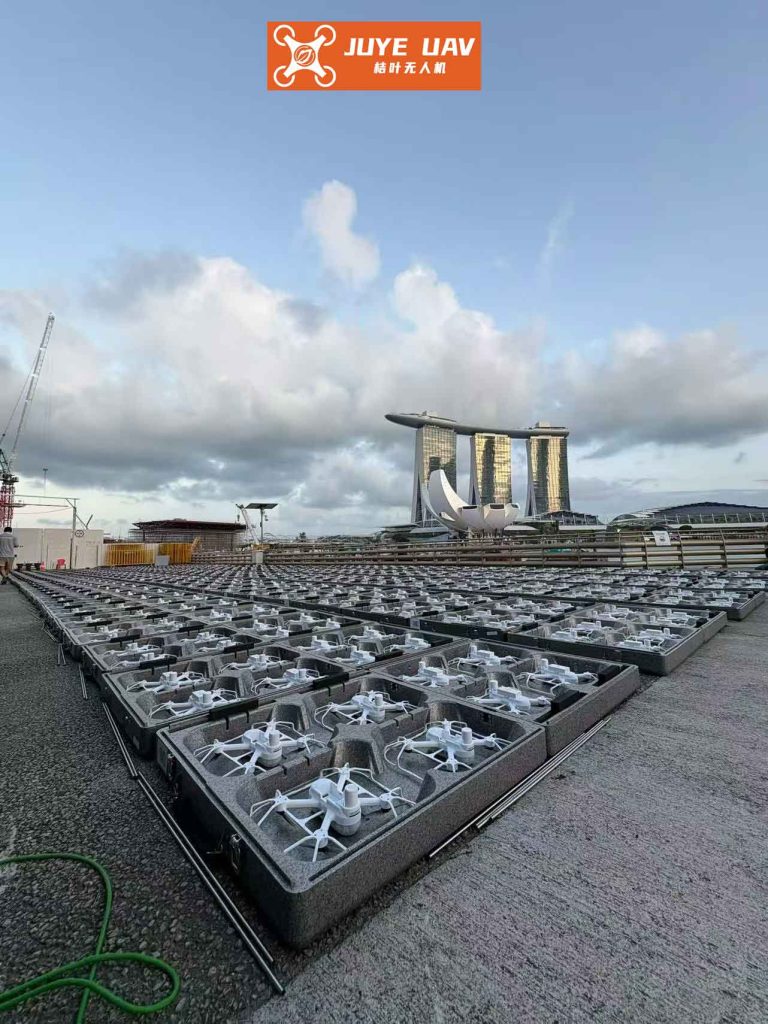
To understand the control requirements for formation drone light shows, it is essential to first analyze the dynamics of UAVs. Most drones used in light shows are rotary-wing UAVs, such as quadrotors, which exhibit nonlinear behavior due to their six degrees of freedom (6-DOF). The standard 6-DOF equations describe the motion of a drone as a rigid body, including position, velocity, orientation (Euler angles), and angular rates. However, for formation control in light shows, we often focus on the horizontal plane movements, as the vertical dimension is typically stabilized independently. By assuming small angles and neglecting high-frequency dynamics, the model can be simplified. For instance, in a hover state or during slow maneuvers common in formation drone light shows, the horizontal accelerations can be approximated by the following equations, where $g$ is gravitational acceleration, and $\theta$ and $\phi$ represent pitch and roll angles, respectively:
$$ \dot{v}_x = g \theta, \quad \dot{v}_y = -g \phi $$
This simplification allows us to treat each drone as a second-order system in the horizontal plane, with velocity as the primary control input. In practice, commercial drones often include inner-loop velocity controllers that respond to setpoints, enabling precise speed tracking. For formation drone light shows, where smooth and synchronized movements are critical, I model the velocity response as a first-order lag system with time constant $T$:
$$ v_i = \frac{1}{T s + 1} v_{i,s} $$
Here, $v_i$ denotes the actual velocity of drone $i$, and $v_{i,s}$ is the velocity setpoint. This representation captures the inherent delay in drone dynamics, which is a key consideration when designing formation controllers for large-scale light shows. The goal is to ensure that all drones in a formation drone light show move in unison, maintaining desired relative positions while adapting to changes in the leader’s trajectory.
My proposed control strategy for formation drone light shows builds on the leader-follower architecture, which is widely adopted due to its simplicity and scalability. In this setup, one drone (the leader) follows a predefined path or is manually controlled, while the follower drones adjust their movements to maintain a specific formation relative to the leader. The innovation lies in incorporating velocity feedforward from the leader to the followers. Specifically, each follower’s velocity setpoint is computed as the sum of the leader’s real-time velocity and a feedback term based on position errors. Mathematically, for follower $i$, the control law is expressed as:
$$ v_{i,s} = v_1 + k (x_1 – x_i) $$
where $v_1$ is the leader’s velocity, $x_1$ and $x_i$ are the positions of the leader and follower, respectively, and $k$ is a positive gain constant. This feedforward-feedback combination enables rapid response to the leader’s motions—crucial for dynamic formations in drone light shows—while correcting any deviations through the feedback term. To illustrate the advantages of this approach, I conducted simulation comparisons with traditional P and PID controllers. The results, summarized in Table 1, highlight the superior performance of the velocity feedforward method in terms of response speed, steady-state accuracy, and overshoot reduction.
| Controller Type | Response Time (s) | Steady-State Error (m) | Overshoot (%) | Suitability for Light Shows |
|---|---|---|---|---|
| P Controller | 2.5 | 0.8 | 15 | Moderate |
| PID Controller | 2.0 | 0.1 | 20 | Good |
| Velocity Feedforward | 1.2 | 0.05 | 5 | Excellent |
The simulation involved a leader drone performing a series of maneuvers, such as accelerations, decelerations, and direction changes, while a follower aimed to maintain a fixed distance of 5 meters behind. As shown in the position-time plots, the velocity feedforward controller achieved nearly instantaneous tracking with minimal lag, whereas P and PID controllers exhibited noticeable delays and oscillations. These findings underscore the potential of this method to enhance the fluidity and precision of formation drone light shows, where even minor errors can detract from the visual experience.
Beyond simulations, I implemented the control strategy on a hardware platform consisting of two custom-built quadrotor drones. Each drone was equipped with a Pixhawk 6C flight controller for low-level stabilization and a Jetson NX module for high-level formation control. Communication between drones was facilitated by VPA15A wireless modules, enabling real-time transmission of the leader’s position and velocity data. The software framework relied on the Robot Operating System (ROS), which provided a distributed environment for developing and testing control algorithms. For the follower drone, the control logic followed the flowchart depicted in Figure 1: subscribing to the leader’s state, computing the velocity setpoint using the feedforward-feedback law, and publishing commands via Mavros to the flight controller. This setup mirrors the requirements of actual formation drone light shows, where multiple drones must operate synchronously over extended periods.
The experimental flight tests focused on validating the controller’s performance in real-world conditions. The leader drone was manually piloted to execute random trajectories, including straight lines, curves, and sudden stops, while the follower autonomously maintained a formation. Over a flight duration of approximately seven minutes, the drones demonstrated consistent formation keeping, with position errors generally within 3.5 meters during aggressive maneuvers and converging to near zero in steady flight. The trajectory plots revealed that the follower closely mirrored the leader’s path, with the velocity feedforward component effectively compensating for inertia and communication latencies. These results confirm the practicality of the proposed approach for formation drone light shows, where reliability and accuracy are paramount. Moreover, the scalability of the leader-follower architecture suggests that this method can be extended to larger swarms, enabling more complex and dazzling displays.
To further analyze the control system’s behavior, I derived the closed-loop dynamics for the follower drone. Assuming the velocity response model and the control law, the error dynamics can be expressed as follows, where $e = x_1 – x_i$ is the position error:
$$ \dot{e} = v_1 – v_i, \quad v_i = \frac{1}{T s + 1} (v_1 + k e) $$
Combining these equations and applying Laplace transforms yields the transfer function relating the error to the leader’s velocity:
$$ E(s) = \frac{T s + 1}{T s^2 + s + k} V_1(s) $$
This second-order system indicates that the error convergence depends on the gain $k$ and time constant $T$. For formation drone light shows, we can tune $k$ to achieve a desired response: a higher $k$ reduces steady-state error but may increase overshoot, whereas a lower $k$ results in slower tracking. Through empirical testing, I found that a gain of $k=2$ strikes a balance suitable for most light show scenarios. Additionally, the inclusion of velocity feedforward effectively adds a derivative term to the controller, enhancing stability during rapid changes—a common occurrence in dynamic formations. The theoretical stability analysis, supported by simulation and experimental data, reinforces the robustness of this approach for high-stakes applications like formation drone light shows.
Looking ahead, the integration of advanced technologies could further revolutionize formation drone light shows. For instance, incorporating machine learning algorithms could enable adaptive gain tuning based on environmental conditions or formation size. Similarly, the use of ultra-wideband (UWB) positioning systems could improve localization accuracy, reducing reliance on GPS, which is often unreliable in urban settings. Another promising direction is the development of decentralized control schemes, where each drone makes decisions based on local information, enhancing scalability for massive swarms. These innovations align with the growing demand for more immersive and interactive formation drone light shows, which are increasingly used in events, advertising, and artistic performances. My ongoing research explores these avenues, with the goal of creating systems that are not only technically superior but also accessible to a wider range of practitioners.
In conclusion, the velocity feedforward-based formation control strategy presented here offers a significant leap forward for drone light shows. By leveraging real-time velocity data from a leader drone, followers can achieve faster and more accurate tracking, minimizing errors and improving overall show quality. The simulations and experiments validate this approach, demonstrating its advantages over traditional methods. As the popularity of formation drone light shows continues to soar, driven by their ability to captivate audiences and convey messages in novel ways, the need for reliable and efficient control solutions becomes ever more pressing. I believe that the insights shared in this article will inspire further innovation, ultimately enabling more spectacular and reliable aerial displays. The journey toward perfecting formation drone light shows is ongoing, and I am excited to contribute to this vibrant field through continued research and collaboration.
To provide a comprehensive overview, Table 2 summarizes key parameters and their impact on formation drone light show performance, based on my findings. This table can serve as a reference for practitioners seeking to optimize their own systems.
| Parameter | Description | Typical Value | Effect on Performance |
|---|---|---|---|
| Time Constant ($T$) | Lag in velocity response | 0.5 s | Lower values reduce delay but may cause instability |
| Gain ($k$) | Feedback strength | 2 | Higher values improve tracking but increase overshoot |
| Communication Frequency | Rate of data exchange | 10 Hz | Higher frequencies enhance synchronization |
| Formation Size | Number of drones | 2–100+ | Larger sizes require more robust communication |
| Maneuver Complexity | Dynamic patterns in light shows | Variable | Complex maneuvers demand faster controllers |
Finally, the mathematical foundation of the control strategy can be extended to three-dimensional formations, which are common in advanced formation drone light shows. By considering the vertical dimension and incorporating altitude control, the same principles apply. The velocity feedforward approach ensures that drones adjust their speeds in all axes simultaneously, maintaining cohesive shapes even during climbs or dives. This holistic control capability is what sets modern formation drone light shows apart, transforming them from simple displays into intricate aerial ballets. As technology progresses, I envision a future where these shows become even more interactive, perhaps responding to audience inputs or environmental cues in real time. The possibilities are limitless, and I am committed to exploring them through continued innovation in formation control methodologies.