
The proliferation of Unmanned Aerial Vehicles (UAVs) within public security operations has marked a significant technological shift in modern policing. These systems, broadly defined as police UAV platforms encompassing the aerial vehicle, ground control station, data link, and mission-specific payloads, have evolved from niche tools to indispensable assets. From their initial deployment during the 2008 Beijing Olympics, police UAV units have expanded rapidly, with dedicated aerial squads now commonplace. Their applications are diverse, including but not limited to emergency response coordination, surveillance for large-scale event security, suspect pursuit and tracking, routine aerial patrols, traffic monitoring, narcotics detection, and geographic information system (GIS) data collection for policing models.
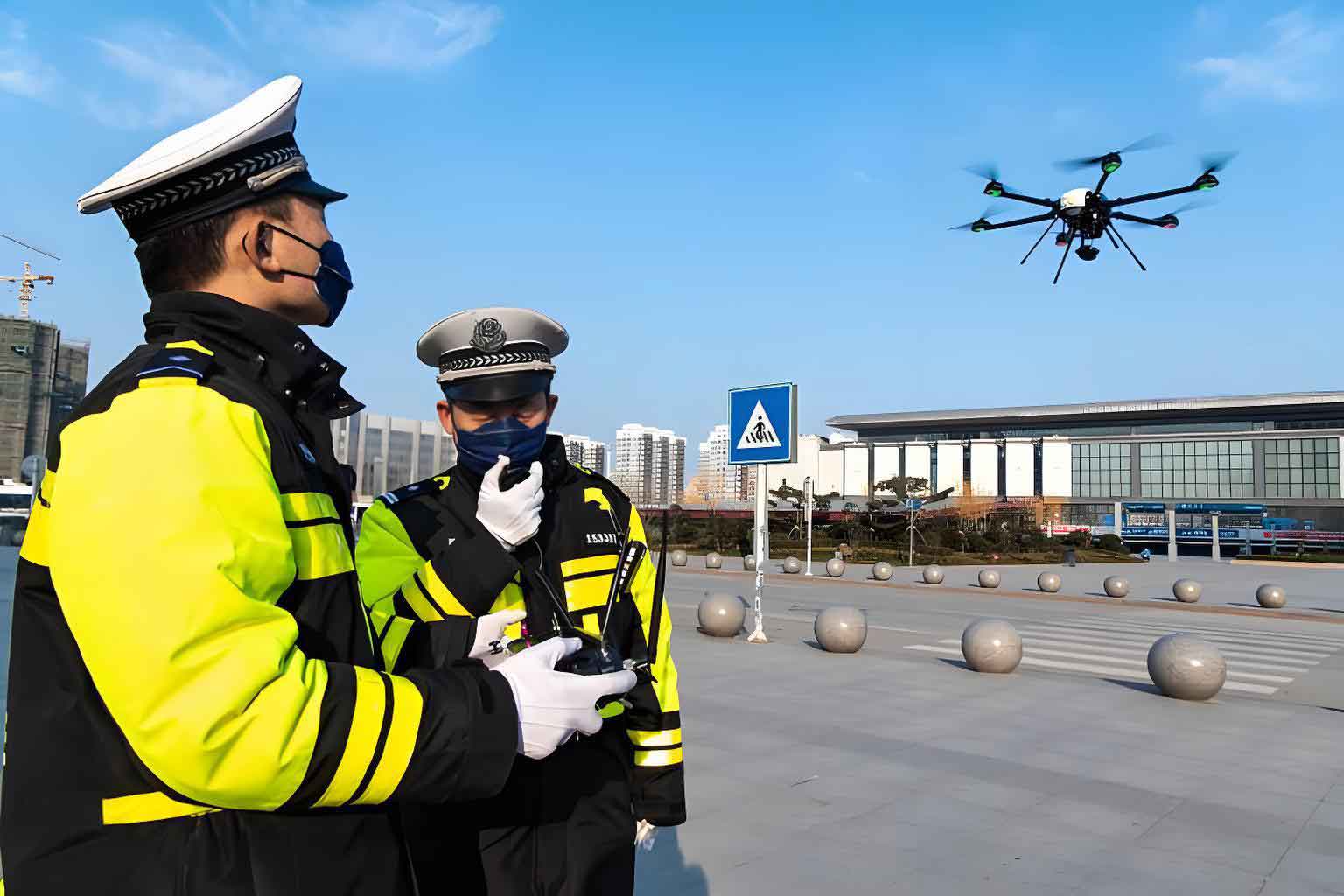
However, this rapid adoption has exposed critical systemic vulnerabilities, primarily the lack of a dedicated, comprehensive standards framework. The absence of such a framework hinders the structured development, acquisition, deployment, and sustainment of police UAV systems. Unlike commercial or consumer drones, police UAV operations involve unique requirements concerning reliability, security, data integrity, interoperability in high-stress environments, and compliance with legal use-of-force protocols. Relying on general civilian UAV standards is insufficient. This paper argues for the urgent establishment of a police UAV Life-Cycle Management (LCM) Standards System. By applying LCM principles, we can scientifically partition the entire lifespan of a police UAV system and define standardized protocols for each phase, thereby ensuring the safe, effective, and legally compliant application of these platforms in law enforcement scenarios.
Current Landscape of UAV Standards and the Gap for Police Applications
The development of UAV standards has accelerated globally, driven by technological maturation and expanding commercial use. National frameworks, such as those outlined in documents like the “Unmanned Aircraft Systems Standards Development Roadmap,” typically organize standards into foundational, management, technical, and industry application categories. While the total number of planned standards is large, many remain under development.
The distribution of industry-specific application standards reveals a telling disparity. Sectors like electric power inspection and precision agriculture have developed relatively mature, application-specific standard suites covering technical specifications, operational procedures, and data handling. In contrast, the domain of police UAV standards is notably underdeveloped. Existing public security standards for UAVs are limited in scope, often addressing only basic generic technical requirements, classification, or exterior markings. There is a profound lack of detailed standards governing mission-specific performance, operational protocols for various law enforcement scenarios (e.g., tactical operations, evidence collection), secure communications, data management, and lifecycle sustainment. This gap forces law enforcement agencies to adapt civilian equipment and procedures, leading to potential risks in performance, safety, and legal defensibility.
The following table summarizes the comparative state of industry application standards, highlighting the deficit for police UAV systems:
| Industry Sector | Focus of Standards | Relative Maturity |
|---|---|---|
| Electric Power | Inspection systems, automated flight paths, specialized payloads (e.g., LiDAR, thermal), data analysis. | High |
| Agriculture | Spraying efficacy, flight safety near crops, payload calibration, environmental impact. | Medium-High |
| Police & Public Security | Basic technical requirements, general classifications. Lacks detailed operational, tactical, and lifecycle standards. | Low |
| Surveying & Mapping | Geometric accuracy, photogrammetric processing, sensor calibration, data formats. | Medium-High |
Constructing a Life-Cycle Management Standards System for Police UAVs
The core premise of Life-Cycle Management (LCM) is to view a police UAV not merely as a purchased product but as a capability with a defined lifespan, from initial conceptualization to final disposal. Managing this lifecycle with standardized phases ensures cost-effectiveness, operational reliability, and strategic alignment with law enforcement needs. We propose a seven-phase LCM model for police UAV systems, each demanding a specific subset of standards.
The total lifecycle cost $C_{T}$ of a police UAV system can be modeled as the sum of costs across all phases:
$$C_{T} = C_{RD} + C_{Prod} + C_{Acq} + C_{O\&S} + C_{Disposal}$$
where $C_{RD}$ is Research & Development cost, $C_{Prod}$ is Production cost, $C_{Acq}$ is Acquisition cost, $C_{O\&S}$ is Operations & Support cost, and $C_{Disposal}$ is Disposal cost. A robust standards system aims to optimize $C_{T}$ while maximizing system effectiveness $E$, often expressed as a function of availability $A$, reliability $R$, and capability $K$: $E = f(A, R, K)$. Standards directly influence $R$ and $A$.
| Life-Cycle Phase | Key Activities | Primary Standard Types Needed |
|---|---|---|
| 1. Concept & Requirements Definition | Identifying operational gaps, defining mission needs, conducting feasibility studies, establishing key performance parameters (KPPs). | Management Standards, Operational Requirements Standards |
| 2. Preliminary Design & Solution Analysis | Developing system architectures, evaluating technology options, planning test programs, drafting standardization outlines. | Technical Design Standards, Interface Standards, Test Planning Standards |
| 3. Prototype Development & Testing | Building and testing engineering prototypes, verifying performance against KPPs, identifying design flaws. | Detailed Technical Standards, Quality Assurance Standards, Flight Test Standards |
| 4. Detailed Design & Production | Finalizing design for manufacturing, establishing production processes, qualifying supply chains, low-rate initial production. | Manufacturing Standards, Material Standards, Quality Control Standards, Configuration Management Standards |
| 5. Acquisition & Deployment | Conducting fair procurement, managing contracts, conducting acceptance testing, fielding units to operators. | Procurement Management Standards, Acceptance Test Standards, Logistics Standards |
| 6. Operations, Maintenance & Support | Day-to-day flight operations, scheduled/unscheduled maintenance, pilot/technician training, logistics supply, software updates. | Operational Procedure Standards, Maintenance Standards, Training Standards, Data Security Standards |
| 7. Evaluation & Disposal | Assessing in-service effectiveness, planning upgrades or replacements, executing safe and secure disposal/recycling. | Performance Evaluation Standards, Disposal/Decommissioning Standards |
To govern this lifecycle effectively, the police UAV standards system must be architected in two interrelated layers: the Management Layer and the Application Layer.
The Management Layer Standards System
This layer comprises overarching standards established by national public security authorities. These are policy and process-oriented standards that define the “rules of the road” for the entire police UAV ecosystem. They provide the top-down framework within which all other standards operate.
| Standard Category | Purpose & Description |
|---|---|
| Policy & Governance | Defines roles, responsibilities, and authorities for police UAV management across different agencies. Establishes principles for use, including legal and ethical guidelines. |
| Life-Cycle Process Management | Standardizes the workflows, decision gates, and documentation requirements for each phase of the LCM (e.g., mandatory reviews at the end of Phase 3). |
| Interoperability & Architecture | Mandates common data links, communication protocols, and control interfaces to ensure police UAV systems from different vendors can work together in joint operations. |
| Training & Qualification | Sets minimum requirements for pilot certification, technician competencies, and commander training for police UAV operations. |
The Application Layer Standards System
This layer contains the detailed, technical standards that directly govern the design, production, testing, and operation of the police UAV system itself. It is the engineering implementation of the management layer’s directives.
- Generic Foundation Standards: These include terminology, classification systems, and symbols specific to police UAV.
- Design & Manufacturing Standards:
- Airworthiness & Safety: Rigorous standards for structural integrity, flight control system redundancy, fail-safe mechanisms, and crashworthiness tailored for dense urban operations.
$$P_{system\_failure} = 1 – \prod_{i=1}^{n} (1 – P_{component\_i\_failure})$$
This formula underscores the need for high-reliability components $(P_{component\_failure} \to 0)$ and redundant architectures in police UAV design. - Performance: Standards for flight endurance, speed, hover accuracy, wind tolerance, and payload capacity under various environmental conditions relevant to policing.
- Mission Payloads: Detailed specifications for electro-optical/infrared (EO/IR) cameras, loudspeakers, illuminators, LiDAR, and other tactical payloads, including data output formats.
- Airworthiness & Safety: Rigorous standards for structural integrity, flight control system redundancy, fail-safe mechanisms, and crashworthiness tailored for dense urban operations.
- Operational Standards:
- Flight Operations: Standard Operating Procedures (SOPs) for different scenarios: surveillance, tracking, crowd monitoring, tactical support.
- Data Management: Standards for secure data encryption during transmission and storage, chain-of-custody protocols for evidentiary video, and data retention policies.
- Maintenance & Logistics: Standards for inspection intervals, repair procedures, spare parts provisioning, and battery handling/safety.
Strategic Recommendations for Advancing the Police UAV Standards System
To transition from the current fragmented state to a coherent LCM standards system, coordinated action is required from standards bodies, industry, and law enforcement agencies.
1. Strengthen Top-Level Planning and Coordination: The national public security standards administration must prioritize and lead the development of a police UAV standards roadmap. This involves establishing dedicated technical committees comprising experts from law enforcement, industry, and academia to systematically draft, review, and promulgate standards across the proposed LCM framework.
2. Promote the Development of Enterprise and Operational Standards: While national standards are being developed, agencies should encourage and recognize robust enterprise standards from leading police UAV manufacturers. Furthermore, operational police units should be empowered to develop and refine tactical-level SOPs based on field experience. These grassroots documents can later be formalized into broader national standards. The operational effectiveness $O$ of a police UAV unit can be conceptualized as:
$$O = \alpha \cdot T_{readiness} + \beta \cdot M_{success} + \gamma \cdot C_{safety}$$
where $T_{readiness}$ is unit readiness rate, $M_{success}$ is mission success rate, $C_{safety}$ is safety compliance score, and $\alpha, \beta, \gamma$ are weighting coefficients defined by standards and policy.
3. Establish a Digital Standards Management and Knowledge Platform: A centralized, cloud-based platform should be created to host the entire police UAV LCM standards library. This platform would facilitate version control, provide easy access for agencies and manufacturers, and include forums for discussing implementation challenges. It could also integrate with logistics and maintenance systems, allowing real-time access to the correct technical manuals and part numbers based on the UAV’s serial number and configuration.
Conclusion
The integration of UAV technology into modern law enforcement is irreversible and holds immense potential for enhancing public safety and operational efficiency. However, this potential can only be fully and safely realized through disciplined, standardized management of the technology across its entire lifespan. The proposed Life-Cycle Management Standards System for police UAVs provides a structured framework to achieve this. By clearly defining management and application layer standards for each phase—from concept and design through to disposal—this system can regulate the industry, guide procurement, ensure interoperability, and most importantly, guarantee that every police UAV deployment is effective, reliable, and accountable. The development and implementation of this standards system is not merely a technical exercise but a critical step towards the professional and responsible use of aerial technology in policing.