
In recent years, police unmanned aerial vehicles (UAVs) have become integral tools in law enforcement operations, ranging from surveillance and reconnaissance to emergency response. However, as police UAVs are increasingly deployed across various警务 units, a critical challenge has emerged: the lack of proficient操控 skills among personnel. This often leads to high loss rates during日常 training and operational inefficiencies. Traditional training methods, which rely heavily on manufacturer-led programs, are often brief and fail to cater to the diverse needs of all operators. Moreover,公安 institutions frequently lack comprehensive training systems and adequate facilities. To address these issues, I propose a holistic method for assembling and training small police UAVs, combining assembly training, virtual simulation, and actual flight training. This approach aims to deepen understanding of police UAV components, cultivate good操控 habits, and enhance practical skills, ultimately reducing equipment loss and improving operational readiness. The method is designed to be adaptable to the existing training conditions of警务 units, providing a scalable framework for effective police UAV training.
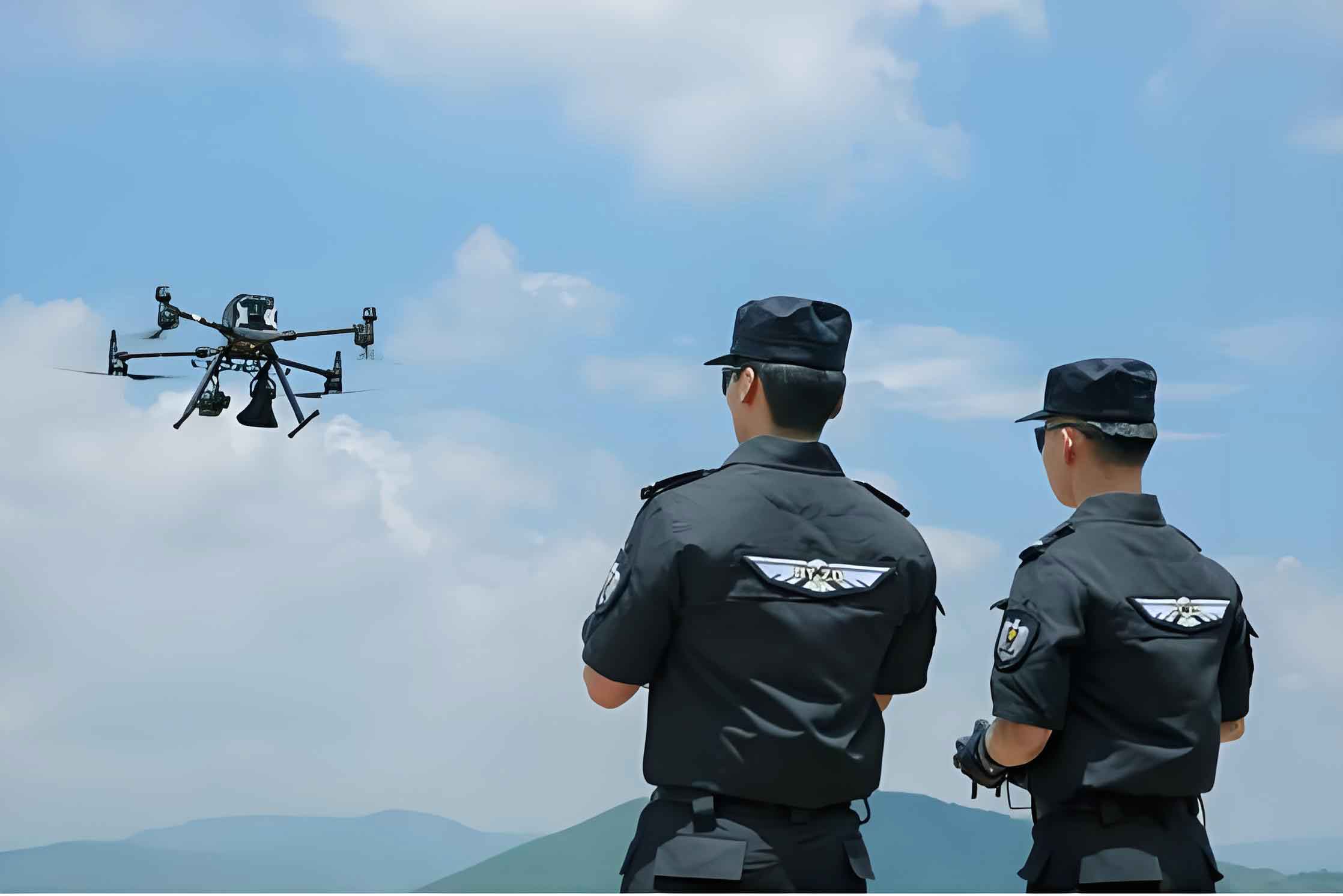
The assembly training phase focuses on familiarizing operators with the core components of a police UAV, ensuring they comprehend each part’s function and interconnections. This hands-on experience is crucial for troubleshooting and maintenance, which are vital for sustaining police UAV operations in the field. The assembly process is divided into three main stages: frame assembly, circuit soldering, and flight controller installation. For frame assembly, a typical quadcopter frame consists of four arms, an upper center plate, and a lower center plate. The arms are color-coded to distinguish the front (e.g., red) and rear (e.g., black) directions, aiding in orientation during flight. The assembly involves securing the arms to the upper center plate using screws, followed by attaching the lower center plate and landing gear. A summary of key components and their functions is provided in Table 1.
| Component | Description | Function |
|---|---|---|
| Arm | Plastic arm with metal screw holes, color-coded for orientation | Supports motors and provides structural integrity |
| Upper Center Plate | Plate with four corner screw holes | Connects arms and serves as mounting base for flight controller |
| Lower Center Plate | Plate with soldering points for power distribution | Hosts soldering points for ESCs and power lines, ensures electrical connectivity |
| Landing Gear | Attached to lower center plate | Provides stability during takeoff and landing |
Circuit soldering is a critical step that ensures reliable electrical connections for the police UAV. It involves soldering electronic speed controllers (ESCs) and power supply lines. For ESCs, the positive (red or white) and negative (black) wires are soldered to corresponding “+” and “-” points on the lower center plate. The power supply lines, typically using XT60 connectors, are soldered to the power points on the lower center plate after tinning the connections. To model the reliability of the soldering process, we can use a probabilistic formula: $$ R_{soldering} = \prod_{i=1}^{n} (1 – p_i) $$ where \( R_{soldering} \) is the overall reliability, \( n \) is the number of soldered joints, and \( p_i \) is the failure probability of each joint. For a police UAV, minimizing \( p_i \) through proper training is essential to prevent in-flight failures.
Flight controller installation involves mounting the flight control board (e.g., an APM board) onto the police UAV frame. The board is attached to a vibration-damping支架 using 3M double-sided tape, which is then fixed to the upper center plate. Alignment is crucial: the board’s marked front direction must correspond with the frame’s front orientation, and its center should coincide with the frame’s center. Wiring connections follow specific rules, linking the flight controller to ESCs and the radio receiver. This step ensures the police UAV’s brain is properly integrated, enabling stable flight. The connection scheme can be summarized with a logical formula: $$ C_{flight} = F(E, R) $$ where \( C_{flight} \) represents the flight controller connections, \( E \) denotes ESC links, and \( R \) denotes receiver links. Proper installation ensures that the police UAV responds accurately to操控 inputs.
Virtual training leverages simulators like Phoenix RC to provide risk-free操控 practice for police UAV operators. This phase is designed to build muscle memory and develop good habits before actual flight. The Phoenix RC simulator offers hundreds of fixed-wing and helicopter models, including quadcopter models类似 to police UAVs, with customizable environments and weather conditions. Training progresses through single-channel, dual-channel, and full-channel exercises, each increasing in complexity. Single-channel training isolates specific controls: for example,仅升降舵 (elevator)悬停训练 requires operators to maintain hover using only the elevator stick, first with the police UAV oriented tail-in (behind), then head-in (front), and side-in (side). Similarly,仅副翼 (aileron)悬停训练 focuses on aileron control. This isolation helps operators master individual control axes, which is foundational for police UAV operations. The操控 response in the simulator can be modeled using a differential equation: $$ \frac{d\theta}{dt} = k \cdot S_{input} $$ where \( \theta \) is the aircraft attitude angle, \( k \) is a sensitivity constant, and \( S_{input} \) is the stick input. Practicing this in simulation reduces overcorrection tendencies in real police UAV flights.
| Training Stage | Channels Active | Objective | Difficulty Level |
|---|---|---|---|
| Single-Channel | Elevator or Aileron only | Master individual control axes in悬停 | Low |
| Dual-Channel | Elevator + Aileron | Coordinate two axes for stable悬停 | Medium |
| Full-Channel | Elevator, Aileron, Rudder, Throttle | Coordinate all axes for complex maneuvers | High |
Dual-channel training introduces simultaneous control of elevator and aileron channels, requiring operators to manage both pitch and roll for悬停. This mimics real-world scenarios where police UAVs must maintain stability under wind gusts or during precise positioning. Full-channel training opens all four primary controls (elevator, aileron, rudder, throttle), enabling comprehensive practice such as tail-in悬停 and figure-eight patterns. The操控 dynamics can be expressed with a vector formula: $$ \vec{F}_{control} = \begin{pmatrix} \text{Elevator} \\ \text{Aileron} \\ \text{Rudder} \\ \text{Throttle} \end{pmatrix} $$ where \( \vec{F}_{control} \) represents the control force vector. Mastery of full-channel control is essential for advanced police UAV missions, like追踪 or inspection tasks. Through repetitive simulation, operators develop the coordination needed to handle police UAVs in dynamic environments.
Actual flight training translates virtual skills to real-world police UAV operations, emphasizing safety and precision. This phase begins with ground checks and调试 to ensure the police UAV is airworthy. Key steps include frequency matching between the transmitter and receiver, power-up inspections, and motor tests. For frequency matching, the transmitter enters linking mode, and the receiver is powered within close proximity until its LED indicates a successful pair. Ground checks involve verifying frame integrity, screw tightness, and ESC self-test sounds (e.g., three short beeps followed by a long beep for a 3S battery). Once armed, low-throttle tests confirm motor consistency and direction. These procedures mitigate risks during police UAV flights, as outlined in Table 3.
| Check Item | Procedure | Expected Outcome |
|---|---|---|
| Frequency Matching | Activate transmitter link mode, power receiver | Receiver LED lights solid green |
| Frame Inspection | Visual check for loose screws or damage | No visible defects; all components secure |
| Power-Up Test | Connect battery, listen for ESC beeps | Correct beep sequence indicating battery type |
| Motor Test | Arm flight controller, gently increase throttle | All motors spin uniformly in correct direction |
Flight操控 training then progresses to maneuvers like the figure-eight pattern, which综合 tests operator skill. The figure-eight involves flying the police UAV along a path with multiple orientation changes: starting tail-in at point A, moving to B (left side-in), C (head-in), D (right side-in), and back to A, then repeating in the opposite direction. This requires coordinated use of all controls to maintain a slow, steady speed and precise turns. The flight path can be modeled parametrically: $$ \begin{cases} x(t) = R \cdot \cos(\omega t) \\ y(t) = R \cdot \sin(2\omega t) \end{cases} $$ where \( x(t) \) and \( y(t) \) are positional coordinates, \( R \) is the turn radius, and \( \omega \) is the angular velocity. Practicing this maneuver enhances an operator’s ability to control police UAVs in complex trajectories, crucial for applications like perimeter patrols or crowd monitoring. Emphasis is placed on smooth control inputs to avoid sudden movements that could destabilize the police UAV.
To evaluate training effectiveness, a scientific考核指标体系 is established, assessing操控 proficiency through multiple criteria. The考核 focuses on降落精度,降落稳定,飞行性能,飞行稳定度,飞行熟练度, and additional bonus items. Each criterion is scored on a scale, with weighted contributions to an overall score. This feedback mechanism helps optimize training methods for police UAV operators. The scoring formula can be defined as: $$ S_{total} = \sum_{i=1}^{6} w_i \cdot s_i $$ where \( S_{total} \) is the total score, \( w_i \) are weights assigned to each criterion (e.g.,飞行性能,飞行稳定度), and \( s_i \) are the scores for each criterion. The weights reflect the relative importance of each aspect in police UAV operations. Detailed scoring ranges are provided in Table 4, which operators can use for self-assessment during police UAV training.
| Criterion | Score Range | Description | Weight (示例) |
|---|---|---|---|
| Flight Performance | 0-10 | Based on UAV damage and response post-power-up; higher scores for intact UAVs with normal起飞 | 0.2 |
| Flight Stability | 0-30 | Assesses晃动幅度 during悬停; lower晃动 with control scores higher | 0.25 |
| Flight Proficiency | 0-20 | Measures ability to keep UAV within concentric circles (green, yellow, red) during悬停; tighter circles and steady height score higher | 0.25 |
| Landing Stability | 0-20 | Evaluates降落过程 for晃动;平稳降落 with no damage scores最高 | 0.15 |
| Landing Accuracy | 0-10 | Based on final position relative to circles; landing in red circle scores highest | 0.1 |
| Bonus Items | 0-10 | Additional points for completing侧 and head-in悬停 maneuvers; stability within circles considered | 0.05 |
The bonus items, such as maintaining side-in and head-in悬停 for 15 seconds each, test advanced操控 skills that are valuable for police UAV missions requiring varied orientations. The overall考核 ensures that operators not only can fly the police UAV but also do so with precision and safety. By regularly assessing performance, training programs can be tailored to address weaknesses, ultimately reducing the loss rate of police UAVs in the field. This data-driven approach supports continuous improvement in police UAV training protocols.
In summary, the proposed method—integrating assembly training, virtual simulation, and actual flight training—provides a comprehensive framework for enhancing police UAV操控 skills. Assembly training builds foundational knowledge of police UAV components, virtual training develops controlled操控 habits without risk, and actual flight training consolidates skills in real environments. The考核指标体系 offers a means to evaluate and refine training outcomes.实践 has shown that this method effectively reduces equipment loss rates and improves操控 ability, making it suitable for adoption by警务 units with limited resources. Future work could explore integrating advanced technologies like artificial intelligence for adaptive police UAV training simulations or expanding the method to larger police UAV platforms. Ultimately, this approach contributes to the safe and efficient deployment of police UAVs in law enforcement operations, ensuring that these vital tools are used to their full potential.