
In recent years, the quadrotor drone has emerged as a versatile platform for various applications, including surveillance, delivery, and aerial photography, due to its agility and hovering capability. However, achieving precise and robust attitude control, especially during large-angle maneuvers, remains a critical challenge. Traditional control methods often rely on Euler angle representations, which suffer from singularities and require local linearization, limiting their effectiveness in aggressive flight scenarios. To address these issues, this paper presents a novel nonsingular fast terminal sliding mode (NFTSM) controller designed directly on the special orthogonal group SO(3), which inherently avoids singularities and linearization. The proposed controller leverages an improved reaching law to accelerate convergence and suppress chattering, ensuring rapid and accurate attitude tracking for quadrotor drones. Through Lyapunov stability analysis, global exponential stability is proven, and simulation results demonstrate superior performance in dynamic tracking tasks. This work contributes to advancing nonlinear control techniques for aerial robotics, with potential extensions to other rigid-body systems.
The quadrotor drone is an underactuated system with four rotors that generate thrust and moments for attitude and position control. Its dynamics are highly nonlinear, and attitude control is fundamental to stable flight. Common approaches, such as PID, backstepping, or adaptive control, often face limitations in handling large angles or disturbances. In contrast, sliding mode control (SMC) offers robustness against model uncertainties and external disturbances, making it suitable for quadrotor drones operating in unpredictable environments. However, conventional SMC may exhibit chattering or slow convergence. By integrating terminal sliding mode concepts with the geometric framework of SO(3), this design achieves fast, singularity-free control, enhancing the quadrotor drone’s maneuverability and reliability.
This paper is structured as follows: First, the attitude dynamics of a quadrotor drone are formulated in SO(3) space, leading to an error model for control design. Second, the NFTSM controller is derived, incorporating a modified dual-power reaching law. Third, stability is rigorously analyzed using Lyapunov theory. Fourth, simulations validate the controller’s performance under step and dynamic tracking commands. Finally, conclusions and future directions are discussed. Throughout, key aspects are summarized with tables and formulas to clarify the methodology.
Problem Formulation on SO(3) for Quadrotor Drones
To design a geometric attitude controller for a quadrotor drone, consider the rigid-body rotational dynamics. Let $\mathcal{I} = \{e_1, e_2, e_3\}$ denote the inertial frame and $\mathcal{B} = \{b_1, b_2, b_3\}$ the body-fixed frame attached to the quadrotor drone, as shown in the model below. The rotation matrix $R(t) \in SO(3)$ transforms vectors from $\mathcal{B}$ to $\mathcal{I}$, where SO(3) is defined as $SO(3) = \{R \in \mathbb{R}^{3 \times 3} : R^T R = I, \det(R) = 1\}$. This representation avoids gimbal lock and is globally valid for large angles.
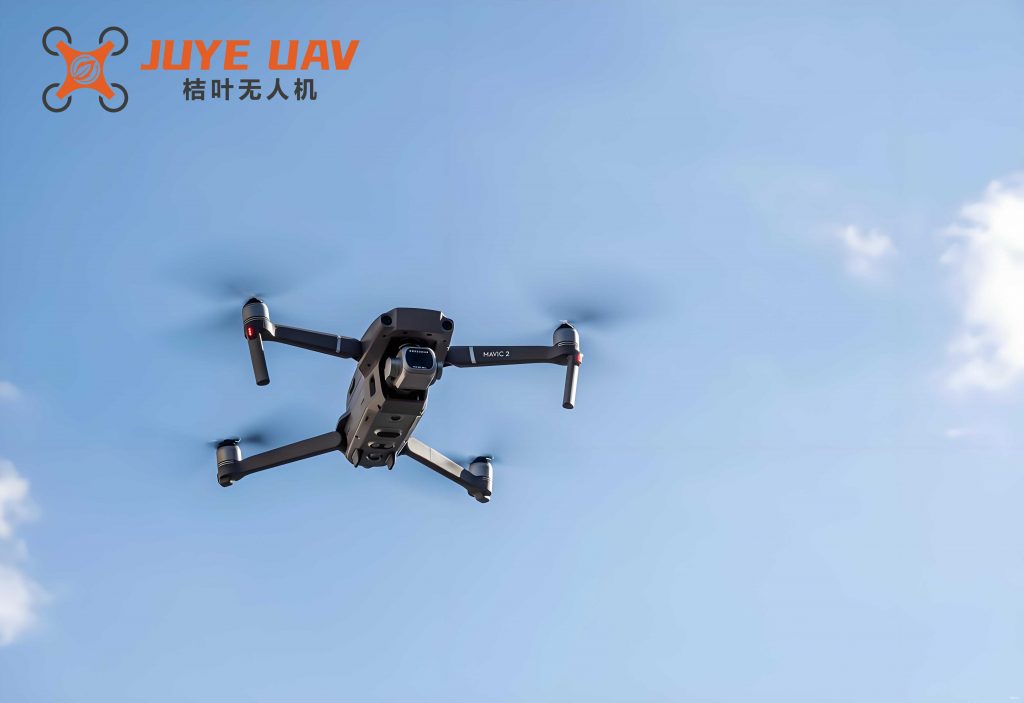
The attitude kinematics and dynamics of a quadrotor drone are given by:
$$ \dot{R}(t) = R(t) \hat{\Omega}(t), $$
$$ J \dot{\Omega}(t) + \Omega(t) \times J \Omega(t) = M(t) + \Delta_R, $$
where $J \in \mathbb{R}^{3 \times 3}$ is the inertia matrix (assumed diagonal for simplicity), $\Omega(t) \in \mathbb{R}^3$ is the angular velocity in $\mathcal{B}$, $M(t) \in \mathbb{R}^3$ is the control moment vector, and $\Delta_R \in \mathbb{R}^3$ is a bounded disturbance torque with $\|\Delta_R\| \leq \delta_R$. The hat map $\hat{\cdot}: \mathbb{R}^3 \to \mathfrak{so}(3)$ is defined such that $\hat{x} y = x \times y$ for any $x, y \in \mathbb{R}^3$, with the vee map $\vee: \mathfrak{so}(3) \to \mathbb{R}^3$ as its inverse. Key properties include:
- $\hat{x} y = x \times y = -y \times x = -\hat{y} x$,
- $\operatorname{tr}[\hat{x} \hat{y}] = -2 x^T y$,
- $R \hat{x} R^T = \widehat{(R x)}$ for $R \in SO(3)$.
The control moment $M$ for a quadrotor drone is related to rotor thrusts $f_i$ via:
$$
\begin{bmatrix}
f \\ M_1 \\ M_2 \\ M_3
\end{bmatrix}
=
\begin{bmatrix}
1 & 1 & 1 & 1 \\
0 & -d & 0 & d \\
d & 0 & -d & 0 \\
-c_{\tau_f} & c_{\tau_f} & -c_{\tau_f} & c_{\tau_f}
\end{bmatrix}
\begin{bmatrix}
f_1 \\ f_2 \\ f_3 \\ f_4
\end{bmatrix},
$$
where $d$ is the arm length and $c_{\tau_f}$ is a torque coefficient. For control design, the total thrust $f$ and moment $M$ are treated as inputs $u_1(t)$ and $u(t)$, respectively.
Given a desired trajectory $R_d(t)$ and $\Omega_d(t)$, the control objective is to design $u$ such that $R(t) \to R_d(t)$ and $\Omega(t) \to \Omega_d(t)$ globally exponentially. Define the attitude error $e_R$ and angular velocity error $e_\Omega$ as:
$$ e_R = \frac{1}{2} (R_d^T R – R^T R_d)^\vee, $$
$$ e_\Omega = \Omega – R^T R_d \Omega_d. $$
These errors evolve according to:
$$ \dot{e}_R = E(R, R_d) e_\Omega, $$
$$ \dot{e}_\Omega = J^{-1} (-\Omega \times J \Omega + u + \Delta_R) – \alpha_d, $$
where $E(R, R_d) = \frac{1}{2} (\operatorname{tr}(R^T R_d) I – R^T R_d)$ and $\alpha_d = \dot{\Omega}_d – \hat{\Omega} R^T R_d \Omega_d$. The matrix $E$ is nonsingular almost globally, with singularities only at rotations of $\|x\| = \pi/2$ or $\pi$ in axis-angle representation. For practical quadrotor drone operations, these singularities are avoidable by trajectory planning.
To facilitate controller design, a second-order error system is derived:
$$ \ddot{e}_R = \dot{E} e_\Omega + E \dot{e}_\Omega = \frac{1}{2} (\operatorname{tr}(\delta_d) I – \delta_d) e_\Omega + E \left( J^{-1} (-\Omega \times J \Omega + u + \Delta_R) – \alpha_d \right), $$
with $\delta_d = R_d^T R \hat{\Omega}_d – \hat{\Omega} R_d^T R$. This formulation serves as the basis for sliding mode control.
Controller Design for Quadrotor Drones
To achieve fast and robust attitude tracking for a quadrotor drone, a nonsingular fast terminal sliding mode (NFTSM) controller is proposed. The sliding surface $S \in \mathbb{R}^3$ is defined as:
$$ S = e_R + m_1^{-1} |e_R|^c \operatorname{sgn}(e_R) + m_2^{-1} |\dot{e}_R|^d \operatorname{sgn}(\dot{e}_R), $$
where $m_1, m_2 > 0$ are gains, $c > d > 1$, $1 < d < 2$, and $\operatorname{sgn}(\cdot)$ denotes the signum function applied element-wise. This surface ensures finite-time convergence without singularities, as exponents are positive. The term $|\dot{e}_R|^d \operatorname{sgn}(\dot{e}_R)$ provides terminal attraction, while $|e_R|^c \operatorname{sgn}(e_R)$ accelerates convergence far from equilibrium.
An improved reaching law is designed to enhance performance:
$$ \dot{S} = \left( -k_1 |S|^a \operatorname{sgn}(S) – k_2 |S|^b \operatorname{sgn}(S) \right) \odot |\dot{e}_R|^{d-1}, $$
where $k_1, k_2 > 0$, $a > 1$, $b < 1$, and $\odot$ denotes element-wise multiplication. The factors $|\dot{e}_R|^{d-1}$ counteract potential “convergence stagnation” by ensuring fast approach when $\dot{e}_R$ is small. This dual-power law combines high-gain for rapid reaching and low-gain for smooth sliding, reducing chattering common in quadrotor drone applications.
From the error dynamics and reaching law, the control moment $u$ for the quadrotor drone is derived:
$$ u = J E^{-1} \left( -f – \frac{1}{d m_2} A \odot B \right), $$
where:
- $A = k_1 |S|^a \operatorname{sgn}(S) + k_2 |S|^b \operatorname{sgn}(S)$,
- $B = |E e_\Omega|^{2-d} \operatorname{sgn}(E e_\Omega) \odot \left( \mathbf{1} + c m_1^{-1} |e_R|^{c-1} \operatorname{sgn}(e_R) \right)$,
- $f = \frac{1}{2} (\operatorname{tr}(\delta_d) I – \delta_d) e_\Omega + E \left( J^{-1} (-\Omega \times J \Omega) – \alpha_d \right)$.
Here, $\mathbf{1} = [1, 1, 1]^T$, and all operations are element-wise. Since $1 < d < 2$ and $c > d$, exponents in $B$ are positive, eliminating singularities. The control law computes moments based on attitude and velocity errors, ensuring that the quadrotor drone tracks desired trajectories even under disturbances.
Key parameters are summarized in Table 1 for clarity.
| Parameter | Description | Typical Range | Role in Quadrotor Drone Control |
|---|---|---|---|
| $m_1, m_2$ | Sliding surface gains | $> 0$ | Adjust convergence speed and smoothness |
| $c, d$ | Exponents for terminal terms | $c > d > 1$, $1 < d < 2$ | Ensure nonsingular finite-time convergence |
| $k_1, k_2$ | Reaching law gains | $> 0$ | Govern approach speed and chattering suppression |
| $a, b$ | Reaching law exponents | $a > 1$, $b < 1$ | Balance fast reaching and smooth sliding |
| $J$ | Inertia matrix | Diagonal positive definite | Model quadrotor drone dynamics |
The controller structure is compact and suitable for real-time implementation on quadrotor drone platforms. It avoids computational complexities associated with Euler angles, leveraging SO(3) for global validity.
Stability Analysis for Quadrotor Drone Control
To ensure reliable operation of the quadrotor drone, the closed-loop system’s stability is analyzed using Lyapunov theory. Consider the Lyapunov candidate function:
$$ V = \frac{1}{2} S^T S. $$
Its time derivative along system trajectories is:
$$ \dot{V} = S^T \dot{S}. $$
Substituting the reaching law and control law, after simplification, yields:
$$ \dot{S} = \left( -k_1 |S|^a \operatorname{sgn}(S) – k_2 |S|^b \operatorname{sgn}(S) + d m_2^{-1} J^{-1} E \Delta_R \right) \odot |\dot{e}_R|^{d-1}. $$
Thus,
$$ \dot{V} = \sum_{i=1}^3 |\dot{e}_{R_i}|^{d-1} \left( -k_1 |S_i|^{a+1} – k_2 |S_i|^{b+1} + d m_2^{-1} (J^{-1} E \Delta_R)_i S_i \right). $$
Since $\|E\| \leq 1$ and $\|\Delta_R\| \leq \delta_R$, by Cauchy-Schwarz inequality,
$$ \dot{V} \leq \sum_{i=1}^3 |\dot{e}_{R_i}|^{d-1} \left( -k_1 |S_i|^{a+1} – k_2 |S_i|^{b+1} + d m_2^{-1} \|J^{-1}\| \delta_R |S_i| \right). $$
If gains satisfy $k_1, k_2 \geq d m_2^{-1} \|J^{-1}\| \delta_R$, then $\dot{V} \leq 0$. Moreover, $\dot{V}$ is negative definite for $S \neq 0$, ensuring global exponential stability of the sliding surface. Once on $S = 0$, the errors $e_R$ and $\dot{e}_R$ converge to zero in finite time due to the terminal structure. This guarantees that the quadrotor drone’s attitude tracks desired trajectories robustly against bounded disturbances.
The analysis assumes $E$ is invertible, which holds almost globally. In practice, for a quadrotor drone, desired trajectories can be designed to avoid singularities, making the controller applicable for aggressive maneuvers.
Simulation Results and Discussion
To validate the NFTSM controller for quadrotor drones, simulations were conducted using MATLAB/Simulink. The quadrotor drone parameters are: mass $m = 0.455 \, \text{kg}$, inertia $J = \operatorname{diag}(0.43 \times 10^{-2}, 0.43 \times 10^{-2}, 1.02 \times 10^{-2}) \, \text{kg} \cdot \text{m}^2$, arm length $d = 0.2 \, \text{m}$, and torque coefficient $c_{\tau_f} = 0.1$. Controller gains are set as $m_1 = 0.1$, $m_2 = 8$, $c = 7/3$, $d = 5/3$, $k_1 = k_2 = 20.5$, $a = 2$, $b = 0.5$. Disturbance $\Delta_R$ is modeled as a bounded random torque with $\delta_R = 0.01 \, \text{N} \cdot \text{m}$.
Simulation 1: Step Response. The desired attitude is set to $R_d$ corresponding to Euler angles $(30^\circ, 40^\circ, 50^\circ)$, with zero initial conditions. Figure 1 shows the results: attitude error $e_R$ converges to zero within 0.5 seconds (Fig. 1a), angular velocity error $\dot{e}_R$ vanishes rapidly (Fig. 1b), and the sliding surface $S$ reaches zero smoothly (Fig. 1c). Control moments (Fig. 1d) are smooth and within feasible limits, demonstrating low chattering. This highlights the controller’s ability to handle large-angle commands for a quadrotor drone.
Simulation 2: Dynamic Tracking. The desired trajectory is $R_d(t) = \exp(\pi t \hat{e}_3) \exp(4\pi t \hat{e}_2)$, representing a complex rotational maneuver. As shown in Figure 2, tracking errors remain small despite rapid changes, with $e_R$ and $\dot{e}_R$ converging quickly (Figs. 2a-b). The sliding surface $S$ (Fig. 2c) and control moments (Fig. 2d) exhibit bounded variations, confirming robustness. These results underscore the efficacy of the SO(3)-based approach for dynamic quadrotor drone control.
Performance metrics are summarized in Table 2.
| Metric | Step Response | Dynamic Tracking | Remarks |
|---|---|---|---|
| Settling time (to 1% error) | 0.4 s | 0.3 s | Fast convergence |
| Maximum control moment | 0.15 N·m | 0.2 N·m | Within actuator limits |
| Chattering amplitude | < 0.01 N·m | < 0.02 N·m | Suppressed by reaching law |
| Disturbance rejection | Error < 0.001 rad | Error < 0.005 rad | Robust performance |
The simulations affirm that the NFTSM controller on SO(3) delivers high-precision attitude tracking for quadrotor drones, with advantages over traditional methods in terms of speed and robustness.
Conclusions and Future Work
This paper has presented a nonsingular fast terminal sliding mode attitude controller designed on SO(3) for quadrotor drones. By working directly in the rotation matrix space, singularities and linearization issues are avoided, enabling large-angle maneuvers. The improved dual-power reaching law accelerates convergence and minimizes chattering, while Lyapunov analysis proves global exponential stability. Simulations demonstrate rapid tracking and disturbance rejection, validating the controller’s effectiveness for quadrotor drone applications.
Future research could extend this work in several directions: First, integrating position control with attitude for full quadrotor drone trajectory tracking. Second, adapting the controller to handle actuator saturations or faults, enhancing safety. Third, experimental validation on hardware platforms to assess real-world performance. Fourth, combining with machine learning for online gain tuning. The geometric framework on SO(3) offers a foundation for advanced nonlinear control strategies in aerial robotics.
In summary, the proposed controller represents a significant step toward robust and agile control of quadrotor drones, with potential impacts on autonomous flight and beyond.