
The proliferation of high-rise buildings is a defining feature of modern urban landscapes. However, this architectural evolution has significantly outpaced the development of corresponding fire rescue capabilities. High-rise firefighting presents a unique and formidable set of challenges, often rendering traditional equipment like ladder trucks and elevated water towers insufficient. Their operational reach is physically and environmentally constrained, struggling to effectively address fires beyond certain heights, especially under adverse wind conditions. This capability gap underscores an urgent need for technological innovation in fire services. In this context, fire UAV (Unmanned Aerial Vehicle) systems have emerged as a transformative force. Equipped with advanced payloads such as high-definition cameras, infrared thermal imagers, and gas analyzers, the modern fire UAV provides an unprecedented aerial perspective and operational flexibility. This article, from my professional perspective, explores the critical role of the fire UAV in high-rise fire rescue, analyzing its technical foundations, operational advantages, and multifaceted applications that are redefining rescue paradigms.
I. The Imperative for Fire UAVs in High-Rise Rescue
The physics and logistics of high-rise fires create a hostile environment for ground-based responders. The vertical dimension introduces critical delays in response, access, and situational awareness. Key challenges that create a direct demand for fire UAV solutions include:
- Limited Reach of Conventional Apparatus: Even the most advanced aerial platforms have practical height limitations and are susceptible to wind, building sway, and spatial constraints around the structure.
- Rapid Vertical Fire Spread: Features like stairwells, elevator shafts, and external cladding can lead to extremely fast vertical fire progression, often outpacing interior firefighting teams.
- Complex Interior Navigation & Reconnaissance: Obtaining real-time intelligence on fire location, intensity, structural integrity, and occupant status within a large, smoke-filled high-rise is exceptionally difficult and dangerous for entry teams.
- Hazardous Atmosphere: Toxic gases and superheated smoke pose immediate life-threatening risks to both trapped occupants and firefighters, often before flames themselves become the primary threat.
A fire UAV platform, typically constructed from lightweight, heat-resistant composites like carbon fiber, is designed to meet these challenges head-on. Its core modules—information acquisition, auxiliary rescue, and fire suppression—are engineered for durability, real-time data transmission, and operational versatility in extreme conditions.
II. Technical and Operational Advantages of the Modern Fire UAV
The superiority of the fire UAV stems from a confluence of advanced technologies that grant it unique capabilities unavailable to traditional rescue assets.
A. Core Technical Advantages
1. Intelligent Autonomy: The integration of artificial intelligence and machine learning has led to a new generation of intelligent fire UAV systems. These systems can execute complex flight missions with minimal direct pilot input.
$$ \text{Mission Success} = f(\text{Autonomy Level}, \text{Sensor Fusion}, \text{Environmental Complexity}) $$
Autonomous navigation, obstacle detection, and even decision-making for optimal flight paths reduce operator cognitive load and minimize human error.
2. Point-of-Interest Navigation: Through GNSS (Global Navigation Satellite System) and visual recognition, a fire UAV can be commanded to fly directly to a specific geo-tagged location (e.g., a reported fire floor or trapped individual). This is governed by basic kinematic equations for navigation:
$$ \vec{P}_{UAV}(t) = \vec{P}_{target} – \vec{P}_{start} $$
The onboard intelligence system continuously calculates and adjusts its trajectory, avoiding obstacles autonomously.
3. Dynamic Visual Tracking: Coupled with advanced computer vision algorithms, a fire UAV can lock onto and track moving objects, such as a fleeing occupant or the leading edge of a spreading fire. This involves real-time image processing:
$$ I_{track}(x,y,t) = \text{Algorithm}(I_{input}(x,y,t), I_{template}) $$
This capability allows for continuous monitoring of critical dynamic elements within the incident.
4. Sensor-Based Obstacle Perception and Avoidance: Utilizing a suite of sensors (LiDAR, ultrasonic, visual stereo cameras), the fire UAV constructs a 3D map of its surroundings. The avoidance maneuver can be modeled as an optimization problem to find the safest path $\vec{P}_{safe}$:
$$ \min_{\vec{P}_{safe}} \left( \text{Collision Risk}(\vec{P}_{safe}) + \text{Time Delay}(\vec{P}_{safe}) \right) $$
This is crucial for navigating the cluttered, unpredictable environment of a burning high-rise.
B. Inherent Operational Advantages
| Advantage | Description | Impact on High-Rise Rescue |
|---|---|---|
| High Flexibility & Agility | Small footprint (often <100kg), rapid deployment, and ability to hover, ascend vertically, and navigate tight spaces. | Enables immediate response and access to facades, setbacks, and other areas unreachable by ground teams. |
| Unobstructed Aerial Vantage Point | Elevated perspective provides a comprehensive, top-down view of the incident. High-resolution, multi-spectral imaging (visible, thermal). | Delivers holistic situational awareness, revealing fire spread patterns, roof conditions, and external hazards invisible from the ground. |
| Enhanced Operational Safety | Removes personnel from immediate physical danger in unstable, toxic, or explosive environments. | Allows for risk-free reconnaissance of flashover conditions, chemical fires, or structurally compromised zones, preserving firefighter safety. |
| Cost-Effectiveness & Persistence | Lower operational cost than manned aircraft; ability to loiter for extended periods to monitor developments. | Provides continuous intelligence over the long duration typical of high-rise fires, supporting strategic decision-making. |
III. Multifaceted Application in High-Rise Fire Rescue Operations
The fire UAV is not a single-purpose tool but an integrated platform whose applications span the entire timeline of a rescue operation.
A. Primary Application: Fire Scene Reconnaissance and Assessment
This is the most immediate and critical application. A fire UAV acts as a flying sensor platform. Its thermal imager detects heat signatures through smoke, identifying the core fire location ($T_{core}$) and hidden hot spots. The data can be processed to create a thermal differential map:
$$ \Delta T(x,y) = T_{measured}(x,y) – T_{ambient} $$
This map, overlaid on a building blueprint, provides commanders with an unprecedented understanding of the fire’s behavior within the structure. It can also identify volatile materials and assess structural weaknesses by detecting abnormal heat patterns on load-bearing elements.
B. Search, Location, and Evacuation Guidance
Locating occupants in a smoke-obscured, multi-story building is like finding a needle in a haystack. The fire UAV‘s infrared sensor detects human body heat signatures. By coordinating data from multiple UAVs, the approximate location of occupants can be triangulated. Furthermore, a fire UAV equipped with a powerful loudspeaker and bright LED lights can guide evacuees. It can broadcast pre-recorded or live instructions to specific floors, indicate safe paths, and provide psychological reassurance, which is a critical factor in successful self-evacuation.
C. Precision Logistics and Payload Delivery
Resupply is a major hurdle in high-rise fires. A fire UAV can be fitted with a secure payload release mechanism. The payload weight $W_{payload}$ must satisfy the UAV’s lift capacity equation:
$$ W_{payload} \leq T_{max} – W_{UAV} $$
where $T_{max}$ is maximum thrust and $W_{UAV}$ is the drone’s weight. It can deliver critical survival equipment—such as respirators, bottled water, emergency medicines, or even portable communication devices—directly to trapped civilians on balconies or rooftops. It can also deliver spare air cylinders or tools to interior firefighting teams, extending their operational endurance.
D. Integrated Command, Control, and Communications (C3) Node
The fire UAV elevates the incident commander’s perspective literally and figuratively. Serving as an airborne communications relay, it can mitigate signal blockage caused by the building itself, maintaining vital contact between interior teams and the command post. The live video feed provides a stable, comprehensive overview of the entire incident, allowing for dynamic resource allocation, verification of tactical objectives, and monitoring of fire spread in real-time. This turns the fire UAV into an indispensable command and control asset.
E. Direct Intervention and Auxiliary Firefighting
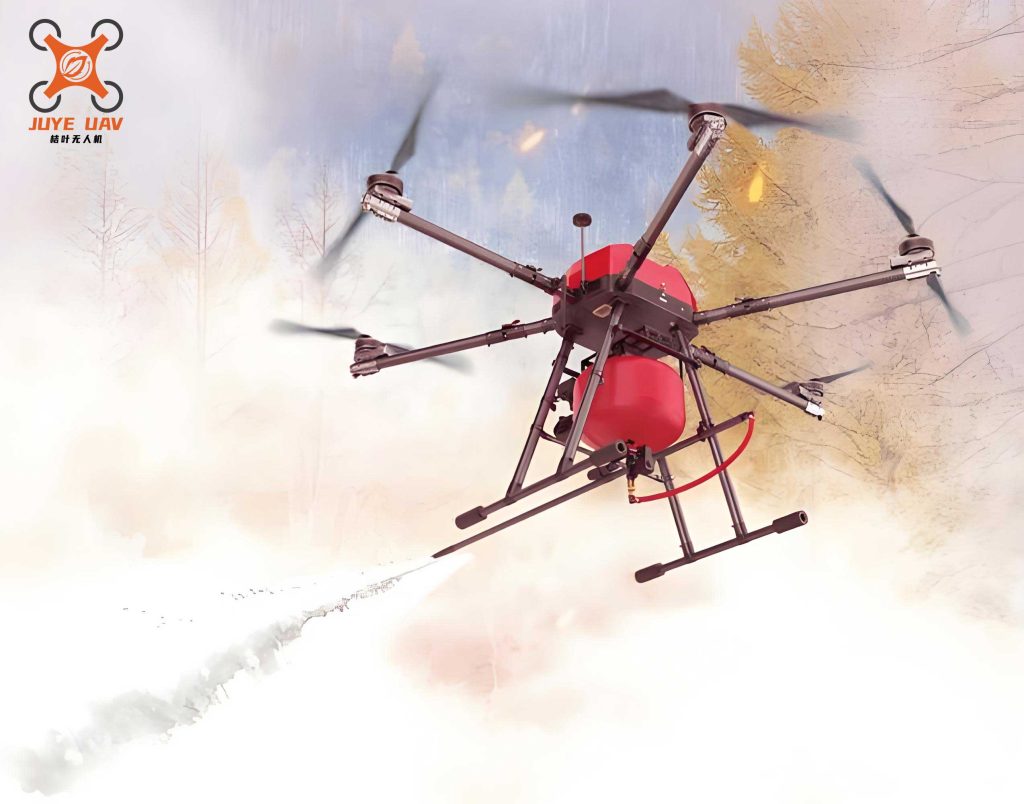
Beyond reconnaissance, specialized fire UAV platforms are being developed for direct intervention. Large, heavy-lift fire UAV can be equipped to:
- Deploy Extinguishing Agents: Carry and discharge water, foam, or dry chemical agents onto external fires or through windows to suppress flames ahead of interior crews.
- Conduct Breaching and Ventilation Support: Deploy small, shaped charges or cutting tools to create controlled ventilation openings.
- Deploy Life-Saving Lines: Deliver lightweight but strong tethers or ropes to trapped individuals, enabling them to secure themselves or be retrieved by rescuers.
The effectiveness of an extinguishing agent drop can be approximated by considering the volume $V_{agent}$ and discharge rate $R$ over the target area $A_{target}$:
$$ \text{Coverage Density} = \frac{V_{agent}}{A_{target}} $$
$$ \text{Application Time} = \frac{V_{agent}}{R} $$
Optimizing these parameters is key to effective UAV-based suppression.
F. Multispectral Data Fusion for Post-Incident Analysis
Every mission flown by a fire UAV generates a rich dataset. High-resolution video, thermal imagery, gas concentration readings, and precise timestamps can be fused to create a detailed 4D (3D space + time) reconstruction of the fire event. This data is invaluable for post-incident forensic analysis to determine the origin and cause, assess the performance of building fire safety systems, and train future responders using highly accurate virtual simulations. The data fusion process can be represented as:
$$ D_{fused} = \sum_{i=1}^{n} w_i \cdot S_i(t, x, y, z) $$
where $S_i$ represents different sensor streams (visual, thermal, gas) and $w_i$ are fusion weights based on reliability and relevance.
| Payload Module | Primary Sensor/Equipment | Key Application in High-Rise Fire |
|---|---|---|
| Reconnaissance & Mapping | Zoom Camera, IR Thermal Imager, LiDAR | Fire location, spread tracking, victim search, 3D mapping. |
| Environmental Sensing | Multi-gas Analyzer, Particulate Sensor | Detection of CO, HCN, low O2; identifying explosive atmospheres. |
| Communication & Guidance | Loudspeaker, Strobe Lights, Mesh Radio Relay | Evacuation guidance, inter-team communication, C3. |
| Logistics & Delivery | Payload Release Mechanism, Secure Cargo Box | Delivery of survival gear, respirators, tools, ropes. |
| Direct Intervention | Water/Foam Cannon, Monitored Deployment System | External fire attack, cooling, creating safe zones. |
IV. Mathematical Modeling for Fire UAV Deployment Optimization
To maximize the effectiveness of a fire UAV fleet, operations can be guided by mathematical models. For instance, the problem of optimally deploying UAVs for victim search in a high-rise can be framed as a coverage path planning (CPP) problem. The objective is to minimize the time $T_{total}$ to scan all critical areas $A_{critical}$ with a probability of detection $P_d$.
$$ \min T_{total} = \sum_{j=1}^{m} \frac{\text{Path Length}_j}{\text{UAV Speed}} $$
Subject to:
$$ \bigcup_{j=1}^{m} \text{Coverage}_j(t) \supseteq A_{critical} $$
$$ P_d(\text{sensor}, \text{range}, \text{obstruction}) \geq P_{threshold} $$
Similarly, the payload delivery mission can be optimized as a knapsack or vehicle routing problem, where the goal is to deliver the maximum priority-weighted supplies $ \sum (Priority_i \cdot Delivered_i) $ within battery life constraints $E_{battery}$.
$$ E_{consumption} = E_{hover} \cdot t_{hover} + E_{flight} \cdot d_{flight} + E_{lift} \cdot W_{payload} \leq E_{battery} $$
These models help in pre-planning and real-time decision support for fire UAV operations.
V. Future Trajectory and Conclusion
The integration of the fire UAV into high-rise fire rescue is not an endpoint but a rapidly evolving beginning. Future developments will focus on:
- Swarm Intelligence: Coordinated fleets of heterogeneous fire UAV (scout, relay, suppression) autonomously collaborating to perform complex tasks like simultaneous search and supply, or forming a communication mesh network throughout a skyscraper.
- Advanced AI for Predictive Analytics: Onboard AI that not only sees the fire but predicts its progression based on real-time sensor data and building information modeling (BIM), suggesting optimal intervention points to commanders.
- Increased Payload Capacity and Arm Integration: Development of more powerful, specialized fire UAV capable of carrying heavier firefighting equipment or robotic arms for interactive tasks like turning off valves or clearing debris.
- Seamless Integration with Building Systems: Fire UAV that can interface directly with a building’s smart fire alarm and suppression systems, receiving real-time data from internal sensors to pinpoint fires even faster.
In conclusion, the fire UAV represents a paradigm shift in responding to one of the most complex fire scenarios—the high-rise building fire. Its unique ability to provide immediate aerial intelligence, deliver critical resources, enhance communication, and directly intervene from the sky addresses the fundamental limitations of traditional ground-based approaches. As the technology continues to mature through advancements in autonomy, sensing, and collaboration, the fire UAV will transition from a supporting tool to a central pillar of modern fire rescue strategy, dramatically improving outcomes and saving lives in the vertical urban environment. The future of high-rise firefighting is, unequivocally, aerial, intelligent, and unmanned.