
In recent years, quadrotor drones have gained widespread usage in fields such as power inspection, agricultural plant protection, and environmental monitoring due to their simple structure, agile mobility, and low cost. However, quadrotor drones are inherently underactuated and highly coupled nonlinear systems, making trajectory tracking a significant challenge. Specifically, quadrotor drones are susceptible to external disturbances and model uncertainties during flight, which can compromise system stability and accuracy. Therefore, developing robust control strategies that ensure precise trajectory tracking under these conditions is a critical research focus. In this work, I propose an appointed-time prescribed performance control (PPC) method based on adaptive radial basis function neural networks (RBFNNs) to address these issues. The approach integrates a novel error transformation and filter compensation mechanism to enhance transient and steady-state performance while handling unknown nonlinearities and disturbances.
The core of this study lies in transforming the trajectory tracking problem for quadrotor drones into desired command tracking for position and attitude subsystems. By employing a prescribed performance function that constraints tracking errors within specified bounds within a user-defined time, the method guarantees both transient and steady-state performance. To mitigate the “explosion of complexity” inherent in backstepping designs, a first-order filter is introduced, along with a compensation system to eliminate filter errors. Furthermore, adaptive RBF neural networks are utilized to approximate external disturbances and model uncertainties, with the estimates fed back to the controller for robust compensation. Through Lyapunov stability analysis, I prove that the closed-loop system achieves appointed-time convergence. Simulation and experimental results validate the effectiveness of the proposed control strategy for quadrotor drones, demonstrating superior tracking accuracy and disturbance rejection compared to conventional methods.
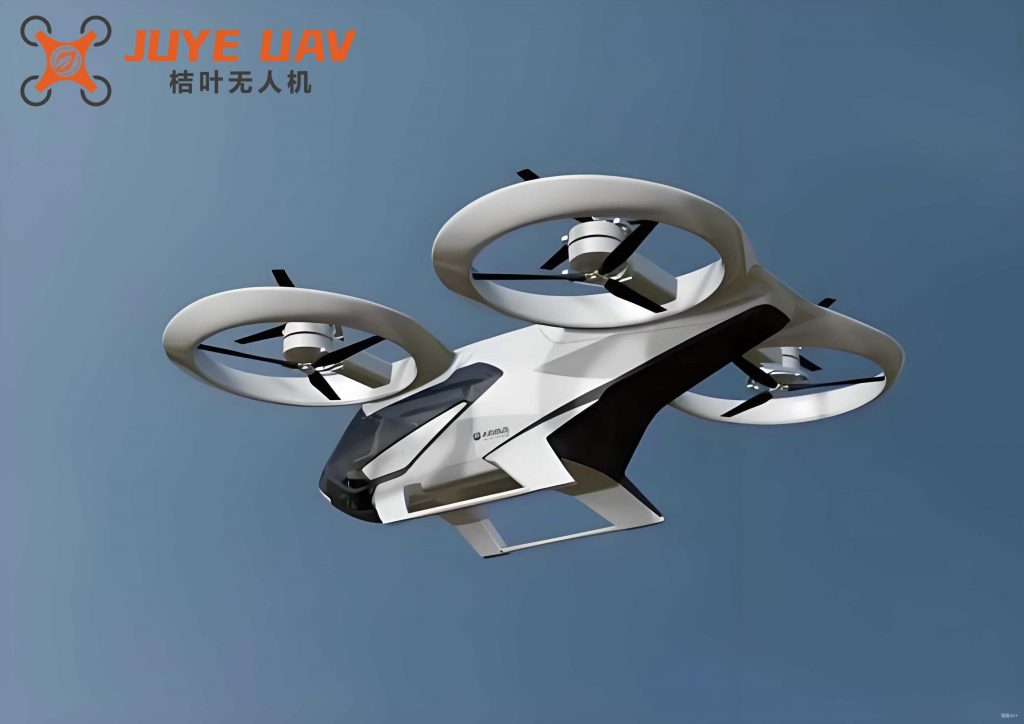
The mathematical model of a quadrotor drone is derived using Newton-Euler equations, considering external disturbances and model uncertainties. The quadrotor drone dynamics are described in an inertial frame and body frame, with states including position $(x, y, z)$ and attitude angles $(\phi, \theta, \psi)$. The equations of motion are given by:
$$
\begin{aligned}
\ddot{x} &= \frac{u_f}{m} (\cos\phi \sin\theta \cos\psi + \sin\phi \sin\psi) – \frac{K_x}{m} \dot{x} + d_x, \\
\ddot{y} &= \frac{u_f}{m} (\cos\phi \sin\theta \sin\psi – \sin\phi \cos\psi) – \frac{K_y}{m} \dot{y} + d_y, \\
\ddot{z} &= \frac{u_f}{m} \cos\phi \cos\theta – g – \frac{K_z}{m} \dot{z} + d_z, \\
\ddot{\phi} &= \dot{\theta} \dot{\psi} \frac{J_y – J_z}{J_x} – \frac{J_r}{J_x} \dot{\theta} \omega – \frac{K_\phi}{J_x} \dot{\phi} + \frac{1}{J_x} u_\phi + d_\phi, \\
\ddot{\theta} &= \dot{\phi} \dot{\psi} \frac{J_z – J_x}{J_y} – \frac{J_r}{J_y} \dot{\phi} \omega – \frac{K_\theta}{J_y} \dot{\theta} + \frac{1}{J_y} u_\theta + d_\theta, \\
\ddot{\psi} &= \dot{\phi} \dot{\theta} \frac{J_x – J_y}{J_z} – \frac{K_\psi}{J_z} \dot{\psi} + \frac{1}{J_z} u_\psi + d_\psi,
\end{aligned}
$$
where $m$ is the mass, $g$ is gravity, $K_i$ are drag coefficients, $J_i$ are moments of inertia, $u_f$ and $u_\phi, u_\theta, u_\psi$ are control inputs, and $d_i$ represent external disturbances. For controller design, the model is simplified into position and attitude subsystems. The position subsystem is:
$$
\begin{aligned}
\dot{p} &= v, \\
\dot{v} &= \frac{u_f}{m} \Xi – g E + f_v(v) + d_p,
\end{aligned}
$$
where $p = [x, y, z]^T$, $v = [\dot{x}, \dot{y}, \dot{z}]^T$, $\Xi$ is a transformation matrix, $f_v(v)$ denotes nonlinear damping terms, and $d_p = [d_x, d_y, d_z]^T$. The attitude subsystem is:
$$
\begin{aligned}
\dot{\Theta} &= \omega, \\
\dot{\omega} &= J^{-1} u_\alpha + f_\omega(\omega) + d_a,
\end{aligned}
$$
where $\Theta = [\phi, \theta, \psi]^T$, $\omega = [\dot{\phi}, \dot{\theta}, \dot{\psi}]^T$, $J$ is the inertia matrix, $u_\alpha = [u_\phi, u_\theta, u_\psi]^T$, $f_\omega(\omega)$ includes Coriolis and damping terms, and $d_a = [d_\phi, d_\theta, d_\psi]^T$. These equations highlight the underactuated nature of quadrotor drones, where only four control inputs govern six degrees of freedom.
To handle model uncertainties and disturbances, I employ RBF neural networks for approximation. An RBFNN can approximate any continuous function $f(x)$ as:
$$
f(x) = W^{*T} h(x) + \mu(x),
$$
where $W^*$ is the ideal weight vector, $h(x)$ is the Gaussian basis function, and $\mu(x)$ is the approximation error. For the quadrotor drone, the unknown nonlinearities $f_v(v)$ and $f_\omega(\omega)$ along with disturbances $d_p$ and $d_a$ are approximated using separate RBFNNs for position and attitude subsystems. This allows the controller to adaptively compensate for uncertainties, enhancing the robustness of the quadrotor drone system.
The prescribed performance control framework ensures that tracking errors remain within predefined bounds. I define an appointed-time performance function $\rho_i(t)$ for each error $e_i$ (where $i$ corresponds to position or attitude states):
$$
\rho_i(t) =
\begin{cases}
\left( \frac{T_i – t}{T_i} \right)^{r_i} (1 – r_i)^{-1} (\rho_{0i} – \rho_{\infty i}) + \rho_{\infty i}, & 0 \leq t < T_i, \\
\rho_{\infty i}, & t \geq T_i,
\end{cases}
$$
where $T_i$ is the user-specified convergence time, $\rho_{0i}$ and $\rho_{\infty i}$ are initial and steady-state bounds, and $r_i$ is a tuning parameter. The tracking error $e_i$ is constrained as:
$$
-b_i \rho_i(t) < e_i < b_i \rho_i(t),
$$
with $b_i$ being positive constants. To incorporate this into control design, an error transformation function $\gamma(\epsilon_i)$ is used:
$$
\gamma(\epsilon_i) = \frac{e_i}{\rho_i(t)} = \frac{2}{\pi} \arctan(\epsilon_i),
$$
which maps the constrained error $e_i$ to an unconstrained variable $\epsilon_i$. This transformation ensures that $e_i$ evolves within the performance bounds, and $\epsilon_i \to 0$ implies $e_i \to 0$. Compared to traditional hyperbolic functions, this arctangent-based transformation offers faster convergence for quadrotor drone applications.
The controller design follows a backstepping approach with dynamic surface control to avoid complexity explosion. For the position subsystem of the quadrotor drone, virtual control laws are designed as:
$$
\alpha_p = \dot{p}_d + \frac{\dot{\rho}_p}{\rho_p} e_p – k_{p,1} \frac{\epsilon_p}{r_p}, \quad \alpha_a = \dot{\Theta}_d + \frac{\dot{\rho}_a}{\rho_a} e_a – k_{a,1} \frac{\epsilon_a}{r_a},
$$
where $p_d$ and $\Theta_d$ are desired trajectories, $k_{p,1}$ and $k_{a,1}$ are control gains, and $r_p$, $r_a$ are scaling factors. A first-order filter is applied to these virtual laws:
$$
T_i \dot{\hat{\alpha}}_i + \hat{\alpha}_i = \alpha_i,
$$
where $\hat{\alpha}_i$ is the filtered signal. To compensate for filter errors, a novel compensation system is introduced:
$$
\begin{aligned}
\dot{\chi}_1 &= (\text{diag}(\rho))^{-1} (-k_1 \chi_1) + r \chi_2 + r (\hat{\alpha}_i – \alpha_i), \\
\dot{\chi}_2 &= -k_2 \chi_2 – r \chi_1,
\end{aligned}
$$
with $k_1$, $k_2$, and $r$ as positive constants. The actual control laws for the quadrotor drone are then derived as:
$$
\begin{aligned}
u_p &= -k_{p,2} z_{p,2} + \dot{\hat{\alpha}}_p – k_2 H_p – r_p \epsilon_p – \hat{W}_p^T h_p(x_p), \\
u_a &= -k_{a,2} z_{a,2} + \dot{\hat{\alpha}}_a – k_2 H_a – r_a \epsilon_a – \hat{W}_a^T h_a(x_a),
\end{aligned}
$$
where $z_{p,2}$ and $z_{a,2}$ are tracking errors, $H_p$ and $H_a$ are filtered errors, and $\hat{W}_p^T h_p(x_p)$ and $\hat{W}_a^T h_a(x_a)$ are RBFNN approximations for uncertainties. The adaptive laws for updating the RBFNN weights are:
$$
\begin{aligned}
\dot{\hat{W}}_p &= k_{w1} (h_p(x_p) z_{p,2}^T – k_{w2} \hat{W}_p), \\
\dot{\hat{W}}_a &= k_{w3} (h_a(x_a) z_{a,2}^T – k_{w4} \hat{W}_a),
\end{aligned}
$$
with $k_{w1}$ to $k_{w4}$ as adaptation gains. This integrated structure ensures that the quadrotor drone achieves robust trajectory tracking despite model uncertainties.
Stability analysis is conducted using Lyapunov theory. I define a composite Lyapunov function for the quadrotor drone system:
$$
V = V_1 + V_2 + \frac{1}{2k_{w1}} \tilde{W}_p^T \tilde{W}_p + \frac{1}{2k_{w3}} \tilde{W}_a^T \tilde{W}_a,
$$
where $V_1 = \frac{1}{2} \rho_p \delta_{1,p}^2 + \frac{1}{2} \rho_a \delta_{1,a}^2$ and $V_2 = \frac{1}{2} \delta_{2,p}^2 + \frac{1}{2} \delta_{2,a}^2$, with $\delta_1 = \epsilon – \chi_1$ and $\delta_2 = H – \chi_2$ being compensated errors. Taking the derivative and substituting the control laws yields:
$$
\dot{V} \leq -k_1 \delta_{1,p}^2 – k_1 \delta_{1,a}^2 – k_2 \delta_{2,p}^2 – k_2 \delta_{2,a}^2 – \frac{k_{w2}}{2} \| \tilde{W}_p \|^2 – \frac{k_{w4}}{2} \| \tilde{W}_a \|^2 + \Pi,
$$
where $\Pi$ is a bounded term due to approximation errors. By selecting gains such that $k_3 = \min\{ \frac{\dot{\rho}_p}{2}, \frac{\dot{\rho}_a}{2}, k_1, k_2 \} > 0$, I obtain $\dot{V} \leq -k_3 V + \Pi$, proving that all signals are uniformly ultimately bounded and the tracking errors converge to a small neighborhood of zero within the appointed time $T_i$. This guarantees the stability of the quadrotor drone control system.
Simulation studies are performed to validate the proposed controller for quadrotor drones. The parameters used for the quadrotor drone model and controller are summarized in the following tables:
| Parameter | Value |
|---|---|
| Mass $m$ (kg) | 2.0 |
| Gravity $g$ (m/s²) | 9.8 |
| Arm length $J_r$ (m) | 0.325 |
| Moment of inertia $J_x$ (kg·m²) | 0.082 |
| Moment of inertia $J_y$ (kg·m²) | 0.082 |
| Moment of inertia $J_z$ (kg·m²) | 0.149 |
| Drag coefficient $K_x$ (kg/m²) | 0.17 |
| Drag coefficient $K_y$ (kg/m²) | 0.17 |
| Drag coefficient $K_z$ (kg/m²) | 0.17 |
| Drag coefficient $K_\phi$ (kg/m²) | 0.17 |
| Drag coefficient $K_\theta$ (kg/m²) | 0.17 |
| Drag coefficient $K_\psi$ (kg/m²) | 0.17 |
| Parameter | Value |
|---|---|
| Compensation gain $k_1$ | 0.1 |
| Compensation gain $k_2$ | 0.1 |
| Position time constant $T_p$ (s) | 0.1 |
| Attitude time constant $T_a$ (s) | 0.002 |
| Position control gain $k_{p,1}$ | 0.1 |
| Position control gain $k_{p,2}$ | 0.2 |
| Attitude control gain $k_{a,1}$ | 0.1 |
| Attitude control gain $k_{a,2}$ | 0.2 |
| RBFNN gain $k_{w1}$ | 0.5 |
| RBFNN gain $k_{w2}$ | 0.5 |
| RBFNN gain $k_{w3}$ | 0.5 |
| RBFNN gain $k_{w4}$ | 0.5 |
The desired trajectory for the quadrotor drone is a circular path with increasing altitude:
$$
\begin{aligned}
x_d &= 5 \cos\left(\frac{\pi t}{10}\right), \\
y_d &= 5 \sin\left(\frac{\pi t}{10}\right), \\
z_d &= \frac{t}{2}.
\end{aligned}
$$
External disturbances are modeled as time-varying functions:
$$
\begin{aligned}
d_x &= 3.2 \sin(0.6t) \cos(0.4t), \quad d_y = 4.4 \cos(0.9t) \sin(0.6t), \quad d_z = 2.3 \cos(0.7t) \sin(0.3t), \\
d_\phi &= 0.5 \cos(0.8t) \sin(0.3t), \quad d_\theta = 0.3 \sin(0.4t) \cos(0.7t), \quad d_\psi = 0.2 \cos(0.2t) \sin(0.4t).
\end{aligned}
$$
Performance function parameters are set as $\rho_{0i} = 5$, $\rho_{\infty i} = 0.2$, and initial conditions for the quadrotor drone are $(x, y, z) = (4, 0, 1)$ and $(\phi, \theta, \psi) = (0, 0, -\pi/4)$. Simulation results show that the quadrotor drone successfully tracks the desired trajectory, with position and attitude errors converging within the appointed time of 5 seconds. The compensation system effectively mitigates filter errors, and the RBFNN approximations adapt to disturbances. To test robustness, abrupt disturbances are introduced at $t = 20$ s:
$$
\begin{aligned}
d_x &= 3 \sin(0.6t) – 0.6 \cos(0.4t), \quad d_y = 2.8 \sin(0.8t) + 0.5 \cos(0.5t), \quad d_z = 4 \sin(0.6t).
\end{aligned}
$$
The controller maintains stable tracking, demonstrating the resilience of the quadrotor drone system. Control input forces and moments remain within feasible limits, as shown in simulation plots.
Experimental validation is conducted using a commercial quadrotor drone platform in a windy outdoor environment. The proposed control algorithm is implemented in C++ on a Pixhawk flight controller. The quadrotor drone performs autonomous trajectory tracking tasks, including takeoff, waypoint navigation, and landing. Performance metrics are evaluated based on position deviation and response time. Key results are summarized below:
| Metric | Value | Reference |
|---|---|---|
| Takeoff/Landing deviation (cm) | < 1 | 2.0 |
| x-axis response time (s) | 0.11 | 0.21 |
| y-axis response time (s) | 0.10 | 0.21 |
| z-axis response time (s) | 0.17 | 0.27 |
The quadrotor drone achieves precise tracking with deviations under 1 cm, outperforming conventional PID-based controllers. The adaptive RBFNN component effectively compensates for wind gusts and model inaccuracies, ensuring smooth flight operations. These experimental outcomes align with simulation predictions, confirming the practicality of the method for real-world quadrotor drone applications.
In conclusion, this work presents an appointed-time prescribed performance control strategy for quadrotor drones with model uncertainties and external disturbances. The integration of adaptive RBF neural networks enables accurate approximation of unknown nonlinearities, while a novel error transformation and compensation mechanism guarantees transient and steady-state performance within user-defined time bounds. Stability analysis proves the uniform ultimate boundedness of all signals, and simulations and experiments validate the controller’s efficacy. Future research may extend this approach to multi-quadrotor drone systems or incorporate fault-tolerant capabilities. Overall, the proposed method enhances the robustness and precision of quadrotor drone trajectory tracking, making it suitable for demanding applications such as agricultural monitoring or search-and-rescue missions.
The mathematical formulations and control laws are generalized for quadrotor drones, but they can be adapted to other unmanned aerial vehicles. Key advantages include appointed-time convergence, which allows operators to specify performance deadlines, and the use of RBFNNs, which reduces dependency on precise dynamic models. For implementation, practitioners should tune gains based on specific quadrotor drone parameters and environmental conditions. The tables provided offer a starting point for parameter selection, but online adaptation via the RBFNNs ensures flexibility. This study contributes to the advancement of intelligent control systems for quadrotor drones, addressing critical challenges in autonomous flight.
To further illustrate the controller design, consider the error dynamics for a quadrotor drone. Define tracking errors $e_p = p – p_d$ and $e_a = \Theta – \Theta_d$. The transformed errors are $\epsilon_p = \tan\left(\frac{\pi}{2} \frac{e_p}{\rho_p}\right)$ and $\epsilon_a = \tan\left(\frac{\pi}{2} \frac{e_a}{\rho_a}\right)$. The control inputs are derived to satisfy Lyapunov conditions, ensuring that $\dot{V}$ is negative definite. The RBFNN approximation errors are bounded by $\| \mu(x) \| \leq \bar{\mu}$, where $\bar{\mu}$ is a constant, and the weight estimation errors $\tilde{W} = W^* – \hat{W}$ converge exponentially due to the adaptive laws. This framework ensures that the quadrotor drone maintains stability even in the presence of significant uncertainties.
In summary, the proposed control method for quadrotor drones combines prescribed performance constraints, adaptive neural networks, and appointed-time convergence to achieve robust trajectory tracking. The approach is validated through rigorous analysis and practical tests, demonstrating its potential for enhancing the autonomy and reliability of quadrotor drone systems in complex environments. As quadrotor drones continue to evolve, such advanced control strategies will play a pivotal role in unlocking new applications and improving operational safety.