
The cooperative control of unmanned aerial vehicle (UAV) swarms represents a pivotal technology for future operational paradigms, offering advantages in cost-effectiveness, scalability, and mission resilience. Among these, distributed quadrotor drone swarms are particularly promising due to their agility, vertical take-off and landing capability, and mechanical simplicity. A fundamental challenge in deploying such swarms in complex, real-world scenarios—such as Suppression of Enemy Air Defenses (SEAD), wide-area reconnaissance, or dynamic surveillance—is achieving robust collective motion without strict pre-defined formation constraints, especially when the underlying communication network is dynamic and subject to noise.
Flocking control, inspired by biological systems like bird flocks or fish schools, provides a powerful framework for this purpose. It enables a group of agents to achieve coherent collective behavior through simple local rules: cohesion, collision avoidance, and velocity alignment. For a quadrotor drone swarm, this translates to the emergent property of moving as a cohesive group towards a goal while adapting to environmental changes and maintaining safe separation, all without a centralized commander or a rigid geometric pattern. The core problem intensifies when the communication topology—defining which drones can exchange information—changes over time due to limited communication range, node failures, or intentional maneuvering. Furthermore, the measurements and communicated data are invariably corrupted by noise, which can degrade control performance if not properly addressed.
This article presents a comprehensive flocking control strategy for a swarm of quadrotor drones operating under dynamic communication topologies and measurement noise. The strategy is built upon a cascaded control architecture intrinsic to quadrotor drone dynamics. The outer loop handles position-level flocking, employing a novel control protocol that integrates a Kalman-Consensus Filter (KCF) for robust state estimation of a dynamic leader. The inner loop manages the attitude dynamics of each individual quadrotor drone using a Brain Emotional Learning Based Intelligent Controller (BELBIC). We provide rigorous stability analysis using Lyapunov theory and demonstrate the efficacy of the approach through detailed numerical simulations.
System Modeling and Problem Formulation
1.1 Quadrotor Drone Dynamics
A quadrotor drone is an underactuated, highly nonlinear system. Defining its position in the inertial frame as $\mathbf{q} = [q_x, q_y, q_z]^T$ and its attitude by the Euler angles $\boldsymbol{\Theta} = [\phi, \theta, \psi]^T$ (roll, pitch, yaw), a simplified dynamic model, neglecting aerodynamic drag effects, is given by:
$$
\begin{aligned}
\ddot{q}_x &= \frac{U_1}{m} (\sin\theta \cos\psi \cos\phi + \sin\psi \sin\phi) \\
\ddot{q}_y &= \frac{U_1}{m} (\sin\theta \cos\psi \sin\phi – \sin\psi \cos\phi) \\
\ddot{q}_z &= \frac{U_1}{m} (\cos\theta \cos\phi) – g \\
\ddot{\phi} &= \frac{1}{I_x} [U_2 + (I_y – I_z) \dot{\theta} \dot{\psi}] \\
\ddot{\theta} &= \frac{1}{I_y} [U_3 + (I_z – I_x) \dot{\phi} \dot{\psi}] \\
\ddot{\psi} &= \frac{1}{I_z} [U_4 + (I_x – I_y) \dot{\phi} \dot{\theta}]
\end{aligned}
$$
where $m$ is the mass, $g$ is gravitational acceleration, $I_x, I_y, I_z$ are moments of inertia, and $U_1, U_2, U_3, U_4$ are the control inputs. $U_1$ is the total thrust, and $U_2, U_3, U_4$ are the moments generated by differentially varying the speeds of the four rotors. The control inputs are related to individual rotor thrusts $T_i$ and drag coefficients.
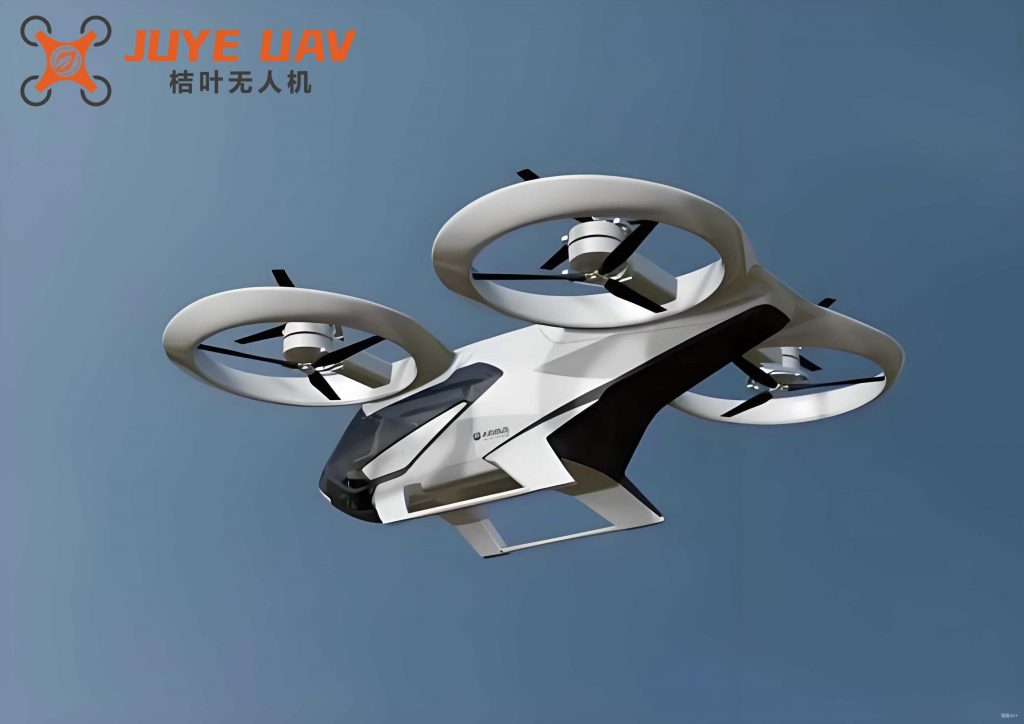
For flocking control design at the position level, we often consider a double-integrator model for the translational dynamics, treating the attitude controller as a fast inner loop. The virtual control input for the position of the $i$-th quadrotor drone is defined from the above equations as $\mathbf{u}_i = [u_{ix}, u_{iy}, u_{iz}]^T$, where:
$$
\begin{aligned}
u_{ix} &= \frac{1}{m}(\sin\theta_i \cos\phi_i \cos\psi_i + \sin\phi_i \sin\psi_i)U_{1i} \\
u_{iy} &= \frac{1}{m}(\sin\theta_i \cos\phi_i \sin\psi_i – \sin\phi_i \cos\psi_i)U_{1i} \\
u_{iz} &= \frac{1}{m}(\cos\phi_i \cos\theta_i)U_{1i} – g
\end{aligned}
$$
These virtual inputs $\mathbf{u}_i$ are the outputs of the flocking controller and are then used to compute the required total thrust $U_{1i}$ and desired attitude angles $(\phi_{d_i}, \theta_{d_i})$ for the inner-loop attitude controller.
1.2 Swarm Network and Problem Statement
Consider a swarm of $n$ homogeneous quadrotor drones. The position-level dynamics for each agent $i$ are modeled as:
$$
\begin{aligned}
\dot{\mathbf{q}}_i(t) &= \mathbf{p}_i(t) \\
\dot{\mathbf{p}}_i(t) &= \mathbf{u}_i(t)
\end{aligned}
$$
where $\mathbf{q}_i, \mathbf{p}_i, \mathbf{u}_i \in \mathbb{R}^3$. The communication topology is represented by a dynamic undirected graph $\mathcal{G}(t)=(\mathcal{V}, \mathcal{E}(t))$, where $\mathcal{V}=\{1,…,n\}$ is the node set and $\mathcal{E}(t)$ is the edge set. An edge $(i, j)$ exists if and only if drones $i$ and $j$ are within a maximum interaction range $d_{max}$:
$$
\mathcal{N}_i(t) = \{ j : \|\mathbf{q}_i(t) – \mathbf{q}_j(t)\| < d_{max}, j \neq i \}.
$$
The adjacency matrix $\mathbf{A}_d(t)=[a_{ij}(t)]$ is defined with $a_{ij}(t)=1$ if $j \in \mathcal{N}_i(t)$, and $0$ otherwise.
A single leader, which may be a virtual agent or a physical guide, dictates the desired swarm trajectory. Its state $\mathbf{x}_\gamma = [\mathbf{q}_\gamma^T, \mathbf{p}_\gamma^T, \mathbf{u}_\gamma^T]^T \in \mathbb{R}^9$ evolves according to a known linear model with process noise $\boldsymbol{\omega}(t)$:
$$
\dot{\mathbf{x}}_\gamma(t) = \mathbf{A} \mathbf{x}_\gamma(t) + \mathbf{B} \boldsymbol{\omega}(t).
$$
Each quadrotor drone $i$ obtains a noisy measurement of the leader’s state if it is within a sensing radius $R_{max}$:
$$
\mathbf{z}_i(t) = \mathbf{H}_i \mathbf{x}_\gamma(t) + \mathbf{v}_i(t),
$$
where $\mathbf{v}_i(t)$ is measurement noise. Both $\boldsymbol{\omega}(t)$ and $\mathbf{v}_i(t)$ are zero-mean Gaussian white noise processes with covariances $\mathbf{Q}$ and $\mathbf{R}_i$, respectively.
Control Objective: Design a distributed control law $\mathbf{u}_i$ for each quadrotor drone using only information from its dynamic neighborhood $\mathcal{N}_i(t)$ and its local noisy measurement of the leader, such that the swarm achieves the following:
- Velocity Consensus: $\lim_{t \to \infty} \|\mathbf{p}_i(t) – \mathbf{p}_j(t)\| = 0$ for all $i, j$.
- Cohesion & Collision Avoidance: Inter-agent distances remain bounded, $\sup_{t \geq 0} \|\mathbf{q}_i(t) – \mathbf{q}_j(t)\| < \infty$, and no collisions occur: $\|\mathbf{q}_i(t) – \mathbf{q}_j(t)\| > 0$ for all $t$ and $i \neq j$.
- Leader Tracking: The swarm centroid tracks the leader’s trajectory, and individual velocities converge to the leader’s velocity: $\lim_{t \to \infty} \|\mathbf{p}_i(t) – \mathbf{p}_\gamma(t)\| = 0$.
This must be achieved despite a dynamically changing graph $\mathcal{G}(t)$ and in the presence of significant measurement and process noise.
Cascaded Flocking Control Architecture
The proposed solution leverages the natural cascaded structure of quadrotor drone control. The overall architecture decomposes the problem into an outer-loop position controller and an inner-loop attitude controller, as summarized in the table below.
| Control Loop | Function | Primary Components | Output |
|---|---|---|---|
| Outer Loop (Position) | Generates swarm-cohesive motion, avoids collisions, tracks leader. | KCF-based Flocking Algorithm | Virtual control acceleration $\mathbf{u}_i$. |
| Inner Loop (Attitude) | Stabilizes the quadrotor drone and tracks the attitude commands from the outer loop. | BELBIC Attitude Controller | Actuation signals $U_{1i}, U_{2i}, U_{3i}, U_{4i}$. |
The outer-loop controller computes the required virtual acceleration $\mathbf{u}_i = [u_{ix}, u_{iy}, u_{iz}]^T$ for the $i$-th drone. This acceleration is then converted into a desired total thrust $U_{1i}$ and desired roll ($\phi_{d_i}$) and pitch ($\theta_{d_i}$) angles:
$$
\begin{aligned}
U_{1i} &= m \sqrt{u_{ix}^2 + u_{iy}^2 + (u_{iz} + g)^2}, \\
\phi_{d_i} &= \arcsin\left( \frac{m}{U_{1i}} (u_{ix} \sin\psi_{d_i} – u_{iy} \cos\psi_{d_i}) \right), \\
\theta_{d_i} &= \arccos\left( \frac{(u_{iz}+g)m}{U_{1i} \cos\phi_{d_i}} \right),
\end{aligned}
$$
where $\psi_{d_i}$ is a separately defined desired yaw angle (often set to zero or a fixed value for flocking). These desired attitudes $(\phi_{d_i}, \theta_{d_i}, \psi_{d_i})$ become the reference commands for the inner-loop BELBIC attitude controller, which computes the actual motor commands to achieve them. This decoupling simplifies the complex 6-DOF control problem into a more manageable form.
Kalman-Consensus Filter Based Flocking Algorithm
3.1 Distributed State Estimation via KCF
To mitigate the effect of noise on leader state information, each quadrotor drone runs a local Kalman-Consensus Filter (KCF). Let $\hat{\mathbf{x}}_i$ and $\mathbf{P}_i$ be the local estimate of $\mathbf{x}_\gamma$ and its error covariance matrix for drone $i$. The KCF algorithm combines a standard Kalman filter update with a consensus term that drives local estimates towards those of neighbors:
$$
\begin{aligned}
\dot{\hat{\mathbf{x}}}_i &= \mathbf{A} \hat{\mathbf{x}}_i + \mathbf{K}_i (\mathbf{z}_i – \mathbf{H}_i \hat{\mathbf{x}}_i) + \mu \mathbf{P}_i \sum_{j \in \mathcal{N}_i(t)} (\hat{\mathbf{x}}_j – \hat{\mathbf{x}}_i), \\
\mathbf{K}_i &= \mathbf{P}_i \mathbf{H}_i^T \mathbf{R}_i^{-1}, \quad \mu > 0, \\
\dot{\mathbf{P}}_i &= \mathbf{A} \mathbf{P}_i + \mathbf{P}_i \mathbf{A}^T + \mathbf{B}\mathbf{Q}\mathbf{B}^T – \mathbf{K}_i \mathbf{R}_i \mathbf{K}_i^T.
\end{aligned}
$$
The term $\mu \mathbf{P}_i \sum_{j \in \mathcal{N}_i(t)} (\hat{\mathbf{x}}_j – \hat{\mathbf{x}}_i)$ is the consensus innovation. It allows drones to fuse not only their own measurements but also the beliefs of their neighbors, leading to a more accurate and robust collective estimate of the leader’s state $\mathbf{x}_\gamma$, even if only a subset of drones can directly sense the leader at any given time.
3.2 Flocking Control Protocol Design
The flocking control input for the $i$-th quadrotor drone is synthesized from three distinct components, utilizing the KCF estimates $\hat{\mathbf{q}}_\gamma^i, \hat{\mathbf{p}}_\gamma^i, \hat{\mathbf{u}}_\gamma^i$:
$$
\mathbf{u}_i = \mathbf{u}_i^\alpha + \mathbf{u}_i^\beta + \mathbf{u}_i^\gamma.
$$
- Velocity Alignment Term ($\mathbf{u}_i^\alpha$): This term promotes velocity matching within the dynamic neighborhood, weighted by a smooth interaction function $\phi(r_{ij})$ that vanishes at $d_{max}$.
$$
\mathbf{u}_i^\alpha = k_1 \sum_{j=1}^{n} \phi(\|\mathbf{q}_j – \mathbf{q}_i\|) (\mathbf{p}_j – \mathbf{p}_i),
$$
where $\phi(r) = \frac{1}{\alpha} \left[ \frac{1}{(1+r^2)^\beta} – \frac{1}{(1+d_{max}^2)^\beta} \right]$ for $r \leq d_{max}$, and $0$ otherwise, with $\alpha, \beta > 0$. - Collision Avoidance & Cohesion Term ($\mathbf{u}_i^\beta$): This term is derived from an artificial potential field $\Psi(\|\mathbf{q}_j – \mathbf{q}_i\|)$ to maintain a desired inter-agent distance $R_0$.
$$
\mathbf{u}_i^\beta = k_2 \sum_{j \neq i} \nabla_{\mathbf{q}_i} \Psi(\|\mathbf{q}_j – \mathbf{q}_i\|) = k_2 \sum_{j=1}^{n} a_{ij}(t) \left[ \frac{\sigma_1}{2 r_{ij}^2} \langle \mathbf{p}_j – \mathbf{p}_i, \mathbf{q}_j – \mathbf{q}_i \rangle (\mathbf{q}_j – \mathbf{q}_i) + \frac{\sigma_2}{2 r_{ij}} (r_{ij} – R_0)(\mathbf{q}_j – \mathbf{q}_i) \right],
$$
where $r_{ij} = \|\mathbf{q}_j – \mathbf{q}_i\|$, and $\sigma_1, \sigma_2 > 0$ are tuning parameters. - Leader Tracking Term ($\mathbf{u}_i^\gamma$): This term steers the drone towards the estimated trajectory of the leader.
$$
\mathbf{u}_i^\gamma = \gamma_i \left[ \hat{\mathbf{u}}_\gamma^i – k_3 (\mathbf{q}_i – \hat{\mathbf{q}}_\gamma^i) – k_4 (\mathbf{p}_i – \hat{\mathbf{p}}_\gamma^i) \right],
$$
where $k_3, k_4 > 0$ are control gains, and $\gamma_i$ is an indicator function: $\gamma_i=1$ if $\|\mathbf{q}_i – \mathbf{q}_\gamma\| \leq R_{max}$, else $\gamma_i=0$.
The complete distributed control law for each quadrotor drone is thus:
$$
\begin{aligned}
\mathbf{u}_i &= k_1 \sum_{j=1}^{n} \phi(r_{ij}) (\mathbf{p}_j – \mathbf{p}_i) \\
&+ k_2 \sum_{j=1}^{n} a_{ij}(t) \left[ \frac{\sigma_1}{2 r_{ij}^2} \langle \mathbf{p}_j – \mathbf{p}_i, \mathbf{q}_j – \mathbf{q}_i \rangle (\mathbf{q}_j – \mathbf{q}_i) + \frac{\sigma_2}{2 r_{ij}} (r_{ij} – R_0)(\mathbf{q}_j – \mathbf{q}_i) \right] \\
&+ \gamma_i \left[ \hat{\mathbf{u}}_\gamma^i – k_3 (\mathbf{q}_i – \hat{\mathbf{q}}_\gamma^i) – k_4 (\mathbf{p}_i – \hat{\mathbf{p}}_\gamma^i) \right].
\end{aligned}
$$
3.3 Stability Analysis
The stability of the coupled KCF and flocking system can be proven using Lyapunov theory. Consider the total energy-like function $V$ for the swarm, comprising relative kinetic energy, artificial potential energy, and tracking error energy relative to the leader’s estimated state:
$$
V(t) = \frac{1}{2} \sum_{i=1}^{n} \left( k_2 \sum_{j \neq i} \Psi(r_{ij}) + \gamma_i k_3 \|\tilde{\mathbf{q}}_i\|^2 + \|\tilde{\mathbf{p}}_i\|^2 \right) + \frac{\kappa}{2\mu} \sum_{i=1}^{n} \boldsymbol{\eta}_i^T \mathbf{P}_i^{-1} \boldsymbol{\eta}_i,
$$
where $\tilde{\mathbf{q}}_i = \mathbf{q}_i – \mathbf{q}_\gamma$, $\tilde{\mathbf{p}}_i = \mathbf{p}_i – \mathbf{p}_\gamma$ are tracking errors, $\boldsymbol{\eta}_i = \mathbf{x}_\gamma – \hat{\mathbf{x}}_i$ are estimation errors, and $\kappa > 0$ is a weighting constant.
Theorem (Stability): Assume the dynamic communication graph $\mathcal{G}(t)$ is jointly connected over time intervals, and the initial energy $V(0)$ is finite. Under the proposed KCF-based flocking control law with appropriately chosen gains $k_1, k_2, k_3, k_4, \mu, \kappa$, the following holds:
- The estimation errors $\boldsymbol{\eta}_i$ are globally asymptotically stable: $\lim_{t \to \infty} \boldsymbol{\eta}_i(t) = \mathbf{0}$ for all $i$.
- The velocity alignment is achieved: $\lim_{t \to \infty} \|\mathbf{p}_i(t) – \mathbf{p}_j(t)\| = 0$ for all $i, j$, and all drones asymptotically converge to the leader’s velocity: $\lim_{t \to \infty} \tilde{\mathbf{p}}_i(t) = \mathbf{0}$.
- If $V(0) < (k^- + 1)\Psi(0)$ for some $k^- \in \mathbb{Z}^+$, then at most $k^-$ pairwise collisions can occur. If $V(0) < \Psi(0)$ ($k^-=0$), then no collisions occur for all $t \geq 0$.
Proof Sketch: The time derivative of $V(t)$ along the trajectories of the system is computed. Using properties of the Laplacian matrix of the dynamic graph $\mathcal{G}(t)$ and the KCF error dynamics, it can be shown that with proper gain conditions (e.g., $k_4 > 1 – \lambda_2(\mathbf{L}_f)$, $\kappa > 1/\lambda_2(\mathbf{L}_e)$ where $\lambda_2$ denotes algebraic connectivity), the derivative satisfies $\dot{V}(t) \leq 0$. Applying Lasalle’s invariance principle and Barbalat’s lemma leads to the convergence results stated in the theorem. The collision avoidance property is proven by contradiction based on the boundedness of the potential energy component of $V(t)$.
Brain Emotional Learning Based Attitude Control
4.1 BELBIC Model
To track the desired attitude $(\phi_{d_i}, \theta_{d_i}, \psi_{d_i})$ generated by the outer loop, a Brain Emotional Learning Based Intelligent Controller (BELBIC) is employed for each quadrotor drone. BELBIC is a biologically-inspired model mimicking the amygdala-orbitofrontal cortex network in mammalian brains. It is computationally simple, adaptable, and handles nonlinearities effectively.
The BELBIC model processes two primary inputs: Sensory Inputs (SI) and a Reward signal (REW). For attitude control, the SI is typically chosen as a function of the attitude tracking error $\mathbf{e}_{\Theta} = \boldsymbol{\Theta}_d – \boldsymbol{\Theta}$ and its integral:
$$
\mathbf{SI} = [k_{s1} \mathbf{e}_{\Theta}, \quad k_{s2} \int \mathbf{e}_{\Theta} dt].
$$
The Reward signal is designed to evaluate the control performance:
$$
REW = k_{r1} \mathbf{e}_{\Theta} + k_{r2} \int \mathbf{e}_{\Theta} dt + k_{r3} \mathbf{u}_{\Theta},
$$
where $\mathbf{u}_{\Theta}$ is the controller’s previous output. The internal model consists of an Amygdala network and an Orbitofrontal Cortex (OFC) network. The final control output $E_b$ (which becomes $\mathbf{u}_{\Theta}$) is the difference between the amygdala output and the OFC output:
$$
E_b = \sum A_j – \sum O_k.
$$
The learning rules adjust the weights $V_j$ (amygdala) and $W_k$ (OFC) as follows:
$$
\begin{aligned}
\Delta V_j &= \alpha_{v} \cdot SI_j \cdot \max(0, REW – \sum A), \\
\Delta W_k &= \alpha_{w} \cdot SI_k \cdot (REW – \sum A + \sum O),
\end{aligned}
$$
where $\alpha_v, \alpha_w$ are learning rates. A key feature is that amygdala weights only increase (monotonic learning), while OFC weights can both increase and decrease to inhibit inappropriate amygdala responses.
4.2 Stability of the BELBIC Attitude Loop
The internal stability of the BELBIC can be analyzed by examining the update rules for the weight vectors $\mathbf{V}$ and $\mathbf{W}$. Consider the discrete-time update for the amygdala weights: $\mathbf{V}(k+1) = \mathbf{V}(k) + \alpha_v \mathbf{SI}(k) \max(0, REW(k) – \mathbf{SI}^T(k)\mathbf{V}(k))$.
Theorem (BELBIC Stability): For a bounded sensory input $\mathbf{SI}(k)$ and reward signal $REW(k)$, if the learning rates satisfy $0 < \alpha_v < \frac{2}{\|\mathbf{SI}(k)\|^2}$ and $0 < \alpha_w < \frac{2}{\sum SI_k^2}$, and the initial weights are bounded, then the weight vectors $\mathbf{V}(k)$ and $\mathbf{W}(k)$ remain bounded, ensuring the BIBO (Bounded-Input-Bounded-Output) stability of the BELBIC controller. The tracking error $\mathbf{e}_{\Theta}$ is driven towards a small neighborhood of zero, as the controller learns to minimize the reward signal which is a function of this error.
This stable, adaptive controller is well-suited for the inner loop of a quadrotor drone, providing robust attitude tracking despite model uncertainties and disturbances, which complements the outer-loop flocking controller.
Simulation and Numerical Analysis
To validate the proposed integrated control strategy, a simulation of a quadrotor drone swarm with $n=50$ agents was conducted. The initial positions and velocities were randomly distributed within a bounded 3D volume. The leader followed a time-varying Dubins-like path defined by:
$$
\begin{aligned}
q_{\gamma x} &= 60 \sin\left(\frac{\pi}{120}(t-90)\right) + 135, \\
q_{\gamma y} &= 60 \cos\left(\frac{\pi}{120}(t-90)\right) + 128, \\
q_{\gamma z} &= 0.5t + 128.
\end{aligned}
$$
Measurement and process noise with significant covariance were injected. Key simulation parameters are listed below.
| Parameter Category | Symbol | Value |
|---|---|---|
| Flocking Control | $k_1, k_2, k_3, k_4$ | 7.5, 5.0, 0.75, 0.75 |
| Potential Field | $\sigma_1, \sigma_2, R_0, d_{max}$ | 1.5, 0.8, 15 m, 60 m |
| KCF | $\mu$, $R_{max}$ | 1.0, 60 m |
| Noise Covariance | $\mathbf{Q}$, $\mathbf{R}_i$ | $\mathbf{I}_3$, $0.5\mathbf{I}_3$ |
| BELBIC Gains | $k_{s1}, k_{s2}, k_{r1}, k_{r2}, k_{r3}$ | 156.25, 15.75, 17.5, 0.75, 0.25 (for $|e_\Theta|<0.2$) |
| BELBIC Learning Rates | $\alpha_v, \alpha_w$ | 0.0025, 0.015 |
Results: The swarm successfully achieved all control objectives.
- Cohesive Flocking: The initially dispersed drones rapidly aggregated into a cohesive, dynamic swarm that followed the leader’s complex 3D trajectory.
- Velocity Consensus: The velocities of all drones synchronized within approximately 10 seconds and remained aligned with the leader’s velocity thereafter.
- Collision Avoidance: The minimum inter-agent distance remained strictly positive throughout the simulation, confirming effective collision avoidance. The distance stabilized near, but slightly below, the desired $R_0=15$ m due to the multi-agent force balance.
- Noise Rejection: The KCF successfully provided accurate estimates of the leader’s state $\hat{\mathbf{x}}_\gamma^i$ to each drone, despite significant noise, enabling precise tracking.
- Attitude Tracking: The BELBIC controllers effectively stabilized the roll, pitch, and yaw angles of each quadrotor drone, tracking the commands from the outer loop with minimal overshoot and fast convergence, superior to a baseline PID controller in performance.
The simulation confirms that the integrated strategy enables a scalable, robust, and flexible quadrotor drone swarm to perform coordinated missions under realistic conditions of dynamic topology and sensor noise.
Conclusion
This article presented a holistic solution for the flocking control of quadrotor drone swarms operating under dynamic communication topologies and noisy measurement environments. The strategy is founded on a cascaded control architecture that decomposes the problem into an outer-loop position controller and an inner-loop attitude controller. The core innovation lies in the outer-loop design, which seamlessly integrates a distributed Kalman-Consensus Filter for robust leader state estimation with a potential-field-based flocking protocol. This combination ensures velocity alignment, collision-free cohesion, and accurate leader tracking despite topological changes and noise. Lyapunov-based stability proofs provide formal guarantees for the coupled estimation-and-control system. For the inner loop, a Brain Emotional Learning Based Intelligent Controller offers an effective, adaptive solution for stabilizing the nonlinear attitude dynamics of each individual quadrotor drone.
The proposed framework demonstrates that achieving complex, emergent swarm behaviors like flocking does not require rigid, pre-computed formations or perfect global information. Instead, through the principled integration of distributed estimation, local interaction rules, and robust low-level control, a swarm of quadrotor drones can exhibit intelligent, adaptable, and resilient collective motion. This capability is fundamental for future applications in defense, disaster response, and large-scale precision agriculture. Future work will focus on extending this framework to enable autonomous sub-swarming and dynamic task-driven reconfiguration, further enhancing the versatility and mission-level intelligence of quadrotor drone swarms.