
In recent years, with the rapid development of the economy and urbanization, emergencies have become increasingly frequent, and fire safety situations have grown more severe. Traditional fire rescue methods are often limited by operational range, endurance, and communication constraints, especially in scenarios involving high-rise buildings or complex terrains, making it difficult to meet the demands for efficient and precise rescue. Therefore, exploring new fire rescue technologies has become an urgent priority. In this study, we delve into the application of tethered fire UAVs in fire rescue missions. These UAVs, connected to ground stations via tethered cables, provide continuous power supply and stable communication, overcoming the limitations of short endurance and restricted communication range typical of conventional drones. We investigate their technical characteristics, application scenarios, challenges, and solutions, aiming to promote innovation and development in fire rescue technology.
From a first-person perspective, our research team has extensively analyzed the potential of tethered fire UAVs. We begin by reviewing the current state of fire rescue operations, where firefighters, as the primary responders, face extremely high risks in hazardous environments. The advent of unmanned systems, such as drones and unmanned vehicles, offers new avenues for modern fire rescue. Drones, with their rapid deployment and flexible flight capabilities, can quickly reach disaster sites like fires. However, traditional fire UAVs are constrained by battery life, payload capacity, and communication issues, limiting their widespread use in rescue scenarios. Tethered fire UAVs address these drawbacks by utilizing ground-based power through tethered cables, ensuring prolonged operation and enhanced stability. This makes them a promising tool for providing reliable and efficient aerial support in fire rescue missions.
To understand the foundation of our work, we first examine the technical overview of tethered fire UAVs. A tethered fire UAV is a special form of multi-rotor drone characterized by its connection to a ground station or other carrier via a tether cable, which supplies power from a ground source, eliminating reliance on traditional lithium batteries. The basic structure of a tethered fire UAV system consists of several key components, as summarized in the table below:
| Component | Description |
|---|---|
| UAV Platform | Typically a multi-rotor design (e.g., quadcopter) with动力系统, flight control systems, and payload mounts for sensors, cameras, or firefighting equipment. |
| Tethering Technology and Equipment | Includes the tether cable, winch, power connectors, and interfaces that enable continuous power supply from the ground, reducing onboard battery weight. |
| Ground Control Station (GCS) | Serves as the command center for起飞, flight control, mission planning, and data processing, equipped with computers, displays, and操作手柄. |
| Communication System | Combines wired (via tether) and wireless (e.g., Wi-Fi, 4G/5G) transmission for real-time data exchange and control between the UAV and GCS. |
We often visualize this setup to better illustrate the integration. For instance, the following figure provides a schematic representation of a tethered fire UAV system in action:
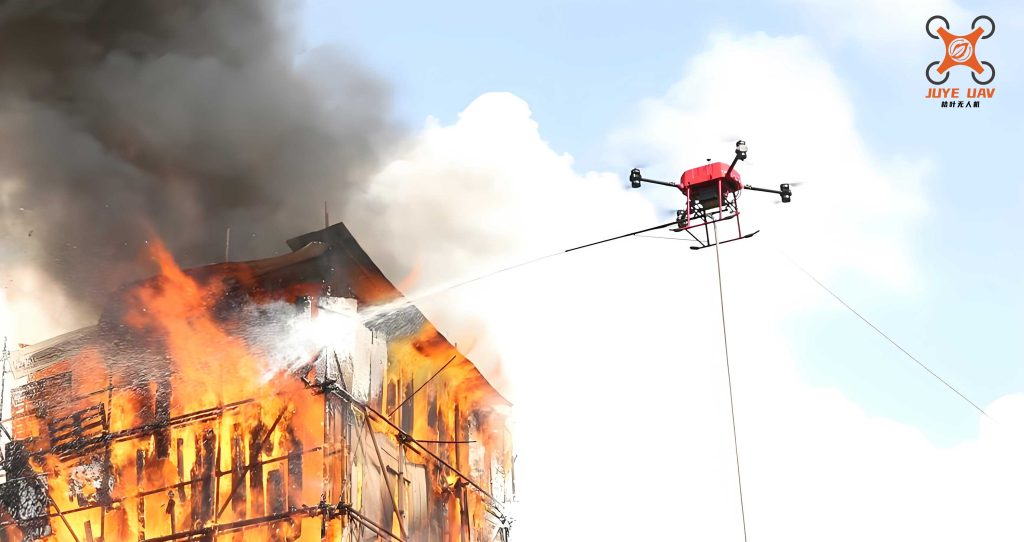
In terms of technical advantages, tethered fire UAVs excel in endurance, communication, and stability. Their endurance can be modeled based on power input. Let \( P_{\text{ground}} \) be the power supplied from the ground, and \( P_{\text{consumption}} \) be the power consumption of the UAV during flight. Since the ground power is continuous, the endurance time \( T \) is theoretically infinite, but in practice, it depends on operational factors such as cable length and environmental conditions. Compared to battery-powered fire UAVs with limited flight time, tethered fire UAVs offer a significant boost. The payload capacity \( L \) is also enhanced due to reduced battery weight, allowing for heavier equipment like fire retardant tanks or advanced sensors. This can be expressed as:
$$ L = L_{\text{max}} – W_{\text{battery}} + W_{\text{tether}} $$
where \( L_{\text{max}} \) is the maximum lift capacity, \( W_{\text{battery}} \) is the weight of the onboard battery (eliminated or reduced), and \( W_{\text{tether}} \) is the weight of the tether system. In most cases, \( W_{\text{tether}} < W_{\text{battery}} \), leading to a net gain in payload.
Communication capability is another strong suit. The tethered fire UAV employs a hybrid communication system. Let \( C_{\text{wired}} \) represent the wired channel through the tether, offering high bandwidth and low latency, and \( C_{\text{wireless}} \) represent the wireless channel for flexibility. The overall communication reliability \( R \) can be approximated as:
$$ R = 1 – (1 – R_{\text{wired}})(1 – R_{\text{wireless}}) $$
where \( R_{\text{wired}} \) and \( R_{\text{wireless}} \) are the reliability of wired and wireless links, respectively. This dual approach ensures stable data transmission even in干扰-prone environments. Stability is quantified by the抗干扰能力 factor \( \alpha \), which is higher for tethered fire UAVs due to the physical connection, reducing drift and enhancing precision in tasks like aerial monitoring.
In fire rescue scenarios, the applicability of tethered fire UAVs is evident. Their long endurance allows for extended operations in complex terrains like forests or mountains, where traditional vehicles cannot easily access. For example, in a wildfire, a tethered fire UAV can hover for hours, providing real-time video and thermal imaging to assess fire spread. The stability enables accurate sensor deployment, even in adverse weather conditions like strong winds or rain. We have observed that tethered fire UAVs often incorporate safety features such as propeller failure protection and communication redundancy, further boosting their reliability in critical missions.
Moving to specific applications, our research explores how tethered fire UAVs can revolutionize fire rescue operations. First, in fire scene monitoring and reconnaissance, these fire UAVs serve as空中 eyes. They can be equipped with high-definition cameras and infrared thermal imagers to capture live footage and temperature data. Let \( I(x,y,t) \) represent the thermal image intensity at coordinates \( (x,y) \) and time \( t \), which helps in identifying火源 locations and tracking火势蔓延. The data can be processed to generate heat maps, aiding in strategic decision-making. Additionally, for搜救 tasks, tethered fire UAVs can use acoustic sensors or生命体征 detectors to locate trapped individuals. The efficiency \( E_{\text{search}} \) of such searches can be modeled as:
$$ E_{\text{search}} = \frac{A_{\text{coverage}}}{T_{\text{search}}} \cdot \rho_{\text{detection}} $$
where \( A_{\text{coverage}} \) is the area covered, \( T_{\text{search}} \) is the search time, and \( \rho_{\text{detection}} \) is the detection probability. Tethered fire UAVs, with their prolonged hover capability, maximize \( A_{\text{coverage}} \) and minimize \( T_{\text{search}} \).
Second, in emergency communication relay, tethered fire UAVs act as空中 nodes. The principle involves using the fire UAV as a relay station between源节点 and目标节点. Consider a scenario where ground communication is disrupted due to a disaster. A tethered fire UAV, positioned at altitude \( h \), can establish a communication link with range \( d \), given by the formula for line-of-sight distance:
$$ d \approx \sqrt{2hR} $$
where \( R \) is the Earth’s radius. This extends coverage significantly. The UAV can carry基站 equipment to create a temporary network, supporting voice, data, and video传输. In multi-hop scenarios, multiple tethered fire UAVs can form a chain, further enhancing connectivity. The table below compares traditional communication methods with tethered fire UAV-based relays:
| Communication Method | Coverage Range | Endurance | Stability |
|---|---|---|---|
| Ground-Based Towers | Limited by terrain | Permanent but prone to damage | High in normal conditions |
| Battery-Powered UAVs | Moderate, depends on flight time | Short (e.g., 30 minutes) | Affected by weather |
| Tethered Fire UAVs | Extended due to altitude and tether | Long (theoretically continuous) | High, with wired backup |
Third, for物资投送 and personnel transfer, tethered fire UAVs offer unique capabilities. While personnel transfer is complex and risky, it can be considered in extreme cases with specialized吊舱 systems. For物资投送, the payload advantage is crucial. Let \( M_{\text{delivery}} \) be the mass of supplies delivered. A tethered fire UAV can carry heavier loads than conventional fire UAVs, enabling the transport of essential items like medical kits or food to inaccessible areas. The delivery efficiency \( \eta \) can be expressed as:
$$ \eta = \frac{M_{\text{delivery}}}{T_{\text{flight}} \cdot P_{\text{consumption}}} $$
where \( T_{\text{flight}} \) is the flight time and \( P_{\text{consumption}} \) is power consumption. With ground power, \( P_{\text{consumption}} \) is offset, allowing for higher \( \eta \). In our assessments, we have found that tethered fire UAVs can significantly reduce response times in disaster zones.
Looking ahead, we foresee several trends in the development of tethered fire UAVs for fire rescue. First, advancements in power systems will enhance endurance further. Innovations in ground-based power delivery and energy management will enable fire UAVs to operate for even longer periods, perhaps indefinitely, supporting continuous surveillance. The power efficiency ratio \( \epsilon \) might be improved through technologies like high-voltage transmission over tethers:
$$ \epsilon = \frac{P_{\text{output}}}{P_{\text{input}}} $$
where higher \( \epsilon \) reduces losses. Second, communication relay technology will become more sophisticated. Future tethered fire UAVs may integrate 5G or satellite links to provide ultra-reliable low-latency communication (URLLC), essential for real-time control in fire rescue. The data rate \( R_{\text{data}} \) could be modeled using Shannon’s theorem:
$$ R_{\text{data}} = B \log_2 \left(1 + \frac{S}{N}\right) $$
where \( B \) is bandwidth and \( S/N \) is signal-to-noise ratio, optimized by the UAV’s elevated position. Third, intelligent autonomous flight and obstacle avoidance will be key. With AI algorithms, tethered fire UAVs can navigate complex environments automatically, reducing the need for manual操控. This involves path planning algorithms that minimize risk and maximize coverage. Additionally, payload diversification will expand applications; for instance, fire UAVs could carry gas detectors or automated extinguishing systems.
In conclusion, our research underscores the transformative potential of tethered fire UAVs in fire rescue operations. By providing sustained aerial support, stable communication, and enhanced payload capacity, these fire UAVs address critical gaps in traditional methods. We have explored their technical foundations, diverse applications, and future directions, offering a comprehensive framework for practitioners and researchers. As technology evolves, we believe tethered fire UAVs will play an increasingly vital role in improving rescue efficiency and safeguarding lives, ultimately contributing to safer communities. Through continued innovation, the integration of fire UAVs into firefighting strategies will become more seamless and effective, paving the way for next-generation rescue solutions.