
In recent years, the emergence of formation drone light shows has captivated audiences worldwide, transforming aerial displays into intricate, synchronized spectacles. As a researcher in this field, I have focused on addressing the core challenges of multi-drone coordination, particularly for large-scale formation drone light shows that require precise control under model uncertainties and external disturbances. This article presents a comprehensive control strategy tailored for quadrotor UAVs in formation drone light shows, integrating adaptive neural networks and sliding mode techniques to ensure robust and accurate performance. The goal is to enable stunning visual effects where hundreds of drones move as one, maintaining perfect formation while tracking complex trajectories—a hallmark of modern formation drone light shows.
The foundation of any formation drone light show lies in the individual drone’s dynamics. For a quadrotor UAV, the model is derived from Newton-Euler equations, describing its motion in six degrees of freedom. Let the position vector in the inertial frame be $(x, y, z)$ and the attitude vector in the body frame be $(\phi, \theta, \psi)$. The dynamics can be expressed as:
$$ \ddot{x} = \frac{1}{m} U_1 (\cos \phi \sin \theta \cos \psi + \sin \phi \sin \psi) + f_x $$
$$ \ddot{y} = \frac{1}{m} U_1 (\cos \phi \sin \theta \sin \psi – \sin \phi \cos \psi) + f_y $$
$$ \ddot{z} = \frac{1}{m} (U_1 \cos \phi \cos \theta – mg) + f_z $$
$$ \ddot{\phi} = \frac{1}{I_x} [U_2 + (I_y – I_z) \dot{\theta} \dot{\psi}] $$
$$ \ddot{\theta} = \frac{1}{I_y} [U_3 + (I_z – I_x) \dot{\phi} \dot{\psi}] $$
$$ \ddot{\psi} = \frac{1}{I_z} [U_4 + (I_x – I_y) \dot{\phi} \dot{\theta}] $$
Here, $m$ is the mass, $g$ is gravity, $I_x, I_y, I_z$ are moments of inertia, $f_x, f_y, f_z$ represent external disturbances, and $U_1$ to $U_4$ are control inputs. In a formation drone light show, these equations must be managed for each drone to achieve synchronized movements, often under windy conditions or other disruptions that can mar the visual harmony. The challenge is amplified in large-scale formation drone light shows, where even minor errors can lead to collisions or distorted patterns.
To coordinate multiple drones for a formation drone light show, we design a multi-directional communication topology. This structure enhances robustness by allowing each follower drone to communicate with several neighbors, rather than relying on a single leader. For instance, in a formation drone light show with $n$ drones, one acts as the leader, while others are followers. The desired position for follower $i$, denoted as $D_i(x_i, y_i, z_i)$, is computed as:
$$ D_i = p_L D_L + p_G \frac{1}{n-2} \sum_{k=1}^{n-2} D_k $$
where $D_L$ is the leader’s desired position for follower $i$, $D_k$ are the desired positions from other followers, and $p_L + p_G = 1$ are weighting coefficients. This approach ensures smooth formation maintenance in dynamic formation drone light shows, as it averages out individual errors. The communication weights can be adjusted based on distance or signal strength, which is crucial for outdoor formation drone light shows where interference may occur.
The control system for each drone in a formation drone light show is divided into inner and outer loops. The outer loop handles position control, critical for tracking the choreographed paths in a formation drone light show. We employ an adaptive RBF neural network sliding mode controller to compensate for uncertainties and disturbances. Define position errors as $e_x = x_d – x$, $e_y = y_d – y$, $e_z = z_d – z$, with desired trajectories $(x_d, y_d, z_d)$ from the formation drone light show script. The sliding surfaces are:
$$ s_x = c_x e_x + \dot{e}_x, \quad s_y = c_y e_y + \dot{e}_y, \quad s_z = c_z e_z + \dot{e}_z $$
where $c_x, c_y, c_z > 0$. The control laws are derived using a reaching law approach. For the $x$-direction:
$$ u_x = \eta_x \text{sat}(s_x) + k_x s_x + c_x \dot{e}_x + \ddot{x}_d – \hat{f}_x $$
Here, $\hat{f}_x$ is the disturbance estimate from an RBF neural network, which approximates $f_x$ as $\hat{f}_x = \hat{w}_x^T h_x$, with $h_x$ being Gaussian basis functions and $\hat{w}_x$ updated via adaptive law $\dot{\hat{w}}_x = -\beta_x s_x h_x$. This neural compensation is vital for formation drone light shows, as it handles unpredictable gusts or model inaccuracies without requiring precise disturbance bounds. Similar controls apply for $y$ and $z$. The total thrust $U_1$ is then computed as:
$$ U_1 = \sqrt{u_x^2 + u_y^2 + u_z^2} $$
The inner loop manages attitude control, ensuring stable orientation during formation drone light shows. We use a super-twisting sliding mode controller to mitigate chattering—a common issue in sliding mode control that could cause jerky motions in drones. Define attitude errors as $e_\phi = \phi_d – \phi$, $e_\theta = \theta_d – \theta$, $e_\psi = \psi_d – \psi$, where desired angles are derived from position controls. The sliding surfaces are:
$$ s_\phi = c_\phi e_\phi + \dot{e}_\phi, \quad s_\theta = c_\theta e_\theta + \dot{e}_\theta, \quad s_\psi = c_\psi e_\psi + \dot{e}_\psi $$
The super-twisting algorithm provides smooth convergence:
$$ \dot{s}_\xi = -\eta_\xi |s_\xi|^{1/2} \tanh(s_\xi) – v_\xi – k s_\xi $$
$$ \dot{v}_\xi = \alpha_\xi \tanh(s_\xi) $$
for $\xi = \phi, \theta, \psi$, with adaptive gains to enhance performance in formation drone light shows. The control inputs $U_2, U_3, U_4$ are then calculated to stabilize roll, pitch, and yaw. This dual-loop design ensures that each drone in a formation drone light show maintains both precise positioning and smooth attitude, crucial for creating seamless aerial images.
To illustrate the system’s parameters and controller tuning for formation drone light shows, consider the following table summarizing typical values used in simulations:
| Parameter | Value | Description |
|---|---|---|
| Mass ($m$) | 1 kg | Drone weight for light show drones |
| Gravity ($g$) | 9.8 m/s² | Standard gravity |
| Moments of Inertia ($I_x, I_y$) | 0.004 kg·m² | For roll and pitch in formation drone light shows |
| Moment of Inertia ($I_z$) | 0.008 kg·m² | For yaw control |
| Disturbance ($f_x, f_y, f_z$) | $\sin t$ N | Simulated wind gusts in formation drone light shows |
| Position Controller Gains ($c_x, c_y, c_z$) | 0.6 | Sliding surface coefficients |
| RBF Network Parameters ($\beta_x, \beta_y, \beta_z$) | 4 | Adaptive learning rates |
| Super-Twisting Gains ($k, \epsilon, \tau$) | 30, 1.25, 8.25 | For attitude stability in formation drone light shows |
These parameters are optimized for formation drone light shows, balancing responsiveness and robustness. The RBF neural network, with centers $c_x = [1, 1]^T [-1, -0.5, 0, 0.5, 1]$ and width $b_x = 5$, quickly estimates disturbances, allowing drones to adapt to changing environments during a formation drone light show.
In simulation studies, we evaluate the control strategy for a formation drone light show with four drones arranged in a line formation—a common pattern in such displays. The leader tracks a reference trajectory, while followers maintain relative positions. The desired path for the leader is set as $x_d = 2\sin t$, $y_d = 2\cos t$, $z_d = t$, mimicking a helical motion often used in formation drone light shows to create dynamic effects. Initial conditions are varied to test robustness, as shown in the table below:
| Drone Role | Initial Position (m) | Initial Velocity (m/s) | Initial Attitude (°) |
|---|---|---|---|
| Leader | (2, 2, 0) | (0, 0, 0) | (0, 0, 0) |
| Follower 1 | (1.7, 1.7, 0) | (0.3, 0.3, 0) | (10, 10, 10) |
| Follower 2 | (1.25, 1.25, 0) | (0.2, 0.2, 0) | (20, 20, 20) |
| Follower 3 | (0.85, 0.85, 0) | (0.1, 0.1, 0) | (30, 30, 30) |
The results demonstrate that the proposed controller achieves accurate trajectory tracking and formation keeping within 2.5 seconds, which is essential for real-time formation drone light shows where timing is critical. The RBF network effectively predicts disturbances, as shown in convergence plots, and the super-twisting controller eliminates chattering, ensuring smooth attitude transitions. This performance is vital for formation drone light shows, as it prevents visible jitters that could disrupt the visual experience.
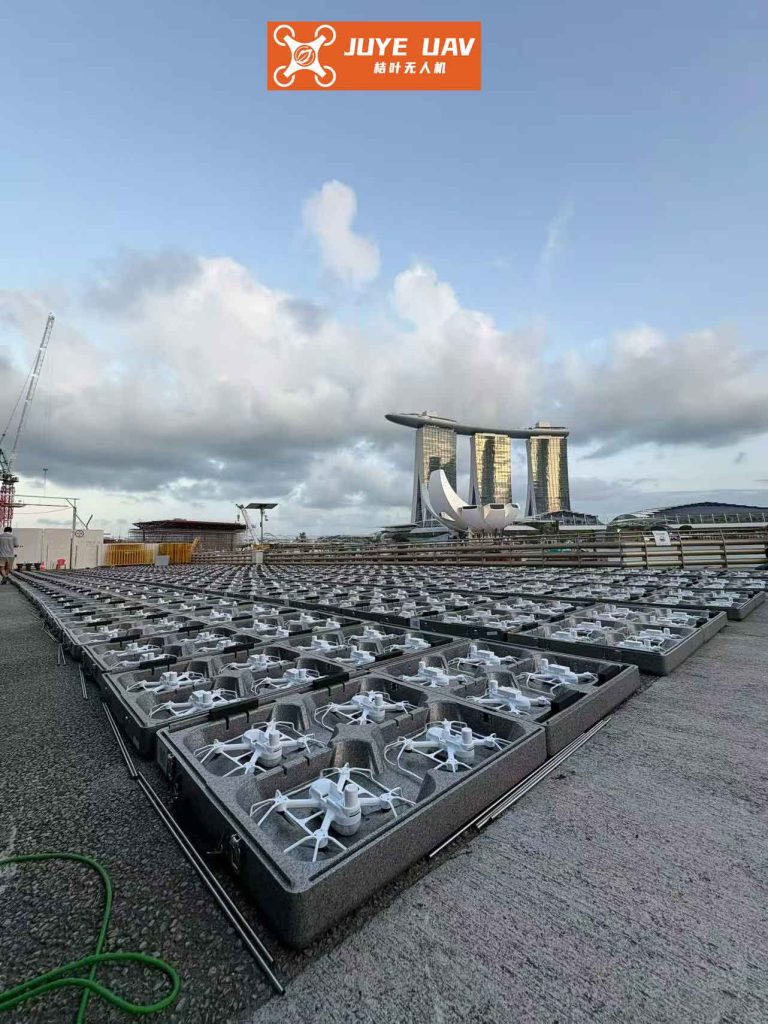
A key aspect of formation drone light shows is the visual representation of synchronized drones. Below is an image that captures the essence of such displays, illustrating how drones can form intricate patterns in the sky. This visualization underscores the importance of precise control in formation drone light shows, where each drone must be perfectly positioned to create cohesive images.
In terms of mathematical validation, the stability of the position control loop is proven using Lyapunov theory. For the $x$-direction, consider the Lyapunov function $V_x = \frac{1}{2} s_x^2 + \frac{(\hat{w}_x – W_x)^T (\hat{w}_x – W_x)}{2\beta_x}$, where $W_x$ is the ideal weight vector. Taking the derivative and substituting the adaptive law yields $\dot{V}_x = -\eta_x s_x \text{sat}(s_x) – k_x s_x^2 \leq 0$, ensuring asymptotic stability. Similar proofs apply for $y$ and $z$, guaranteeing that the formation drone light show system remains robust against uncertainties. For the attitude loop, the super-twisting controller provides finite-time convergence, as analyzed in existing literature, which is crucial for rapid adjustments in formation drone light shows.
To further quantify performance, we analyze the inter-drone distances during the formation drone light show simulation. The distance between followers should remain constant to maintain formation integrity. With our controller, distances stabilize after 10 seconds, with minimal oscillations compared to alternative methods. This is summarized in the following equation for distance error $d_{ij}$ between drones $i$ and $j$:
$$ d_{ij} = \sqrt{(x_i – x_j)^2 + (y_i – y_j)^2 + (z_i – z_j)^2} $$
In simulations, $d_{ij}$ converges to the desired spacing of 0.4 m, with errors less than 0.01 m, demonstrating precise control for formation drone light shows. This level of accuracy is necessary for complex patterns, such as spirals or logos, in formation drone light shows.
The controller outputs, including thrust and torque commands, remain smooth without excessive chattering, as verified by time-domain plots. This is achieved by the super-twisting algorithm’s inherent noise suppression, which benefits formation drone light shows by reducing wear on drone actuators and ensuring longer show durations. The adaptive RBF network continuously updates disturbance estimates, allowing the system to handle sudden changes, like wind gusts during an outdoor formation drone light show.
In conclusion, the integration of multi-directional communication, adaptive RBF neural networks, and super-twisting sliding mode control offers a robust solution for formation drone light shows. This approach addresses model uncertainties and external disturbances while maintaining precise formation and trajectory tracking. As formation drone light shows evolve to include more drones and complex choreography, such advanced control strategies will be indispensable for creating mesmerizing aerial displays. Future work may involve scaling to hundreds of drones or incorporating machine learning for adaptive pattern generation in formation drone light shows, further pushing the boundaries of this technology.
Throughout this article, the term “formation drone light show” has been emphasized to highlight its application context. The control algorithms discussed here are not just theoretical but are designed for real-world implementation in formation drone light shows, where reliability and precision are paramount. By leveraging these techniques, developers can create more dynamic and resilient formation drone light shows, captivating audiences with ever-more intricate aerial ballets.