
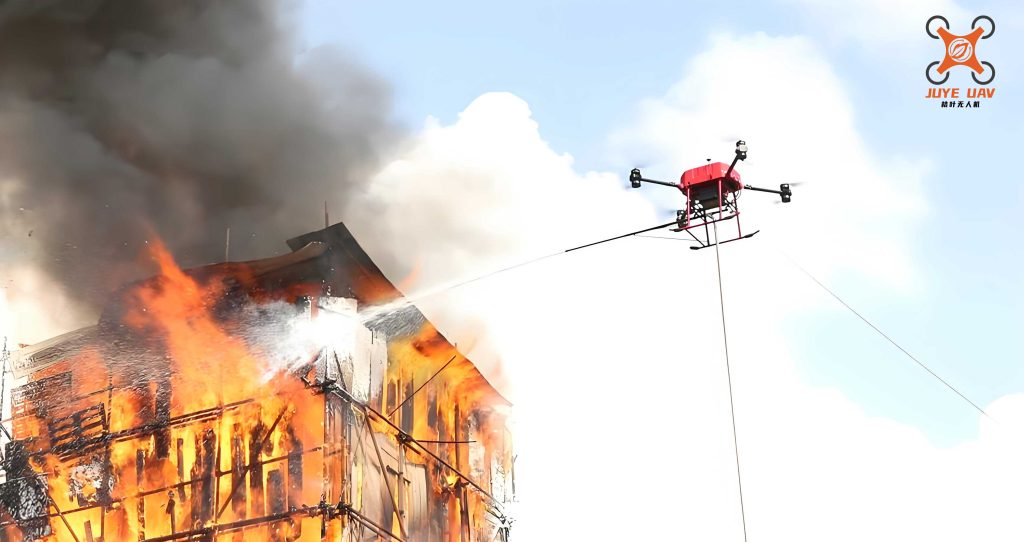
In my extensive involvement with firefighting and rescue operations, I have observed a paradigm shift driven by technological advancements, particularly the adoption of fire UAV. Under the framework of “comprehensive disaster management and large-scale emergency response,” the fire UAV has emerged as a critical tool for handling increasingly complex fire suppression and social rescue tasks. Its applications in fire warning, on-site detection, and beyond have significantly mitigated human casualties and enhanced operational efficiency. This article delves into the multifaceted utilization of fire UAV, exploring its principles, advantages, applications, and future trajectories, with a focus on reinforcing the keyword ‘fire UAV’ throughout the discussion.
The operational essence of a fire UAV lies in its design as an unmanned aerial vehicle controlled via wireless remote technology and automatic control systems. Predominantly multi-rotor in configuration, a typical fire UAV boasts a theoretical endurance of approximately 38 minutes, an operational radius of 8000 meters, and a payload capacity ranging from 1 kg to 5 kg, depending on the model. The core components include the airframe, power system, flight control system, and data link system, with the flight control system serving as the central nervous system. The endurance can be modeled using the formula: $$ T = \frac{E_{total}}{P_{avg}} $$ where \( T \) is the flight time, \( E_{total} \) is the total energy available from the battery, and \( P_{avg} \) is the average power consumption during flight. For instance, if a fire UAV has a battery energy of 100 Wh and consumes 200 W on average, its flight time calculates to: $$ T = \frac{100 \, \text{Wh}}{200 \, \text{W}} = 0.5 \, \text{hours} = 30 \, \text{minutes} $$ This highlights the need for improved energy solutions to extend the fire UAV’s mission duration.
| Component | Description | Typical Specifications |
|---|---|---|
| Airframe | Provides structural integrity and houses other systems; often lightweight materials like carbon fiber. | Weight: 907 g (e.g., DJI Mavic 2) to 9613 g (e.g., DJI Matrice 600). |
| Power System | Includes batteries and motors; determines endurance and payload capacity. | Lithium-polymer batteries, voltage ranges from 22.2 V to 51.8 V. |
| Flight Control System | Core for stability, navigation, and autonomous functions; integrates sensors like GPS and IMU. | Uses PID controllers: $$ u(t) = K_p e(t) + K_i \int_0^t e(\tau) d\tau + K_d \frac{de(t)}{dt} $$ where \( u(t) \) is control output and \( e(t) \) is error. |
| Data Link System | Enables real-time communication between the fire UAV and ground control station. | Frequency: 2.4 GHz or 5.8 GHz; range up to 8000 m; supports video transmission at 1080p or 4K. |
| Payload Modules | Attachable equipment like cameras, sensors, speakers, or delivery mechanisms. | Includes thermal imaging cameras (resolution: 640×512), gas detectors, loudspeakers (output: 100 dB). |
The advantages of deploying a fire UAV are manifold, revolutionizing traditional firefighting approaches. First, its机动灵活 nature is evident in its lightweight design—for example, some models weigh under 1 kg—and minimal takeoff requirements, needing only about 1 square meter of space, even atop vehicles. Operable by just one or two personnel, the fire UAV can swiftly penetrate restricted disaster sites. Second, the视野全面 capability is enhanced by integrating data link and broadband technologies, coupled with infrared and thermal imaging cameras. This allows for comprehensive reconnaissance across various lighting conditions and angles, providing holistic aerial views that inform strategic deployments. The visual data can be processed to generate detailed maps, aiding in decision-making. Third,操作简单 is achieved through user-friendly remote controllers and mobile interfaces like tablets or smartphones, enabling seamless control via public networks. Fourth,安全可靠 is paramount; the fire UAV operates effectively in hazardous environments such as high temperatures, radiation zones, or toxic leaks, where human entry is perilous. This reliability stems from robust materials and redundant systems, ensuring continuous monitoring.
| Aspect | Traditional Methods (e.g., Ground Teams) | Fire UAV Application |
|---|---|---|
| Mobility | Limited by terrain and accessibility; slow deployment. | High mobility; rapid deployment from small areas; covers large distances quickly. |
| Reconnaissance | Risk-prone; limited field of view; dependent on human vision. | Comprehensive aerial views; real-time video feeds; infrared detection for hidden hazards. |
| Safety | Exposes personnel to direct dangers like collapse or explosions. | Minimizes human risk; operates remotely in extreme conditions. |
| Efficiency | Time-consuming for large areas; prone to errors in assessment. | Fast data acquisition; enables precise targeting and resource allocation. |
| Cost-effectiveness | High due to manpower and equipment logistics. | Lower operational costs; reusable with minimal maintenance. |
In practical灭火救援 scenarios, the fire UAV demonstrates versatile applications that underscore its indispensability. For灾情勘察, during fire suppression, the fire UAV delivers panoramic高空侦察 footage to command centers, tracking火势发展蔓延 and force distribution. Using thermal imaging, it pinpoints明火目标 for精准消灭残火. Post-incident, it aids in战评总结 by creating二维平面图 to review tactics. In抢险救援, such as hiker rescues or collapses, the fire UAV synergizes with devices like satellite stations and 4G图传 to transmit音视频, enabling thorough searches and status checks of trapped individuals. This enhances救援效率 significantly. For灾害现场数据采集, the fire UAV ventures into core disaster zones—often inaccessible due to高温,高辐射, or toxic leaks—equipped with侦检模块 to analyze substances, measure地理数据,风速,温度, and monitor全覆盖无死角. The data facilitates the creation of 2D and 3D maps via photogrammetry, modeled as: $$ P(x,y,z) = \sum_{i=1}^{n} \lambda_i I_i $$ where \( P \) represents a point in the 3D reconstruction, \( \lambda_i \) are weights, and \( I_i \) are image intensities from multiple angles. This supports informed救援方案制定.
The音视频传输功能 of a fire UAV is pivotal; its camera captures live footage, output via HDMI to ground terminals, and then relayed through动中通,静中通, or微波 systems to后方指挥中心. This ensures real-time situational awareness. For扩音喊话, in noisy environments like高层建筑区域 or洪涝灾害, the fire UAV搭载喊话器 enables高空喊话, broadcasting messages to guide or安抚被困者. In辅助灭火救援行动, the fire UAV transforms into a delivery platform, carrying灭火器,氧气呼吸机,救援消防绳, or supplies to specific locations in complex incidents like地震灾害. This versatility extends to辅助灭火救援预案制作, where the fire UAV captures全景图 of high-risk areas such as森林火灾频发 zones or洪涝泥石流 regions. These images are processed into二维图和三维图 for预案制定, offering a “God’s-eye view” for proactive planning. The智能无人机集群技术 represents a leap forward, enabling协同侦察 and灭火 through multiple fire UAVs controlled via地面站计算机. This system employs algorithms for swarm coordination, such as: $$ \min_{u_i} \sum_{i=1}^{N} \| x_i(t) – x_d(t) \|^2 $$ subject to dynamics \( \dot{x}_i = f(x_i, u_i) \), where \( x_i \) is the state of the i-th fire UAV, \( x_d \) is the desired trajectory, and \( u_i \) is control input. This enhances任务执行能力 while reducing人力投入.
Looking ahead, the development direction of fire UAV must address several key areas to optimize its utility in消防救援. For恶劣环境飞行的可靠性, the fire UAV requires enhanced抗风,防雨,耐高温, and防爆炸 capabilities, alongside infrared functionality. This involves material science advancements, such as using composites with high thermal resistance, and control algorithms that compensate for environmental disturbances. For区别与民用机的操控性, improvements in续航能力 are crucial; targeting over 60 minutes of flight time and a 20-kilometer operational radius would be ideal. This can be achieved through higher energy-density batteries, exemplified by the formula: $$ E_{new} = \rho_{bat} \times V_{bat} $$ where \( \rho_{bat} \) is energy density and \( V_{bat} \) is volume. Additionally,空域放开 in restricted zones—with proper authorization—would expand the fire UAV’s applicability without compromising aviation safety. For飞控系统的稳定性, the fire UAV must ensure清晰,连续可靠的 image transmission with抗干扰能力, leveraging error-correction codes like: $$ R_c = \frac{k}{n} $$ where \( R_c \) is the code rate, \( k \) is data bits, and \( n \) is transmitted bits. For集成拓展的兼容性, the fire UAV should support modular upgrades for语音功能,距离判定,温度测定,气体探测, and三维建模, fostering interoperability with existing消防信息化建设 systems.
| Development Area | Current Status | Target Goals | Technical Approaches |
|---|---|---|---|
| Endurance and Range | ~38 min, 8 km radius | >60 min, >20 km radius | Advanced battery tech (e.g., solid-state), solar辅助, hybrid power systems. |
| Environmental Robustness | Limited resistance to extreme conditions | High抗风 (e.g., up to 12级风),防雨 (IP67 rating),耐高温 (up to 500°C). | Reinforced airframes, thermal shielding, waterproofing seals. |
| Payload Versatility | Basic modules (cameras, speakers) | Multi-sensor integration (gas, thermal, LiDAR), AI-driven analysis. | Standardized mounting interfaces, software-defined radios. |
| Swarm Intelligence | Experimental阶段 | Fully autonomous clusters for complex tasks like urban搜索救援. | Machine learning algorithms, mesh networking protocols. |
| Regulatory Compliance | Restricted in某些空域 | Streamlined approval processes for emergency use in禁飞区域. | Collaboration with aviation authorities, geofencing solutions. |
In conclusion, the fire UAV has already proven instrumental in应急通信保障 and辅助灭火救援行动, evolving from passive, single-task tools toward自组化,多任务 systems. As technology progresses, the fire UAV will play an even greater role in消防信息化建设, providing critical support for防范化解重大安全风险 and应对处置各类灾害事故. Through continuous innovation in durability, control, and integration, the fire UAV will solidify its position as a cornerstone of modern emergency response, saving lives and enhancing operational efficacy across diverse disaster scenarios. The repeated emphasis on ‘fire UAV’ throughout this discussion underscores its centrality to these advancements, and I am confident that future iterations will address current limitations, paving the way for more resilient and intelligent firefighting solutions.