
With the rapid development of urban construction globally, super high-rise buildings are emerging in large numbers, posing significant challenges for firefighting and rescue operations. Once a fire breaks out in such structures, it can lead to catastrophic social impacts and losses. Therefore, addressing fire incidents in super high-rise buildings has become a critical priority. In this context, fire UAVs (unmanned aerial vehicles) have emerged as a transformative technology, offering innovative solutions to enhance firefighting efficiency and safety. This article explores the application of fire UAVs in firefighting and rescue domains, analyzing their functionalities, technical requirements, and expanded capabilities. I will delve into a rapid fire suppression solution for high-rise buildings, emphasizing the pivotal role of fire UAVs in modern emergency response.
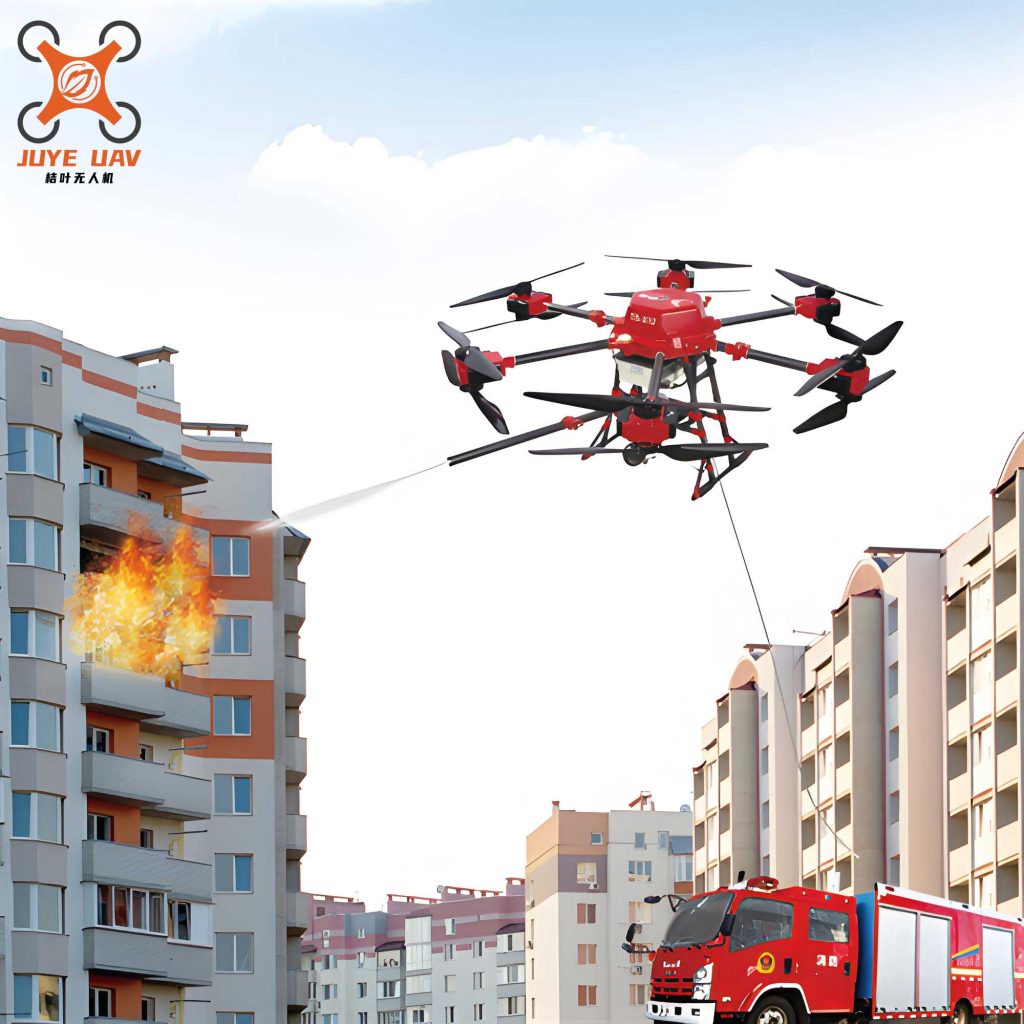
Unmanned aerial vehicles, commonly known as drones, are aircraft operated without a human pilot onboard, controlled remotely via wireless devices or pre-programmed flight plans. Their lightweight, agile, and versatile nature, coupled with vertical take-off and landing capabilities, has facilitated their adoption in various civilian sectors, including disaster management. The evolution of drone technology has paved the way for specialized fire UAVs designed explicitly for firefighting scenarios. These fire UAVs integrate advanced sensors and payloads, enabling them to perform complex tasks in hazardous environments. As I examine their development, it is evident that fire UAVs are revolutionizing traditional firefighting methods by providing aerial perspectives and real-time data, which are indispensable for effective decision-making.
The advantages of fire UAVs in firefighting operations are multifaceted, making them invaluable assets in emergency response. Below is a table summarizing these key advantages, which highlight why fire UAVs are increasingly deployed in high-rise fire incidents.
| Advantage | Description | Impact on Firefighting |
|---|---|---|
| Operational Simplicity | Fire UAVs are designed with user-friendly controls, requiring minimal training for pilots to master flight, remote operation, and module integration. | Enables rapid deployment and reduces setup time, crucial for time-sensitive fire scenarios. |
| Safety and Reliability | By conducting aerial surveillance and tracking, fire UAVs mitigate risks to firefighters, providing critical data without exposing personnel to direct danger. | Enhances responder safety and minimizes casualties, as fire UAVs can access areas unsafe for humans. |
| Maneuverability and Flexibility | Fire UAVs exhibit small turning radii and agile movement, allowing precise navigation through complex urban landscapes to reach designated points quickly. | Facilitates swift response and efficient coverage of large fire zones, improving resource allocation. |
| Comprehensive Field of View | Utilizing broadband and data-link technologies, fire UAVs offer beyond-visual-line-of-sight control, enabling holistic aerial imaging and real-time video feeds. | Provides commanders with situational awareness, aiding in strategic planning and hazard assessment. |
To quantify the maneuverability of a fire UAV, consider its flight dynamics. The turning radius \( r \) can be expressed as: $$ r = \frac{v^2}{g \cdot \tan(\phi)} $$ where \( v \) is the velocity, \( g \) is gravitational acceleration, and \( \phi \) is the bank angle. This formula illustrates how fire UAVs can achieve tight turns, enhancing their agility in confined spaces around high-rise structures.
The technical demands and functional expansions for fire UAVs are substantial, given the harsh conditions of fire environments. I have identified several critical areas that require attention to optimize fire UAV performance. First, fire UAVs must withstand extreme factors such as high winds, intense heat, smoke, and water exposure. For instance, in super high-rise settings, wind gusts can reach 6-8 on the Beaufort scale, necessitating robust aerodynamic designs. The required wind resistance \( F_w \) can be modeled as: $$ F_w = \frac{1}{2} \cdot \rho \cdot C_d \cdot A \cdot v_w^2 $$ where \( \rho \) is air density, \( C_d \) is the drag coefficient, \( A \) is the cross-sectional area, and \( v_w \) is wind velocity. Fire UAVs should be engineered to tolerate temperatures exceeding 500°C and incorporate waterproofing for operation in sprinkler-drenched zones.
Second, endurance and power technology are paramount for fire UAVs, as missions often involve prolonged flights at altitudes over 200 meters while carrying heavy payloads like extinguishers or sensors. The flight time \( T \) of a fire UAV can be approximated by: $$ T = \frac{E}{P \cdot \eta} $$ where \( E \) is battery energy, \( P \) is power consumption, and \( \eta \) is efficiency. To extend endurance, fire UAVs may employ hybrid power systems or hydrogen fuel cells, which offer higher energy densities. The table below compares different power options for fire UAVs, emphasizing their suitability for extended operations.
| Power Source | Energy Density (Wh/kg) | Advantages | Challenges for Fire UAVs |
|---|---|---|---|
| Lithium-ion Battery | 150-200 | Lightweight, rechargeable | Limited endurance, sensitive to high temperatures |
| Hydrogen Fuel Cell | 500-1000 | High energy output, longer flight times | Bulky storage, requires refueling infrastructure |
| Hybrid System | 300-400 | Balances endurance and weight | Complex design, maintenance-intensive |
Third, stable data transmission is essential for fire UAVs to relay clear, continuous imagery and sensor readings to ground stations. Interference from fire-related electromagnetic noise can disrupt signals, so fire UAVs must incorporate anti-jamming protocols. The signal-to-noise ratio \( SNR \) for a fire UAV’s transmission can be defined as: $$ SNR = \frac{P_t \cdot G_t \cdot G_r \cdot \lambda^2}{(4\pi R)^2 \cdot N} $$ where \( P_t \) is transmit power, \( G_t \) and \( G_r \) are antenna gains, \( \lambda \) is wavelength, \( R \) is distance, and \( N \) is noise power. Enhancing \( SNR \) ensures reliable communication, vital for real-time monitoring.
Fourth, intelligent deployment capabilities allow fire UAVs to assist in rescue operations by establishing anchor points for ropes or cables on building exteriors. This is crucial for evacuating trapped individuals from heights beyond the reach of conventional ladders. The load-bearing capacity \( L \) of a fire UAV in such scenarios can be calculated as: $$ L = m \cdot g – F_d $$ where \( m \) is the UAV mass, \( g \) is gravity, and \( F_d \) is drag force. By optimizing \( L \), fire UAVs can safely deliver rescue gear, providing a lifeline in emergencies.
Fifth, multi-UAV coordination technology enables swarms of fire UAVs to collaborate, sharing data and acting as communication relays. This requires advanced algorithms for formation flying and resource allocation. The efficiency of a multi-fire UAV system can be expressed as: $$ E_{sys} = \sum_{i=1}^{n} \frac{C_i}{T_i} $$ where \( n \) is the number of fire UAVs, \( C_i \) is the contribution of each fire UAV, and \( T_i \) is its operational time. Such systems enhance coverage and redundancy, critical for large-scale fire incidents.
Building on these technical foundations, I propose a comprehensive rapid fire suppression solution for high-rise buildings, leveraging the capabilities of fire UAVs. This solution encompasses multiple phases, from initial assessment to active intervention, each enhanced by fire UAV deployments. The integration of fire UAVs into standard firefighting protocols can significantly reduce response times and improve outcomes. Below, I detail the components of this solution, emphasizing how fire UAVs address specific challenges in high-rise fire scenarios.
Aerial reconnaissance is a cornerstone of this solution. Fire UAVs can be equipped with an array of sensors, including color digital cameras, infrared thermal imagers, GPS locators, anemometers, thermometers, and toxic gas detectors. These devices collect real-time data, transmitted to ground control for analysis. For example, thermal imaging helps identify hotspots through smoke, while gas sensors detect hazardous fumes. The data fusion from multiple fire UAVs allows for a comprehensive risk assessment. The table summarizes key sensors and their functions in fire UAVs for reconnaissance.
| Sensor Type | Function | Data Output |
|---|---|---|
| Infrared Thermal Imager | Detects heat signatures through obscurants | Temperature maps, hotspot localization |
| GPS and Anemometer | Monitors position and wind conditions | Coordinates, wind speed/direction |
| Toxic Gas Detector | Identifies hazardous airborne chemicals | Gas concentration levels |
| Color Camera | Provides visual footage of the fire scene | High-resolution video streams |
Airborne-assisted fire suppression involves using fire UAVs to deliver extinguishing agents directly to the fire source during its early stages. By mounting lightweight fire extinguishers or misting systems, a fire UAV can ascend hundreds of meters in seconds and deploy suppressants with precision. This rapid intervention can contain incipient fires before they escalate. The effectiveness of such an approach can be modeled using fire spread dynamics. For instance, the rate of fire growth \( \frac{dA}{dt} \) might be reduced by the extinguishing agent discharge rate \( Q \) from a fire UAV: $$ \frac{dA}{dt} = k \cdot A – \alpha \cdot Q $$ where \( A \) is fire area, \( k \) is growth constant, and \( \alpha \) is suppression efficiency. Deploying multiple fire UAVs in tandem can amplify this effect, showcasing the scalability of fire UAV-based solutions.
Airborne-assisted rescue operations leverage fire UAVs to supply trapped individuals with essential gear, such as respirators or ropes, facilitating self-evacuation. Additionally, fire UAVs can be fitted with loudspeakers to broadcast evacuation instructions, guiding people to safety. The probability of successful rescue \( P_r \) with fire UAV assistance can be estimated as: $$ P_r = 1 – e^{-\lambda \cdot t} $$ where \( \lambda \) is the rescue rate enhanced by fire UAVs, and \( t \) is time. By reducing \( t \) through swift deployment, fire UAVs increase survival chances significantly.
Airborne strong lighting is another critical function, where fire UAVs hover above disaster zones, illuminating areas with powerful LED lights. This not only aids aerial imaging in low-light conditions but also assists ground crews in nighttime operations. The illumination intensity \( I \) at a distance \( d \) from a fire UAV’s light source can be given by: $$ I = \frac{P_l}{4\pi d^2} $$ where \( P_l \) is the luminous power. Optimizing \( P_l \) ensures adequate visibility for both surveillance and rescue tasks.
Monitoring and tracking via fire UAVs provide continuous oversight of fire dynamics, enabling commanders to adapt strategies in real time. With live video feeds and data analytics, fire UAVs help predict fire spread and identify structural weaknesses. This proactive monitoring can be quantified using change detection algorithms, where the difference \( \Delta D \) between consecutive frames from a fire UAV’s camera triggers alerts: $$ \Delta D = \sum |I_t – I_{t-1}| $$ where \( I_t \) is the image at time \( t \). High values of \( \Delta D \) indicate rapid changes, prompting immediate response.
In conclusion, fire UAVs represent a paradigm shift in firefighting and rescue methodologies, particularly for super high-rise buildings. Their ability to operate in perilous environments, coupled with advanced technological integrations, positions them as indispensable tools in modern emergency response. As fire UAV technology matures, we can anticipate further innovations, such as autonomous swarms or AI-driven decision support, which will amplify their impact. I am confident that fire UAVs will play an increasingly vital role in saving lives and mitigating property damage, marking a new era in disaster management. The ongoing development and adoption of fire UAVs will undoubtedly contribute to safer and more resilient urban landscapes, underscoring their transformative potential in the firefighting domain.