
As a researcher and practitioner in firefighting technology, I have witnessed the transformative role of unmanned aerial vehicles (UAVs) in modern emergency response. The catastrophic Tianjin Port “8·12” explosion in 2015 marked a pivotal moment, where fire UAVs provided critical aerial reconnaissance, transmitting real-time imagery from the core disaster zone to command centers. This enabled data-driven decision-making and highlighted the potential of fire UAVs in large-scale incidents. Since then, fire UAVs have become indispensable in various disaster responses, from forest fires to floods. In this article, I will explore the current applications, challenges, and future trends of fire UAVs in firefighting and rescue operations, emphasizing technological advancements and practical implementations. My analysis draws from hands-on experience and testing, aiming to provide a comprehensive perspective on how fire UAVs can evolve to better serve emergency responders.
The integration of fire UAVs into firefighting forces has accelerated, but it is accompanied by significant limitations. In my department, for instance, we primarily deploy multi-rotor fire UAVs, such as the DJI Mavic 2 and Matrice series. While these offer agility and ease of use, they suffer from inherent drawbacks that hinder operational efficiency. Through rigorous testing, I have identified four key problems: short endurance, limited operational range, low payload capacity, and slow flight speeds. These issues are particularly pronounced in extended missions like forest fire suppression or flood救援, where fire UAVs must cover vast areas. For example, in a 2022 forest fire incident in Jiangxi, our fire UAVs could not maintain signal coverage over the entire fire line, forcing manual interventions. Similarly, during a 2020 flood rescue, a fire UAV lost transmission at just 1.3 km from the launch point, underscoring range deficiencies. To quantify these challenges, I conducted tests on multi-rotor fire UAVs, measuring parameters like endurance and distance. The results reveal that achieving continuous aerial surveillance requires extensive battery management, with at least 8 batteries and 6 chargers needed for uninterrupted cycles. This logistical burden highlights the urgent need for advanced fire UAV designs.
To better understand these limitations, let’s examine the performance metrics of common fire UAVs. The following table summarizes test data from my evaluations, focusing on multi-rotor models:
| Fire UAV Model | Endurance (minutes) | Max Operational Range (meters) | Payload Capacity (kg) | Max Horizontal Speed (m/s) |
|---|---|---|---|---|
| DJI Mavic 2 | 25-30 | 1,687 | 0.5 | 20 |
| DJI Matrice 300 RTK | 40-55 | 8,000 | 2.7 | 23 |
| DJI Matrice 600 | 35-45 | 5,000 | 5.5 | 18 |
These data points illustrate the trade-offs in current fire UAV systems. Endurance is often compromised by payload; for instance, when a fire UAV carries a full load, its flight time decreases exponentially. This relationship can be expressed mathematically. Let $E$ represent endurance in minutes, $P$ denote payload in kg, and $C$ be the battery capacity in Wh. A simplified formula for multi-rotor fire UAV endurance is:
$$E = \frac{C \cdot \eta}{P \cdot g \cdot v + W_0}$$
where $\eta$ is the power efficiency, $g$ is gravitational acceleration, $v$ is the velocity, and $W_0$ is the base power consumption. This equation shows that as $P$ increases, $E$ diminishes, explaining why heavy payloads like communication gear (e.g., a 3.85 kg E-pack 200 device) are impractical for standard fire UAVs. Moreover, the operational range $R$ is limited by signal transmission loss, which follows an inverse-square law:
$$R \propto \frac{1}{d^2}$$
where $d$ is the distance from the controller. In open areas, $R$ can extend to a few kilometers, but in obstructed environments like forests, it drops sharply, affecting fire UAV effectiveness.
Fire UAVs can be categorized based on their flight platforms, each with distinct characteristics. Understanding these types is crucial for selecting the right fire UAV for specific rescue scenarios. The primary categories include multi-rotor, fixed-wing, helicopter, and hybrid designs. Multi-rotor fire UAVs, as mentioned, rely on multiple rotors for lift and stability, allowing precise hovering and maneuverability. Fixed-wing fire UAVs use wings for lift, enabling longer endurance and higher speeds but requiring runways for takeoff and landing. Helicopter fire UAVs feature a main rotor and tail rotor for control, offering vertical takeoff and landing (VTOL) capabilities with moderate payloads. Emerging platforms like hybrid fire UAVs combine these advantages. The table below compares these fire UAV types:
| Fire UAV Type | Advantages | Disadvantages | Typical Endurance | Best Use Case |
|---|---|---|---|---|
| Multi-rotor | VTOL, hovering, easy control | Short endurance, low speed | 20-60 minutes | Close-range reconnaissance |
| Fixed-wing | Long range, high speed | Requires runway, no hover | 1-10 hours | Large-area mapping |
| Helicopter | VTOL, good payload | Complex mechanics, noise | 30-90 minutes | Heavy-lift operations |
| Hybrid (e.g., compound-wing) | VTOL, long endurance | High cost, developing tech | 1-3 hours | Versatile missions |
From this comparison, it’s clear that no single fire UAV type excels in all aspects. Therefore, the future of fire UAVs in firefighting lies in specialized developments that address current shortcomings. I foresee two main directions: enhancing multi-rotor fire UAVs with tethering systems for extended endurance, and reducing fixed-wing fire UAVs’ dependency on runways through hybrid designs like compound-wing and tilt-rotor configurations. These advancements will redefine how fire UAVs are deployed in emergencies.
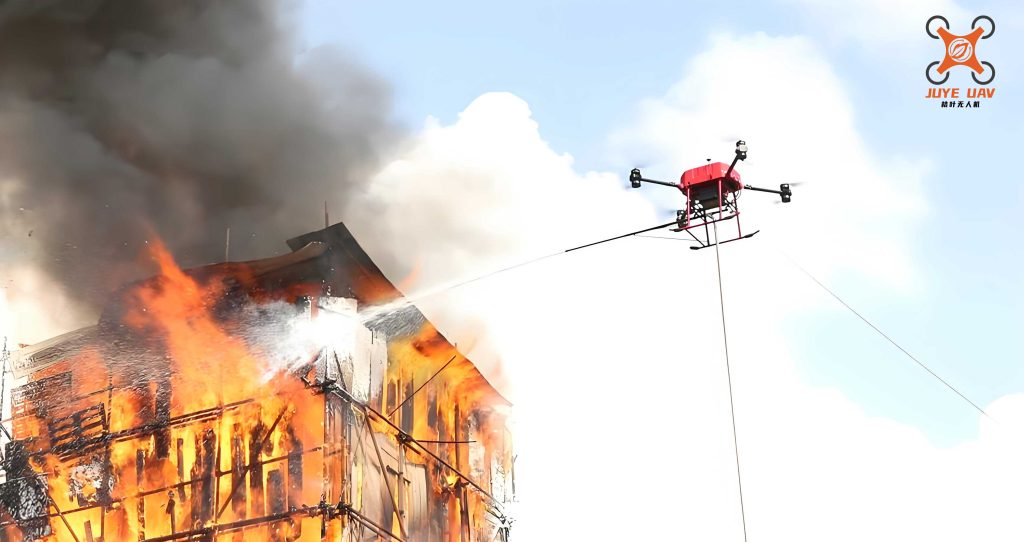
One promising solution is the tethered fire UAV, which addresses endurance limitations by providing continuous power via a ground-based cable. A tethered fire UAV inherits the VTOL and hovering benefits of multi-rotor systems while achieving 24/7 aerial persistence. In my tests, a tethered fire UAV maintained a stable position at 100-200 meters altitude for over 72 hours, powered by a generator. This makes it ideal for static missions such as command post surveillance or emergency lighting. The endurance of a tethered fire UAV can be modeled as infinite for practical purposes, given a reliable power source. However, its mobility is restricted by the tether length, typically 100-200 meters, which limits operational radius. The payload capacity also increases, as weight constraints are relaxed due to external power. For instance, a tethered fire UAV can carry heavy communication relays or high-resolution cameras without compromising flight time. This is a game-changer for firefighting, where prolonged monitoring is essential.
Another innovative direction is the compound-wing fire UAV, which blends multi-rotor VTOL with fixed-wing efficiency. This fire UAV uses separate rotors for vertical takeoff, then transitions to fixed-wing flight for cruising. It eliminates the need for runways, making it suitable for rugged terrain common in firefighting operations. During my evaluation of a prototype compound-wing fire UAV, I observed a significant improvement in range and speed compared to multi-rotor counterparts. The transition phase involves complex aerodynamics, which can be described by lift and drag equations. For a compound-wing fire UAV, the total lift $L$ during VTOL is generated by rotors:
$$L = n \cdot T_r$$
where $n$ is the number of rotors and $T_r$ is the thrust per rotor. In fixed-wing mode, lift is derived from wings:
$$L = \frac{1}{2} \rho v^2 S C_L$$
where $\rho$ is air density, $v$ is velocity, $S$ is wing area, and $C_L$ is the lift coefficient. This dual-mode operation allows a compound-wing fire UAV to achieve speeds up to 80 m/s and endurance exceeding 3 hours, far surpassing traditional multi-rotor fire UAVs. Similarly, the tilt-rotor fire UAV represents a more advanced hybrid, where rotors tilt horizontally for forward flight, reducing drag and improving efficiency. Although tilt-rotor technology is still emerging for fire UAVs, its potential is immense, offering VTOL with jet-like performance. I believe that once tilt-rotor fire UAVs become commercially viable, they will dominate firefighting applications due to their versatility.
Looking ahead, fire UAVs will play increasingly specialized roles in firefighting and rescue work. Based on my field experience, I envision a collaborative ecosystem where different fire UAV types complement each other. For instance, tilt-rotor or compound-wing fire UAVs will handle large-scale tasks like communication relay and forest fire monitoring, while tethered fire UAVs provide persistent oversight at key locations, and multi-rotor fire UAVs execute precise, close-range missions. The following table outlines potential application scenarios for each fire UAV type:
| Fire UAV Type | Primary Applications | Key Features | Example Missions |
|---|---|---|---|
| Tilt-rotor Fire UAV | Long-range reconnaissance, communication boost, infrared scanning | High speed, VTOL, long endurance | Mapping wildfire perimeters, relaying signals in mountains |
| Compound-wing Fire UAV | Large-area mapping, rapid response, payload delivery | VTOL, moderate payload, efficient cruise | Disaster assessment after earthquakes, delivering supplies |
| Tethered Fire UAV | Continuous surveillance, emergency lighting, local communication | 24/7 hover, stable position, high payload | Monitoring flood barriers, illuminating rescue sites at night |
| Multi-rotor Small Fire UAV | Close-in inspection, search and rescue, detailed mapping | Agility, easy deployment, low cost | Inspecting collapsed structures, locating trapped victims |
| Quadcopter Light Fire UAV | Initial assessment, indoor operations, training | Portability, simplicity, real-time video | Scouting building fires, training exercises for firefighters |
In communication保障, fire UAVs like tilt-rotor models can carry基站设备 to extend coverage. For example, a fire UAV equipped with a 5G base station can cover up to 50 km², providing data rates of 50 Mbps downlink and 30 Mbps uplink. This is crucial in remote disaster zones where infrastructure is damaged. Similarly, in forest fire prevention, fire UAVs with infrared sensors can detect hotspots post-extinguishment, preventing re-ignition. The effectiveness of such a fire UAV can be quantified by its detection probability $P_d$, which depends on sensor resolution and altitude:
$$P_d = 1 – e^{-\lambda A}$$
where $\lambda$ is the hotspot density and $A$ is the area covered by the fire UAV’s sensor. By optimizing flight paths, a fire UAV can maximize $A$, improving overall safety.
Moreover, tethered fire UAVs excel in守护中枢 roles. For instance, a tethered fire UAV with a 30x zoom camera can monitor a 10 km radius for security breaches during large-scale incidents. When outfitted with lighting modules, it can illuminate areas up to 10,000 lumens, aiding night operations. The power requirement for such a tethered fire UAV can be calculated using:
$$P_{total} = P_{lift} + P_{payload}$$
where $P_{lift}$ is the power for hovering, and $P_{payload}$ is for附加设备. With ground power, this is sustainable indefinitely, making tethered fire UAVs a reliable tool for command centers.
In conclusion, the future of firefighting救援 will be shaped by a diverse fleet of fire UAVs, each tailored to specific tasks. Multi-rotor, fixed-wing, tethered, compound-wing, and tilt-rotor fire UAVs will collaborate seamlessly, leveraging their unique strengths. For example, in a地震 response, tilt-rotor fire UAVs could conduct rapid aerial surveys, while multi-rotor fire UAVs perform detailed inspections of rubble. This synergy enhances efficiency and saves lives. As technology advances, I anticipate further innovations in fire UAV autonomy, swarm coordination, and AI integration, pushing the boundaries of what’s possible in emergency response. The key is continued investment in R&D and training, ensuring that fire departments can harness the full potential of fire UAVs. Through my work, I aim to contribute to this evolution, advocating for smart adoption of fire UAVs that address real-world challenges. The journey has just begun, and the sky is no longer the limit for fire UAVs in firefighting and rescue operations.