
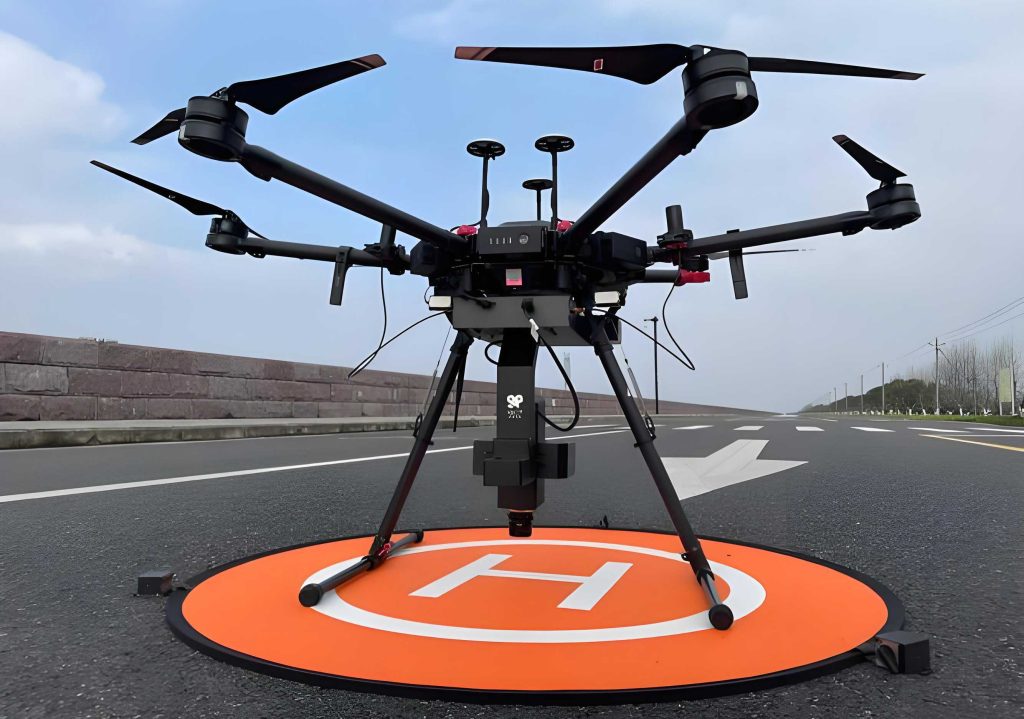
The increasing frequency and intensity of extreme weather events pose a significant and escalating threat to the reliable operation of modern power infrastructure. Among these, ice storms stand out due to their potential to cause widespread and catastrophic damage to overhead distribution networks. The accretion of ice on power lines increases mechanical loading, leading to conductor breakage, insulator flashovers, and tower collapses. Traditional disaster response often involves de-energizing lines for manual repair, which exacerbates the societal impact through prolonged power outages. In this context, the concept of a “resilient grid”—characterized by defense, adaptation, coordination, and recovery capabilities—has become paramount. This article explores a comprehensive resilience enhancement methodology for Integrated Electricity-Heat Energy Systems (IEHS) facing ice storms, with a particular focus on the innovative application of Unmanned Aerial Vehicles (UAV drones). We propose a synergistic strategy that leverages in-disaster, non-outage de-icing by UAV drones, post-disaster restoration coordination, and the multi-energy complementarity of the IEHS to maintain critical energy supply.
The core of the problem lies in quantifying the impact of an ice storm on distribution lines. A line’s susceptibility to failure is not static; it evolves dynamically with the growing ice load. We begin by modeling the ice accretion process, critically accounting for the effect of increased load current during the storm. While the increased current raises conductor temperature via Joule heating and can slightly delay the initial ice formation, the dominant effect is the relentless growth of ice mass. The surface temperature of a conductor under steady-state pre-storm conditions is given by:
$$T_s = \frac{I^2 r \times 10^2}{9.9\pi v d} + T_c$$
where \(T_s\) is the conductor surface temperature, \(I\) is the current, \(r\) is the line resistance, \(v\) is the wind speed, \(d\) is the conductor diameter, and \(T_c\) is the ambient temperature. During the ice storm, the thermal balance on the conductor surface, considering the latent heat of freezing, is crucial. The time \(t_n\) before ice starts to form, considering the change in Joule heating \(\Delta q_z\), is:
$$t_n = \int_0^{T_0} \frac{m C_p}{\Delta q_z} dT$$
where \(m\) is the mass per unit length, \(C_p\) is the specific heat capacity, and \(T_0\) is the pre-storm surface temperature. For time \(t > t_n\), the ice thickness \(D_{ice}(t)\) grows according to an empirical model dependent on冻雨量 \(\phi(t)\), wind speed \(v_w(t)\), and air water content \(W(t)\):
$$D_{ice}(t) = \frac{\sqrt{(3.6 v_w(t) (t-t_n) W(t-t_n))^2 + (\phi(t-t_n) \rho_w)^2 }}{\pi \rho_I}, \quad t > t_n$$
This increasing ice thickness directly elevates the mechanical load on the line. The combined ice and wind load per unit length \(L_{IW}(t)\) is:
$$L_{IW}(t) = \sqrt{L_I^2(t) + L_{IW}^2(t)} = 9.8 \times 10^{-3} \rho_I \pi (d + D_{ice}(t)) D_{ice}(t) + C S v_w^2(t) (d + 2D_{ice}(t))$$
The failure probability \(P_{fl}(t)\) for a unit length is then modeled as a function of this load relative to the line’s design load \(a_{IW}\) and ultimate load \(b_{IW}\):
$$P_{fl}(t) = \begin{cases} 0, & L_{IW}(t) \le a_{IW} \\ e^{0.6931(\frac{L_{IW}(t)-a_{IW}}{b_{IW}-a_{IW}})} – 1, & a_{IW} \le L_{IW}(t) \le b_{IW} \\ 1, & L_{IW}(t) \ge b_{IW} \end{cases}$$
Finally, the failure probability for an entire line of length \(l\) is \(P_{fl,i}(t) = 1 – (1 – P_{fl}(t))^l\). Monte Carlo simulation based on this model is used to generate realistic failure scenarios for the IEHS during an ice storm event.
To measure the effectiveness of any resilience strategy, we establish a quantitative assessment framework. Inspired by the resilience curve, we define key metrics from four perspectives: Defense, Adaptation, Coordination, and Recovery. Let \(f_0(t)\) represent the normal system load curve and \(f(t)\) represent the actual load served during and after the storm. Critical time instants are: \(t_0\) (storm starts), \(t_1\) (ice begins to accrete), \(t_2\) (UAV drone de-icing starts), \(t_3\) (load shedding begins), \(t_4\) (storm ends, recovery begins), \(t_5\) (load restoration begins), \(t_6\) (normal operation restored).
| Resilience Dimension | Metric | Formula | Interpretation |
|---|---|---|---|
| Defensive Capacity (R_st) | System Defense Capability | $$R_{st} = \frac{\int_{t_0}^{t_1} f(t) dt}{\int_{t_0}^{t_2} f(t) dt}$$ | Measures the system’s innate resistance to initial ice formation, influenced by line losses. |
| Adaptive Response (R_sur) | Load Sustainment Quantity | $$R_{sur} = \frac{\int_{t_3}^{t_4} f(t) dt}{\int_{t_3}^{t_4} f_0(t) dt}$$ | Evaluates success of in-disaster measures (UAV drone de-icing, thermal storage) in preserving load. |
| Coordinated Capability (R_rem) | Load Compensation Quantity | $$R_{rem} = \frac{\int_{t_4}^{t_5} (f(t) – R_{min}) dt}{\int_{t_4}^{t_5} f_0(t) dt}$$ | Assesses post-disaster multi-energy synergy, e.g., waste-heat power generation. |
| Recovery Effectiveness (R_rec) | Load Restoration Quantity | $$R_{rec} = \frac{\int_{t_5}^{t_6} f(t) dt}{\int_{t_5}^{t_6} f_0(t) dt}$$ | Measures the speed and completeness of the final restoration phase. |
A comprehensive resilience index \(R\) is then formulated as a weighted sum: \(R = \omega_{st} R_{st} + \omega_{sur} R_{sur} + \omega_{rem} R_{rem} + \omega_{rec} R_{rec}\), with weights determined via a combination of entropy and analytic hierarchy process methods.
The proposed resilience enhancement strategy is a two-stage optimization problem aimed at maximizing the comprehensive resilience index \(R\). The first stage involves in-disaster response, and the second stage covers post-disaster recovery.
Stage 1: In-Disaster Response with UAV Drones and Thermal Inertia. Upon predicting the ice storm and identifying a set of high-probability failure lines \(\Omega_f\) via Monte Carlo simulation, the system operator must decide which lines to prioritize for preventative de-icing. A line criticality index \(m_{fi}\) is calculated, combining ice thickness, load impact upon outage, and power flow transfer entropy. The preventative de-icing is performed by UAV drones equipped with laser de-icers, which can melt ice without requiring a power outage. The optimization schedules the UAV drone fleet from workstations to target lines, subject to operational constraints:
- Path & Task Constraints: Each UAV drone starts from and returns to a workstation, and each fault line is assigned to only one UAV drone:
$$\sum_{j \in \Omega_f} X_{start,j,u} = 1, \quad \forall u \in U$$
$$\sum_{u \in U} X_{i,u} = 1, \quad \forall i \in \Omega_f$$ - De-icing Time Constraint: The time \(t_{li,ice}\) for a UAV drone to de-ice line \(i\) depends on the ice mass \(m_{li}\) and laser power \(P\):
$$m_{li} = \pi \rho_I \left[ \left(\frac{d_i}{2} + D_{i,ice}\right)^2 – \left(\frac{d_i}{2}\right)^2 \right] l_i$$
$$t_{li,ice} = \frac{(C_I m_{li} \Delta T_I + L_I m_{li} (1+\mu))}{P}$$ - UAV Drone Energy Consumption: The total energy \(e^{sum}_{rem}\) consumed by all UAV drones for de-icing must be within the operational limit:
$$0 \le e^{sum}_{rem} \le e^{max}_{rem}$$
Simultaneously, leveraging the thermal inertia of buildings, the heat network can store thermal energy by increasing the heat source output several hours before an anticipated power outage. This stored heat compensates for the lack of electrical heating later, reducing the effective heat load demand and enhancing overall system survivability. The indoor temperature \(T^w_{i,t}\) dynamics for building \(i\) are modeled as:
$$T^w_{i,t+1} = T^w_{i,t} e^{-\frac{\Delta t}{R_i C^i_{air}}} + \left( \frac{R_i P^i_{the,load}}{B_i} + T^s_{l,t} \right) \left(1 – e^{-\frac{\Delta t}{R_i C^i_{air}}} \right)$$
with comfort constraints \(T^{w}_{min} \le T^w_{i,t} \le T^{w}_{max}\).
Stage 2: Post-Disaster Recovery with ORC Generation and Coordinated Repair. After the storm, recovery actions are twofold. First, the Organic Rankine Cycle (ORC) system is activated to convert waste heat from the thermal network into electricity, supplying the crippled power grid. The net power output \(P_{net}\) depends on working fluid properties,蒸发 temperature, and heat source parameters (\(m_g, \Delta T_{g,Ev}\)):
$$P_{net} = m_f (\Delta h_t – \Delta h_p) = \frac{m_g C_{p,g} \Delta T_{g, Ev}}{\Delta h_{Ev}} (\Delta h_t – \Delta h_p)$$
Second, for lines that did fail, a coordinated restoration effort begins. UAV drones are dispatched again to clear ice from the damaged lines to facilitate safe access and repair by ground crews. The repair crews are scheduled from workstations to fault locations, with the constraint that each fault is repaired by one crew:
$$\sum_{w \in W} \sum_{d \in D} y_{i,w,d} = 1, \quad \forall i \in \Omega_f$$
The objective is to optimize the sequence of UAV drone and repair crew actions to maximize the load restoration metric \(R_{rec}\).
To validate the proposed methodology, a case study is constructed using a 6-node thermal network coupled with a modified IEEE 33-node distribution system via an electric boiler and an ORC unit. An ice storm is simulated over 48 hours. We compare four resilience enhancement scenarios:
| Scenario | In-Disaster Measures | Post-Disaster Measures |
|---|---|---|
| Scenario 1 (Proposed) | UAV Drone De-icing & Thermal Storage | ORC Generation + UAV/Repair Crew Coordination |
| Scenario 2 | UAV Drone De-icing & Thermal Storage | UAV/Repair Crew Coordination Only |
| Scenario 3 | Thermal Storage Only | ORC Generation + UAV/Repair Crew Coordination |
| Scenario 4 | Thermal Storage Only | UAV/Repair Crew Coordination Only |
The simulation results clearly demonstrate the superiority of the integrated approach. The preventive de-icing by UAV drones in Scenarios 1 and 2 significantly delayed the onset of load shedding and reduced the total amount of load lost. The load sustainment metric \(R_{sur}\) reached 0.78 in these scenarios, compared to 0.62 in Scenarios 3 and 4 without preventative UAV drone action. This represents a 38.1% reduction in load loss during the storm phase. Furthermore, the use of UAV drones shortened the post-disaster restoration time by approximately 10.7 hours.
The contribution from the ORC system in Scenarios 1 and 3 provided a crucial post-disaster power injection. At an optimal evaporation temperature and working fluid mixture ratio, the ORC system delivered up to 422.6 kW, compensating for 44.7% of the remaining load loss in Scenario 1. This highlights the vital role of multi-energy coordination in resilience. The final resilience scores for each scenario are calculated as follows:
| Resilience Metric | Scenario 1 | Scenario 2 | Scenario 3 | Scenario 4 |
|---|---|---|---|---|
| \(R_{st}\) (Defense) | 0.08 | 0.08 | 0.08 | 0.08 |
| \(R_{sur}\) (Adaptation) | 0.78 | 0.78 | 0.62 | 0.62 |
| \(R_{rem}\) (Coordination) | 0.12 | 0.00 | 0.12 | 0.00 |
| \(R_{rec}\) (Recovery) | 0.69 | 0.69 | 0.53 | 0.53 |
| Comprehensive Index \(R\) | 0.89 | 0.83 | 0.72 | 0.64 |
Scenario 1, incorporating all proposed measures, achieves the highest comprehensive resilience index. This conclusively validates the effectiveness of the synergistic strategy combining in-disaster UAV drone de-icing, exploitation of thermal inertia, post-disaster waste-heat recovery via ORC, and coordinated unmanned and crewed repair logistics.
In conclusion, this work presents a holistic framework for enhancing the resilience of Integrated Electricity-Heat Energy Systems against devastating ice storms. The key innovation lies in the seamless integration of advanced technology—specifically UAV drones for non-outage de-icing—with the inherent multi-energy flexibility of the system. The quantitative resilience metrics provide a clear yardstick for evaluating different strategies. The optimization model effectively coordinates limited resources (UAV drones, repair crews, thermal storage, ORC generation) across the disaster timeline. The case study proves that a proactive, coordinated approach using UAV drones as a central tool can significantly reduce load loss, accelerate recovery, and build a more robust and resilient energy infrastructure capable of withstanding the challenges posed by extreme winter weather. Future work may explore real-time path re-planning for UAV drones under uncertain weather evolution and the integration of more distributed energy resources into the resilience-oriented dispatch framework.