
In my years of experience in firefighting and emergency response, I have witnessed firsthand the transformative impact of technology on saving lives and property. Among these advancements, fire UAVs (unmanned aerial vehicles) stand out as a pivotal tool, reshaping how we approach fire suppression and rescue missions. The complexity and peril of fire scenes demand innovative solutions, and fire UAVs offer a blend of agility, intelligence, and safety that traditional methods often lack. This article delves into the multifaceted applications of fire UAVs, drawing from practical insights to outline their principles, advantages, and implementation strategies. By leveraging data-driven analysis, including mathematical models and comparative tables, I aim to provide a comprehensive guide for firefighters and rescue teams seeking to integrate these systems effectively. The evolution of fire UAV technology continues to accelerate, promising even greater efficacy in mitigating disasters, and through this discussion, I hope to underscore their critical role in modern emergency response frameworks.
Fire UAVs represent a class of aerial devices that operate without onboard human pilots, thereby minimizing risk to personnel. In essence, a fire UAV is an electronic-mechanical system integrated with advanced control algorithms, enabling autonomous or remote-controlled flight. These systems are typically equipped with sensors, cameras, and communication modules that transmit real-time data from hazardous environments. From my perspective, the core value of a fire UAV lies in its ability to access areas that are otherwise unreachable or too dangerous for firefighters, such as infernos with intense heat, toxic smoke, or structural instability. Historically, drones were limited to reconnaissance, but modern fire UAVs have expanded to include payload delivery,灭火 agent deployment, and even structural assessment. The term “fire UAV” emphasizes their specialized design for fire-related scenarios, distinguishing them from general-purpose drones. As I explore their functionalities, it becomes clear that these devices are not mere accessories but essential components of a proactive rescue strategy, capable of adapting to dynamic fire conditions through intelligent programming.
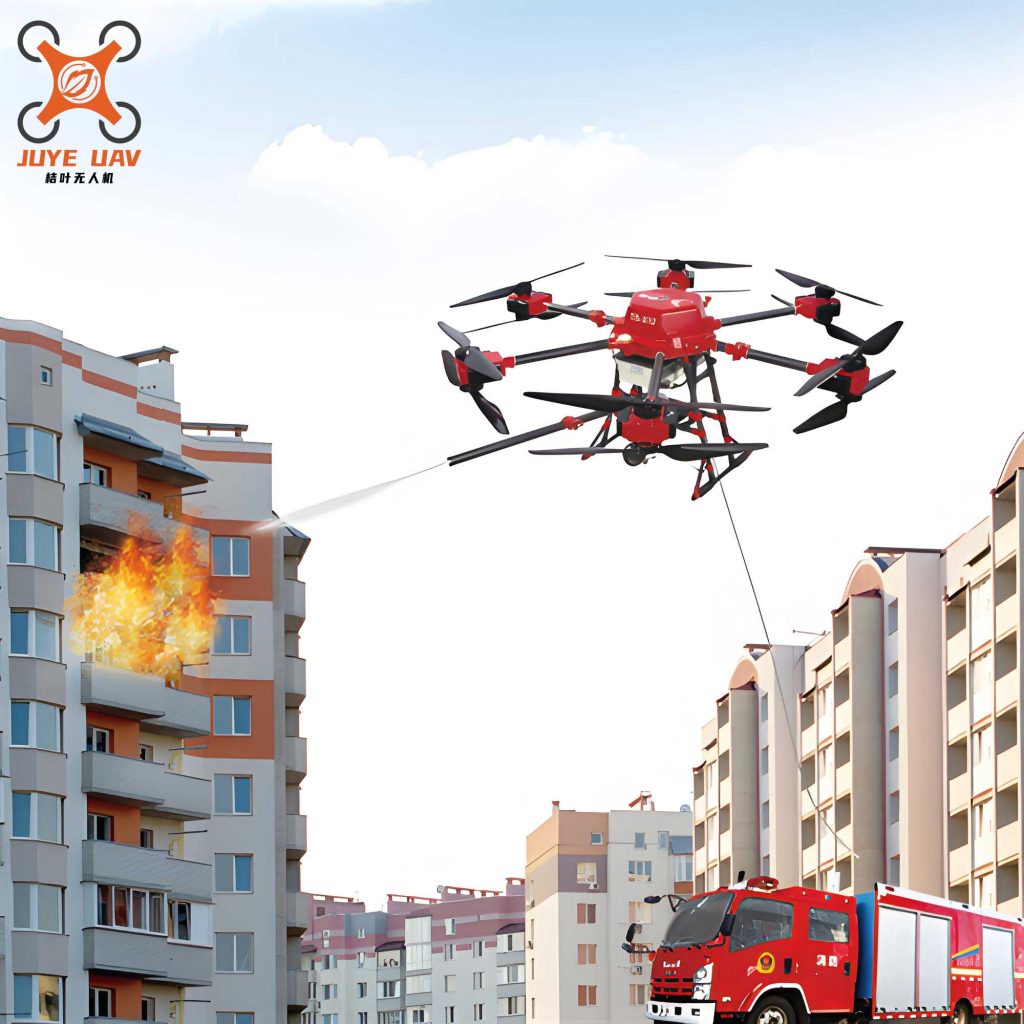
The operational principles of fire UAVs in rescue missions hinge on their mobility and data integration capabilities. Fundamentally, a fire UAV functions by following pre-programmed flight paths or real-time commands from operators, utilizing GPS and inertial navigation systems for precision. The key mechanism involves the collection of environmental data—such as temperature, gas concentrations, and visual imagery—through onboard sensors, which is then processed and relayed to command centers. In mathematical terms, the flight dynamics of a fire UAV can be modeled using equations of motion. For instance, the lift force $L$ generated by rotors in a multirotor fire UAV is given by: $$L = k \cdot \omega^2$$ where $k$ is a constant dependent on rotor design and air density, and $\omega$ is the angular velocity of the rotors. This allows for stable hovering and maneuverability in turbulent fire zones. Additionally, the data transmission efficiency $E_t$ can be expressed as: $$E_t = \frac{B \cdot \log_2(1 + SNR)}{t_d}$$ where $B$ is bandwidth, $SNR$ is signal-to-noise ratio, and $t_d$ is transmission delay. Such formulas underscore the technical underpinnings that enable fire UAVs to provide real-time situational awareness, crucial for decision-making in time-sensitive operations.
The advantages of deploying fire UAVs in firefighting are manifold, stemming from their intelligent design and adaptability. Below is a comparative table summarizing key benefits over traditional methods:
| Aspect | Traditional Firefighting | With Fire UAV Integration |
|---|---|---|
| Reconnaissance Speed | Slow, reliant on human scouts | Rapid, aerial surveillance in minutes |
| Risk to Personnel | High exposure to hazards | Minimized, operators remain at safe distances |
| Data Accuracy | Limited by line-of-sight and obstructions | High-resolution thermal and visual feeds |
| Operational Cost | Expensive due to equipment and manpower | Cost-effective over time, reduced resource use |
| Maneuverability | Constrained by terrain and infrastructure | Excellent, capable of vertical takeoff and tight spaces |
One significant advantage is the智能化 of fire UAV control systems. Through artificial intelligence algorithms, fire UAVs can perform autonomous tasks such as obstacle avoidance and path planning. For example, the obstacle detection probability $P_d$ can be modeled as: $$P_d = 1 – e^{-\lambda \cdot s}$$ where $\lambda$ is the sensor sensitivity and $s$ is the distance to the obstacle. This ensures safe navigation in cluttered environments. Moreover, fire UAVs excel in指点飞行, where they are programmed to fly to specific coordinates, enabling rapid localization of fire sources. The time $T_{reach}$ to reach a target at distance $d$ with velocity $v$ is: $$T_{reach} = \frac{d}{v} + \Delta t_{proc}$$ where $\Delta t_{proc}$ accounts for processing delays. Visual tracking capabilities allow continuous monitoring of fire spread, described by the frame rate $F_r$ needed for effective tracking: $$F_r \geq \frac{v_{fire}}{r_{pixel}}$$ where $v_{fire}$ is the fire propagation velocity and $r_{pixel}$ is the pixel resolution. These features collectively enhance the efficacy of rescue missions, making fire UAVs indispensable tools.
In terms of application studies, the use of fire UAVs can be categorized into several domains, each with unique technical considerations. First, in辅助救援 operations, fire UAVs are deployed to deliver payloads or perform direct灭火 tasks. For instance, a fire UAV can carry extinguishing agents like water or dry powder, with the payload capacity $C_{payload}$ determined by: $$C_{payload} = M_{total} – (M_{frame} + M_{battery})$$ where $M_{total}$ is the maximum takeoff mass, $M_{frame}$ is the structural mass, and $M_{battery}$ is the battery mass. The following table outlines common types of fire UAVs used in rescue scenarios:
| Fire UAV Type | Payload Capacity (kg) | Typical Mission | Flight Time (minutes) |
|---|---|---|---|
| Lightweight Reconnaissance | 0-2 | Scouting and imaging | 20-30 |
| Medium Payload Carrier | 2-10 | Equipment delivery | 15-25 |
| Heavy灭火 System | 10-30 | Direct fire suppression | 10-20 |
| Long-Endurance Monitor | 5-15 | Continuous surveillance | 40-60 |
These fire UAVs enable tasks such as creating逃生通道 by deploying ropes or guiding trapped individuals via loudspeakers. The effectiveness $E_{rescue}$ of such operations can be quantified as: $$E_{rescue} = \frac{N_{saved}}{T_{response} \cdot R_{risk}}$$ where $N_{saved}$ is the number of people rescued, $T_{response}$ is the response time, and $R_{risk}$ is the risk factor. Second, in火灾险情监控, fire UAVs provide continuous oversight of fire dynamics. Using thermal imaging, the heat flux $Q$ from a fire can be estimated with: $$Q = \epsilon \sigma A (T^4 – T_0^4)$$ where $\epsilon$ is emissivity, $\sigma$ is the Stefan-Boltzmann constant, $A$ is the area, $T$ is the fire temperature, and $T_0$ is ambient temperature. This data helps predict fire spread patterns, allowing for proactive measures. Third, in侦察 missions, fire UAVs map interior structures and identify hazards. The detection range $D_{detect}$ for obstacles in smoky conditions is given by: $$D_{detect} = \frac{I_0 \cdot e^{-\beta x}}{S_{threshold}}$$ where $I_0$ is the initial sensor intensity, $\beta$ is the attenuation coefficient, $x$ is the distance, and $S_{threshold}$ is the signal threshold. By integrating these applications, fire UAVs significantly reduce operational盲点 and enhance situational awareness.
Furthermore, the integration of advanced technologies in fire UAVs warrants deeper analysis. For example, machine learning algorithms enable predictive analytics for fire behavior. The probability $P_{spread}$ of fire spreading in a direction $\theta$ can be modeled as: $$P_{spread}(\theta) = \frac{1}{1 + e^{-(\alpha \cdot w + \beta \cdot h + \gamma)}}$$ where $w$ is wind velocity, $h$ is humidity, and $\alpha, \beta, \gamma$ are coefficients learned from historical data. This allows fire UAVs to forecast危险 zones and advise evacuation routes. Additionally, swarm technology, where multiple fire UAVs coordinate, amplifies their capabilities. The coordination efficiency $E_{swarm}$ for $n$ fire UAVs is: $$E_{swarm} = \frac{\sum_{i=1}^n u_i}{\sqrt{\sum_{i=1}^n c_i^2}}$$ where $u_i$ is the utility of each fire UAV and $c_i$ is the communication cost. Such swarms can blanket large areas, like forest fires, providing comprehensive coverage. In my assessment, the durability of fire UAVs in extreme conditions is also critical. The operational lifetime $L_{op}$ under high temperatures $T_{high}$ is approximated by: $$L_{op} = L_0 \cdot e^{-\frac{E_a}{k_B T_{high}}}$$ where $L_0$ is the nominal lifetime, $E_a$ is activation energy, and $k_B$ is Boltzmann’s constant. These formulas illustrate the sophisticated engineering behind reliable fire UAV performance.
To optimize the deployment of fire UAVs, logistical and strategic factors must be considered. A key aspect is battery management, as flight time limits mission duration. The energy consumption $E_{cons}$ of a fire UAV during a mission with time $t$ and power draw $P$ is: $$E_{cons} = \int_0^t P(t) \, dt$$ Using lithium-polymer batteries, the specific energy $E_{specific}$ (in Wh/kg) dictates payload trade-offs. Another factor is communication reliability, especially in urban canyons or remote areas. The signal strength $S$ at distance $r$ from the transmitter is modeled by the log-distance path loss: $$S = S_0 – 10n \log_{10}\left(\frac{r}{r_0}\right) + X_\sigma$$ where $S_0$ is the reference signal, $n$ is the path loss exponent, $r_0$ is the reference distance, and $X_\sigma$ is a Gaussian random variable for shadowing. This necessitates robust protocols to maintain control links for fire UAVs. Moreover, regulatory compliance, such as airspace restrictions, affects operational planning. In my experience, successful integration requires training firefighters in fire UAV operation and data interpretation, fostering a symbiotic relationship between human expertise and technological aid.
In conclusion, the adoption of fire UAVs in firefighting and rescue operations marks a paradigm shift toward safer and more efficient emergency response. Through this analysis, I have highlighted how fire UAVs leverage intelligent systems for reconnaissance, monitoring, and direct intervention, supported by mathematical models and comparative data. The repeated emphasis on fire UAV technology underscores its centrality in modern消防 strategies. As these systems evolve with advancements in AI, materials science, and telecommunications, their potential will only expand, offering new ways to combat fires and save lives. I urge fire departments and救援 teams to invest in fire UAV capabilities, ensuring they are equipped to handle the complex challenges of today’s disaster landscapes. Ultimately, the synergy between human courage and robotic precision, embodied by fire UAVs, paves the way for a more resilient future.