
As an analyst observing the modern battlefield, I have witnessed a profound transformation driven by the proliferation of unmanned aerial systems. The rapid advancement of drone technology has fundamentally altered operational paradigms, expanding the scope of military applications and significantly enhancing the efficacy of intelligence, surveillance, reconnaissance, and precision strike missions. This evolution has naturally precipitated an urgent and focused response from major military powers on the development of countermeasures. Among these, the Russian military’s approach to building anti-drone capabilities presents a particularly systematic and multifaceted case study. Their methodology, developed through a combination of theoretical research, technological innovation, doctrinal adaptation, and battlefield experience, offers significant insights. In this analysis, I will explore the primary methods through which Russia has strengthened its anti-drone ecosystem, focusing on equipment development, tactical doctrines, and operational application.
1. Development of a Multi-Layered Anti-Drone Arsenal
The cornerstone of any effective anti-drone strategy is a robust suite of purpose-built equipment. The Russian approach is characterized by a comprehensive, systematic development effort spanning the entire engagement chain: detection, disruption, capture, and kinetic defeat. This reflects a deliberate move towards a holistic and精细化 (fine-grained) capability.
1.1 Detection and Tracking Systems
The first and often most challenging step in anti-drone operations is detecting small, low-flying, and low-radar-signature targets. Russian research has focused on augmenting traditional radar with complementary technologies.
- Non-Radiating Optical Radar Systems: These systems are designed to detect drones at ranges of 3-5 km using optical and electro-optical means, providing a passive detection capability that is immune to radar warning receivers. They can subsequently cue other defensive weapons for engagement.
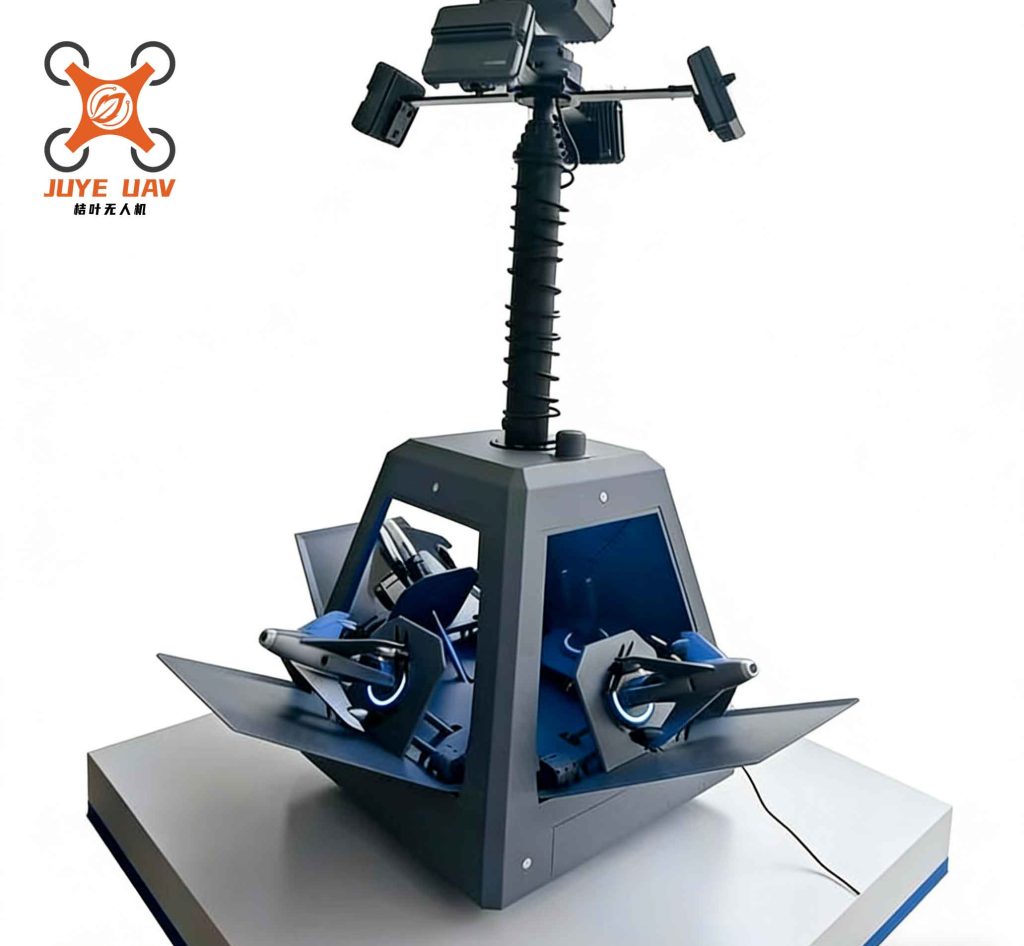
- Geodeziya-V System: This innovative system utilizes the TB-29V automated take-off and landing unmanned helicopter as a sensor platform. Its primary mission is to detect and track hostile drones, transmitting precise trajectory coordinates to a ground command post, effectively creating a mobile, airborne detection node.
- Sentry Radar-Optical Complex: This integrated system combines a perimeter surveillance radar station with a “Flight-1” optoelectronic module. It is reportedly capable of detecting small aerial targets, including mini-UAVs, at distances up to 20 km, fusing radar and visual data for improved classification and tracking.
| System Name | Primary Technology | Reported Detection Range | Key Function |
|---|---|---|---|
| Non-Radiating Optical Radar | Electro-Optical/Infrared | 3-5 km | Passive detection, fire control cueing |
| Geodeziya-V | UAV-borne sensors | Operational range of TB-29V | Mobile detection & tracking, coordinate transmission |
| Sentry Radar-Optical Complex | Radar + EO/IR fusion | Up to 20 km | Integrated wide-area surveillance of low-signature targets |
1.2 Disruption and Suppression Systems
Electronic warfare (EW) is considered a central pillar of Russia’s anti-drone efforts, targeting the drones’ reliance on communication links, navigation signals, and onboard electronics.
- Microwave (HPEM) Cannons: Mounted on platforms like the Buk air defense system chassis, these directed-energy weapons are designed to conduct full-spectrum suppression of a drone’s electronic components at distances exceeding 10 km, causing immediate malfunction.
- Stupor Electromagnetic Gun: A man-portable device intended to suppress drones within a 2 km line-of-sight range. It emits electromagnetic pulses aimed primarily at disrupting the command and control link, causing the drone to lose connection with its operator and crash. Secondary effects include jamming navigation and video transmission channels.
- Integrated EW Systems: Systems like Rosa-AERO and Barnaul represent sophisticated, vehicle-mounted platforms. They can rapidly detect drones, jam their control and telemetry channels, even geo-locate the drone operator, and spoof Global Navigation Satellite System (GNSS) signals to take control and force-land the drone at a designated location.
The effectiveness of a radio frequency jamming system can be modeled by the jamming-to-signal ratio (J/S) required at the target drone’s receiver:
$$ \frac{J}{S} = \frac{P_j G_j R_{cs}^2 \gamma_j B_r}{P_s G_s R_{js}^2 \gamma_s B_j} $$
Where $P_j$ and $P_s$ are jammer and signal power, $G_j$ and $G_s$ are antenna gains, $R_{cs}$ and $R_{js}$ are ranges from communication source and jammer to target, $\gamma$ are polarization factors, and $B_r$ and $B_j$ are receiver and jammer bandwidths. Russian systems aim to maximize this ratio through high power ($P_j$) and sophisticated jamming techniques across a wide $B_j$.
| System/Weapon | Type | Reported Range | Primary Effect |
|---|---|---|---|
| Microwave Cannon | High-Power Microwave (HPM) | >10 km | Broad-spectrum electronic component suppression/frying |
| Stupor EM Gun | Portable Electromagnetic | ~2 km | C2 link disruption, forced crash |
| Rosa-AERO / Barnaul | Integrated EW System | Tens of km | Comms/Nav jamming, spoofing, takeover, operator location |
1.3 Control and Capture Systems
Beyond simple jamming, Russian research seeks to actively hijack or physically capture hostile drones, preserving them for intelligence purposes or simply removing them from the sky non-destructively.
- Izumrud (Emerald) Radio Station: This system uses microwave radiation to transmit information, attempting to hack into and infiltrate enemy unmanned systems. Its stated purpose is to seize control of drones and robotic systems, essentially turning the enemy’s asset against them.
- Remote Interception System for Small UAVs: A net-capture system that can be mounted on aircraft, helicopters, or larger drones. Upon command, it fires a 16 m² reinforced nylon net to entangle the target drone, rendering it unable to fly.
1.4 Kinetic Destruction Systems
When disruption or capture is not feasible or sufficient, direct kinetic destruction remains the final layer of defense. Russia has adapted and developed various weapon systems for this role.
- Dedicated Air Defense Systems: The Sosna anti-aircraft system and the Morpheus close-in air defense system are designed to engage small, low-altitude targets including drones and precision-guided munitions. Morpheus, in particular, is intended to engage targets before they reach their launch point.
- Adapted Armaments: Development of “smart” artillery munitions that detonate in proximity to small drones, and the upgrading of systems like the ZSU-23-4 Shilka with modern sensors for drone engagement.
- Unmanned Fighter Aircraft: Perhaps the most forward-looking development is the concept of an unmanned combat aerial vehicle (UCAV) specifically designed as an interceptor. Equipped with a gun system and specialized ammunition, it is envisioned to autonomously seek out and destroy various types of drones in flight, representing a new paradigm in counter-swarm and anti-drone warfare.
The probability of a successful kinetic intercept $P_k$ can be considered a function of multiple variables:
$$ P_k = f(P_d, P_{track}, P_{lock}, P_{guide}, P_{lethal}) $$
Where $P_d$ is detection probability, $P_{track}$ is tracking probability, $P_{lock}$ is weapon lock probability, $P_{guide}$ is guidance success probability, and $P_{lethal}$ is the conditional probability of lethal damage given a hit. Russian anti-drone systems aim to optimize each stage, especially $P_d$ for low-observable targets and $P_{lethal}$ using appropriate warheads (fragmentation, directed energy) against small, agile drones. The momentum transfer from a hit can be critical:
$$ \Delta p = m_{proj}v_{proj} – m_{drone}v_{drone} $$
For a lightweight drone, even a small-caliber hit with high $\Delta p$ can cause catastrophic structural failure.
2. Evolving Anti-Drone Doctrine and Tactical Employment
Technology alone is insufficient without coherent doctrine and tactics to bind it into an effective fighting force. Russia has actively developed and institutionalized its anti-drone operational concepts.
2.1 Standardization of Operational Procedures
In 2017, the Russian military formally established standardized procedures for anti-drone combat. This was a critical step in moving from ad-hoc responses to a repeatable, scalable methodology. The key elements defined include:
- Tactical Group Composition: Formation of joint tactical groups specifically for counter-UAV missions, typically comprising a detection/suppression detachment and a destruction detachment.
- Core Missions: Tasks such as detecting drones and relaying their coordinates to air defense units; coordinating the fire of anti-drone assets; and employing both electronic and kinetic means to neutralize threats.
- Primary Engagement Methodologies: Officially categorized into three tracks:
- Use of EW assets to disable/disrupt the drone’s electronic systems (soft-kill).
- Use of combined arms fire (air defense, long-range strikes) by relevant units within their zones to destroy drones and their ground control stations (GCS).
- Simultaneous, coordinated application of EW, air defense, and direct fire against both the aerial drone and its GCS.
This doctrinal framework provides a clear blueprint for force structure and training, ensuring that disparate units can integrate their efforts during anti-drone operations.
2.2 Soft-Kill Tactics: EW-Centric Neutralization
The Russian military views electronic warfare as the most efficient initial counter to drone threats. The underlying principle exploits the drone’s inherent vulnerability: its dependence on electromagnetic spectrum for control, navigation, and data transmission.
Disruption & Paralysis: This tactic focuses on attacking the communication link between the drone and its operator. By identifying the operating frequency and employing targeted jamming and suppression, the command link is severed. The drone may enter a failsafe mode (e.g., return-to-home, hover, land) or become uncontrollable and crash. The effectiveness hinges on signal intelligence (SIGINT) and rapid electronic attack.
$$ \text{Operational Outcome} = \text{SIGINT(Drone Comms)} + \text{EA(Jamming Power, Bandwidth)} $$
Where EA represents Electronic Attack.
Spoofing & Capture: A more sophisticated tactic involves not just jamming, but deceiving the drone. By broadcasting counterfeit GNSS (GPS/GLONASS) signals stronger than the genuine ones, systems like Rosa-AERO can “hijack” the drone’s navigation system. The drone, believing it is following its original course or being given new legitimate coordinates, is then guided to a predetermined landing zone for capture. This represents a complete information domain takeover.
$$ \text{Spoof Success} \propto \frac{P_{spoof}G_{spoof}}{P_{true}G_{true}} \cdot \text{Code/Phase Alignment} $$
Directed Energy Soft-Kill: Assessments suggest that high-power electromagnetic pulses can damage a drone’s internal electronics at ranges of 5-7 km, while high-energy lasers or intense optical radiation can blind or disrupt electro-optical sensors at 1-1.5 km. Russia’s development of electromagnetic guns and integrated “radio-electronic warfare” complexes aims to create a seamless detect-locate-defeat cycle for soft-kill engagements.
2.3 Hard-Kill Tactics: Kinetic Destruction
When prevention or disruption fails, physical destruction is necessary. Russian tactics for kinetic anti-drone engagements are multi-domain.
| Tactic | Assets Employed | Target | Operational Concept |
|---|---|---|---|
| Air-to-Ground (Pre-Launch) | Artillery, Missiles, Tactical Aviation (Helicopters, Attack Aircraft) | Drone launch sites, ground control stations, parked drones | Destroy the threat before it becomes airborne; requires excellent intelligence on enemy UAV unit locations. |
| Ground-to-Air (Point & Area Defense) | Pantsir-S1, Tor-M2, Strela-10, MANPADS (Igla), AAA (Shilka) | Drones in flight | Create layered, overlapping fields of fire from very short to medium range. Use rapid deployment, sector defense, and massed fires against swarms. |
| Air-to-Air (Aerial Interception) | Fighters (Su-27/30/35), Attack Helicopters (Mi-24/28NM) | Medium/high altitude or long-endurance drones | Use aircraft as mobile interceptors. Fighters patrol designated zones; helicopters provide localized defense. Armament includes guns, air-to-air missiles, and developing laser systems on platforms like the Mi-28NM. |
2.4 Integrated Tactics: The Soft-Hard Kill Combination
The most potent anti-drone effects are achieved by synchronizing electronic and kinetic means. Russian training emphasizes mixed tactical groups that blend capabilities.
Mixed-Element Tactical Groups: Since 2017, Russian military districts have been forming and refining company-level anti-drone units. The baseline includes detection/suppression (EW) and destruction (air defense) detachments. Variations add motorized infantry for mobility or sniper teams for engaging visual observers or GCS personnel. These groups train specifically in coordinated actions: EW units provide an electromagnetic screen for friendly forces while simultaneously degrading enemy drones, creating ideal conditions for kinetic systems to engage.
Electronic-Fire Coordination: Exercises routinely pair EW and air defense units. A common sequence involves: 1) EW assets detect and jam a drone, disrupting its control and navigation; 2) Radar or optical systems from the air defense unit acquire the now-vulnerable or predictable target; 3) A hard-kill system engages. This synergy increases the probability of successful negation, $P_{negation}$:
$$ P_{negation} = 1 – [(1 – P_{soft}) \times (1 – P_{hard|soft})] $$
Where $P_{soft}$ is the probability of soft-kill success, and $P_{hard|soft}$ is the conditional probability of a hard-kill success given the soft-kill was attempted (and may have degraded the target).
Training for Validation: Large-scale exercises regularly test these integrated tactics. For example, in one Eastern Military District drill, an electronic warfare team provided EM protection for an artillery position while simultaneously using a Kupol jamming station to disrupt enemy drone communications. In a Western Military District exercise, a combined team used Repellent and Borisoglebsk-2 systems to suppress control links and conduct radio-electronic strikes on command systems, while radar teams vectored automated jamming stations. These drills institutionalize the procedural and technical interoperability essential for modern anti-drone warfare.
3. Operational Tempo: Training and Combat Experience
Theoretical and technological advancements are stress-tested and refined through rigorous training and real-world application. Russia has pursued both avenues aggressively.
3.1 Frequent and Diverse Training Exercises
Russian forces conduct a high volume of anti-drone focused drills across all military districts. These exercises are not limited to specialized units but involve combined arms formations, emphasizing that counter-UAV is a universal battlefield requirement. Scenarios range from defending fixed bases like airfields and command posts to protecting maneuvering motorized rifle and artillery units on the move. The consistent training objectives are to:
- Improve the speed and accuracy of detecting small, low-flying UAVs.
- Practice the seamless handover of tracks from detection assets (EW, radar) to engagement assets (air defense, aircraft).
- Drill the coordinated application of electronic suppression and kinetic fires.
- Enhance the mobility and rapid deployment capabilities of anti-drone tactical groups.
This constant rehearsal builds muscle memory and validates equipment and tactics under controlled but challenging conditions.
3.2 Combat Application and Adaptation
The most significant validation of Russia’s anti-drone capabilities came in the Syrian theater. The defense of the Khmeimim airbase and Tartus naval facility in January 2018 against a coordinated swarm attack is a seminal case study. Thirteen armed drones were launched from over 100 km away. The Russian layered defense responded:
- Electronic Warfare: EW systems successfully intercepted and seized control of 6 drones, forcing them to land.
- Point Defense: Pantsir-S1 short-range air defense systems shot down the remaining 7.
- Result: Zero casualties or material damage at the defended sites.
This engagement demonstrated the critical importance of pre-deployed, integrated anti-drone systems. The combination of EW for “catch” (hijacking) and hard-kill for “shoot” proved highly effective against a low-cost, GPS-guided swarm. The lessons learned from this and other incidents in Syria have directly fed back into equipment development (e.g., emphasis on swarm defense, improved GNSS spoofing) and tactical refinements across the Russian armed forces.
Conclusion: A Holistic and Adaptive Approach
In my analysis, the Russian military’s approach to building anti-drone capacity is notable for its comprehensiveness and adaptability. It is not reliant on a single “silver bullet” technology but is constructing a deeply layered system-of-systems. This system integrates continuous investment in a wide spectrum of technologies—from passive detection and high-power microwaves to net guns and unmanned interceptors—within a clear and evolving doctrinal framework that emphasizes mixed groups and soft-hard kill synergy. Perhaps most importantly, this theoretical and technical foundation is constantly pressure-tested through relentless, realistic training and informed by hard-won combat experience. While challenges remain, particularly against evolving swarm tactics and autonomous drones, Russia’s systematic methodology has undoubtedly positioned it at the forefront of global anti-drone capabilities. The core lesson is that effective counter-UAV strategy requires parallel advancement in dedicated equipment, innovative tactics, and a culture of continuous operational learning and adaptation.