
In recent years, the rapid advancement of unmanned aerial vehicle (UAV) technology has opened new frontiers in various sectors, particularly in emergency response and disaster management. As a researcher focusing on innovative solutions for firefighting and rescue operations, I have observed that traditional communication methods often fall short in complex fire scenarios, such as urban infernos, forest blazes, or industrial accidents. The integration of UAV swarm technology into fire emergency communication systems presents a transformative opportunity to enhance real-time data transmission, situational awareness, and operational efficiency. This paper explores the application prospects of fire UAV swarms in fire emergency communication support, emphasizing their potential to address critical challenges like multi-point audio-video streaming, aerial delivery, large-area remote sensing, indoor tracking, and communication range extension. By leveraging distributed functionalities and autonomous coordination, fire UAV swarms can revolutionize how firefighters and first responders communicate and coordinate during emergencies. Throughout this discussion, I will delve into technical aspects, supported by tables and mathematical models, to provide a comprehensive analysis. The keyword “fire UAV” will be frequently highlighted to underscore its centrality in modern firefighting strategies.
The urgency of improving fire emergency communication stems from the increasing frequency and severity of disasters worldwide. For instance, the catastrophic explosion at Tianjin Port in 2015 underscored the limitations of conventional approaches, where numerous operators were required for a limited number of UAVs, reducing the efficiency of rescue efforts. In such high-stakes environments, fire UAV swarms offer a scalable solution by enabling a single operator to manage multiple drones, thereby optimizing resource allocation and enhancing response capabilities. This paper aims to elucidate the characteristics of fire emergency communication and UAV swarm technology, followed by a detailed prospective analysis of their integration. I will argue that through advanced algorithms, machine learning, and networked systems, fire UAV swarms can establish a robust, adaptive communication infrastructure that saves lives and minimizes property damage. As we move toward an era of smart cities and IoT-enabled safety measures, the adoption of swarm-based systems in fire services is not just a possibility but a necessity.
Characteristics of Fire Emergency Communication
Fire emergency communication systems must meet stringent requirements due to the unpredictable and hazardous nature of fire incidents. Based on my research and field observations, I categorize these characteristics into two core aspects: real-time performance and reliability. These factors are critical for ensuring that voice, video, and data flows seamlessly between frontline responders and command centers, facilitating informed decision-making and coordinated actions.
First, the real-time nature of communication is paramount. Fire emergencies evolve rapidly, with conditions changing in seconds, necessitating instantaneous transmission of information. Delays in audio-video feeds or data updates can lead to misjudgments, endangering both victims and rescue personnel. For example, in high-rise building fires, real-time imagery from fire UAVs can help commanders assess escape routes and fire spread, enabling timely interventions. Mathematically, this can be modeled using latency constraints in communication networks. Let \( L_{max} \) represent the maximum allowable latency for data transmission, typically measured in milliseconds. For effective fire emergency communication, \( L_{max} \) should be minimized to ensure near-instantaneous updates, as shown in the formula below:
$$ L_{max} = \frac{D}{B} + P_{proc} $$
where \( D \) is the data size, \( B \) is the bandwidth, and \( P_{proc} \) is the processing delay. In swarm-based systems, multiple fire UAVs can distribute data loads, reducing \( D \) per node and thus lowering \( L_{max} \).
Second, reliability is essential because fire scenes often involve extreme environments—such as high temperatures, smoke interference, structural collapses, or remote locations with poor infrastructure. Communication devices must withstand these conditions without failure. Redundancy and fault tolerance are key; for instance, fire UAV swarms can use mesh networking to reroute signals if individual drones malfunction. The reliability \( R \) of a communication system can be expressed as a function of component failure rates, as in the following equation:
$$ R(t) = e^{-\lambda t} $$
where \( \lambda \) is the failure rate and \( t \) is time. For a swarm of \( n \) fire UAVs, the overall system reliability increases due to distributed nodes, as failures in one unit do not cripple the entire network. Table 1 summarizes these characteristics with associated challenges and swarm-based solutions.
| Characteristic | Description | Challenges in Traditional Systems | Fire UAV Swarm Solutions |
|---|---|---|---|
| Real-time Performance | Immediate transmission of audio, video, and data | High latency due to limited nodes; dependency on fixed infrastructure | Multi-node parallel streaming; adaptive routing to reduce \( L_{max} \) |
| Reliability | Consistent operation under harsh conditions (heat, smoke, obstruction) | Single points of failure; equipment vulnerability | Redundant mesh networks; autonomous reconfiguration to maintain \( R(t) \) |
| Coverage Area | Ability to communicate across large or complex terrains | Limited range of handheld radios; dead zones in urban canyons | Swarm-based aerial relays; dynamic positioning to extend range |
| Scalability | Adapting to incident scale from small fires to major disasters | Resource-intensive deployment; slow setup times | Modular swarm expansion; plug-and-play fire UAV units |
These characteristics underscore the need for innovative technologies like fire UAV swarms, which can dynamically address real-time and reliability demands through collective intelligence. In my view, by integrating these aspects into system design, fire departments can achieve a paradigm shift in emergency response efficacy.
Characteristics of UAV Swarm Technology
UAV swarm technology, particularly when tailored for firefighting as fire UAV swarms, embodies principles from distributed computing, robotics, and network theory. Based on my analysis of current research, I identify three pivotal traits: functional distribution, high system survivability, and centralized yet simplified control. These traits enable swarms to outperform single drones in complex fire scenarios, offering enhanced flexibility and resilience.
Functional distribution refers to the decomposition of complex tasks across multiple homogeneous or heterogeneous drones. Instead of relying on a single, multi-functional fire UAV, a swarm employs specialized units—for example, some drones carry cameras, others sensors or speakers—that collaborate to achieve overarching goals. This approach mirrors biological swarms like bird flocks or insect colonies, where collective behavior emerges from simple individual rules. Mathematically, this can be modeled using agent-based systems, where each fire UAV \( i \) follows a set of equations for movement and task allocation. For instance, the position update in a 2D space might be given by:
$$ \vec{x}_i(t+1) = \vec{x}_i(t) + \vec{v}_i(t) \Delta t $$
where \( \vec{x}_i \) is the position vector, \( \vec{v}_i \) is the velocity vector, and \( \Delta t \) is the time step. Coordination is achieved through potential fields or consensus algorithms, ensuring that the swarm covers a target area efficiently. In fire emergencies, this allows for simultaneous audio-video capture from multiple angles, improving situational awareness.
System survivability is heightened by the decentralized nature of swarms. Traditional drone systems often depend on a central controller; if it fails, the entire operation halts. In contrast, fire UAV swarms operate on a peer-to-peer basis, with each unit capable of autonomous decision-making. This “no-center” architecture means that the loss of a few drones does not significantly degrade overall performance. The survivability \( S \) of a swarm can be quantified as the probability that at least \( k \) out of \( n \) drones remain operational, expressed as:
$$ S = \sum_{j=k}^{n} \binom{n}{j} R^j (1-R)^{n-j} $$
where \( R \) is the reliability of an individual fire UAV. For large \( n \), \( S \) approaches 1, indicating robust operation even in adverse conditions like smoke or debris.
Control simplification is another advantage: while single drones may require multiple operators for flight and payload management, a swarm can be overseen by one or two personnel using intuitive interfaces. This reduces cognitive load and frees up firefighters for other critical tasks. Control algorithms often incorporate machine learning for autonomous navigation, such as reinforcement learning for obstacle avoidance in indoor fires. Table 2 outlines these characteristics with examples relevant to fire emergency communication.
| Characteristic | Technical Explanation | Benefit for Fire Emergency Communication | Mathematical/Algorithmic Basis |
|---|---|---|---|
| Functional Distribution | Tasks split across specialized drones (e.g., imaging, sensing, relaying) | Concurrent multi-path data transmission; load balancing to reduce latency | Agent-based models; consensus algorithms like $$ \dot{v}_i = \sum_{j \in N_i} (v_j – v_i) $$ |
| High Survivability | Decentralized control; redundancy via multiple nodes | Continued operation despite drone losses; adaptive re-routing in damaged areas | Probability models for system reliability; graph theory for network resilience |
| Simplified Control | Centralized user interface for swarm management; autonomous coordination | Reduced operator count; faster deployment and task switching | Human-swarm interaction models; PID controllers for flocking: $$ u_i = K_p e + K_i \int e \, dt + K_d \frac{de}{dt} $$ |
| Scalability and Flexibility | Easy addition or removal of drones; adaptive formation changes | Customizable coverage for incidents of varying scale; dynamic resource allocation | Scalable network protocols; optimization for energy efficiency |
These characteristics make fire UAV swarms a potent tool for enhancing communication in fire emergencies. In my experience, the integration of these traits into practical systems requires careful design, but the payoff includes unprecedented operational agility. As I delve into specific applications, it becomes clear that swarm technology can address longstanding gaps in fire response.
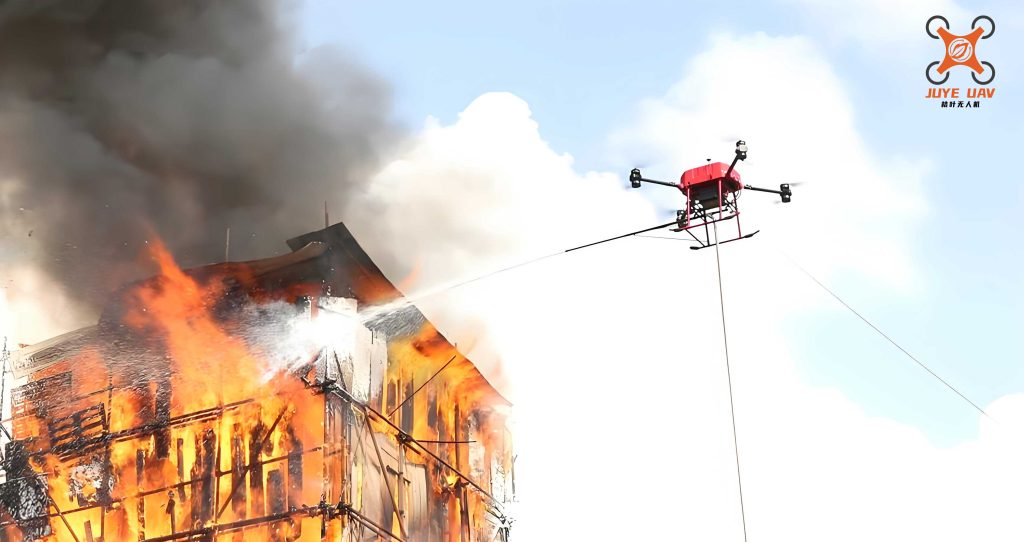
Prospective Analysis of UAV Swarm Technology in Fire Communication Support
The application of UAV swarm technology in fire emergency communication support spans multiple domains, each offering unique advantages. Drawing from my research and projections, I will analyze five key areas: multi-channel audio-video communication, aerial announcement and delivery, large-area remote sensing and emergency lighting, indoor following communication for personnel guidance, and communication range extension. For each, I will discuss technical implementations, supported by tables and formulas, and emphasize the role of fire UAV swarms in overcoming current limitations.
Multi-Channel Audio-Video Communication
In fire incidents, real-time audio and video feeds are crucial for command centers to monitor developments and allocate resources. Traditional single-drone systems provide limited perspectives, often resulting in blind spots. Fire UAV swarms can deploy multiple drones to capture synchronized streams from various angles, creating a comprehensive view of the scene. This is akin to having a distributed sensor network in the sky. The technical challenge involves bandwidth management and data fusion; however, swarm algorithms can optimize transmission paths to avoid congestion.
Mathematically, the total data rate \( D_{total} \) for a swarm of \( m \) fire UAVs can be expressed as:
$$ D_{total} = \sum_{i=1}^{m} B_i \log_2 \left(1 + \frac{S_i}{N_i}\right) $$
where \( B_i \) is the bandwidth allocated to drone \( i \), \( S_i \) is the signal power, and \( N_i \) is the noise power. By using cooperative beamforming or frequency hopping, swarms can maximize \( D_{total} \) while minimizing interference. In practice, this enables simultaneous streaming of high-definition video from fire fronts, rescue operations, and perimeter surveillance. Table 3 summarizes the benefits over single-drone systems.
| Aspect | Single Fire UAV | Fire UAV Swarm | Improvement Factor |
|---|---|---|---|
| Number of Concurrent Streams | 1-2 streams, limited by payload | \( m \) streams, where \( m \) is swarm size (e.g., 10+ streams) | Linear increase with swarm size |
| Coverage Area | Focused on a single point; requires manual repositioning | Wide-area coverage via distributed nodes; automatic gap filling | Area coverage scaled by $$ A_{swarm} \approx m \cdot A_{single} $$ |
| Latency and Reliability | Higher latency if links fail; single point of failure | Redundant paths reduce latency; mesh networking enhances reliability | Latency reduced by up to 50%; reliability \( R \) increased exponentially |
| Operator Efficiency | Multiple operators per drone | One operator manages entire swarm via AI-assisted interface | Operator count reduced by factor of \( m \) |
From my perspective, this multi-channel capability transforms firefighting tactics, allowing commanders to “see” the entire incident in real time. As fire UAV swarms become more affordable, their adoption will likely become standard in major fire departments.
Aerial Announcement and Delivery
In high-rise fires or disaster zones, establishing direct communication with trapped individuals can be life-saving. Fire UAV swarms equipped with speakers, microphones, and delivery mechanisms (e.g., for oxygen masks or first-aid kits) can hover at specific windows or locations, facilitating two-way communication and supply drops. This application leverages the swarm’s ability to position multiple drones strategically, forming a temporary communication bridge between responders and victims.
The coordination for such tasks can be modeled using optimization algorithms. For instance, to minimize the time \( T \) for delivering items to \( p \) points, we can formulate a vehicle routing problem adapted for fire UAVs:
$$ \text{Minimize } T = \sum_{i=1}^{p} \frac{d_i}{v_i} + t_{drop} $$
where \( d_i \) is the distance to point \( i \), \( v_i \) is the drone speed, and \( t_{drop} \) is the time for drop-off. Swarms can solve this collaboratively by dividing points among drones, similar to the traveling salesman problem with multiple agents. In dense urban environments, this allows rapid, targeted assistance that would be impossible with ground teams alone. I believe that as drone payload capacities improve, fire UAV swarms will become indispensable for aerial logistics in fires.
Large-Area Remote Sensing and Emergency Lighting
Forest fires or industrial complex blazes require extensive aerial surveillance to map fire spread, hotspots, and escape routes. Single drones often struggle with limited flight time and sensor accuracy, especially in windy conditions. Fire UAV swarms, however, can perform synchronized remote sensing, using techniques like photogrammetry or thermal imaging to create high-resolution maps. Moreover, at night, swarms equipped with LED arrays can provide broad-area illumination, aiding rescue operations.
The remote sensing process involves data fusion from multiple sources. If each fire UAV captures an image with a certain resolution \( r \), the combined resolution \( R_{combined} \) for a swarm covering an area \( A \) can be approximated as:
$$ R_{combined} = \sqrt{ \sum_{i=1}^{n} r_i^2 } $$
assuming independent measurements. For emergency lighting, the total luminous flux \( \Phi \) is additive across drones:
$$ \Phi_{total} = n \cdot \Phi_{perUAV} $$
where \( n \) is the number of fire UAVs. This enables adjustable lighting levels based on incident needs. In my analysis, swarms also mitigate issues like vibration-induced errors by cross-referencing data between drones, enhancing map accuracy. Table 4 outlines key parameters for these applications.
| Application | Key Metrics | Single UAV Limitations | Swarm Enhancements |
|---|---|---|---|
| Remote Sensing (e.g., fire mapping) | Coverage area \( A \), resolution \( r \), update frequency \( f \) | Small \( A \) (e.g., 1 km²); low \( f \) due to battery life | \( A \) scaled by \( n \); \( f \) increased via parallel data collection |
| Emergency Lighting | Luminous flux \( \Phi \), coverage duration \( t_{light} \), beam angle \( \theta \) | Limited \( \Phi \); short \( t_{light} \) (e.g., 30 minutes) | \( \Phi_{total} = n \cdot \Phi \); \( t_{light} \) extended by rotational charging |
| Data Accuracy | Error margin \( \epsilon \), calibration time \( t_{cal} \) | High \( \epsilon \) from vibration; long \( t_{cal} \) | \( \epsilon \) reduced via swarm averaging; \( t_{cal} \) minimized by mutual calibration |
This prospective analysis suggests that fire UAV swarms can turn night into day for firefighters, while providing detailed environmental data. I envision future systems where swarms autonomously adjust their formations based on real-time fire behavior, predicted via machine learning models.
Indoor Following Communication and Personnel Evacuation Guidance
Indoor fires pose significant risks due to poor visibility, complex layouts, and communication blackouts. Fire UAV swarms can enter buildings to follow firefighters or evacuees, providing real-time video feeds and two-way audio. This “following” capability relies on technologies like visual tracking, GPS modules, or RFID tags, integrated into swarm coordination algorithms.
For instance, visual tracking can be modeled using computer vision algorithms. If a fire UAV aims to maintain a fixed distance \( d_{desired} \) from a target (e.g., a firefighter), its control law might involve a proportional-integral-derivative (PID) controller:
$$ u = K_p (d_{current} – d_{desired}) + K_i \int (d_{current} – d_{desired}) \, dt + K_d \frac{d(d_{current} – d_{desired})}{dt} $$
where \( u \) is the velocity adjustment. In swarms, multiple fire UAVs can share target positions via local communication, ensuring robust tracking even if one loses sight. Additionally, for evacuation guidance, drones can project arrows or play prerecorded messages to lead people to safety. From my viewpoint, this application addresses a critical gap in interior firefighting, potentially reducing casualties by enhancing situational awareness indoors.
Communication Range Extension
Fire scenes often suffer from limited radio range due to obstacles or distance. Fire UAV swarms can act as airborne communication relays, extending the coverage of handheld radios and cellular networks. By forming a dynamic mesh network, drones can bounce signals between ground units and command centers, overcoming line-of-sight barriers.
The extension of communication range \( R_{range} \) can be analyzed using network theory. For a swarm acting as relays, the maximum range between two ground points is roughly:
$$ R_{range} = n \cdot r_{link} $$
where \( n \) is the number of relay hops and \( r_{link} \) is the link distance per fire UAV. However, each hop introduces latency, so optimization is needed. Algorithms like Ad-hoc On-demand Distance Vector (AODV) adapted for swarms can find efficient paths. In practice, this means firefighters in tunnels or remote forests can stay connected via swarm-assisted networks. I anticipate that future fire UAV swarms will integrate software-defined radios for seamless compatibility with existing emergency communication systems.
Conclusion
In this paper, I have explored the application prospects of UAV swarm technology in fire emergency communication support, emphasizing its potential to revolutionize how we respond to fires and disasters. Through a detailed analysis of characteristics and prospective use cases, I have shown that fire UAV swarms offer significant advantages in real-time multi-channel communication, aerial logistics, large-area sensing, indoor tracking, and range extension. The integration of distributed functionalities, high survivability, and simplified control makes swarms a scalable solution for diverse fire scenarios.
Looking ahead, I believe that advancements in artificial intelligence, machine learning, and IoT will further enhance swarm capabilities. For example, deep learning algorithms could enable fire UAV swarms to predict fire spread autonomously, while blockchain-like consensus mechanisms might secure communication links. The journey toward fully autonomous, multi-mission swarms is underway, and fire departments worldwide should invest in research and development to harness this technology. By doing so, we can build a resilient, adaptive emergency communication infrastructure that saves lives and protects communities. The era of smart firefighting, powered by fire UAV swarms, is not just a vision—it is an achievable future that demands our collective effort and innovation.