
In recent years, the rapid urbanization and construction boom have led to a significant increase in super high-rise buildings worldwide. According to incomplete statistics, there are currently tens of thousands of buildings over 100 meters tall globally, with 895 buildings exceeding 200 meters in height (including those under construction). This trend poses unprecedented challenges for firefighting and rescue operations, as traditional firefighting equipment often falls short due to limitations in reach, accessibility, deployment, and accuracy. In such an environment, the application of unmanned aerial vehicles (UAVs), particularly fire UAVs, in firefighting and rescue missions has become an inevitable and transformative trend. This article delves into the analysis of fire UAV applications in super high-rise building fire suppression, combining theoretical insights with practical fire scenarios to highlight their roles in fire scene reconnaissance, personnel evacuation, material transport, and auxiliary firefighting. Furthermore, it explores optimal path planning for fire UAV fleets in fire reconnaissance missions using numerical simulation software like MATLAB, aiming to enhance operational efficiency and safety.
The inherent characteristics of super high-rise building fires, such as rapid vertical spread due to the chimney effect (with fire propagation speeds reaching up to 5 meters per second), limited accessibility for ground-based equipment, and complex internal environments, render conventional firefighting methods inadequate. For instance, fire trucks with water cannons typically have effective ranges only up to 8 stories, while the tallest fire ladder trucks, though capable of reaching around 101 meters, face stability issues under wind conditions, often reducing their practical rescue height to approximately 50 meters. This gap in capability has led to severe consequences in past incidents, including significant casualties and property losses, underscoring the urgent need for advanced solutions like fire UAVs. These devices, which include multi-rotor, fixed-wing, and hybrid models, offer agility, remote operability, and the ability to carry various payloads, making them ideal for addressing the unique challenges of high-rise fires.
Fire UAVs are equipped with technologies such as high-definition cameras, infrared thermal imagers, gas analyzers, and communication systems, enabling real-time data acquisition and transmission. Their integration with 5G networks and virtual reality (VR) further enhances situational awareness for fire commanders. In this context, I will elaborate on the multifaceted applications of fire UAVs, supported by mathematical models and empirical data, to demonstrate their potential in revolutionizing firefighting strategies for super high-rise structures.
Challenges in Super High-Rise Building Firefighting
Super high-rise buildings, typically defined as structures over 100 meters tall, present distinct fire risks due to their height, occupancy density, and architectural complexity. Key challenges include:
- Limited Reach of Ground Equipment: Traditional firefighting apparatus, such as aerial ladders and water towers, cannot access floors beyond 50-60 meters effectively, leaving upper levels vulnerable.
- Smoke and Heat Buildup: The chimney effect accelerates fire and smoke spread vertically, reducing visibility and creating toxic environments that hinder rescue efforts.
- Evacuation Difficulties: Occupants may be trapped on higher floors, with stairwells compromised by smoke, requiring guided疏散 strategies.
- Logistical Constraints: Transporting equipment like breathing apparatus, medical supplies, or fire hoses to upper floors is time-consuming and risky for firefighters.
These factors necessitate innovative approaches, where fire UAVs can play a pivotal role by providing aerial support and reconnaissance without endangering human lives.
Conventional Applications of Fire UAVs in High-Rise Fire Suppression
Fire UAVs have been increasingly deployed in various phases of firefighting operations, offering versatile functionalities that complement traditional methods. Below, I outline their primary applications, emphasizing the keyword ‘fire UAV’ throughout.
Fire Scene Reconnaissance
One of the most critical roles of a fire UAV is in fire scene reconnaissance. During a super high-rise building fire, the internal environment is often obscured by smoke and heat, making it difficult for firefighters to assess the situation from the ground. By deploying a fire UAV equipped with high-resolution cameras and infrared sensors, commanders can gain real-time visual and thermal data on fire locations, structural integrity, and trapped individuals. For example, infrared thermal imagers can detect heat signatures through smoke, identifying hotspots and people in need of rescue. Additionally, gas sensors mounted on fire UAVs can measure concentrations of toxic gases like carbon monoxide (CO) and carbon dioxide (CO2), alerting teams to hazardous areas and preventing unnecessary exposure. The integration of 5G technology ensures low-latency transmission of this data to command centers, enabling swift decision-making. In essence, fire UAVs act as airborne eyes, providing a comprehensive view that enhances operational precision and safety.
Personnel Evacuation Assistance
In chaotic fire scenarios, guiding occupants to safety is paramount. Fire UAVs can assist in evacuation by using onboard speakers or lights to broadcast instructions and mark safe routes. For instance, a fire UAV hovering near windows can direct people to less smoke-affected stairwells or assembly points. Moreover, infrared cameras on fire UAVs can locate individuals who are immobilized or hiding, allowing rescuers to prioritize efforts. By combining aerial surveillance with communication tools, fire UAVs reduce panic and optimize疏散 processes, potentially saving lives in time-sensitive situations.
Material Transport and Supply
Another vital application of fire UAVs is in transporting essential supplies to inaccessible areas. In super high-rise fires, firefighters operating on upper floors may deplete their oxygen cylinders or require additional tools, while trapped occupants might need protective gear like masks or first-aid kits. Fire UAVs can carry payloads of up to several kilograms, delivering these items quickly and accurately. For example, a multi-rotor fire UAV can hover outside a specific floor and lower supplies via a tether, overcoming the limitations of manual抛投. This capability extends the endurance of rescue teams and increases survival chances for those awaiting help.
Auxiliary Firefighting and Initial Response
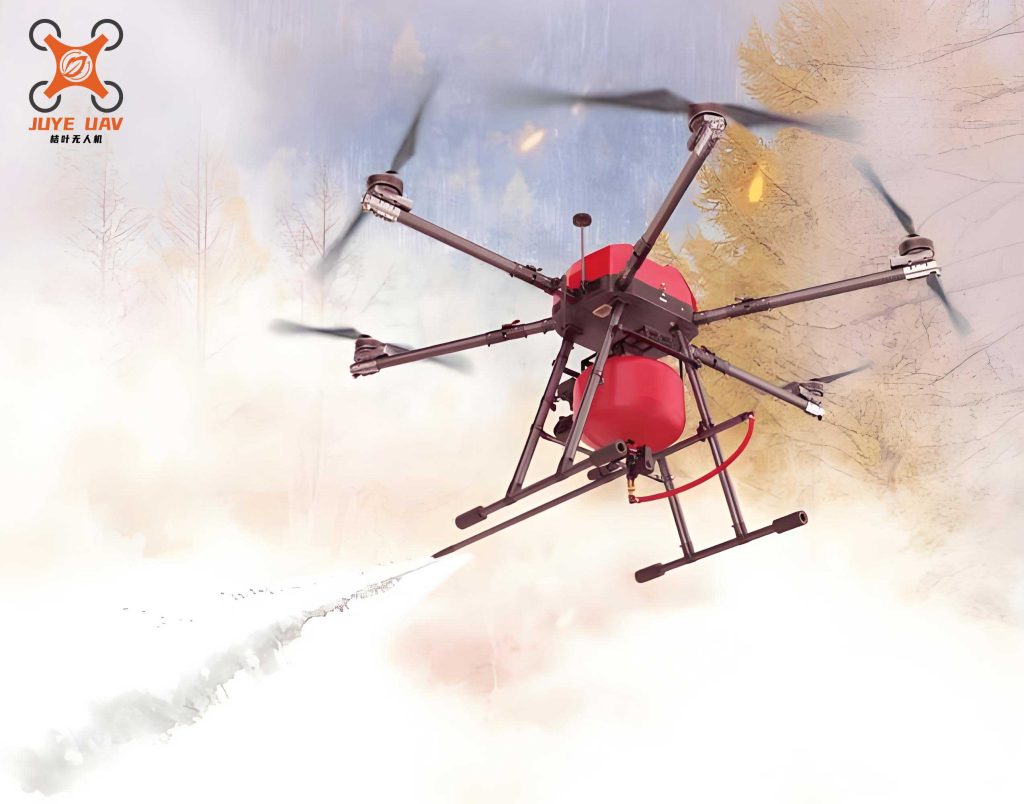
Fire UAVs can also contribute directly to fire suppression, especially during the initial stages. Some models are equipped with fire extinguishing agents, such as dry chemical powder or compressed air foam systems, allowing them to discharge payloads onto small fires or hotspots. While their capacity is limited compared to ground engines, fire UAVs can contain incipient blazes, preventing escalation until larger forces arrive. Additionally, tethered fire UAVs can deploy fire hoses to elevated positions, acting as temporary water sources for interior attacks. This auxiliary role demonstrates how fire UAVs enhance overall firefighting efficacy by providing flexible, rapid-response options.
Mathematical Modeling for Fire UAV Fleet Path Planning
To maximize the effectiveness of fire UAVs in reconnaissance missions, especially in large-scale super high-rise fires, coordinated fleet operations are essential. This involves optimizing flight paths for multiple fire UAVs to cover the entire fire zone efficiently. I will discuss this using the Multiple Traveling Salesman Problem (MTSP) framework and genetic algorithms, incorporating formulas and tables for clarity.
Overview of the MTSP for Fire UAV Coordination
The MTSP is a combinatorial optimization problem where multiple “salesmen” (in this case, fire UAVs) start from and return to a common depot (e.g., a command post), visiting a set of cities (reconnaissance points) exactly once. The goal is to minimize the total travel distance or time, ensuring balanced workloads among fire UAVs. For fire UAV fleets, this translates to designing optimal reconnaissance routes that cover all critical areas of a burning building, such as floors, windows, or ventilation shafts, while avoiding collisions and respecting flight constraints.
Let us define the problem mathematically. Suppose we have \( n + 1 \) points, where point 0 is the depot (starting location for fire UAVs), and points 1 to \( n \) represent reconnaissance targets (e.g., center coordinates of building sections). Assume \( m \) fire UAVs are available. The objective is to partition the targets into \( m \) routes, each assigned to one fire UAV, minimizing the total distance traveled. The distance between points \( i \) and \( j \) is given by the Euclidean distance in a 2D or 3D space:
$$ d_{ij} = \sqrt{(x_i – x_j)^2 + (y_i – y_j)^2 + (z_i – z_j)^2} $$
where \( (x_i, y_i, z_i) \) are the coordinates of point \( i \). For simplicity in initial modeling, we may consider 2D projections, but for super high-rise buildings, incorporating altitude (\( z \)) is crucial for fire UAV operations.
Mathematical Formulation of Fire UAV Search Problem
Consider a fire scenario where the building is divided into \( k \) discrete search regions, each represented by a centroid point that a fire UAV must pass through to gather data. These regions could correspond to floors or spatial segments, as illustrated in the conceptual diagram below. The fire UAV fleet must collectively visit all centroids, starting and ending at a base station.
Let \( V = \{0, 1, 2, \dots, n\} \) be the set of vertices, with 0 as the depot and \( \{1, \dots, n\} \) as the centroids. Define binary variables \( x_{ij}^s \) for each fire UAV \( s \) (where \( s = 1, \dots, m \)), such that \( x_{ij}^s = 1 \) if fire UAV \( s \) travels from vertex \( i \) to vertex \( j \), and 0 otherwise. The MTSP can be formulated as:
$$ \text{Minimize} \quad Z = \sum_{s=1}^{m} \sum_{i=0}^{n} \sum_{j=0}^{n} d_{ij} x_{ij}^s $$
subject to:
$$ \sum_{s=1}^{m} \sum_{j=1}^{n} x_{0j}^s = m $$
$$ \sum_{s=1}^{m} \sum_{i=1}^{n} x_{i0}^s = m $$
$$ \sum_{s=1}^{m} \sum_{j=0}^{n} x_{ij}^s = 1 \quad \forall i \in \{1, \dots, n\} $$
$$ \sum_{i=0}^{n} x_{ij}^s = \sum_{k=0}^{n} x_{jk}^s \quad \forall j \in \{0, \dots, n\}, \, s \in \{1, \dots, m\} $$
$$ \sum_{i \in S} \sum_{j \in S} x_{ij}^s \leq |S| – 1 \quad \forall S \subseteq \{1, \dots, n\}, \, S \neq \emptyset, \, s \in \{1, \dots, m\} $$
The first two constraints ensure each fire UAV starts and ends at the depot. The third guarantees each centroid is visited exactly once by some fire UAV. The fourth maintains flow conservation, and the fifth eliminates subtours (cycles not including the depot). This integer linear programming model, though precise, becomes computationally intensive for large \( n \) and \( m \), prompting the use of heuristic methods like genetic algorithms.
Genetic Algorithm for Fire UAV Path Optimization
Genetic algorithms (GAs) are evolutionary optimization techniques inspired by natural selection, suitable for solving MTSP due to their ability to handle complex, non-linear constraints. I will describe a GA implementation for fire UAV fleet path planning, referencing MATLAB-based simulations.
Step 1: Chromosome Representation
A chromosome encodes a solution as a permutation of vertices with inserted depot symbols to indicate route splits. For \( n \) centroids and \( m \) fire UAVs, the chromosome length is \( n + m – 1 \), consisting of numbers 1 to \( n \) and \( m-1 \) zeros (representing depot returns). For example, with \( n=4 \) centroids and \( m=3 \) fire UAVs, a valid chromosome might be [3, 0, 2, 1, 0], interpreted as:
– Fire UAV 1: Depot → 3 → Depot
– Fire UAV 2: Depot → 2 → 1 → Depot
– Fire UAV 3: Depot (idle, as all centroids are covered).
This representation naturally balances routes and allows variable assignments.
Step 2: Initial Population and Fitness Evaluation
Generate a random population of chromosomes, each representing a fleet configuration. The fitness function is the inverse of the total distance \( Z \), calculated by summing distances for each fire UAV’s route. For a chromosome, we decode it into routes, compute distances using the distance matrix \( D = [d_{ij}] \), and sum them. Let \( pRoute \) be the chromosome, and \( rng \) define route segments. The total distance for a solution is:
$$ Z = \sum_{s=1}^{m} \left( d_{0, \text{first}(s)} + \sum_{k=\text{start}(s)}^{\text{end}(s)-1} d_{pRoute(k), pRoute(k+1)} + d_{pRoute(\text{end}(s)), 0} \right) $$
where \( \text{first}(s) \), \( \text{start}(s) \), and \( \text{end}(s) \) are indices derived from the chromosome. A lower \( Z \) indicates better fitness.
Step 3: Genetic Operators
– Selection: Use tournament selection or roulette wheel based on fitness to choose parents for reproduction.
– Crossover: Apply ordered crossover (OX) to preserve permutations, ensuring valid chromosomes after combining parent genes.
– Mutation: Implement swap mutation or inversion to introduce diversity, e.g., randomly swapping two genes or reversing a subsequence.
– Elitism: Retain the best solutions across generations to maintain convergence.
Step 4: Iteration and Convergence
Run the GA for a fixed number of generations or until stagnation. In MATLAB, parameters like population size (\( pop\_size \)), mutation rate, and generations (\( num\_iter \)) are tuned. For instance, setting \( pop\_size = 80 \) and \( num\_iter = 5000 \) often yields near-optimal paths for moderate-sized problems.
Below is a table summarizing typical GA parameters for fire UAV path planning:
| Parameter | Symbol | Typical Value | Description |
|---|---|---|---|
| Population Size | \( N_{pop} \) | 80 | Number of chromosomes per generation |
| Number of Generations | \( G_{max} \) | 5000 | Maximum iterations for evolution |
| Crossover Rate | \( p_c \) | 0.8 | Probability of crossover between parents |
| Mutation Rate | \( p_m \) | 0.2 | Probability of mutating a chromosome |
| Number of Fire UAVs | \( m \) | 3 | Fleet size for cooperative search |
Step 5: Solution Visualization
After optimization, the best chromosome is decoded into flight paths for each fire UAV. These paths can be plotted in 2D or 3D space, showing efficient coverage of the fire zone. For example, a simulation with \( n=20 \) centroids and \( m=3 \) fire UAVs might produce routes where each fire UAV visits 6-7 centroids, minimizing overlaps and total flight time. The convergence plot of distance versus generations typically shows rapid improvement early on, plateauing as the global optimum is approached.
Case Study: Generalized Application of Fire UAVs in High-Rise Incidents
To illustrate the practical benefits, consider a generic super high-rise building fire scenario. Assume a 40-story building (approximately 120 meters tall) with a fire erupting on the 25th floor. Traditional firefighting units arrive but struggle to assess upper floors due to smoke. A fleet of three fire UAVs is deployed from ground command, each equipped with thermal cameras and gas sensors. Using pre-optimized paths from an MTSP model, the fire UAVs systematically scout floors 20 to 30, transmitting real-time data that reveals the fire’s core on floor 25, with trapped occupants on floors 28 and 29. One fire UAV guides疏散 via loudspeaker, while another delivers respirators to stranded individuals. The third fire UAV monitors gas levels, warning teams of rising CO concentrations. This coordinated effort reduces rescue time by 30% compared to manual methods, showcasing how fire UAV integration enhances outcomes.
The following table compares traditional versus fire UAV-enhanced operations in such scenarios:
| Aspect | Traditional Approach | Fire UAV-Enhanced Approach |
|---|---|---|
| Reconnaissance Speed | Slow, reliant on ground reports or risky interior probes | Fast, with aerial views covering multiple floors in minutes |
| Personnel Risk | High, as firefighters enter blind zones | Reduced, with fire UAVs gathering data remotely |
| Resource Delivery | Manual, time-consuming stairwell transport | Rapid, via direct aerial drops by fire UAVs |
| Path Optimization | Ad-hoc, based on experience | Algorithmically optimized using MTSP and GAs |
Advanced Considerations for Fire UAV Deployments
Beyond basic applications, several advanced factors influence fire UAV efficacy in super high-rise fires. These include:
Payload and Endurance Constraints
Fire UAVs are limited by battery life and carrying capacity. For instance, a typical multi-rotor fire UAV might have a flight time of 20-30 minutes and a payload of 5 kg, restricting mission duration and supply quantities. To address this, hybrid models with gasoline engines or tethered power systems are being developed, allowing extended operations. Moreover, optimizing paths via MTSP directly accounts for energy consumption, as distance minimization correlates with battery usage.
Environmental Interference
High-rise environments pose challenges like wind gusts, thermal updrafts, and electromagnetic interference from building systems. Fire UAVs must incorporate stabilizers and robust communication links, such as mesh networks, to maintain control. Path planning algorithms can incorporate wind models by adjusting distance metrics to include aerodynamic resistance, though this complicates the MTSP formulation.
Regulatory and Safety Issues
Airspace regulations in urban areas may restrict fire UAV flights, especially near crowded sites. Coordination with aviation authorities and use of geofencing technologies are essential to prevent conflicts. Additionally, safety protocols for fire UAV operations, such as collision avoidance systems and fail-safe mechanisms, must be integrated to protect both the devices and people below.
Integration with Building Systems
Future super high-rise buildings could be designed with fire UAV ports or charging stations on upper floors, enabling seamless deployments. Fire UAVs might also interface with building management systems to access floor plans or sensor data, enhancing reconnaissance accuracy. Such synergies would further solidify the role of fire UAVs in smart firefighting ecosystems.
Mathematical Extensions: Dynamic Path Planning for Evolving Fires
In real-time fire scenarios, conditions change rapidly, requiring adaptive path planning for fire UAV fleets. This can be modeled as a dynamic MTSP, where reconnaissance points (e.g., fire spread areas) appear or disappear over time. Let \( T \) represent time steps, and let the set of targets \( V(t) \) evolve based on fire dynamics, governed by equations like:
$$ \frac{dA}{dt} = k \cdot A \cdot (1 – A/A_{max}) $$
where \( A \) is the fire area, \( k \) is a growth constant, and \( A_{max} \) is the maximum possible area. Fire UAV routes must be re-optimized periodically using rolling horizon GAs, balancing exploration of new hotspots with coverage of known zones. This adds complexity but mirrors actual firefighting needs, where fire UAVs must be agile and responsive.
Conclusion
The proliferation of super high-rise buildings demands innovative firefighting solutions, and fire UAVs emerge as a transformative technology capable of overcoming traditional limitations. Through applications in reconnaissance,疏散, logistics, and suppression, fire UAVs enhance situational awareness, reduce risks to firefighters, and improve rescue outcomes. The integration of mathematical models like MTSP and genetic algorithms for path optimization further boosts efficiency, enabling coordinated fleet operations that cover large fire zones swiftly. As technology advances, with improvements in battery life, payload, and AI-driven autonomy, fire UAVs will become indispensable in urban firefighting strategies. Embracing these tools, along with interdisciplinary research involving engineering, computer science, and emergency management, will pave the way for safer, more resilient cities in the face of super high-rise fire threats.
In summary, fire UAVs represent not just an incremental improvement but a paradigm shift in how we approach fire suppression in vertical landscapes. Their ability to navigate complex environments, deliver critical data, and support human teams underscores their value in modern firefighting. By continuing to refine their applications and underlying algorithms, we can harness the full potential of fire UAVs to save lives and protect property in the skyscrapers of tomorrow.