
In the rapidly evolving landscape of low-altitude economy, China drone logistics has emerged as a transformative force in last-mile delivery, particularly within campus environments. As a leading contributor to this field, our team has developed a fully automated ground connection system designed to address the critical challenges of efficiency, safety, and reliability in drone-to-ground parcel handover. This system, tested extensively in real outdoor conditions, represents a significant advancement in China drone logistics infrastructure. In this article, I will detail the architectural design, mechanical innovations, control strategies, and experimental validation of this system, emphasizing how it satisfies the stringent demands of campus delivery operations.
1. System Architecture and Design Objectives
Our system is built upon a modular, three-layer architecture comprising hardware, software, and drive layers. The hardware layer includes a landing platform (helipad) and a storage cabinet. The software layer integrates a human-machine interface (HMI) developed on the .NET Framework, while the drive layer employs an XPLC108E-V2 motion controller coupled with bus-type servo drivers. The overall structure follows a “cloud-edge-end” collaborative paradigm, where the edge node—our ground connection cabinet—acts as the central coordinator between cloud-based services and on-site actuators.
Key performance indicators for the system were established before design, as summarized in Table 1.
| Component | Design Specification |
|---|---|
| Helipad | Area ≥ 1.6 m × 1.6 m; deformation under load < 0.5 mm |
| Bidirectional positioning mechanism | Single-axis positioning error < 2 mm |
| Cabin cover | No interference with drone propellers; opening time ≤ 10 s; IP65 waterproof |
| Cabinet top height | Height ≥ 2.2 m to ensure physical separation between users and drone |
| Storage compartments | Load capacity ≥ 30 N; deformation < 0.75 mm |
| Three-axis stacker crane | Total storage/retrieval time ≤ 120 s |
| Pickup port | Auto anti-pinch protection; user-safe design |
| Maintenance access | Passage width > 1.2 m |
2. Mechanical Structure and Key Innovations
The cabinet is divided into two main sections: the upper airport module and the lower storage cabinet module. The airport includes a cascade-type waterproof cover, a helipad, and a bidirectional positioning mechanism. The storage section houses a three-axis stacker crane, multiple storage compartments, a pickup port, and a user touchscreen. Below, I highlight the most critical mechanical innovations.
2.1 Cascade-Type Cover and Helipad
The cover is designed as a set of interconnected panels that fold via a linkage mechanism, allowing compact stowage and rapid deployment. Finite element analysis using CATIA confirmed that a 5 mm thick aluminum alloy helipad experiences a maximum deformation of only 0.3 mm under a 30 N load, well within the 0.5 mm limit. The cover achieves IP65 protection after sealing tests, ensuring reliable operation during rain. The cover opens in 6 seconds, meeting the 10-second requirement.
2.2 Bidirectional Positioning Mechanism
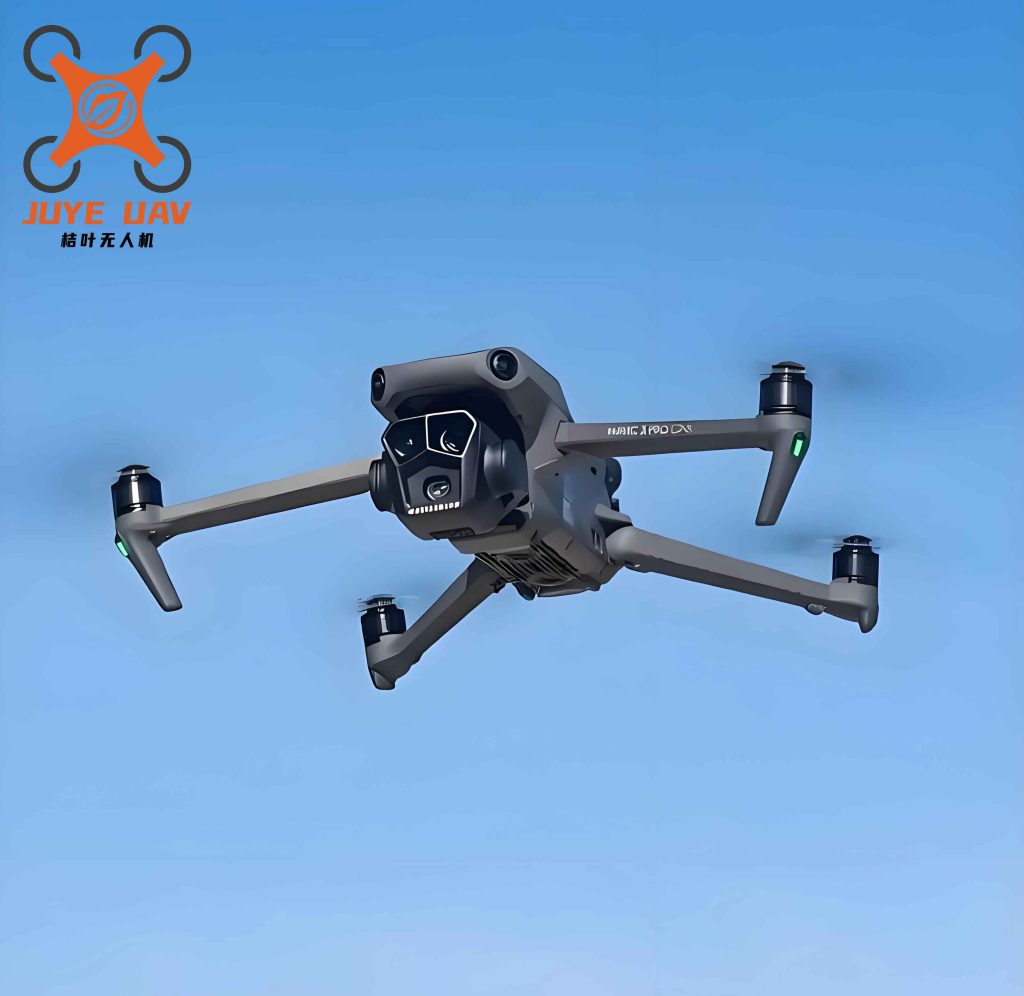
After a China drone releases a parcel on the helipad, the parcel’s initial position is random. To solve this, we designed a bidirectional positioning mechanism using rack-and-pinion drives and linear guide rails. The system corrects the parcel’s X and Y coordinates with a single-axis error of less than 2 mm (actual measured: 0.7 mm in X, 0.6 mm in Y). This ensures reliable pickup by the stacker crane.
2.3 Three-Axis Stacker Crane
The stacker crane uses three orthogonal axes (X, Y, Z) driven by servo motors and synchronous belts. To minimize cumulative positioning errors, we employed preloaded linear guides and symmetric rail layouts. Each axis is equipped with triple protection: end sensors, mechanical stops, and software limits. The measured positioning accuracy across all axes is within ±0.2 mm, and noise levels during operation stay below 55 dB. The stacker carries an ES4650 embedded barcode scanner on the Z-axis to read parcel codes (Code 128 encoding) during inbound processes, automatically binding the parcel ID to its storage slot.
3. Control System and Software Development
The control system adopts a master-slave architecture: an industrial PC (IPC) serves as the upper computer, handling HMI, cloud communication, and task scheduling, while the XPLC108E-V2 motion controller executes low-level motion commands. Communication between the upper and lower computers uses Modbus over serial port or Ethernet. Cloud connectivity relies on the MAVLink protocol for drone coordination.
3.1 Finite State Machine for Workflow
We modeled the entire parcel handling process as a finite state machine. Two primary states exist: inbound (parcel storage) and outbound (parcel retrieval). The inbound sequence is shown below:
| Step | Action | Trigger/Response |
|---|---|---|
| 1 | Drone sends landing request | Cloud dispatches permission |
| 2 | Cabinet opens cover | Returns “ready” signal |
| 3 | Drone lands and releases parcel | Drone sends “depart” signal |
| 4 | Bidirectional positioning corrects parcel | Automatic |
| 5 | Inbound door opens; stacker picks parcel | Scans barcode; assigns slot |
| 6 | Stacker stores parcel in designated compartment | Updates database |
| 7 | Cabinet sends confirmation to cloud | Cloud notifies recipient |
The outbound sequence for user pickup is equally streamlined:
| Step | Action | Trigger/Response |
|---|---|---|
| 1 | User enters pickup code on touchscreen | Search database for slot |
| 2 | Stacker retrieves parcel from slot | Moves to pickup port |
| 3 | Pickup port door opens; parcel presented | Light curtain monitors removal |
| 4 | User takes parcel | Door closes automatically |
| 5 | System returns to idle | Update inventory |
3.2 Human-Machine Interface
The HMI is developed using .NET Framework 4.7.2 with WPF (XAML) for the frontend and C# for the backend. It supports both QR code scanning and manual code entry for pickup. The backend provides a management dashboard with four modules: Main, Communication, Data, and User. Through the Data module, operators can monitor real-time parcel status, drone IDs, and cabinet slot occupancy. The system also logs all events for traceability.
4. Experimental Validation and Robustness Testing
We conducted a comprehensive field test in an outdoor campus environment to validate the system’s performance. The test protocol involved 50 consecutive cycles of full inbound-outbound operations, simulating real-world usage. Each cycle included drone landing, parcel release, positioning, storage, user pickup, and return to idle. Key metrics recorded were storage time, retrieval time, positioning accuracy, and error rates.
4.1 Performance Against Design Specifications
Table 4 summarizes the measured results compared to the design targets.
| Specification | Target | Measured | Status |
|---|---|---|---|
| Helipad area | ≥ 1.6 m × 1.6 m | 1.6 m × 1.6 m | Pass |
| Helipad deformation (30 N load) | < 0.5 mm | 0.3 mm | Pass |
| Positioning error (X-axis) | < 2 mm | 0.7 mm | Pass |
| Positioning error (Y-axis) | < 2 mm | 0.6 mm | Pass |
| Cover opening time | ≤ 10 s | 6 s | Pass |
| IP rating | IP65 | IP65 verified | Pass |
| Cabinet top height | ≥ 2.2 m | 2.26 m | Pass |
| Compartment load capacity | ≥ 30 N | 40 N (deformation 0.5 mm) | Pass |
| Total storage/retrieval time | ≤ 120 s | ~115 s average | Pass |
| Electrical reliability | No failure | 1,440 h continuous | Pass |
| Pickup port anti-pinch | Active protection | 500 cycles, no incident | Pass |
| Maintenance passage width | > 1.2 m | ~2 m | Pass |
4.2 Robustness and Timing Analysis
Figure 1 illustrates the distribution of storage and retrieval times over 50 cycles. [Insert image here]
The average inbound time (storage) was 80.11 s, with a standard deviation of 0.43 s. The average outbound time (retrieval) was 30.03 s, with a standard deviation of 0.51 s. Table 5 provides the statistical parameters.
| Metric | Mean (s) | Std Dev (s) | Range (s) | CV (%) |
|---|---|---|---|---|
| Inbound time | 80.11 | 0.43 | 1.50 | 0.54 |
| Outbound time | 30.03 | 0.51 | 1.70 | 1.70 |
The coefficient of variation (CV) for both processes remains below 2%, indicating excellent repeatability. The total average cycle time (storage + retrieval) is approximately 110.14 s, well within the 120 s limit. The maximum positioning deviation observed during the test was 0.5 mm, confirming high precision. No failures or safety incidents occurred.
5. Conclusion and Future Outlook
This paper presents a robust, fully automated ground connection system for campus drone logistics, a key component in China drone infrastructure. The system integrates a cascade cover, bidirectional positioning mechanism, three-axis stacker crane, and a cloud-connected control architecture. Experimental validation over 50 cycles demonstrates an average storage time of 80 s, average retrieval time of 30 s, and maximum positioning deviation of 0.5 mm, meeting all design targets. The system’s reliability and precision make it suitable not only for campus environments but also for broader applications such as emergency medical supply delivery and urban last-mile logistics.
Looking ahead, we plan to enhance the system with AI-based predictive maintenance and adaptive control algorithms to further improve robustness. The modular design also allows easy scalability for multi-drone operations. As China drone logistics continues to expand, our system offers a practical, tested solution for safe and efficient parcel handling in high-density human environments.