
The relentless threat of fire, particularly in densely populated residential areas, presents a continuous and grave challenge to urban safety. As an industrial design researcher focused on smart product development, my analysis of fire incident data reveals a persistent, alarming trend. The annual fire statistics from 2017 to 2019, while showing a slight numerical decrease, underscore a devastating reality of significant loss of life and property. The data compels a critical re-evaluation of our current fire safety paradigms, especially for high-rise residential buildings where traditional firefighting reach is inherently limited. This article presents a comprehensive design and engineering analysis of an integrated “Monitor-Warn-Extinguish” fire UAV (Unmanned Aerial Vehicle), leveraging low-frequency sonic wave technology, specifically engineered for the residential environment. The core thesis is to shift the intervention point to the earliest possible moment—striking the incipient fire—through an autonomous, intelligent system deployed within the living space itself.
1. Statistical Foundation: The Imperative for Innovation
To ground the design requirements in empirical reality, a detailed review of national fire statistics is essential. The data from 2017 to 2019 establishes the scope and nature of the problem the residential fire UAV must address.
| Statistical Parameter | 2017 | 2018 | 2019 | 3-Year Total |
|---|---|---|---|---|
| Reported Fires (10k) | 28.1 | 23.7 | 23.3 | 75.1 |
| Fatalities | 1,390 | 1,407 | 1,335 | 4,132 |
| Direct Property Loss (Billion CNY) | 36.00 | 36.75 | 36.12 | ~108.87 |
A more granular analysis reveals the disproportionate danger of residential fires. For instance, in 2018, while residential fires accounted for less than half of the total incidents, they were responsible for nearly 80% of all fire-related fatalities. This stark disparity highlights the vulnerable context of homes. Key patterns emerge: a majority of deadly fires occur at night (between 10 PM and 6 AM), electrical faults are the leading cause, and the most vulnerable populations (the elderly, disabled, or ill) suffer the highest casualties. Crucially, over 50% of fires are extinguished within 30 minutes, proving that early detection and rapid response are the most critical factors in preventing catastrophe. This statistical insight forms the foundational design principle: the primary function of the residential fire UAV must be autonomous early-stage intervention.
2. The Residential Fire Environment: Challenges and Dynamics
Designing an effective fire UAV requires a deep understanding of the complex and hostile environment it must operate within. Residential fires are characterized by their sudden onset, rapid evolution, and extreme difficulty of suppression, especially in high-rises.
2.1 Fire Development Physics
The growth of a compartment fire can be modeled approximately by a t-squared growth curve:
$$ Q = \alpha (t – t_0)^2 $$
where $Q$ is the heat release rate (kW), $\alpha$ is the fire growth coefficient (kW/s²), $t$ is time, and $t_0$ is the ignition time. For typical residential fuel loads (furniture, textiles), $\alpha$ can be “fast” or “ultrafast,” leading to flashover conditions in a matter of minutes. The temperature within a room can exceed 1000°C. This physics underscores the “golden minute” for response.
2.2 Human Factors in Fire Emergencies
Beyond the physics, human behavior under duress presents a major challenge for evacuation. A fire UAV must account for and mitigate these psychological responses.
| Psychological State | Behavioral Manifestation | Design Implication for Fire UAV |
|---|---|---|
| Panic & Fear | Irrational decisions, freezing, following crowds | Requires clear, calm, audio-guided instructions. |
| Disorientation | Inability to find exits, especially in smoke. | Capability for projected escape route guidance. |
| Return Tendency | Going back for belongings or familiar paths. | Dynamic real-time re-routing and persistent warning. |
2.3 Structural and Logistical Hurdles
High-rise buildings face the “height barrier,” where external fire service access is physically constrained. Internal firefighting is perilous and slow. Furthermore, locked or obstructed escape routes, non-functional firefighting systems, and complex floor plans compound the danger. An indoor-deployed fire UAV bypasses the external access problem and operates within the fire’s compartment of origin.
3. Critical Analysis of Existing Fire Suppression Methods for UAVs
Current firefighting UAVs deployed by fire services typically carry suppressant agents. A comparative analysis is necessary to justify the selection of sonic wave technology for the residential fire UAV.
| Suppressant Method | Mechanism | Advantages | Disadvantages for Residential Fire UAV |
|---|---|---|---|
| Water / Foam | Cooling, smothering | Effective on Class A fires, readily available. | Heavy payload, limited capacity, water damage, conductive (electrical risk). |
| Dry Chemical Powder | Chemical inhibition, smothering. | Effective on A, B, C, and some electrical fires. | Messy, corrosive, obscures vision, requires cleanup, payload weight. |
| CO₂ / Clean Agent | Oxygen displacement, heat absorption. | Clean, no residue, good for electrical/electronics. | Asphyxiation hazard in occupied spaces, limited range, high-pressure storage. |
| Extinguishing Ball/Cartridge | Burst dispersal of agent. | Simple deployment, can be targeted. | Single-use, requires reloading, potential collateral damage from explosion. |
| Sonic Waves (30-60 Hz) | Pressure waves disrupt air-fuel mixing & flame stability. | Clean, unlimited “ammunition,” no collateral damage, safe for occupants. | Effective range/size limitations, requires precise targeting and power. |
The analysis strongly favors sonic technology for an always-on, in-home fire UAV. Its key advantages—zero consumables, no secondary contamination or damage, and inherent safety for humans—align perfectly with the goal of frequent, automatic intervention on incipient fires without creating mess or hazard during false alarms or tests.
4. The Physics of Sonic Fire Extinguishing
The core innovation of this fire UAV lies in its application of low-frequency sound for suppression. The principle is based on the properties of sound as a longitudinal pressure wave. When a low-frequency (30-60 Hz), high-amplitude sound wave is directed at a flame, it induces rapid oscillations in the air surrounding the fuel source.
These oscillations have two primary extinguishing effects:
1. Increased Heat Transfer Rate: The oscillating airflow dramatically increases the convective heat transfer coefficient ($h$), as approximated by:
$$ \dot{q}_{conv}” = h (T_{flame} – T_{air}) $$
where $\dot{q}_{conv}”$ is the convective heat flux. The increased $h$ accelerates heat dissipation from the flame zone, lowering the temperature below the sustenance point.
2. Disruption of Fuel-Air Mixing & Flame Stability: The pressure variations ($\Delta P$) disrupt the stoichiometric mixing zone at the flame front. The flame’s reaction zone becomes unstable and is physically stretched and torn apart by the acoustic velocity field ($u’$), related to sound pressure by:
$$ u’ = \frac{P’}{\rho_0 c} $$
where $P’$ is the acoustic pressure, $\rho_0$ is air density, and $c$ is the speed of sound. When the particle displacement exceeds the flame quenching distance, the flame is extinguished. The required acoustic power ($\Pi_{ac}$) can be related to the extinction of a flame of cross-sectional area $A$:
$$ \Pi_{ac} \propto \frac{A \cdot I_{ext}}{\epsilon} $$
where $I_{ext}$ is the empirical intensity needed for extinction and $\epsilon$ is the transducer efficiency. This guides the sizing of the acoustic emitter on the fire UAV.
5. Integrated Design of the Residential Fire UAV
The proposed design synthesizes the environmental challenges, statistical imperatives, and chosen technology into a cohesive, manufacturable system. The aesthetic form factor takes inspiration from biomimicry for stability and symbolic reassurance, while the internal architecture is driven by harsh-environment functionality.
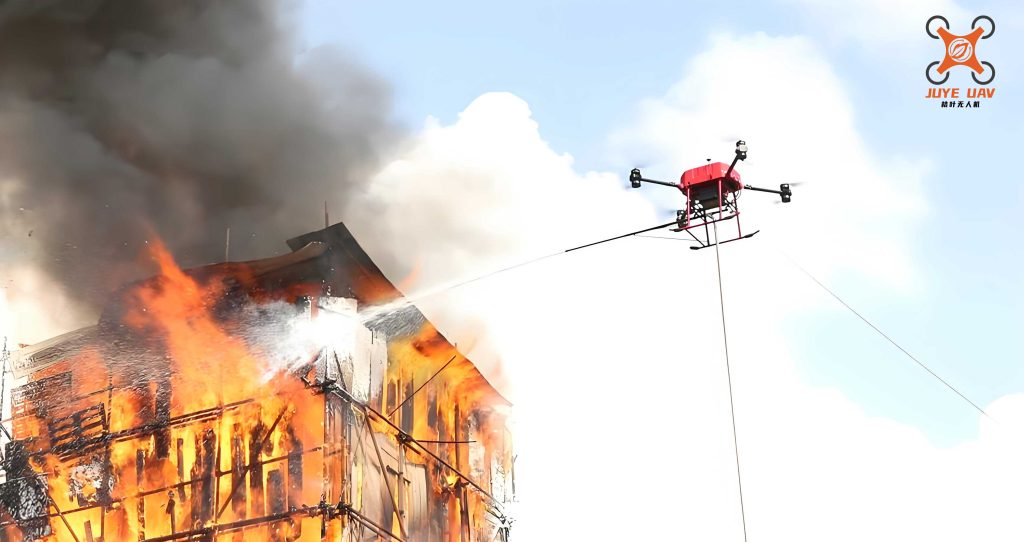
The drone features a quadcopter configuration for maneuverability in tight indoor spaces. The airframe utilizes a carbon fiber composite monocoque structure, chosen for its exceptional strength-to-weight ratio ($\sigma/\rho$), electromagnetic shielding properties, and corrosion resistance. A sealed internal aluminum alloy capsule houses and protects the core electronics from heat and humidity.
5.1 Critical Subsystem Specifications
| Subsystem | Component & Technology | Function & Specification |
|---|---|---|
| Propulsion & Power | Brushless DC Motors, Li-Po Battery, Wireless Charging Pad | Provides station-keeping and transit flight. Docks automatically to a wall-mounted wireless charger for constant readiness. |
| Avionics & Control | Integrated Flight Controller (IMU, Barometer), Ultrasonic/ToF Sensors | Enables stable autonomous flight, obstacle avoidance, and precise positioning within a known home layout map. |
| Fire Detection Suite | Dual-wavelength IR Pyrometer, CMOS Optical Camera, Gas Sensor Array (CO, VOCs) | Fused sensor data for reliable early fire detection. IR sensor mitigates false alarms from dust/steam. Gas sensors provide secondary confirmation. |
| Acoustic Extinguisher | Low-Frequency Speaker Array (30-60 Hz), Amplifier Circuit | Generates focused, high-SPL acoustic waves to disrupt and extinguish flames. The primary “weapon” of the fire UAV. |
| Human Interface | High-lumen LED Projector, Directional Speaker, Strobing Navigation Lights | Projects escape routes onto floors/walls. Broadcasts calm evacuation instructions. Lights provide visibility in smoke. |
| Environmental Hardening | Porous PTFE Membrane (e.g., Puwei Breather Valve), High-temp Silicone Seals | Equalizes pressure and expels moisture without letting in particulates or water. Protects electronics from humidity and mild heat. |
5.2 Operational Workflow Algorithm
The intelligence of the fire UAV is encoded in its autonomous operational sequence, which can be modeled as a finite state machine:
1. STATE: Monitoring & Docking. The UAV remains docked on its charging station. Its detection suite samples the environment at a low frequency. Power system is at 100%.
$$ P_{sys} = P_{sleep} $$
2. EVENT: Anomaly Detected. Sensor fusion algorithm triggers. IR temperature ($T_{IR}$) exceeds threshold $\Theta_T$ AND/OR gas concentration ($C_{gas}$) exceeds $\Theta_C$.
$$ Alert = 1 \quad \text{if} \quad (T_{IR} > \Theta_T) \lor (C_{gas} > \Theta_C) $$
3. STATE: Launch & Assess. UAV undocks and ascends to a pre-mapped vantage point. Optical camera confirms fire location ($x_f, y_f, z_f$). Severity is classified (Incipient/Growing).
4. STATE: Engage & Extinguish. UAV navigates to an optimal stand-off position relative to the fire. Activates the acoustic emitter at a frequency $f$ and power $\Pi$ tuned to the flame size.
$$ \Pi_{emit} = k \cdot A_{flame}^{0.8} $$
It maintains position, adjusting acoustics until the flame is extinguished (IR signature drops below $\Theta_T$).
5. STATE: Warn & Guide (Contingency). If the fire is classified as “Growing” or suppression fails after time $t_{max}$, the UAV switches to life-safety mode. It broadcasts warnings, projects the clearest exit route, and relays all data (video, location) to the homeowner’s phone and emergency services.
$$ \text{Action} = \text{Extinguish} \quad \text{if } t < t_{max}; \quad \text{else} \quad \text{Action} = \text{Evacuate} $$
6. STATE: Return & Report. Post-extinguishment or upon fire department arrival, the UAV returns to its dock, logs the event, and initiates a charging cycle.
6. Technical Challenges and Future Development Vectors
While the proposed residential fire UAV is technologically feasible, several challenges require attention for robust real-world deployment.
6.1 Acoustic Efficiency and Directivity: Maximizing the acoustic pressure at the flame while minimizing power consumption is key. Future work involves phased array speakers for steerable, focused beams, modeled by the directivity factor $D$:
$$ D = \frac{4 \pi r^2 I_{max}}{\Pi_{ac}} $$
where $I_{max}$ is the maximum intensity at distance $r$.
2. Sensor Fusion and False Alarm Rejection: The algorithm must distinguish a cooking flame from a fire, steam from smoke. Advanced machine learning models trained on diverse home sensor data are essential.
$$ \text{Confidence} = \text{MLP}(T_{IR}(t), C_{CO}(t), C_{VOC}(t), \text{Optical\_Features}) $$
3. Navigation in Degraded Visual Environments (DVE): Dense smoke incapacitates optical cameras. Future iterations must integrate lightweight millimeter-wave radar or LiDAR for robust mapping and obstacle detection in zero-visibility conditions, a critical capability for any advanced fire UAV.
4. Multi-Agent Swarm Potential: For larger residences or complex fire scenarios, a coordinated swarm of fire UAV units could be deployed. This requires developing communication protocols and distributed control algorithms for cooperative suppression and search.
$$ \Pi_{total} = \sum_{i=1}^{n} \Pi_i \quad \text{and} \quad \text{Coverage}_{area} = \bigcup_{i=1}^{n} A_i $$
7. Conclusion
The design and analysis presented herein advocate for a proactive, technologically integrated approach to residential fire safety. Moving beyond reactive external response, the in-home, intelligent fire UAV represents a paradigm shift towards automated, immediate protection. By leveraging the clean, precise power of low-frequency acoustics for suppression and integrating advanced sensing and human-guidance interfaces, this system is designed to tackle the very specific challenges revealed by fire statistics: rapid intervention on incipient fires, guidance during evacuation, and overcoming the physical limits of high-rise rescue. While challenges in acoustic optimization, navigation, and reliable AI detection remain as vectors for ongoing research, the foundational concept—a constantly vigilant, airborne guardian within the home—is a compelling and feasible vision for the future of domestic life safety. The evolution of the residential fire UAV from concept to ubiquitous household appliance holds the potential to dramatically reduce the tragic human and economic costs of home fires, making the smart home truly a safe home.