
In my analysis of modern firefighting techniques, I find that enhancing equipment to improve forest fire suppression capabilities is a critical pathway to boosting the combat effectiveness of forest firefighting teams. With the rapid development of unmanned aerial vehicle (UAV) technology, I observe that these systems are increasingly being applied across various aspects of emergency rescue operations. Their non-contact disposal methods effectively reduce risks for rescue personnel. In Tibet, forest fires pose unique challenges due to the special plateau terrain environment, which makes manual firefighting particularly difficult. Facing the reality of plateau mountain forest fires—characterized by numerous fire points, difficult access, and high risks—I believe that employing fire UAVs for forest fire suppression serves as an effective supplement to traditional firefighting means. These fire UAVs can achieve direct or indirect灭火, while providing on-site support for task units. Based on current advancements in fire UAV technology and the patterns of forest fire occurrence and development in plateau regions, I will delve into the feasibility, applicability, and tactics of using fire UAVs to combat forest fires in the Tibetan Plateau. Furthermore, I offer insights into fire UAV selection and unit construction, aiming to provide a reference for applying fire UAVs to suppress various types of forest fires.
Currently, forest fire suppression in many regions primarily relies on firefighters approaching fire lines directly. However, in Tibet, the natural conditions—such as high altitude, rugged terrain, and low oxygen levels—create significant hurdles for human intervention. Fire UAVs, as a non-contact firefighting tool, offer advantages like portability, flexibility, and reduced risk. They can tackle火lines,火points, and smoke points that are inaccessible to humans, and also support火field logistics. If推广ed in实战, I am convinced that fire UAVs represent a promising and valuable research direction for Tibet, potentially offering lessons for other regions globally.
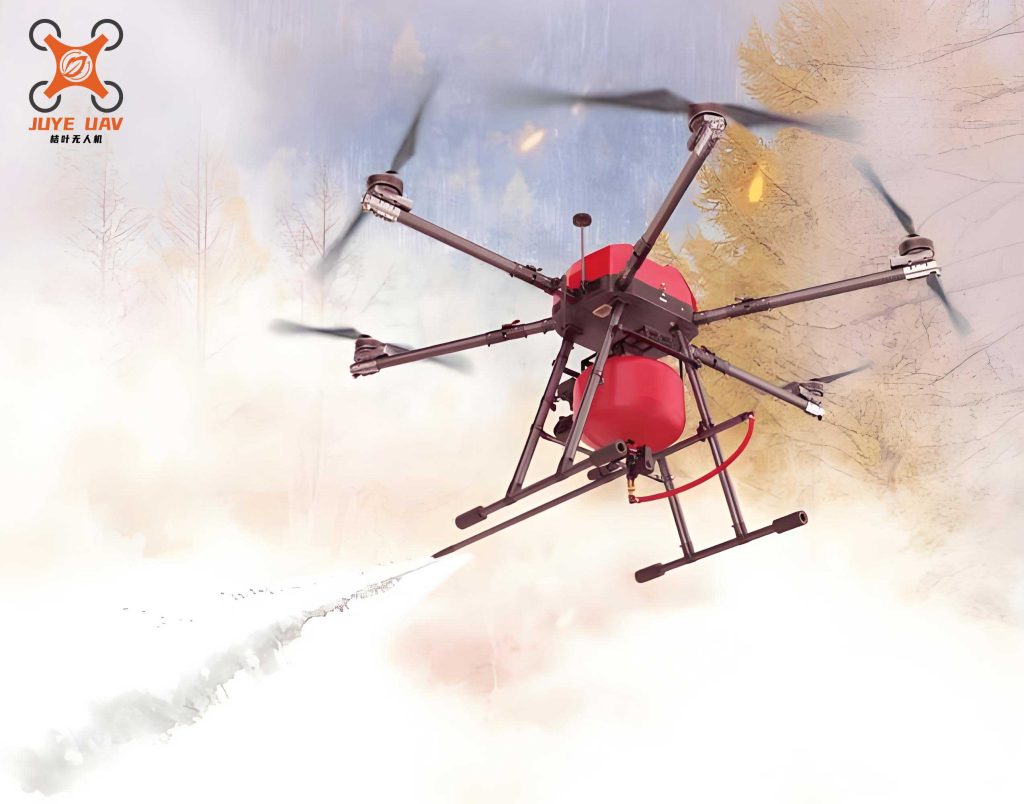
In my review of UAV technology, I define a fire UAV as an unmanned aerial vehicle that does not carry operators, uses aerodynamic forces for lift, can fly autonomously or via remote guidance, is reusable, and carries various payloads for firefighting purposes. Based on takeoff, landing, and flight modes, I categorize fire UAVs into fixed-wing, multi-rotor, vertical takeoff and landing (VTOL), and unmanned helicopters. To summarize their characteristics, I present the following table:
| Fire UAV Type | Key Advantages | Typical Range/Endurance | Primary Applications in Forest Fire Suppression |
|---|---|---|---|
| Fixed-wing UAV | Long endurance, long range | 100–900 km or more | Long-distance火field reconnaissance, large-area patrol |
| Multi-rotor UAV | Portable, easy operation, quick deployment | 10–20 km radius, shorter endurance | Close-range火情 monitoring, high-risk tasks |
| VTOL UAV | Combines fixed-wing and multi-rotor benefits | Moderate range and endurance | Versatile operations in complex terrain |
| Unmanned Helicopter | Hovering capability, good maneuverability | 100–150 km radius | Regional patrol, detailed火point inspection |
In practice, some forested areas in China have begun experimenting with fire UAVs for防火 and灭火 work. For instance, in Northeast China, where护林 stations cover radii of 100–300 km, long-endurance fire UAVs with satellite relay capabilities are used for extensive patrols. Since 2014, pilot programs by forestry authorities have tested fire UAVs in various护林 stations. Forest firefighting teams are already deploying fire UAVs for communication, command, and火field勘察, enabling tracking of火line dynamics and even direct灭火 via灭火弹 drops.
Turning to Tibet’s forest fire characteristics, I note that Tibet is an autonomous region integrating mountainous, pastoral, border, ethnic, religious, and economically underdeveloped areas. With an average altitude over 4,000 meters, forest coverage is 11.91%, primarily原始林. The火behavior here exhibits distinct features due to the plateau environment. I summarize the key aspects in the table below:
| Aspect | Characteristics in Tibet |
|---|---|
| 火源 | 90.6% human-caused, often near villages and roads |
| Temporal Distribution | Fire season from November to May, with dry, windy conditions |
| Spatial Distribution | Forests concentrated in eastern, southern, and southeastern Tibet |
| 火Behavior | Non-closed火fields, discontinuous vegetation, lateral spread,飞火, diurnal patterns |
Specifically, I observe that火fields in Tibet are often non-closed due to discontinuous vegetation with裸露 rocks and cliffs, forming scattered火points and断续火lines.火spread tends to focus on the flanks, as山顶 areas may have snow cover and山脚 have natural barriers.飞火 is common due to terrain and火field microclimates, leading to new火points. Diurnally,火behavior is calmer in mornings and nights, but intensifies in afternoons with wind gusts, causing crown火s and even火爆.
In discussing the feasibility of using fire UAVs for高原 forest fire suppression, I first acknowledge the challenges in高原灭火 operations: difficulty in approaching火lines due to terrain and altitude; limited灭火手段; short operational windows (mainly stable mornings); arduous火line清理; and logistical hurdles in supplying gear and provisions. Fire UAVs offer notable advantages: they are less affected by地形, can access hazardous areas with reduced risk, respond quickly to初发火, perform multiple functions (e.g., reconnaissance,物资投送), and are portable for跨区域 deployment. However, I must address current shortcomings of fire UAVs: limited payload and endurance, which degrade further at high altitudes due to lower air density; signal transmission issues in mountainous terrain; and imprecise灭火手段 with单一灭火剂. To quantify payload and endurance, I propose a basic formula for fire UAV performance:
$$ \text{Endurance} = \frac{E_{\text{battery}}}{\eta \cdot (P_{\text{lift}} + P_{\text{aux}})} $$
where \(E_{\text{battery}}\) is the battery energy, \(\eta\) is efficiency, \(P_{\text{lift}}\) is power for lift, and \(P_{\text{aux}}\) is auxiliary power. At高原, air density \(\rho\) decreases, affecting lift power: \(P_{\text{lift}} \propto \frac{1}{\rho}\). Thus, endurance and payload capacity diminish, which must be accounted for in fire UAV design for Tibet.
Regarding applicability, I explore various roles for fire UAVs in扑救高原森林火灾. For communication and image transmission, fire UAVs can provide aerial火field overviews and real-time video to aid指挥决策. For direct灭火, fire UAVs can tackle中低强度火lines,孤立火points, and悬崖火s by精准喷洒灭火剂. For火势 control, they can perform湿化作业 to slow spread. For logistics, they can transport supplies like water, food, and equipment. I envision fire UAVs as versatile tools that complement human teams, especially in inaccessible zones. To illustrate灭火剂 usage, consider a formula for灭火剂 requirement per火point:
$$ M_{\text{agent}} = A_{\text{fire}} \times d_{\text{rate}} \times t_{\text{extinguish}} $$
where \(M_{\text{agent}}\) is灭火剂 mass, \(A_{\text{fire}}\) is火area, \(d_{\text{rate}}\) is application rate, and \(t_{\text{extinguish}}\) is time to extinguish. Fire UAVs must carry sufficient \(M_{\text{agent}}\) for effective扑打.
In technical探讨, I detail desired specifications for森林灭火 fire UAVs. Based on operational needs, I propose key parameters, summarized in the table below:
| Parameter | Requirement (at 3,000 m altitude) |
|---|---|
| Payload Capacity | ≥30 kg灭火剂, max ≥50 kg |
| Endurance | ≥30 minutes under full load |
| 灭火Method | 机载泵压喷洒, water-based foam, non-pressurized tanks |
| Data Link Range | ≥5 km with 360° coverage |
| Wind Resistance | Operate in 5-level winds, safe return in 6–7级 |
| Deployment Time | ≤5 minutes setup, ≤2 minutes reload |
| Targeting Accuracy | Error ≤10 m for灭火剂喷洒 |
For command control and communication, I suggest solutions like aerial relay platforms using a high-altitude fire UAV, satellite communication, or AI-based autonomous targeting.灭火方式 can vary: for isolated火points, direct喷洒; for spreading火lines,灭火弹 drops; for large火fields,人工增雨 or阻隔剂喷洒. To optimize fire UAV deployment, I model cluster operations with multiple fire UAVs working in sequence. The total灭火capacity \(C_{\text{total}}\) for a fire UAV swarm can be expressed as:
$$ C_{\text{total}} = \sum_{i=1}^{n} \left( \frac{M_{\text{agent},i}}{t_{\text{cycle},i}} \right) $$
where \(n\) is the number of fire UAVs, \(M_{\text{agent},i}\) is payload per trip, and \(t_{\text{cycle},i}\) is cycle time including flight and reload. This emphasizes the need for efficient fire UAV teams.
On unit construction, I contemplate forming dedicated fire UAV squads or teams to leverage swarm operations. A proposed structure includes: a reconnaissance group with fixed-wing and multi-rotor fire UAVs for火field assessment;扑打 groups with multiple multi-rotor fire UAVs for direct灭火; and a transport group with large multi-rotor fire UAVs for logistics. I outline a sample organization:
| Group | Personnel | Fire UAV Types and Quantity | Primary Role |
|---|---|---|---|
| Reconnaissance | 4–6 people | 2 fixed-wing, 2 multi-rotor/VTOL | 火field侦察, real-time transmission |
| 扑打 (per group) | 15–20 people | 12–18 multi-rotor fire UAVs | Direct灭火 operations |
| Transport | 8–10 people | 5–8 large multi-rotor fire UAVs | Supply delivery, equipment transport |
Training should involve professional institutions for certification, with ongoing drills. Vehicles like UAV transport trucks are needed for mobility. The integration of fire UAVs into existing firefighting frameworks requires careful planning, but I believe it will enhance overall efficacy.
In conclusion, my exploration underscores the transformative potential of fire UAVs in addressing Tibet’s unique forest fire challenges. By leveraging their versatility, safety, and adaptability, fire UAVs can extend operational windows, access perilous areas, and provide critical support. However, technical hurdles in payload, endurance, and communication must be overcome through tailored design and swarm tactics. I recommend continued research into高原-optimized fire UAVs, robust command systems, and comprehensive unit training. As fire UAV technology evolves, I anticipate broader adoption not only in Tibet but globally, paving the way for smarter, safer forest fire management. The fire UAV represents a pivotal innovation in modern firefighting, and its integration into高原 strategies will undoubtedly yield significant benefits for ecosystem preservation and human safety.
To further illustrate technical aspects, I present a formula for calculating the required number of fire UAVs for a given火field. Suppose a火field has multiple火points with total area \(A_{\text{total}}\). Each fire UAV can cover area \(A_{\text{UAV}}\) per sortie with灭火剂 density \(\rho_{\text{agent}}\). The number of sorties needed is:
$$ N_{\text{sorties}} = \frac{A_{\text{total}} \cdot \rho_{\text{agent}}}{M_{\text{agent}}} $$
If each fire UAV conducts \(k\) sorties per hour, the required fire UAVs \(N_{\text{UAV}}\) is:
$$ N_{\text{UAV}} = \frac{N_{\text{sorties}}}{k \cdot t_{\text{operation}}} $$
where \(t_{\text{operation}}\) is operational duration. This model helps in planning fire UAV deployments. Additionally, for communication reliability in mountains, signal strength \(S\) can be modeled as:
$$ S = P_t \cdot G_t \cdot G_r \cdot \left( \frac{\lambda}{4\pi d} \right)^2 \cdot L $$
where \(P_t\) is transmit power, \(G_t\) and \(G_r\) are antenna gains, \(\lambda\) is wavelength, \(d\) is distance, and \(L\) is loss factor due to obstacles. Fire UAVs may need repeaters to maintain \(S\) above threshold.
In summary, the fire UAV is a cornerstone of future高原 forest fire suppression. Through iterative design, strategic deployment, and continuous refinement, fire UAVs will become indispensable assets, reducing risks and enhancing effectiveness in one of the world’s most challenging environments.