
In recent years, the rapid advancement of drone technology has ushered in a new era of aerial threats, with drone clusters emerging as a pivotal challenge for modern air defense systems. As a researcher focused on counter-unmanned aerial systems (C-UAS), I have observed that drone clusters represent a paradigm shift in warfare, combining scalability, intelligence, and information integration to overwhelm traditional defenses. Incidents such as the attacks on military bases, though not detailed here, underscore the reality that drone clusters have transitioned from conceptual models to operational threats, necessitating robust anti-drone strategies. This study delves into the characteristics, key technologies, and limitations of current defense systems, while proposing comprehensive methods for anti-drone cluster operations. The term “anti-drone” will be emphasized throughout, reflecting the critical need for targeted countermeasures against these evolving threats.
The proliferation of drone clusters is driven by their ability to execute coordinated attacks at low cost, leveraging artificial intelligence and swarm behaviors. From a defensive perspective, understanding these clusters is essential for developing effective anti-drone capabilities. In this analysis, we explore how drone clusters exploit vulnerabilities in existing air defense infrastructures and how innovative anti-drone systems can mitigate these risks. By integrating tables and mathematical models, we aim to provide a structured overview of the anti-drone landscape, emphasizing the importance of multi-layered defenses and adaptive tactics.
Characteristics of Drone Clusters
Drone clusters exhibit distinct features that enhance their operational effectiveness and complicate anti-drone efforts. These characteristics can be categorized into scalability, intelligence, and informationization, each contributing to the cluster’s resilience and threat potential.
Scalability Features
Scalability refers to the ability of drone clusters to deploy in large numbers, achieving saturation attacks that overwhelm defense systems. This feature is central to anti-drone challenges, as it directly impacts resource allocation and engagement strategies. The scalability can be expressed through a cost-benefit model: $$C_{cluster} = N \cdot c_d$$ where \(C_{cluster}\) is the total cost of the drone cluster, \(N\) is the number of drones, and \(c_d\) is the unit cost per drone. For anti-drone systems, the cost of interception, \(C_{intercept}\), often exceeds \(C_{cluster}\), highlighting the economic asymmetry. A comparative table illustrates this:
| Component | Average Cost (USD) | Anti-Drone Implication |
|---|---|---|
| Small Drone (e.g., quadcopter) | 1,500 – 10,000 | Low-cost saturation requires high-volume anti-drone fire. |
| Anti-Drone Missile (e.g., air-to-air) | 500,000 – 2,000,000 | High cost per engagement necessitates efficient targeting. |
| Drone Cluster of 100 units | 150,000 – 1,000,000 | Can drain missile inventories, emphasizing need for scalable anti-drone solutions. |
Scalability also enables distributed lethality, where drones coordinate to attack from multiple vectors, increasing the complexity for anti-drone sensors and weapons. From an anti-drone perspective, this requires systems capable of handling high target densities, such as network-centric defenses or area-denial weapons.
Intelligence Features
Intelligence in drone clusters manifests through decentralized control, autonomy, and self-organization, reducing vulnerabilities to single-point failures. These features pose significant hurdles for anti-drone operations, as traditional methods that target central command nodes are less effective. The intelligence can be modeled using swarm algorithms, such as the boids model: $$\vec{v}_i(t+1) = \vec{v}_i(t) + \alpha \sum_{j \neq i} \vec{f}_{ij} + \beta \vec{g}_i$$ where \(\vec{v}_i\) is the velocity of drone \(i\), \(\vec{f}_{ij}\) represents interaction forces (e.g., cohesion, separation), and \(\vec{g}_i\) is a goal-directed force. This autonomy complicates anti-drone tracking, as clusters can adaptively evade threats.
Key intelligence aspects include:
- Decentralization: No single leader, enhancing resilience against anti-drone strikes.
- Autonomy: Pre-programmed or real-time adaptive flight paths, reducing reliance on external control and making anti-drone jamming harder.
- Self-organization: Rapid reformation after disruptions, requiring continuous anti-drone engagement.
For anti-drone systems, this necessitates AI-driven countermeasures that can predict and disrupt swarm behaviors, rather than merely targeting individual units.
Informationization Features
Informationization involves the seamless exchange of data within the cluster and with external assets, enabling coordinated missions. This reliance on communication networks presents both a strength and a vulnerability for anti-drone strategies. The information flow can be quantified by the data rate, \(R\), required for coordination: $$R = \sum_{i=1}^{N} B_i \log_2(1 + \text{SNR}_i)$$ where \(B_i\) is the bandwidth and \(\text{SNR}_i\) is the signal-to-noise ratio for drone \(i\). High \(R\) values indicate robust communication but also create opportunities for anti-drone electronic warfare.
Informationization encompasses command-and-control links, navigation data, and sensor sharing, all critical for cluster cohesion. Anti-drone efforts can exploit this by targeting these links with jamming or spoofing, as discussed later. A table summarizes the informationization challenges:
| Aspect | Description | Anti-Drone Opportunity |
|---|---|---|
| Command Control | Real-time instructions from ground stations | Jamming or hacking the control signals |
| Intra-Cluster Communication | Data exchange between drones for coordination | Disrupting mesh networks with anti-drone EW |
| Sensor Fusion | Shared targeting and environmental data | Deception with false signals or clutter |
Effective anti-drone operations must therefore integrate cyber-electronic capabilities to degrade this information layer, thereby neutralizing the cluster’s synergistic advantages.
Key Technologies and Analysis of Drone Clusters
Drone clusters leverage several advanced technologies that enhance their capabilities and, conversely, inform anti-drone development. Understanding these technologies is crucial for designing effective countermeasures.
Data Link Transmission and Anti-Jamming Technology
Data links are the lifeline of drone clusters, facilitating real-time communication and control. However, they are susceptible to anti-drone electronic attacks. The performance of a data link under jamming can be modeled using the bit error rate (BER): $$\text{BER} = Q\left(\sqrt{\frac{2E_b}{N_0 + J_0}}\right)$$ where \(E_b\) is energy per bit, \(N_0\) is noise power spectral density, and \(J_0\) is jamming power spectral density. Anti-drone jamming aims to increase \(J_0\), thereby degrading BER and disrupting operations.
Drone clusters employ anti-jamming techniques such as frequency hopping, spread spectrum, and adaptive beamforming to mitigate these threats. For anti-drone systems, this requires sophisticated jammers that can dynamically track and overwhelm these defenses. A comparative analysis of anti-jamming methods:
| Technology | Drone Cluster Use | Anti-Drone Countermeasure |
|---|---|---|
| Frequency Hopping | Rapidly switches frequencies to avoid jamming | Wideband jamming or predictive hopping pattern detection |
| Direct Sequence Spread Spectrum | Spreads signal over wide bandwidth | High-power barrage jamming or correlation attacks |
| MIMO Beamforming | Directs signals toward intended receivers | Spatial nulling or drone localization for targeted jamming |
From an anti-drone perspective, investing in multi-mode jammers and AI-based signal analysis is essential to counter these adaptive technologies.
Low, Slow, Small and Stealth Technology
Drones in clusters often exhibit low radar cross-section (RCS), slow speeds, and small sizes, making detection and tracking difficult for traditional anti-drone sensors. The RCS, \(\sigma\), for a small drone can be approximated as: $$\sigma = \frac{4\pi A^2}{\lambda^2}$$ where \(A\) is the effective area and \(\lambda\) is the radar wavelength. Low \(\sigma\) values reduce detection ranges, complicating anti-drone early warning.
Stealth technologies, such as radar-absorbent materials and shape design, further diminish detectability. Anti-drone systems must therefore integrate multi-spectral sensors (e.g., radar, infrared, acoustic) to overcome these limitations. The probability of detection, \(P_d\), for a low-slow-small (LSS) target can be expressed as: $$P_d = 1 – \exp\left(-\frac{\text{SNR} \cdot T}{D}\right)$$ where \(T\) is integration time and \(D\) is a detectability factor. Anti-drone radars need high SNR and long \(T\) to improve \(P_d\), but this trades off with response time.
In practice, anti-drone networks combine complementary sensors: radars for long-range cueing, electro-optical/infrared (EO/IR) for confirmation, and acoustic arrays for close-in tracking. This multi-layer approach is critical for effective anti-drone operations against stealthy clusters.
Distributed Mission and Coordination Technology
Distributed coordination allows drone clusters to execute complex tasks, such as surveillance or attack, through synchronized behaviors. This technology relies on algorithms like consensus protocols or flocking rules, which can be disrupted by anti-drone measures. The coordination efficiency, \(E\), can be modeled as: $$E = \frac{1}{N} \sum_{i=1}^{N} \frac{T_{success,i}}{T_{total}}$$ where \(T_{success,i}\) is the time drone \(i\) contributes to the mission and \(T_{total}\) is the total mission time. Anti-drone actions aim to reduce \(E\) by introducing delays or failures.
Key coordination methods include:
- Role Allocation: Drones assign tasks dynamically; anti-drone systems can target key roles (e.g., leaders or relays).
- Formation Control: Maintains geometric patterns; anti-drone jamming can cause collisions or dispersion.
- Collaborative Sensing: Fuses data from multiple drones; anti-drone deception can inject false data.
For anti-drone strategies, exploiting these coordination mechanisms offers a force multiplier, as disrupting one aspect can cascade through the cluster. Developing autonomous anti-drone agents that can interfere with coordination algorithms is a promising direction.
Multi-Platform Launch and Control Technology
Drone clusters can be launched from various platforms—ground vehicles, ships, aircraft, or submarines—increasing their operational flexibility and complicating anti-drone preemption. The launch probability, \(P_{launch}\), from a platform type \(k\) is: $$P_{launch}(k) = \frac{N_{launch,k}}{N_{total,k}}$$ where \(N_{launch,k}\) is the number of successful launches and \(N_{total,k}\) is the total attempts. Anti-drone efforts must account for all \(k\) to defend against multi-vector threats.
Control stations, whether mobile or fixed, provide command functions, but they emit signals that can be exploited for anti-drone targeting. The vulnerability of control links can be assessed via the link margin, \(M\): $$M = P_t – L + G_r – P_{min}$$ where \(P_t\) is transmit power, \(L\) is path loss, \(G_r\) is receiver gain, and \(P_{min}\) is the minimum required power. Anti-drone systems can reduce \(M\) through jamming or locate control stations by triangulating signals.
A summary of multi-platform aspects:
| Platform | Advantage for Drones | Anti-Drone Counter |
|---|---|---|
| Airborne (e.g., transport aircraft) | Rapid deployment over long ranges | Airborne early warning and interceptor aircraft for anti-drone patrols |
| Maritime (e.g., ships) | Covert launch from sea | Naval anti-drone systems with radar and decoys |
| Ground (e.g., trucks) | High mobility and concealment | Preemptive strikes on launch sites using anti-drone missiles |
Integrating anti-drone defenses across domains is essential to counter this multi-platform threat, emphasizing the need for joint operations and intelligence sharing.
Analysis of Anti-Drone Cluster Operations
Effective anti-drone operations require a thorough understanding of both existing defensive systems and emerging technologies. This analysis evaluates their capabilities and limitations in countering drone clusters, with a focus on anti-drone efficacy.
Analysis of Existing Air Defense Systems
Traditional air defense systems, designed for larger, faster threats, often struggle against drone clusters due to detection, tracking, and engagement challenges. The performance of an anti-drone system can be quantified by the kill probability, \(P_k\), against a cluster: $$P_k = 1 – \prod_{i=1}^{N} (1 – p_{k,i})$$ where \(p_{k,i}\) is the kill probability against drone \(i\). For clusters with large \(N\), \(P_k\) decreases rapidly unless \(p_{k,i}\) is very high, highlighting the scalability issue.
Existing systems include:
- Long-Range Air Defense (e.g., Patriot, S-400): Effective against high-altitude targets but have large low-altitude blind zones and high cost per engagement, making them inefficient for anti-drone use against low-cost clusters.
- Short-Range Air Defense (e.g., Pantsir-S1): Better suited for low-altitude threats but limited by missile inventory and tracking stability against slow, small drones.
- Close-In Weapon Systems (e.g., Phalanx): High rate of fire but limited ammunition and range, struggling with swarms beyond immediate proximity.
A table compares these systems for anti-drone applications:
| System Type | Range (km) | Strengths for Anti-Drone | Weaknesses for Anti-Drone |
|---|---|---|---|
| Long-Range | >100 | High speed, large engagement zone | High cost, poor low-altitude coverage, overkill for small drones |
| Short-Range | 10-20 | Good against low-slow targets, modular | Limited ammunition, vulnerable to saturation |
| Close-In | <5 | Rapid engagement, automated tracking | Short endurance, ineffective against dispersed clusters |
From an anti-drone perspective, these systems often fail due to:
– Detection Difficulties: Low RCS and slow speed reduce radar performance.
– Tracking Instability: Erratic flight paths cause lock-on issues.
– Economic Imbalance: Expensive missiles versus cheap drones, undermining sustainability.
Therefore, augmenting existing defenses with dedicated anti-drone technologies is crucial.
Analysis of New Anti-Drone Systems
Emerging technologies, such as directed-energy weapons and advanced sensors, offer promising avenues for anti-drone operations. These systems address some limitations of traditional defenses but introduce new challenges.
Laser Weapon Systems: Lasers provide precision engagement with low cost per shot, ideal for anti-drone use. The laser power required to disable a drone, \(P_{req}\), can be estimated as: $$P_{req} = \frac{E_{threshold}}{\eta \cdot t_{dwell}}$$ where \(E_{threshold}\) is the energy needed for damage, \(\eta\) is atmospheric transmission efficiency, and \(t_{dwell}\) is the dwell time. However, lasers are sequential engagement weapons, limiting their rate against clusters. Cooling and recharge times further reduce availability, necessitating multiple units for continuous anti-drone coverage.
High-Power Microwave (HPM) Systems: HPM weapons deliver wide-area effects, capable of disabling multiple drones simultaneously through electromagnetic pulse. The effectiveness depends on the field strength, \(E\), at the target: $$E = \frac{\sqrt{30 P_t G_t}}{d}$$ where \(P_t\) is transmit power, \(G_t\) is antenna gain, and \(d\) is distance. HPM systems excel against dense clusters but have short ranges and may cause collateral damage. Integrating them into layered anti-drone networks can enhance area denial.
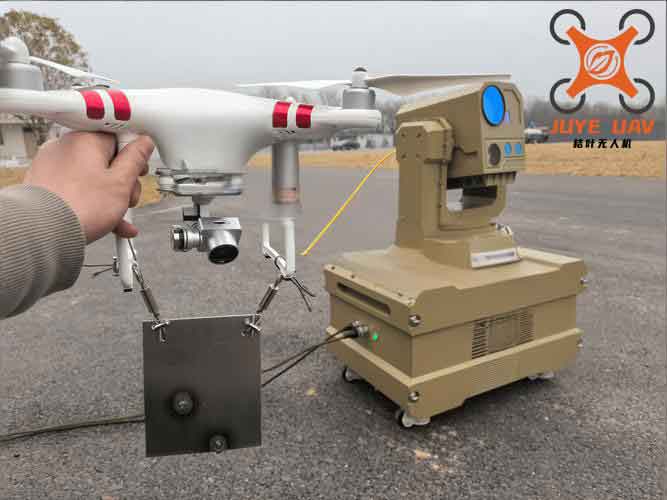
Enhanced Detection Systems: Specialized sensors for low-slow-small targets combine radar, EO/IR, and acoustic technologies. The fusion of sensor data improves detection probability, \(P_{d,fused}\), as: $$P_{d,fused} = 1 – \prod_{s=1}^{S} (1 – P_{d,s})$$ where \(P_{d,s}\) is the detection probability from sensor \(s\). These systems reduce false alarms and extend warning times, but they are weather-dependent and require extensive calibration for anti-drone applications.
A comparative analysis:
| System | Engagement Method | Anti-Drone Advantages | Anti-Drone Limitations |
|---|---|---|---|
| Laser | Directed energy, thermal damage | High precision, low cost per shot, silent | Line-of-sight only, sequential firing, atmospheric attenuation |
| HPM | Electromagnetic pulse, area effect | Simultaneous multi-target engagement, fast | Short range, potential collateral damage, power-intensive |
| Multi-Sensor Detection | Fused radar, EO/IR, acoustic | Improved detection of stealthy drones, all-weather potential | High cost, integration complexity, false positives |
For comprehensive anti-drone operations, these new systems should be deployed in concert, leveraging their strengths to cover each other’s weaknesses. For instance, lasers can pick off individual drones after HPM softens the cluster, while advanced sensors provide targeting data.
Comprehensive Anti-Drone Cluster Warfare Methods
To effectively counter drone clusters, a holistic approach integrating multiple tactics and technologies is essential. These methods focus on preemption, disruption, and layered defense, all centered on anti-drone objectives.
System Strike Against Platforms
Targeting the launch and control platforms of drone clusters is a proactive anti-drone strategy that neutralizes threats before they fully deploy. This method reduces the burden on point defenses and exploits the vulnerability of centralized assets. The expected utility, \(U\), of such strikes can be modeled as: $$U = P_{hit} \cdot (1 – P_{surv}) \cdot V_{target}$$ where \(P_{hit}\) is the probability of hitting the platform, \(P_{surv}\) is the survival probability of drones post-strike, and \(V_{target}\) is the value of the target. High \(U\) values justify preemptive anti-drone actions.
Key tactics include:
- Preemptive Destruction: Using missiles or airstrikes against identified launch sites, such as trucks or ships, based on intelligence. This requires real-time ISR (intelligence, surveillance, reconnaissance) for anti-drone targeting.
- Neutralizing Control Stations: Locating and jamming or destroying ground control stations, which emit detectable signals. Anti-drone electronic warfare units can triangulate these emissions for precise strikes.
- Attacking Relay Nodes: If drones use airborne relays (e.g., other aircraft), engaging them disrupts communication, serving as an anti-drone force multiplier.
This method aligns with the anti-drone principle of attacking the “head” rather than the “swarm,” but it depends on accurate intelligence and may escalate conflicts. Therefore, it should be part of a broader anti-drone campaign.
Precision Functional Disruption Against Missions
Instead of destroying every drone, anti-drone efforts can focus on degrading specific functions critical to the cluster’s mission. This precision approach conserves resources and complicates adversary recovery. The effectiveness, \(E_{disrupt}\), of functional disruption is: $$E_{disrupt} = \sum_{f=1}^{F} w_f \cdot D_f$$ where \(w_f\) is the weight of function \(f\) (e.g., sensing, weapon release) and \(D_f\) is the degradation level (0 to 1). Anti-drone systems aim to maximize \(E_{disrupt}\) by targeting high-\(w_f\) functions.
Examples include:
- Optical Disruption: Using lasers to dazzle or blind drone cameras and sensors, rendering them ineffective for reconnaissance or targeting. This is a non-lethal anti-drone measure suitable for sensitive areas.
- Payload Neutralization: For armed drones, jamming weapon release signals or spoofing guidance systems prevents attacks, a key anti-drone tactic for force protection.
- Mission Confusion: Injecting false data into drone networks to cause navigation errors or abort missions, leveraging cyber anti-drone capabilities.
This method requires detailed knowledge of drone capabilities and mission profiles, emphasizing the need for anti-drone intelligence gathering and adaptive countermeasures.
Jamming, Suppression, and Deception Against Information Links
Exploiting the information dependence of drone clusters is a cornerstone of anti-drone electronic warfare. By disrupting communication and navigation links, defenses can decouple the swarm, reducing its coordination advantage. The jamming effectiveness, \(J_{eff}\), can be expressed as: $$J_{eff} = \frac{P_j / P_s}{B_j / B_s} \cdot L_{path}$$ where \(P_j\) is jamming power, \(P_s\) is signal power, \(B_j\) is jammer bandwidth, \(B_s\) is signal bandwidth, and \(L_{path}\) is path loss factor. High \(J_{eff}\) values indicate successful anti-drone jamming.
Techniques include:
- Barrage Jamming: Flooding frequency bands with noise to overwhelm signals, a broad anti-drone approach that may affect friendly systems.
- Spoofing: Transmitting false GPS or control signals to take over drones or lead them astray, a precise anti-drone method that requires signal mimicry.
- Decoy Deployment: Launching infrared or radar decoys to distract drone sensors, creating confusion and diverting attacks—a classic anti-drone deception tactic.
Integrating these methods into a coordinated electronic attack plan enhances anti-drone resilience, especially when combined with kinetic strikes. A table outlines electronic warfare options:
| Technique | Mechanism | Anti-Drone Benefit | Risk |
|---|---|---|---|
| Jamming | Noise interference on communication bands | Disrupts coordination, low cost | May jam friendly comms, detectable |
| Spoofing | False signal injection for control or navigation | Can capture or misdirect drones | Requires precise signal knowledge |
| Deception | Decoys to simulate targets or environments | Diverts attacks, protects high-value assets | Limited duration, may be discerned |
Effective anti-drone electronic warfare demands spectrum dominance and rapid adaptability to counter evolving drone technologies.
Multi-Layer Coordinated Defense with New Equipment
A layered defense integrates multiple anti-drone systems across ranges and domains to create a resilient shield against clusters. This approach, often termed “defense in depth,” ensures that drones face successive barriers, increasing the overall kill probability. The overall system effectiveness, \(E_{system}\), can be modeled as: $$E_{system} = 1 – \prod_{l=1}^{L} (1 – E_l)$$ where \(E_l\) is the effectiveness of layer \(l\) (e.g., detection, interception). For anti-drone operations, maximizing \(E_{system}\) involves optimizing layer synergy.
Layers typically include:
- Long-Range Detection: Using airborne early warning radar or satellite surveillance to identify clusters early, enabling preemptive anti-drone strikes.
- Mid-Range Engagement: Deploying mobile anti-drone systems like laser or HPM weapons to engage clusters before they reach critical areas.
- Short-Range Point Defense: Employing guns, nets, or missiles for last-ditch protection, often automated for rapid response.
- Cyber-Electronic Layer: Continuous jamming and hacking to degrade drone functionality throughout the engagement.
Coordination is facilitated by a common operational picture (COP) that fuses data from all sensors, allowing real-time anti-drone decision-making. Investing in interoperable systems and AI-driven command and control enhances this coordination, making anti-drone defenses more agile and effective.
Conclusion
In conclusion, drone clusters represent a formidable and evolving threat that demands innovative anti-drone solutions. Through this study, we have analyzed their characteristics—scalability, intelligence, and informationization—and the key technologies that enable them, from data links to stealth design. Our examination of existing and new anti-drone systems reveals limitations, such as cost imbalances and sequential engagement issues, but also opportunities with directed energy and multi-sensor fusion. The proposed comprehensive methods, including platform strikes, functional disruption, electronic warfare, and layered defense, offer a pathway to robust anti-drone cluster warfare. As drone technology advances, with trends toward greater autonomy and miniaturization, anti-drone research must accelerate, focusing on adaptive, cost-effective, and integrated systems. Ultimately, success in anti-drone operations will hinge on continuous innovation and multi-domain collaboration, ensuring that defenses stay ahead of these pervasive aerial threats.