
The proliferation of high-rise structures, while emblematic of urban progress, presents formidable challenges to firefighting and rescue operations. Their complex vertical topology, dense utility shafts, and high occupant density create a perfect storm during a fire incident. Flames and toxic smoke can propagate with alarming speed through elevator shafts and service conduits, rapidly obscuring egress routes and severely hindering both evacuation and fire suppression. Traditional methods often grapple with insufficient reach, limited situational awareness, and coordination inefficiencies at these extreme heights. In this context, the emergence and maturation of unmanned aerial systems offer a transformative solution. I believe that fire drones, with their unique capabilities for rapid deployment, overhead perspective, and versatile payload integration, are poised to fundamentally reshape high-rise fire rescue paradigms. Their intrinsic ability to access hazardous zones and execute complex tasks aligns perfectly with the demands of these scenarios. Therefore, a deep dive into their application logic, inherent limitations, and optimization pathways is not merely an academic exercise but a critical undertaking with significant practical implications for enhancing operational efficiency and reducing life and property loss.
My analysis begins with the core operational arenas where fire drones deliver immediate value. The initial and perhaps most crucial role is in fire reconnaissance and situational awareness. The accuracy of initial intelligence directly dictates the scientific rigor of subsequent rescue decisions. In high-rise fires, conventional ground-level observation is severely hampered by smoke and structural obstructions. A fire drone equipped with a multi-sensor payload, typically comprising high-definition visible light cameras and infrared (IR) thermal imagers, enables a comprehensive, three-dimensional assessment. It can quickly ascend to provide an aerial overview, identifying the fire’s epicenter, direction of spread, and intensity. The IR camera’s ability to penetrate smoke is a game-changer, allowing it to detect hidden hot spots and smoldering fires that pose a re-ignition risk. For search and rescue, the thermal signature of a human body stands out against the ambient chaos, enabling precise localization of trapped individuals even through dense smoke, while visual cameras can assess their condition. I foresee the integration of AI algorithms for real-time data processing as a pivotal advancement. Such systems can automatically map fire spread dynamics, predict progression trends using models, and provide data-driven support for pre-positioning resources and planning evacuations. The comparative effectiveness of different reconnaissance modes can be summarized as follows:
| Reconnaissance Mode | Advantages | Limitations in High-Rise Context | Role of Fire Drone |
|---|---|---|---|
| Ground-Based Observation | Direct human assessment, tactile feedback. | Severely limited field of view, blocked by structure and smoke, dangerous for personnel. | N/A (Replaced/ Augmented) |
| Aerial (Manned Helicopter) | High payload capacity, long endurance. | Slow deployment, high cost, risk in turbulent thermal plumes, noise disrupts communication. | Complementary; drone handles closer, riskier inspection. |
| Fire Drone (Visible Light) | Rapid deployment, overhead view, real-time video. | Impaired by heavy smoke, requires lighting at night. | Primary visual mapper and documentation tool. |
| Fire Drone (Thermal Imaging) | Sees through smoke, detects heat sources, day/night operation. | Lower image resolution, can be confused by other heat sources. | Primary tool for life detection and hidden fire finding. |
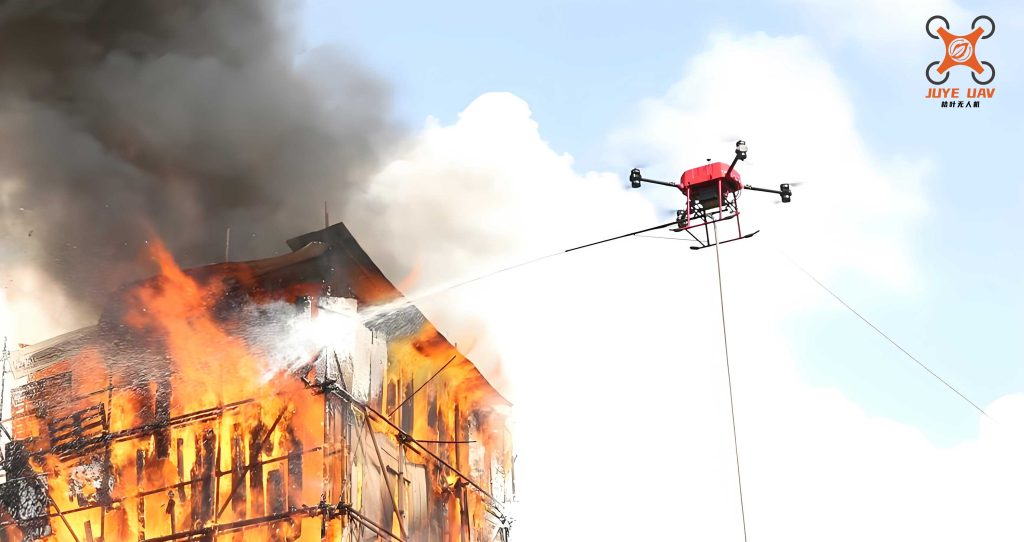
The second core application is the execution of precise fire suppression tasks. This addresses the critical reach limitation of ground-based streams. Through modular payload design, fire drones enable novel tactical options. In the incipient stage, a fire drone equipped with a extinguisher ball or cartridge launcher can deliver dry chemical or retardant gel with pinpoint accuracy onto a localized fire. For larger interfaces, a coordinated swarm of fire drones can execute saturation attacks, creating a suppression blanket or a chemical firebreak to impede lateral spread. A particularly innovative application involves drones fitted with controlled glass-breaking devices. They can safely fracture windows from a distance, creating an entry point for suppression agents—a task perilous for firefighters rappelling down facades. The most promising development for sustained attack is the tethered fire drone. By receiving continuous power and, in some designs, a firefighting agent supply via a hose from a ground vehicle, it overcomes the primary endurance and payload constraints. It can maintain a stationary position for prolonged periods, applying water or foam directly to a high-floor fire. The effectiveness of such an operation can be modeled by considering the flow rate and energy transfer. The theoretical heat absorption rate $Q_{extinguish}$ by a water stream from a tethered fire drone can be approximated by:
$$Q_{extinguish} = \dot{m} \cdot [c_p \cdot (T_{vap} – T_{init}) + h_{fg}]$$
where $\dot{m}$ is the mass flow rate of water, $c_p$ is the specific heat capacity of water, $T_{vap}$ is the vaporization temperature (≈100°C), $T_{init}$ is the initial water temperature, and $h_{fg}$ is the latent heat of vaporization. This highlights the direct relationship between agent delivery rate (a function of drone payload and tether design) and fire suppression power.
The third vital role is in providing resilient communication relay and coordination support. Fires often degrade or destroy existing cellular and radio infrastructure within a building. A fire drone acting as an airborne communication node can restore connectivity. Hovering at an optimal altitude, it can extend the range of ground-based networks, ensuring seamless communication between the incident command post and interior teams. Furthermore, the fire drone serves as a data fusion hub. It can integrate its own sensory data (video, thermal, telemetry) with inputs from ground robots, fire apparatus, and wearable sensors on firefighters. This aggregated data stream, transmitted via 5G or a dedicated mesh network, furnishes the command center with a Common Operational Picture (COP), enabling dynamic resource allocation and strategy adjustment. This facilitates true “air-ground integration,” where the fire drone guides a ground robot to clear debris or provides a live feed to optimize the angle of an aerial ladder.
Despite their transformative potential, the integration of fire drones into high-rise firefighting is constrained by several significant bottlenecks. The most fundamental limitations are physical: payload capacity and endurance. The useful payload $P_{useful}$ of a multirotor fire drone is a fraction of its total lift capacity $L_{total}$, as it must account for the weight of the airframe $W_{frame}$, avionics $W_{avionics}$, and the power system $W_{power}$:
$$P_{useful} = L_{total} – (W_{frame} + W_{avionics} + W_{power})$$
For battery-powered systems, flight time $T_{flight}$ is severely limited by battery energy density $E_{density}$ and the power demand $P_{demand}$ of both flight and payload systems: $T_{flight} \propto E_{density} / P_{demand}$. This equation starkly illustrates the trade-off: carrying a heavier suppression payload (increasing $P_{demand}) drastically reduces operational time. While tethered systems solve the energy problem, they trade mobility and operational radius for endurance. Environmental adaptation is another major hurdle. High temperatures can degrade battery and electronic performance, turbulent thermal updrafts and urban wind canyons challenge flight stability, and smoke particulates can coat sensors and lenses. The operational envelope of a standard fire drone is thus constrained.
| Bottleneck Category | Specific Challenges | Impact on Operations |
|---|---|---|
| Physical Performance | Limited Payload Capacity (5-20 kg typical) | Restricts amount of suppressant carried per sortie; necessitates frequent reloading or large swarms. |
| Short Battery Endurance (15-30 min typical) | Insufficient for prolonged missions; limits time on station for reconnaissance or suppression. | |
| Environmental Adaptation | High Temperature & Turbulence | Induces equipment failure, reduces battery life, and causes unstable flight requiring advanced flight control. |
| Smoke & Particulate Contamination | Obscures visual sensors, can clog moving parts, and degrades thermal sensor accuracy over time. | |
| System Integration | Lack of Standardized Data Interfaces | Creates data silos; impedes real-time fusion of drone data with command and control systems. |
| Absence of Unified Tactical Protocols | Leads to ad-hoc coordination between drone operators and ground crews, reducing overall efficiency and safety. |
Beyond hardware, systemic integration poses a critical challenge. I have observed that many fire drone systems operate as technological islands. The lack of standardized data protocols (e.g., for video streaming, telemetry, and sensor data) prevents seamless integration with existing Computer-Aided Dispatch (CAD) and Building Information Modeling (BIM) systems. Data often requires manual transcription, causing fatal delays. Tactically, the absence of standardized operating procedures (SOPs) for combined air-ground operations leads to miscommunication. For instance, a fire drone commencing a suppression run might not be synchronized with the activation of a ground-based supply pump, wasting the critical first seconds of agent delivery. Furthermore, the regulatory landscape for operating multiple fire drones, especially large or tethered ones, in congested urban airspace alongside other emergency aircraft remains complex and can hinder rapid deployment.
To elevate the fire drone from a promising tool to a core component of high-rise rescue doctrine, a multi-faceted optimization strategy is required. The first pillar is directed technological innovation. Research must focus on breaking the energy-density barrier through next-generation batteries (e.g., solid-state) and hybrid power systems. For tethered fire drones, developing lightweight, high-strength composite cables and automated tether management systems is key. Material science must yield airframes and components with higher thermal and chemical resistance. Sensor suites need active protection (e.g., blowers, wipers) and self-cleaning coatings. Crucially, onboard processing powered by AI must advance from simple object detection to predictive analytics, enabling real-time fire behavior modeling and autonomous threat assessment.
The second pillar is the creation of a unified operational ecosystem. This involves mandating open architecture standards for data communication (e.g., adapting MISB/STANAG protocols for public safety) to ensure plug-and-play interoperability between any fire drone and the incident command system. Joint tactical exercises must be institutionalized to develop and refine SOPs that define clear roles, communication phrases, and safety boundaries for drone operators working alongside ladder companies and rescue teams. A formal certification standard for “Fire Service UAS Operators” should be established, covering not only piloting skills but also fire dynamics, airspace management, and tactical integration. Regulatory frameworks need to be streamlined, potentially through pre-negotiated “temporary flight restriction” templates that can be activated instantly for major incidents.
The third pillar centers on human capital and risk management. Investing in comprehensive, scenario-based training programs is non-negotiable. Operators must be proficient in manual flight under degraded conditions (e.g., GPS-denied, high wind) but also in managing automated swarms and complex payloads. We must cultivate a new breed of “Drone Tactician” within the officer corps—leaders who understand the capabilities and limitations of fire drones and can weave them effectively into the incident action plan. On the risk side, drones must be equipped with robust health monitoring systems and redundant flight controllers. Detailed risk assessments for operations near crowds and critical infrastructure are mandatory, and insurance products tailored to public safety UAS operations need to be developed.
| Strategic Pillar | Key Actions | Expected Outcome |
|---|---|---|
| Technological Advancement | Develop high-energy-density power systems; Create AI-integrated smart payloads; Engineer for extreme environment tolerance. | Increased mission duration and payload mass; Autonomous “sense-and-respond” capabilities; Reliable operation in intense heat/smoke. |
| System Integration & Standards | Define open data & communication protocols; Establish joint fire-drone tactical SOPs; Create streamlined airspace coordination protocols. | Seamless data flow to command center; Safe, efficient air-ground team coordination; Rapid legal deployment in complex airspace. |
| Training & Risk Governance | Implement tiered operator certification programs; Develop “Drone Tactician” curriculum for officers; Integrate drones into regular multi-unit drills. | Highly skilled, specialized operators; Tactical leadership that leverages UAS effectively; Proven, safe interoperability in live incidents. |
In conclusion, the unique perils of high-rise firefighting demand a technological leap, and the fire drone is a catalyst for that leap. Its roles in multidimensional reconnaissance, precision suppression, and networked communication directly address the historic vulnerabilities of vertical firefighting. While current limitations in endurance, integration, and regulation are real, they are not insurmountable. I am convinced that through targeted R&D, systemic integration focused on interoperability, and profound investment in human expertise, the fire drone will evolve from an auxiliary asset to a central pillar of the modern fireground. The future lies in intelligent, interconnected swarms of fire drones operating as a cohesive layer within a broader “Air-Ground-Robot” rescue matrix, fundamentally enhancing our ability to protect life and property in the vertical urban landscape. The path forward requires sustained collaboration between firefighters, engineers, regulators, and data scientists to fully realize this potential.