
From my perspective as a researcher and practitioner in the field of unmanned systems, the integration of artificial intelligence and robotics has revolutionized crisis management, particularly during public health emergencies. The COVID-19 pandemic served as a stark test of global resilience, highlighting the urgent need for innovative technologies to safeguard human life and health. In this context, unmanned intelligent systems—comprising robots, drones, and other autonomous platforms—have emerged as indispensable tools, enabling efficient, contactless operations that mitigate infection risks and enhance operational efficacy. This article delves into the comprehensive applications of these systems, with a special emphasis on fire drones, which exemplify versatility in disaster response. Through detailed analysis, tables, and mathematical formulations, I will explore how these technologies are reshaping pandemic control strategies.
Unmanned intelligent systems are products of the convergence between artificial intelligence, robotics, and real-time control decision-making systems. They possess the capability to perform tasks independently in specific environments, replacing humans in hazardous, dirty, or monotonous duties, thereby reducing risks while boosting productivity. During the pandemic, various regions leveraged these systems to combat the virus, achieving remarkable results. The core advantage lies in their ability to operate without direct human intervention, which is crucial in containing infectious diseases. I have observed that these systems can be categorized broadly into intelligent robots, drones (including fire drones), and other auxiliary platforms, each serving distinct functions across multiple stages of prevention and control.
To systematically understand their applications, I have compiled a table summarizing the primary types of unmanned intelligent systems and their roles in pandemic response. This table highlights how fire drones, in particular, have been adapted for diverse tasks beyond their traditional firefighting roles.
| System Type | Key Functions | Examples in Pandemic | Advantages |
|---|---|---|---|
| Intelligent Robots | Delivery, disinfection, logistics | Meal-delivery robots, disinfecting robots | Reduces human exposure, operates continuously |
| Drones (Fire Drones) | Lighting, spraying, surveillance, transport | Illumination drones, disinfection drones | High mobility, rapid deployment, covers large areas |
| Other Systems | Remote consultation, aquatic operations | 5G telemedicine platforms, unmanned vessels | Enables remote expertise, handles unique environments |
Intelligent robots have been widely deployed in healthcare settings to alleviate the burden on medical staff. For instance, delivery robots transport meals and medications within hospitals, minimizing contact between healthcare workers and patients. These robots are equipped with advanced sensors and processors, allowing them to navigate complex environments autonomously. Disinfection robots, another critical category, utilize technologies such as ultraviolet light, hydrogen peroxide vapor, or plasma filtration to sterilize surfaces and air. Their efficiency can be modeled mathematically: the disinfection effectiveness E depends on the coverage area A, exposure time t, and pathogen kill rate k. A simplified formula is:
$$ E = k \cdot \int_{0}^{t} A(\tau) \, d\tau $$
where A(τ) represents the area covered over time. This ensures thorough decontamination while keeping personnel safe. Logistics robots, often used in warehouses, also played a role in transporting medical supplies, with payload capacities up to 200 kg. Their operational efficiency can be expressed as:
$$ \text{Throughput} = \frac{\text{Number of deliveries} \times \text{Payload weight}}{\text{Time}} $$
This highlights how robots enhance logistical chains during crises.
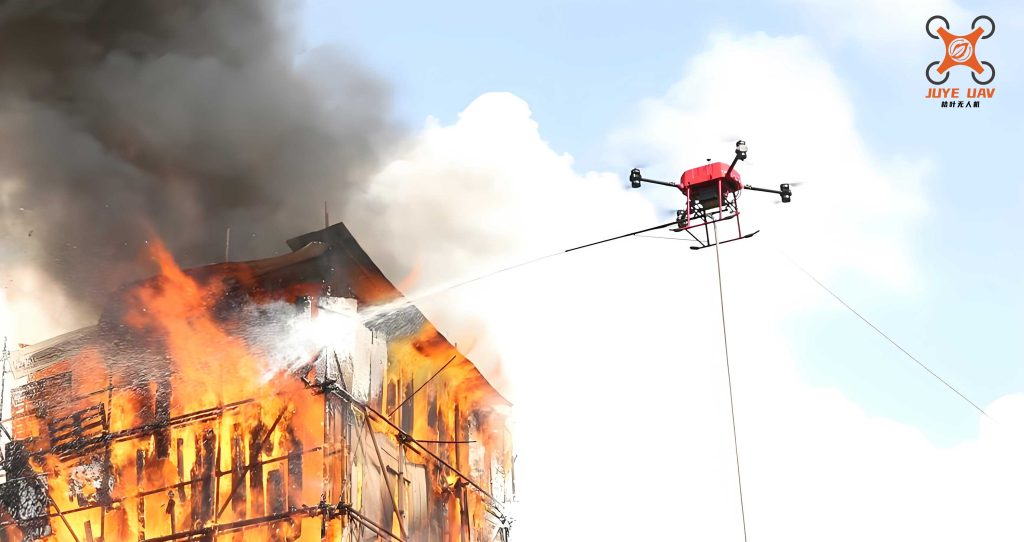
Drones, especially fire drones, have demonstrated extraordinary adaptability in pandemic control. Originally designed for firefighting and emergency response, fire drones have been repurposed for tasks such as illumination, disinfection, and surveillance. For example, illumination drones provided lighting for nighttime construction of temporary hospitals, covering areas up to 6000 square meters with energy consumption as low as 1 kWh per hour. Their effectiveness in lighting can be quantified using the illumination intensity formula:
$$ I = \frac{P \cdot \eta}{4\pi r^2} $$
where I is intensity, P is power, η is efficiency, and r is distance. This allows for optimal deployment in field settings. Disinfection drones, a subset of fire drones, spray disinfectants over public spaces, achieving higher coverage rates than ground-based methods. The spraying efficiency S can be calculated as:
$$ S = \frac{V \cdot \rho \cdot n}{t} $$
where V is liquid volume, ρ is spray density, n is number of passes, and t is time. These fire drones excel in reaching inaccessible areas, ensuring comprehensive sanitization. Surveillance drones equipped with loudspeakers broadcast public health messages, dispersing crowds and enforcing social distancing. The versatility of fire drones makes them a cornerstone of modern pandemic response, as they can be rapidly reconfigured for various missions.
Other unmanned intelligent systems have also contributed significantly. 5G-enabled remote consultation platforms facilitated telemedicine, allowing experts to diagnose patients from afar. The data transmission requirements for such platforms are substantial; for instance, a single CT image may be several gigabytes in size. The necessary bandwidth B can be derived from:
$$ B = \frac{D \cdot f}{\log_2(1 + \text{SNR})} $$
where D is data size, f is frame rate, and SNR is signal-to-noise ratio. This ensures high-fidelity remote诊疗. Unmanned vessels, like the “Dolphin 1” surface rescue robot, were adapted for contactless delivery of supplies to isolated ships, showcasing innovation in aquatic environments. These systems underscore the broad applicability of unmanned technologies.
To further elucidate the impact of fire drones, I present a table comparing different fire drone models and their pandemic-related functionalities. This emphasizes how fire drones have been optimized for specific tasks, from lighting to disinfection.
| Fire Drone Model | Primary Function | Key Parameters | Pandemic Application |
|---|---|---|---|
| Illumination Fire Drone | Lighting for construction | Coverage: 6000 m², Power: 1 kW | Nighttime hospital building |
| Disinfection Fire Drone | Spraying sanitizers | Capacity: 10 L, Rate: 5 L/min | Public space decontamination |
| Surveillance Fire Drone | Broadcasting and monitoring | Range: 500 m, Endurance: 30 min | Crowd control and awareness |
| Logistics Fire Drone | Transporting medical supplies | Payload: 5 kg, Speed: 50 km/h | Emergency物资 delivery |
The effectiveness of fire drones in pandemic response can be modeled through a multi-criteria efficiency index F, which integrates factors like deployment speed, coverage area, and risk reduction. Let v be deployment velocity, a be area covered, and r be risk mitigation factor (0 to 1). Then:
$$ F = \alpha \cdot v + \beta \cdot a + \gamma \cdot r $$
where α, β, γ are weighting coefficients based on task priorities. This formula helps optimize fire drone deployments for maximum impact. In practice, fire drones have proven essential across the three levels of pandemic prevention: primary (e.g., surveillance and education), secondary (e.g., early detection via thermal imaging), and tertiary (e.g., contactless delivery to infected individuals). For instance, in primary prevention, fire drones with loudspeakers disseminate information efficiently, reducing the need for ground personnel. The sound propagation can be described by:
$$ L_p = L_w – 20 \log_{10}(d) + 11 $$
where Lp is sound pressure level, Lw is sound power level, and d is distance. This ensures messages are audible over wide areas.
Looking ahead, the role of fire drones and other unmanned intelligent systems will only expand. Future advancements may include autonomous medical diagnosis robots and integrated AI platforms for real-time epidemic modeling. The scalability of these systems is crucial; for example, a fleet of fire drones can be coordinated using swarm algorithms, where the overall efficiency Eswarm scales with the number of drones N:
$$ E_{\text{swarm}} = N \cdot e^{-c \cdot N} $$
where c is a coordination constant, reflecting diminishing returns due to congestion. This highlights the need for strategic planning in large-scale deployments. Moreover, fire drones could be equipped with advanced sensors for early fire detection in quarantine facilities, adding another layer of safety. The integration of 5G technology will further enhance their capabilities, enabling ultra-reliable low-latency communications for critical operations.
In conclusion, unmanned intelligent systems, particularly fire drones, have proven to be transformative in pandemic response. From my experience, their ability to perform diverse tasks—whether lighting construction sites, disinfecting public areas, or transporting essentials—underscores their value in reducing human exposure and improving efficiency. The mathematical models and tables presented here illustrate their operational parameters and optimization strategies. As we navigate future health crises, investing in these technologies will be paramount for building resilient public health emergency management systems. Fire drones, with their adaptability and proven track record, should be at the forefront of such initiatives, ensuring that we are better prepared for whatever challenges lie ahead.
To encapsulate the broader implications, I have developed a final table summarizing the future trends and potential improvements for fire drones in disaster management. This serves as a roadmap for researchers and policymakers aiming to harness these systems for global health security.
| Future Trend | Description | Expected Impact on Fire Drones |
|---|---|---|
| AI Integration | Machine learning for autonomous decision-making | Enhanced adaptability in dynamic environments |
| Swarm Technology | Coordinated fleets of drones | Scalability for large-area operations |
| Advanced Sensors | Multispectral imaging, gas detectors | Early detection of hazards and outbreaks |
| Energy Efficiency | Improved batteries and solar power | Longer endurance and sustainability |
| Regulatory Frameworks | Standardized protocols for deployment | Safer and more widespread adoption |
The continuous evolution of fire drones will rely on interdisciplinary collaboration, blending engineering, epidemiology, and data science. As I reflect on the lessons from recent pandemics, it is clear that unmanned intelligent systems are not merely tools but essential partners in safeguarding humanity. By embracing innovation and fostering international cooperation, we can leverage fire drones to build a safer, more responsive world.