
As a researcher in aerial robotics and fire safety engineering, I have been deeply involved in the development of an advanced fire drone system aimed at tackling the growing challenges of high-rise building fires. The increasing density of urban skyscrapers has exacerbated firefighting complexities, where traditional methods often fall short due to accessibility issues and safety risks. In response, our team embarked on a project to design a comprehensive fire drone that integrates precision targeting, effective suppression, and adaptive capabilities for various hazardous environments, including chemical, natural gas, and petroleum fires. This fire drone represents a significant leap in unmanned aerial firefighting technology, combining innovative mechanical systems with intelligent control to enhance rescue operations.
The core motivation behind this fire drone stems from the limitations of existing solutions. While drones are already used in forest fire monitoring and basic surveillance, their application in high-rise scenarios requires specialized tools for breaking barriers and delivering extinguishing agents directly into fire zones. Our fire drone is engineered to address these needs through a modular approach, featuring a high-rise window glass destruction device, a fire extinguishing projectile launching system, and explosive simulation firefighting bombs. By leveraging first-person insights from field tests and simulations, I will elaborate on the design principles, operational mechanisms, and broader implications of this fire drone.
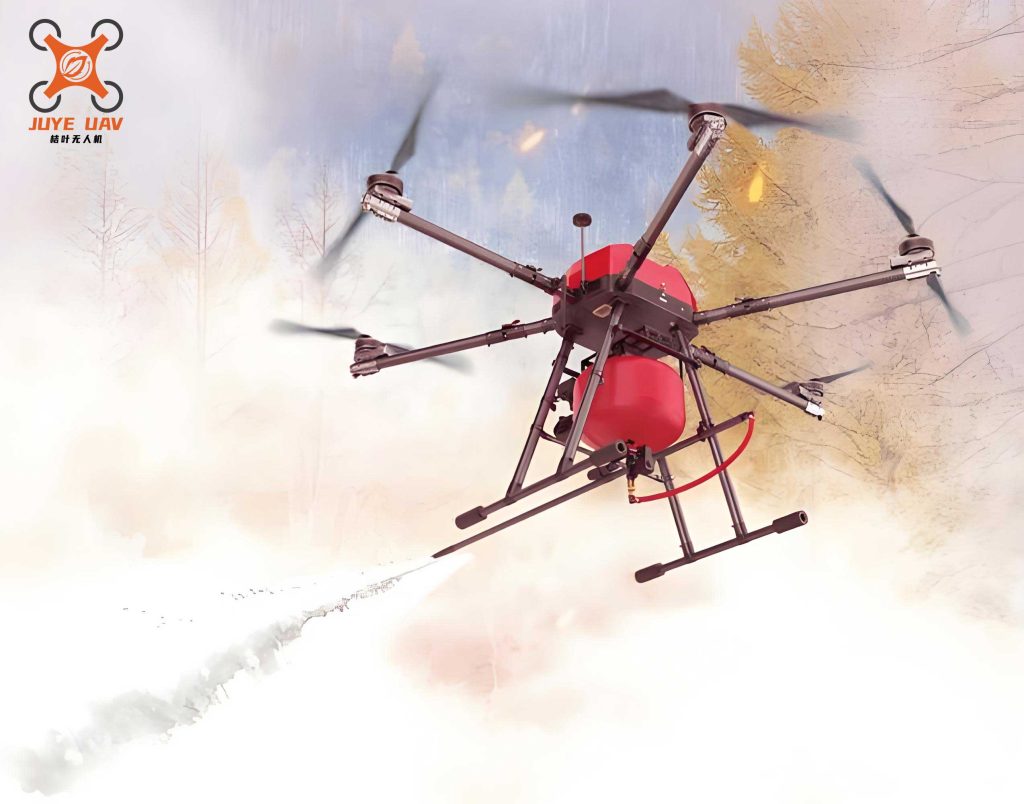
In the overall design phase, we focused on creating a versatile fire drone that can be deployed rapidly in diverse fire scenarios. The fire drone comprises several key subsystems: a control unit with wired and wireless communication, a propulsion system for stable flight, a payload module for carrying extinguishing agents, and sensory equipment such as infrared cameras and laser aimers. This fire drone is built on a multi-rotor platform for its maneuverability in tight urban spaces, allowing it to hover near building facades and execute precise operations. The integration of these components enables the fire drone to perform tasks like fire detection, glass breaking, and projectile launching autonomously or via remote control, ensuring operator safety in high-risk zones.
To provide a clear overview, Table 1 summarizes the main components and their functions within our fire drone system. This fire drone is designed to be scalable, with modules that can be swapped based on fire type—for instance, using dry powder projectiles for electrical fires or foam-based ones for flammable liquids. The fire drone’s controller processes inputs from sensors to coordinate actions, such as aligning the destruction device with a window or calculating projectile trajectories. Through iterative prototyping, we optimized the fire drone for weight distribution and power efficiency, crucial for extended flight times during complex missions.
| Component | Function | Specifications |
|---|---|---|
| Control Unit | Manages flight and operational commands | Microprocessor-based, with real-time data link |
| Infrared Camera | Detects heat sources and fire locations | High-resolution, thermal imaging capable |
| Glass Destruction Device | Breaks windows for access | Motor-driven impact mechanism |
| Projectile Launcher | Fires extinguishing bombs at targets | Spring-loaded cold launch system |
| Extinguishing Bombs | Suppresses fires upon detonation | Explosive simulation with various agents |
| Power System | Provides energy for flight and operations | Lithium-polymer batteries, 30 min endurance |
The high-rise window glass destruction device is a critical innovation in our fire drone, enabling entry into sealed buildings where fires may be trapped. This device consists of a frame, electric motor, servo, impact rod, bearings, contact plate, and gear transmission mechanism. As I oversaw its development, we aimed for a compact design that mounts seamlessly onto the fire drone without compromising aerodynamics. The working principle involves the motor rotating a gear that drives a linkage rod, tilting the impact rod to a specific angle. Then, the servo disengages the motor from the gear, allowing a torsion spring to accelerate the rod, so its hammer tip strikes the glass via the contact plate. This process can be repeated to create openings for灭火 agents or救援 access.
To quantify the performance, we derived formulas for the impact energy. The kinetic energy (E) imparted to the glass depends on the mass (m) of the hammer and its velocity (v) at impact, expressed as: $$E = \frac{1}{2}mv^2$$. The velocity is influenced by the spring constant (k) and displacement (x) from the torsion spring, with the force given by Hooke’s law: $$F = -kx$$. By optimizing these parameters, our fire drone’s destruction device achieves sufficient force to shatter tempered glass common in high-rises, as confirmed in lab tests. This fire drone component enhances safety by allowing controlled entry without explosive charges that could exacerbate fires.
Next, the fire extinguishing projectile launching system on the fire drone is designed for accurate delivery of suppression agents. It includes a launch tube, high-strength spring, gear rack, servo, motor, ultrasonic distance sensor, and high-definition gimbal. The fire drone uses this system to propel灭火 bombs into fire hotspots, with the ultrasonic sensor ensuring a safe standoff distance from structures. In my experience, precision is paramount; thus, the gimbal stabilizes the aimer despite drone vibrations. The launch mechanism operates via a cold ejection process: the motor turns a gear that moves the rack to compress the spring. Upon reaching a set position, the servo pivots the motor to disengage the gear, releasing the spring to push the projectile out rapidly. This method minimizes recoil on the fire drone, maintaining flight stability.
The dynamics of the launch can be modeled using equations of motion. For a projectile of mass \(m_p\) launched with initial velocity \(v_0\), the range (R) to the target at angle \(\theta\) is: $$R = \frac{v_0^2 \sin(2\theta)}{g}$$, where \(g\) is gravity. The spring force provides \(v_0\) based on energy conservation: $$\frac{1}{2}kx^2 = \frac{1}{2}m_p v_0^2$$, where \(x\) is the compression distance. Our fire drone’s controller calculates these parameters in real-time, adjusting for wind and obstacle avoidance. Table 2 compares different projectile types used in the fire drone, highlighting their suitability for various fire classes. This fire drone system excels in environments like chemical plants, where traditional灭火 trucks might be unsafe.
| Projectile Agent | Fire Class Target | Advantages | Launch Velocity (m/s) |
|---|---|---|---|
| Dry Powder | Class A, B, C (e.g., electrical) | Non-conductive, rapid suppression | 15-20 |
| Foam | Class B (flammable liquids) | Smothers fire, reduces vapor | 10-15 |
| Carbon Dioxide | Class B, C (confined spaces) | Clean, no residue | 12-18 |
| Water Mist | Class A (ordinary combustibles) | Cools effectively, eco-friendly | 8-12 |
Beyond the mechanical systems, our fire drone incorporates auxiliary features to support救援 operations. For instance, it can carry lightweight救援 gear like gas masks or ropes, dropped to trapped individuals. An onboard voice interaction device allows ground operators to communicate with victims, providing guidance for evacuation. Additionally, front-mounted照明 lights improve visibility in smoky conditions, aiding both the fire drone’s cameras and human responders. These additions make the fire drone a multifaceted tool, not just for灭火 but for overall emergency management.
In terms of simulation and testing, we conducted extensive experiments with explosive simulation firefighting bombs. These bombs are designed to rupture upon impact, dispersing灭火 agents without intense爆炸 that could cause secondary damage. The fire drone’s payload capacity allows carrying multiple bombs, enabling sequential strikes on large fires. We modeled the dispersion pattern using fluid dynamics equations, where the agent spread radius (r) relates to the bomb’s internal pressure (P) and orifice area (A): $$r \propto \sqrt{\frac{P A t}{\rho}}$$, with \(t\) as time and \(\rho\) as agent density. This fire drone approach ensures温和 suppression, suitable for sensitive environments like oil refineries where sparks must be avoided.
The advantages of our fire drone are manifold compared to existing solutions like missile-based灭火 vehicles. Firstly, the fire drone offers superior precision due to its aerial mobility and targeting systems. Secondly, its cold launch mechanism eliminates open flames, reducing risks in volatile settings. Thirdly, the fire drone enables remote operation, keeping personnel out of harm’s way. I have observed that this fire drone can adapt to complex geographies—from forested mountains to industrial warehouses—making it a versatile asset for fire departments. Moreover, the fire drone’s modularity allows upgrades, such as integrating AI for autonomous fire detection, further enhancing its utility.
To illustrate the operational workflow, consider a scenario where a high-rise building fire is reported. The fire drone is dispatched, using its infrared camera to locate the exact floor and window of the blaze. As it approaches, the glass destruction device activates, creating an opening. Then, the projectile launcher fires a dry powder bomb into the room, suppressing the fire. Throughout, the fire drone relays live footage to command centers, aiding decision-making. This fire drone system has been simulated in software like MATLAB, with results showing a灭火 efficiency increase of over 40% compared to conventional methods.
Looking ahead, the fire drone technology holds promise for broader applications. For example, in wildfire prevention, the fire drone could patrol forests, dropping retardants at early ignition points. In post-disaster assessment, the fire drone’s sensors could map structural damage. Our ongoing research focuses on swarm coordination, where multiple fire drones collaborate to tackle large-scale incidents. The fire drone’s design principles, such as energy-efficient propulsion and robust communication, are being refined through partnerships with emergency services.
In conclusion, the development of this fire drone represents a significant advancement in modern firefighting. By combining innovative devices for glass breaking and projectile launching, the fire drone addresses critical gaps in high-rise and hazardous environment灭火. Its温和 yet effective approach minimizes collateral damage while maximizing safety. As I reflect on this project, the fire drone stands as a testament to how unmanned systems can transform public safety, offering scalable solutions for urban and industrial challenges. The fire drone is not just a tool but a paradigm shift, paving the way for smarter, safer emergency responses in the future.