
In my years of experience in agricultural economic management, I have witnessed a transformative shift towards integrating advanced technologies to enhance productivity and sustainability. The core of this evolution lies in setting clear management goals, innovating systems, improving human capital, and leveraging information technology. One of the most promising advancements is the adoption of fire drone systems for forest fire prevention, which exemplifies how technological tools can revolutionize traditional agricultural and resource management practices. This article explores these aspects in depth, emphasizing the critical role of fire drone applications in bolstering agricultural economies, particularly in forest-rich regions. I will delve into the principles, challenges, and future directions, supported by tables and formulas to summarize key concepts.
Agricultural economic management aims to achieve predefined operational states that align with national objectives. The management target, denoted as $T$, can be expressed as a function of various factors: $$ T = f(G, R, S) $$ where $G$ represents policy goals, $R$ denotes resource availability, and $S$ signifies socio-economic conditions. This target dictates the focus, content, and direction of management efforts. For instance, in forest management, a primary goal is to minimize fire risks to protect resources—a domain where fire drone technology has become indispensable. By analyzing regional agricultural data, managers can set specific targets, such as reducing fire incidents by 30% through fire drone surveillance, thereby safeguarding economic assets.
To illustrate the components of effective agricultural economic management, consider Table 1, which contrasts traditional approaches with modern integrated methods incorporating technologies like fire drone systems.
| Aspect | Traditional Management | Modern Management with Fire Drone Integration |
|---|---|---|
| Monitoring | Manual patrols, limited coverage | Automated fire drone flights, real-time data collection |
| Data Accuracy | Low, prone to human error | High, via sensors and imaging |
| Response Time | Slow, often delayed | Rapid, with immediate fire drone alerts |
| Cost Efficiency | High labor costs | Lower operational costs over time |
| Risk Management | Reactive to fires | Proactive prevention using fire drone analytics |
Innovating agricultural economic management systems is crucial for adaptability. A robust framework should incorporate market dynamics and technological advancements. For example, the efficiency of a management system $E$ can be modeled as: $$ E = \alpha M + \beta I + \gamma T $$ where $\alpha$, $\beta$, and $\gamma$ are weighting coefficients, $M$ stands for market alignment, $I$ for institutional innovation, and $T$ for technology adoption like fire drone networks. Drawing from global best practices, I advocate for customized systems that avoid copying others blindly. Each region must assess its unique conditions—such as climate and terrain—to tailor solutions. In forest fire management, this means deploying fire drone systems optimized for local vegetation and weather patterns, ensuring they complement broader agricultural goals.
Enhancing the professional素质 of personnel is another pillar. As agricultural technologies evolve, managers must master skills in data analysis and tech operation. The competency level $C$ of a management team can be expressed as: $$ C = \sum_{i=1}^{n} (S_i \cdot E_i) $$ where $S_i$ is the skill level in area $i$ (e.g., fire drone operation), and $E_i$ is experiential knowledge. Governments should invest in training programs, including specialized schools, to foster expertise in areas like fire drone maintenance and data interpretation. This human capital development directly impacts the effectiveness of fire drone deployments in fire-prone areas, reducing losses and boosting economic resilience.
Information technology revolutionizes management methods. Traditional approaches often rely on manual records, but digital tools enable precision. For instance, using computer systems to log agricultural data improves accuracy and accessibility. The integration of fire drone technology exemplifies this shift: drones equipped with cameras and sensors collect real-time data, which is processed using algorithms to predict fire risks. A key formula for data analysis is the fire risk index $FRI$, calculated as: $$ FRI = \frac{P \cdot V}{A} $$ where $P$ is the probability of ignition (derived from fire drone thermal imaging), $V$ is vegetation density, and $A$ is the area’s accessibility. By leveraging such models, managers can make informed decisions, positioning fire drone systems as central to modern agricultural strategies.
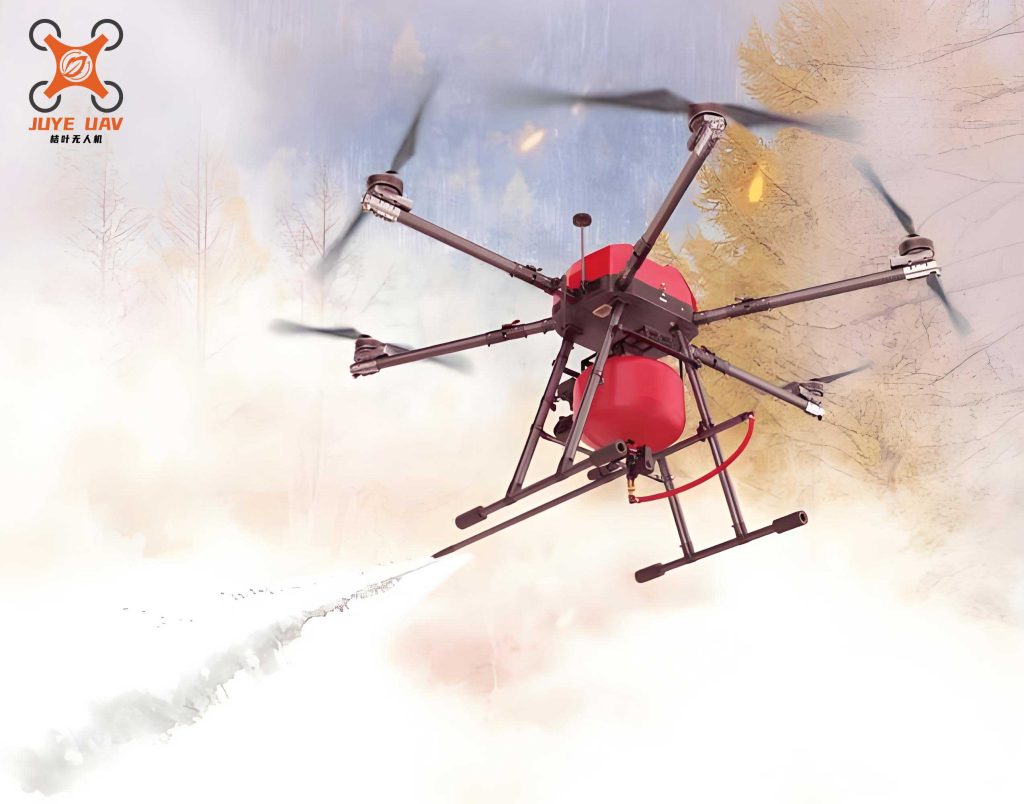
The application of fire drone technology in forest fire management represents a leap forward. Initially designed for cost-effective monitoring, fire drone systems now perform roles from early detection to post-fire assessment. Internationally, automated alarm systems and digital mapping are common, but fire drone enhancements offer superior accuracy. For example, a fire drone can patrol vast forests, transmitting data to command centers for 24/7 surveillance. This aligns with agricultural economic management goals by protecting forest resources—a vital component of rural economies. The operational workflow involves flight cycles adjusted to local needs, with airspace coordination to ensure safety. When a fire drone detects anomalies, it zooms in for verification, providing coordinates and imagery that enable swift responses, thus minimizing economic disruption.
However, challenges persist in fire drone adoption. Table 2 summarizes key issues and potential solutions, emphasizing their impact on agricultural management.
| Challenge | Description | Solution for Agricultural Integration |
|---|---|---|
| Regulatory Gaps | Lack of standardized管理制度 for fire drone use | Develop clear policies tied to economic management frameworks |
| Technical Limitations | Weak wind resistance, image accuracy issues | Invest in R&D to improve fire drone durability and sensors |
| High Costs | Expensive maintenance and operation of fire drone fleets | Subsidize through agricultural budgets, emphasizing long-term savings |
| Industry Integration | Poor fusion with traditional sectors like forestry | Train managers on fire drone applications for holistic planning |
Despite these hurdles, the future of fire drone technology is bright. Trends point toward全天候 monitoring capabilities, where fire drone networks provide continuous data streams. This enhances agricultural economic management by offering real-time insights into forest conditions. For instance, a fire drone can assess fire spread rates $S_f$ using the formula: $$ S_f = v_w \cdot \rho_f $$ where $v_w$ is wind velocity and $\rho_f$ is fuel density, both measured via drone sensors. By relaying this information, fire drone systems help allocate resources efficiently, reducing fire damage and preserving agricultural outputs.
Moreover, fire drone applications extend to communication bridging in remote forests. In areas with poor connectivity, fire drone can act as aerial relays, transmitting critical data to emergency teams. This function is vital for agricultural management, as it ensures timely interventions that protect crops and forests alike. The effectiveness $E_c$ of such communication can be modeled as: $$ E_c = \frac{B \cdot D}{L} $$ where $B$ is bandwidth provided by the fire drone, $D$ is data urgency, and $L$ is latency. Optimizing these parameters through fire drone deployments strengthens overall economic resilience.
To maximize benefits, fire drone systems must be tailored to local environments. For example, in regions with high temperatures, fire drone耐高温性能 is crucial. Enhancing materials to withstand heat ensures reliable operation during fires. The thermal tolerance $TT$ of a fire drone can be expressed as: $$ TT = T_{max} – \Delta T $$ where $T_{max}$ is the maximum operational temperature and $\Delta T$ is the safety margin. By improving $TT$, fire drone can maintain imaging quality in smoky conditions, aiding accurate decision-making. This aligns with agricultural economic management goals by reducing asset losses and insurance costs.
In conclusion, integrating fire drone technology into agricultural economic management is not just an option but a necessity for sustainable development. From setting precise targets to innovating systems, every aspect benefits from the precision and efficiency of fire drone applications. As I reflect on my observations, the synergy between management practices and fire drone tools can drive economic growth, protect resources, and foster innovation. By addressing challenges through collaborative efforts, we can harness the full potential of fire drone systems, ensuring they become cornerstone of modern agriculture and forestry management strategies.