
As a firefighting technology specialist, I have witnessed the increasing frequency and complexity of fire incidents in recent years. Economic development has led to diverse fire hazards, posing greater challenges to firefighting operations. These challenges include heightened difficulty, intensity, and danger in rescue efforts. To address this, there is a pressing need to enhance the efficiency and stability of wireless video transmission systems. Such systems must ensure timely delivery of information resources to urban fire command centers, providing strong scientific evidence for decision-making by fire commanders. In this context, fire drones have emerged as a pivotal tool, revolutionizing firefighting through their integration into wireless video transmission systems. This article delves into the essential characteristics of fire drones, their applications in firefighting wireless video transmission, and the ongoing improvements needed to optimize their performance.
The use of fire drones for aerial photography at fire scenes is a highly technical task that cannot be accomplished by consumer-grade drones with mere camera functions. While such devices can capture images from altitude, their value is often superficial. To truly depict the reality of fire scenes, fire departments must advance their technological capabilities, ensuring that fire drones are comprehensively equipped for rigorous firefighting environments. Below, I outline the key characteristics that fire drones must possess to be effective in firefighting wireless video transmission systems.
First and foremost, safety is paramount. A fire drone must have a lightweight yet robust body to withstand unexpected impacts and carry payloads when necessary. Redundancy in design, particularly for power systems, is crucial. For instance, if a component fails during operation, a well-designed fire drone should still be able to land safely, minimizing risks. This can be mathematically represented by considering failure probabilities. Let the probability of system failure be $$P_f$$, and the redundancy factor be $$r$$; then the enhanced safety $$S$$ can be modeled as: $$S = 1 – (P_f)^r$$. By increasing $$r$$, safety improves exponentially, ensuring that fire drones remain operational even under duress.
Wind resistance is another critical factor. Fire incidents occur in diverse locations with varying wind conditions and climates. In some areas, wind levels can be high, especially around tall buildings where wind speeds increase with altitude. A fire drone must exhibit strong anti-wind capabilities to maintain stable flight and ensure high-quality video capture. The force exerted by wind on a fire drone can be described by the drag equation: $$F_d = \frac{1}{2} \rho v^2 C_d A$$, where $$F_d$$ is the drag force, $$\rho$$ is air density, $$v$$ is wind velocity, $$C_d$$ is the drag coefficient, and $$A$$ is the cross-sectional area. To achieve anti-wind performance, fire drones must minimize $$C_d$$ and $$A$$ through aerodynamic design, allowing them to counteract $$F_d$$ with sufficient thrust.
Temperature tolerance is essential due to heat generated during drone operation and the high temperatures at fire scenes. Fire drones should incorporate high-power engines to reduce frequency of overload operation, thereby lowering internal heat production. Additionally, they must withstand external heat from fires, which can spread to surrounding environments. The heat dissipation capacity can be quantified using Newton’s law of cooling: $$\frac{dT}{dt} = -k(T – T_{\text{env}})$$, where $$T$$ is the drone’s temperature, $$T_{\text{env}}$$ is the environmental temperature, and $$k$$ is a cooling constant. Fire drones with enhanced thermal management systems have higher $$k$$ values, enabling them to maintain operational integrity even in extreme heat.
Waterproofing is vital because firefighting involves extensive use of water, and natural precipitation like rain or snow can occur. Fire drones must be designed to resist water ingress, not only in the body but also in components, to prevent malfunctions. The level of waterproofing can be assessed using the Ingress Protection (IP) rating, where a higher rating indicates better protection. For fire drones, an IP67 or higher rating is desirable, ensuring they remain functional in wet conditions.
Endurance is a key consideration, as firefighting operations often span extended periods. Fire drones need batteries with long usage times to complete comprehensive scene recordings without frequent recharging. The flight time $$T_{\text{flight}}$$ of a fire drone can be calculated as: $$T_{\text{flight}} = \frac{E_{\text{battery}}}{P_{\text{avg}}}$$, where $$E_{\text{battery}}$$ is the battery energy capacity in watt-hours, and $$P_{\text{avg}}$$ is the average power consumption in watts. By optimizing $$E_{\text{battery}}$$ and minimizing $$P_{\text{avg}}$$ through efficient motors and electronics, fire drones can achieve longer missions, reducing gaps in surveillance.
Controllability ensures that fire drones can be maneuvered accurately over long distances, maintaining directionality, speed, and altitude for high-quality video. This involves advanced control algorithms, such as Proportional-Integral-Derivative (PID) controllers, which adjust drone dynamics based on error signals. The control response can be modeled as: $$u(t) = K_p e(t) + K_i \int e(t) dt + K_d \frac{de(t)}{dt}$$, where $$u(t)$$ is the control output, $$e(t)$$ is the error, and $$K_p$$, $$K_i$$, $$K_d$$ are tuning parameters. Fine-tuning these parameters allows fire drones to navigate obstacles and maintain stable flight paths.
Anti-interference capability is crucial for reliable video transmission. Fire drones must minimize signal interference to ensure clear,连贯的视频流. This involves robust wireless communication systems, often using frequency hopping or error correction codes. The signal-to-noise ratio (SNR) is a key metric: $$\text{SNR} = \frac{P_{\text{signal}}}{P_{\text{noise}}}$$. By boosting transmission power $$P_{\text{signal}}$$ and employing shielding techniques to reduce $$P_{\text{noise}}$$, fire drones can enhance SNR, leading to better video quality.
To summarize these characteristics, I present a table that outlines the essential features of fire drones for firefighting applications:
| Characteristic | Description | Key Metrics/Formula |
|---|---|---|
| Safety | Lightweight, robust design with redundancy to handle impacts and failures. | $$S = 1 – (P_f)^r$$ |
| Wind Resistance | Aerodynamic design to withstand high winds, especially around tall structures. | $$F_d = \frac{1}{2} \rho v^2 C_d A$$ |
| Temperature Tolerance | Thermal management to endure internal and external heat from fires. | $$\frac{dT}{dt} = -k(T – T_{\text{env}})$$ |
| Waterproofing | Resistance to water ingress from firefighting or precipitation. | IP rating (e.g., IP67) |
| Endurance | Long battery life for extended flight times during firefighting operations. | $$T_{\text{flight}} = \frac{E_{\text{battery}}}{P_{\text{avg}}}$$ |
| Controllability | Precise remote control for navigation and obstacle avoidance. | $$u(t) = K_p e(t) + K_i \int e(t) dt + K_d \frac{de(t)}{dt}$$ |
| Anti-interference | Robust signal transmission to ensure clear video feed in noisy environments. | $$\text{SNR} = \frac{P_{\text{signal}}}{P_{\text{noise}}}$$ |
Moving to applications, fire drones are integral to firefighting wireless video transmission systems, often paired with gimbals or pods equipped with specialized cameras. For instance, thermal imaging cameras can be installed in pods, enabling diverse operational modes. The primary applications include aerial photography, disaster reconnaissance, real-time monitoring, fire point localization, and area calculation. Each of these leverages the unique capabilities of fire drones to enhance firefighting efficiency.
Aerial photography is achieved by mounting zoom-capable optical cameras on gimbals. This allows fire drones to capture wide-ranging, high-resolution videos from standard altitudes, covering buildings, terrain, and other key features. The resolution and clarity aid fire departments in detailed assessments, supporting fire prevention plans and experience总结. The field of view (FOV) can be calculated as: $$\text{FOV} = 2 \arctan\left(\frac{s}{2f}\right)$$, where $$s$$ is the sensor size and $$f$$ is the focal length. By adjusting $$f$$, fire drones can zoom in on specific areas, providing crucial details for command decisions.
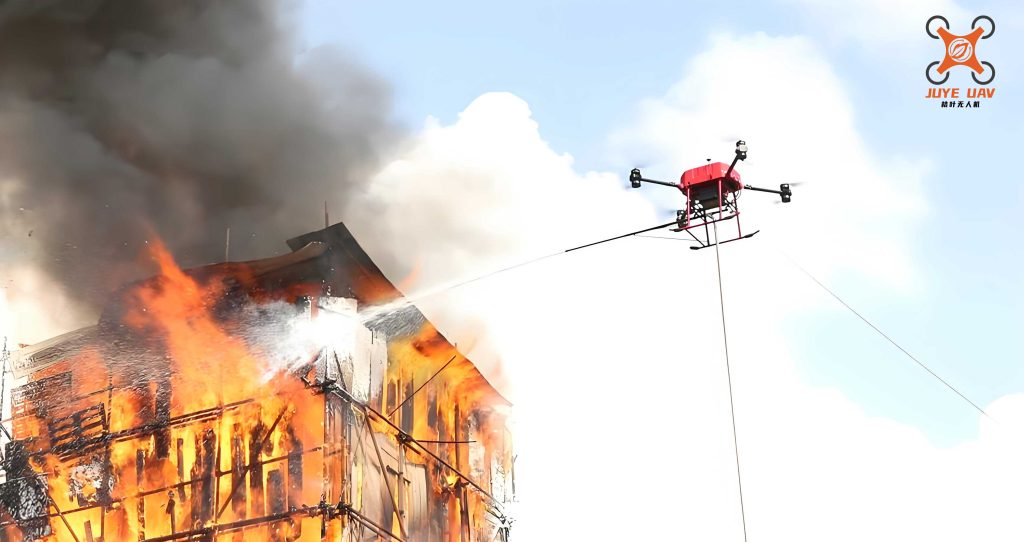
Disaster reconnaissance extends beyond fires to natural calamities like earthquakes, floods, and mudslides. These events create hazardous zones that are difficult to access. Fire drones can survey these areas, capturing images that reveal terrain and conditions. This data is transmitted wirelessly to command centers, highlighting critical zones for focused救援 efforts. The reconnaissance efficiency $$E_{\text{recon}}$$ can be expressed as: $$E_{\text{recon}} = \frac{A_{\text{covered}}}{t_{\text{flight}}}$$, where $$A_{\text{covered}}$$ is the area covered and $$t_{\text{flight}}$$ is the flight time. Fire drones with high $$E_{\text{recon}}$$ enable rapid assessment, saving valuable time in emergencies.
Real-time monitoring is vital due to the dynamic nature of disasters. Fire drones provide continuous video feeds, updating command centers on changing conditions. This allows commanders to adjust strategies promptly. The video transmission latency $$L$$ must be minimized for effective monitoring: $$L = t_{\text{processing}} + t_{\text{transmission}}$$. By optimizing data compression and using high-speed wireless links, fire drones reduce $$L$$, ensuring near-instantaneous updates.
Fire point localization utilizes thermal imaging cameras on fire drones to detect heat signatures through smoke or blind spots. This helps identify the core fire areas and specific ignition points, guiding灭火 efforts. The temperature detection sensitivity can be modeled as: $$\Delta T = \frac{T_{\text{object}} – T_{\text{background}}}{\text{NETD}}$$, where $$\Delta T$$ is the detectable temperature difference, and NETD is the Noise Equivalent Temperature Difference of the camera. Fire drones with low NETD values can pinpoint火点 accurately, even in obscured environments.
Area calculation is essential for large-scale fires where spread is rapid. Fire drones estimate the fire area by combining altitude, flight path, and camera angles. The area $$A_{\text{fire}}$$ can be computed using geometric formulas, such as for a polygon traced by the drone: $$A_{\text{fire}} = \frac{1}{2} \left| \sum_{i=1}^{n} (x_i y_{i+1} – x_{i+1} y_i) \right|$$, where $$(x_i, y_i)$$ are coordinates of boundary points. This data, integrated with location information, creates detailed fire maps for strategic planning.
To illustrate these applications, here is a table summarizing how fire drones contribute to firefighting wireless video transmission systems:
| Application | Description | Key Technology/Formula |
|---|---|---|
| Aerial Photography | High-altitude video capture for scene assessment and planning. | $$\text{FOV} = 2 \arctan\left(\frac{s}{2f}\right)$$ |
| Disaster Reconnaissance | Surveying hazardous areas for terrain and condition analysis. | $$E_{\text{recon}} = \frac{A_{\text{covered}}}{t_{\text{flight}}}$$ |
| Real-time Monitoring | Continuous video feed for dynamic situation updates. | $$L = t_{\text{processing}} + t_{\text{transmission}}$$ |
| Fire Point Localization | Thermal imaging to identify heat sources through obstacles. | $$\Delta T = \frac{T_{\text{object}} – T_{\text{background}}}{\text{NETD}}$$ |
| Area Calculation | Geometric computation of fire spread area for mapping. | $$A_{\text{fire}} = \frac{1}{2} \left| \sum_{i=1}^{n} (x_i y_{i+1} – x_{i+1} y_i) \right|$$ |
Despite their advantages, fire drones face challenges in firefighting wireless video transmission systems. Two major issues are portability and heat resistance. Firefighters often operate in inaccessible areas where vehicles cannot reach, requiring equipment to be carried on foot. Current fire drones can be bulky, making单兵携行 difficult, especially over rough terrain or long distances. To improve, fire drones should feature modular or foldable designs that reduce size and weight without compromising strength. The portability score $$P_{\text{score}}$$ can be defined as: $$P_{\text{score}} = \frac{W_{\text{max}} – W_{\text{drone}}}{W_{\text{max}}} \times 100\%$$, where $$W_{\text{drone}}$$ is the drone weight and $$W_{\text{max}}$$ is the maximum allowable weight for easy carrying. By minimizing $$W_{\text{drone}}$$, fire drones become more practical for field deployment.
Heat resistance is another limitation, as fire drones operate near flames, facing thermal radiation, convection, and direct exposure. Enhancing heat resistance involves using composite materials like carbon fiber mixed with flame retardants, or applying protective coatings. The thermal protection factor (TPF) can be expressed as: $$\text{TPF} = \frac{T_{\text{max, material}}}{T_{\text{fire}}}$$, where $$T_{\text{max, material}}$$ is the material’s maximum耐受 temperature and $$T_{\text{fire}}$$ is the fire temperature. By increasing TPF through advanced materials, fire drones can withstand harsh conditions, ensuring reliable performance.
In conclusion, the integration of fire drones into firefighting wireless video transmission systems marks a significant advancement in emergency response technology. As these fire drones become more widespread, they will elevate the应急通信保障水平 of fire departments, particularly in video transmission during灭火救援. Fire drones provide可视化支持 that aids commanders in accurate judgment, rational deployment, and scientific decision-making. This enhances灭火救援效能, ultimately saving public property and protecting lives. The future of fire drones lies in continuous innovation—addressing portability and heat resistance while expanding capabilities through AI and automation. As I reflect on my experiences, I am confident that fire drones will play an increasingly vital role in safeguarding communities against fire hazards, driven by ongoing research and development in this field.