
As a firefighter and researcher in the field of emergency response, I have witnessed firsthand the transformative potential of multi-rotor unmanned aerial vehicles, commonly referred to as fire drones, in modern firefighting and rescue missions. These fire drones are not just gadgets; they are essential tools that enhance our ability to tackle complex disasters. In this article, I will explore the various scenarios where fire drones are deployed, analyze their performance requirements, and provide recommendations for integrating them into fire rescue teams. The focus will be on practical insights, supported by tables and formulas to summarize key points. Throughout, I will emphasize the term ‘fire drone’ to highlight its specialized role in emergency operations.
The adoption of fire drones aligns with the evolving needs of comprehensive rescue teams facing “all-disaster” and “large-emergency” scenarios. By providing real-time aerial intelligence, these fire drones enable safer and more efficient operations. For instance, during a major fire, a fire drone can quickly survey the scene, transmitting data that guides our strategies. This capability is crucial in high-risk environments like high-rise buildings or chemical plants, where traditional reconnaissance is perilous. The image below illustrates a typical fire drone used in such operations, showcasing its compact design and versatility.
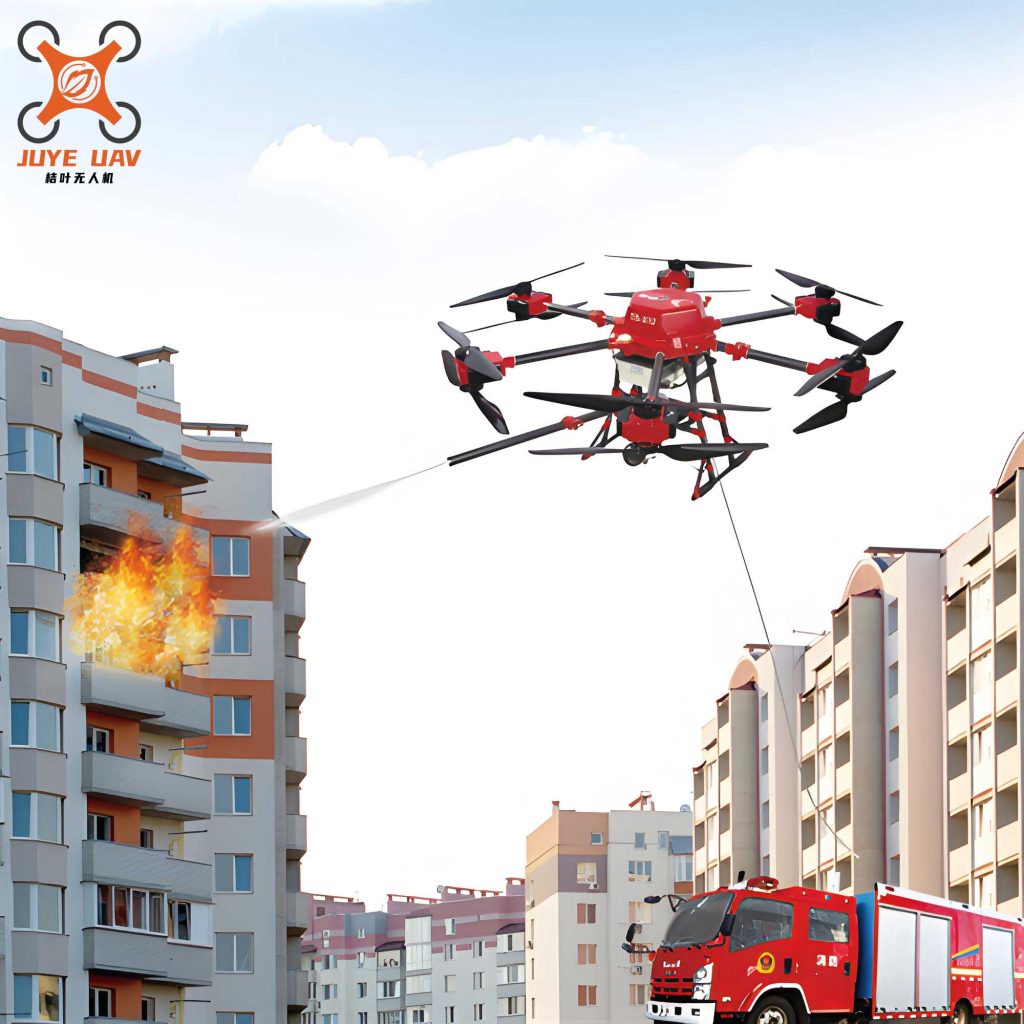
In fire rescue, the application of fire drones spans multiple phases, from initial detection to post-fire cleanup. I have observed that fire drones excel in tasks such as scene reconnaissance, rescue疏散, direct fire suppression, and aftermath monitoring. For example, in a large-space fire, a fire drone equipped with thermal cameras can identify hotspots and trapped individuals, reducing the need for human entry into dangerous zones. Similarly, in抢险救援 like flood operations, a fire drone can deliver life-saving equipment with precision. To encapsulate these uses, I have compiled a table summarizing the primary applications of fire drones in firefighting and rescue contexts.
| Application Scenario | Key Functions of Fire Drone | Benefits |
|---|---|---|
| Scene Reconnaissance | Aerial imaging, thermal detection, real-time data transmission | Enhances safety, provides comprehensive overview,快速决策 |
| Rescue疏散 | Broadcasting instructions via speakers, guiding evacuations | Reduces panic, optimizes疏散 routes |
| Fire Suppression | Deploying灭火弹, breaking windows for ventilation | Enables targeted attacks, improves排烟 efficiency |
| Post-Fire Cleanup | Monitoring with thermal sensors, detecting reignition risks | Saves time, ensures thorough assessment |
| Water Rescue | Precise投递 of life rings, establishing rope lines | Increases accuracy, extends range up to 1 km |
| Wasp Nest Removal | Using喷火或注射 pesticides from a safe distance | Minimizes risk to personnel,高效处理 |
| Earthquake Rescue | Mapping damage, relaying communications, delivering supplies | Overcomes terrain obstacles, supports指挥 systems |
The effectiveness of a fire drone in these scenarios often depends on its technical specifications. For instance, in灭火作业, the payload capacity determines how much灭火剂 can be carried. We can model this using a simple formula for the required thrust. If a fire drone needs to lift a payload of mass \( m_p \) (including灭火弹) against gravity, the total thrust \( F_t \) must satisfy: $$ F_t = (m_d + m_p) \cdot g + F_{drag} $$ where \( m_d \) is the drone’s mass, \( g \) is acceleration due to gravity (approximately \( 9.8 \, \text{m/s}^2 \)), and \( F_{drag} \) is the aerodynamic drag force. In practice, for a fire drone to perform reliably, engineers optimize \( m_d \) and motor power to achieve sufficient \( F_t \). This is critical when deploying fire drones in high-rise fires, where they must carry灭火弹 to specific floors.
Beyond firefighting, fire drones prove invaluable in抢险救援. During flood events, the fire drone’s ability to hover and precisely drop救生器材 can be quantified by its投递 accuracy. Suppose a fire drone is tasked with delivering a life ring to a target at coordinates \( (x_t, y_t) \) from a height \( h \). The horizontal distance \( d \) from the drone’s position \( (x_d, y_d) \) is given by: $$ d = \sqrt{(x_t – x_d)^2 + (y_t – y_d)^2} $$ For successful投递, the fire drone must minimize \( d \) while accounting for wind drift. Modern fire drones use GPS and sensors to achieve \( d < 1 \, \text{m} \) in calm conditions, but in storms, this requires advanced stabilization. I have seen fire drones save lives by reaching被困者 faster than traditional methods, thanks to such precision.
However, the deployment of fire drones faces several challenges that demand improvement. Based on my experience, fire rescue tasks impose unique requirements on fire drone design. Firstly, fire drones must withstand harsh environments like intense heat and smoke. The temperature tolerance can be expressed as a function of material properties. For example, if a fire drone operates near a fire with ambient temperature \( T_a \), its internal components must remain below a critical temperature \( T_c \). Using heat transfer theory, we can estimate the time \( t_{safe} \) before overheating: $$ t_{safe} = \frac{C \cdot (T_c – T_i)}{k \cdot (T_a – T_i)} $$ where \( C \) is the heat capacity, \( T_i \) is initial temperature, and \( k \) is a thermal conductivity coefficient. Enhancing \( t_{safe} \) through耐高温 materials is essential for fire drones to function in火场.
Secondly, electromagnetic interference (EMI) poses a risk to fire drone navigation. Typically, fire drones rely on GPS signals, but in urban fires or industrial sites, EMI can disrupt these signals. To mitigate this, fire drones should integrate multiple navigation systems, such as北斗 and GLONASS. The signal strength \( S \) from a satellite can be modeled as: $$ S = S_0 \cdot e^{-\alpha d} – I_{EMI} $$ where \( S_0 \) is the original signal, \( \alpha \) is attenuation factor, \( d \) is distance, and \( I_{EMI} \) is interference intensity. By diversifying信号 sources, fire drones can maintain operation even if one system fails. This redundancy is crucial for fire rescue missions where reliability is paramount.
Thirdly,续航能力 remains a limitation for fire drones. Most multi-rotor fire drones use electric batteries, offering flight times \( T_{flight} \) between 30 minutes to 1 hour. We can calculate \( T_{flight} \) based on battery energy \( E_{batt} \) and power consumption \( P_{cons} \): $$ T_{flight} = \frac{E_{batt}}{P_{cons}} $$ where \( P_{cons} \) depends on factors like payload and wind resistance. For extended missions, such as monitoring a forest fire, fire drones need higher \( E_{batt} \) or hybrid power systems. In my view, advancing battery technology or adopting fuel cells could extend \( T_{flight} \) beyond 2 hours, making fire drones more sustainable for prolonged救援 tasks.
To address these issues, I propose a systematic approach to equipping fire rescue teams with fire drones. The table below outlines a tiered装备 strategy, matching fire drone capabilities to different organizational levels and mission types. This ensures that resources are allocated efficiently, from local fire stations to regional headquarters.
| Organization Level | Recommended Fire Drone Quantity | Key Features | Typical Missions |
|---|---|---|---|
| Fire Station (Squad) | 2-3 units | Basic imaging, portability, easy operation | Initial scene assessment, small-scale fires |
| Battalion/District | 5-10 units | Enhanced payload, thermal cameras, modular attachments | Medium-risk operations,水域救援,灭蜂 |
| City/Regional Command | 10-20 units | High endurance, advanced navigation, communication relays | Large disasters, earthquake响应, coordinated campaigns |
| National/Provincial Reserve | Specialized fleets | Cutting-edge tech, AI integration, swarm capabilities | Complex multi-agency efforts, R&D testing |
Implementing such a strategy requires not only hardware but also skilled personnel. As a firefighter, I stress the importance of training专业操作手 for fire drones. These operators must master飞行技巧, maintenance, and tactical deployment. For example, in灭蜂救援, a two-person team can operate a fire drone with a喷火 attachment, following a protocol to ensure safety. The training should include simulations of EMI scenarios or high-wind conditions, preparing operators for real-world challenges. Moreover, ongoing战术研讨 is vital to refine fire drone usage; since fire drone adoption in fire rescue is relatively new, we must积累经验 through exercises and post-mission analyses.
Looking ahead, the future of fire drones in firefighting and rescue is promising. With advancements in AI and robotics, fire drones could autonomously collaborate with ground robots, forming a ‘fire drone + rescue robot’ synergy. For instance, in earthquake救援, a fire drone might deploy a small robot into rubble, guided by aerial imagery. This combined approach can enhance效率, reducing the time to locate survivors. The potential for fire drones to become standard equipment is clear, but it hinges on continuous innovation and investment.
In conclusion, as someone deeply involved in fire rescue, I believe that fire drones are indispensable assets that revolutionize our operations. From侦查 to direct intervention, the fire drone proves its worth across diverse scenarios. By addressing environmental adaptability, EMI resistance, and续航, we can unlock even greater potential. I advocate for widespread adoption of fire drones, coupled with rigorous training, to build resilient fire rescue forces. The journey toward integrating fire drones is ongoing, but with each mission, we learn and improve, ultimately saving more lives and protecting communities. The fire drone is not just a tool—it is a伙伴 in our quest for safety.