
In this paper, I address the critical challenge of attitude tracking for a quadrotor drone under parameter uncertainties and external disturbances. The quadrotor drone, a versatile unmanned aerial vehicle (UAV), has garnered significant attention due to its agility, vertical take-off and landing capabilities, and precise hovering. These attributes make the quadrotor drone invaluable in both military and civilian applications, such as surveillance, delivery, and environmental monitoring. However, the quadrotor drone is inherently a highly nonlinear system with underactuation, model uncertainties, and susceptibility to external perturbations, rendering high-precision control a formidable task. Traditional control methods, like PID, often fall short in handling nonlinear disturbances, leading to reduced accuracy. Thus, I propose a novel desired compensation Robust Integral of the Sign of Error (RISE) controller with adaptive gain adjustment, designed to enhance tracking performance and robustness for the quadrotor drone. This approach integrates model compensation based solely on desired trajectories, reducing online computational burden and mitigating measurement noise, while an adaptive law tunes the sign function gain dynamically to suppress disturbances effectively. Through rigorous stability analysis and extensive simulations, I demonstrate the superiority of this controller over conventional methods, ensuring asymptotic tracking for the quadrotor drone attitude.
The dynamics of a quadrotor drone are typically derived using Newton-Euler equations, considering it as a six-degree-of-freedom rigid body. The attitude model involves roll, pitch, and yaw angles, along with their angular velocities. Let me define the key variables: the attitude angle vector $\Theta = [\phi, \theta, \psi]^T$, where $\phi$, $\theta$, and $\psi$ represent the roll, pitch, and yaw angles, respectively; the angular velocity vector $\Omega = [\Omega_\phi, \Omega_\theta, \Omega_\psi]^T$; the inertia matrix $J = \text{diag}(J_1, J_2, J_3) \in \mathbb{R}^{3 \times 3}$; the damping coefficient matrix $\Pi = \text{diag}(k_\phi, k_\theta, k_\psi) \in \mathbb{R}^{3 \times 3}$; the control input vector $U = [u_\phi, u_\theta, u_\psi]^T$ representing the rotational moments; and the external disturbance vector $d_\Theta = [d_\phi, d_\theta, d_\psi]^T$. The original cascaded model is given by:
$$\dot{\Theta} = \Omega,$$
$$J\dot{\Omega} = -\Pi\Omega + g_1 U + d_\Theta(t),$$
where $g_1 = \text{diag}(l, l, c) \in \mathbb{R}^{3 \times 3}$, with $l$ denoting the distance from each rotor to the center of mass and $c$ being a torque constant factor. To facilitate controller design, I transform this cascaded model into a strict-feedback form with lumped disturbances. Define the states $X_1 = \Theta$ and $X_2 = \Omega$, and introduce parameter uncertainties: let $\bar{\Pi}$ and $\bar{g}_1$ be nominal values, and $\Delta\Pi$ and $\Delta g_1$ represent unmodeled dynamics. Then, the lumped disturbance $d$ incorporates both parameter uncertainties and external disturbances:
$$d = J^{-1}(d_\Theta(t) – \Delta\Pi X_2 + \Delta g_1 U).$$
The system can be rewritten in strict-feedback form as:
$$\dot{X}_1 = X_2,$$
$$\dot{X}_2 = f(X_2) + g_2 U + d,$$
where $f(X_2) = -J^{-1}\bar{\Pi} X_2$ and $g_2 = J^{-1}\bar{g}_1$. This formulation is crucial for designing backstepping-based controllers for the quadrotor drone. The control objective is to ensure that the attitude $X_1$ asymptotically tracks a smooth reference command $X_{1d} = [X_{1d1}, X_{1d2}, X_{1d3}]^T$, despite the presence of the lumped disturbance $d$. I assume that $d$ is sufficiently smooth, with its first and second derivatives bounded by unknown constants $\sigma_1$ and $\sigma_2$, i.e., $\|\dot{d}\| \leq \sigma_1$ and $\|\ddot{d}\| \leq \sigma_2$, which is reasonable for practical quadrotor drone operations.
To provide a clear overview of the quadrotor drone parameters and symbols used in this work, I summarize them in the following table:
| Symbol | Description | Value or Expression |
|---|---|---|
| $\Theta$ | Attitude angle vector (roll, pitch, yaw) | $[\phi, \theta, \psi]^T$ |
| $\Omega$ | Angular velocity vector | $[\Omega_\phi, \Omega_\theta, \Omega_\psi]^T$ |
| $J$ | Inertia matrix | $\text{diag}(J_1, J_2, J_3)$ |
| $\Pi$ | Damping coefficient matrix | $\text{diag}(k_\phi, k_\theta, k_\psi)$ |
| $U$ | Control input vector | $[u_\phi, u_\theta, u_\psi]^T$ |
| $g_1$ | Input gain matrix | $\text{diag}(l, l, c)$ |
| $d_\Theta$ | External disturbance vector | $[d_\phi, d_\theta, d_\psi]^T$ |
| $X_1, X_2$ | System states | $X_1 = \Theta, X_2 = \Omega$ |
| $d$ | Lumped disturbance | $J^{-1}(d_\Theta – \Delta\Pi X_2 + \Delta g_1 U)$ |
| $f(X_2)$ | Nominal dynamics function | $-J^{-1}\bar{\Pi} X_2$ |
| $g_2$ | Transformed input gain | $J^{-1}\bar{g}_1$ |
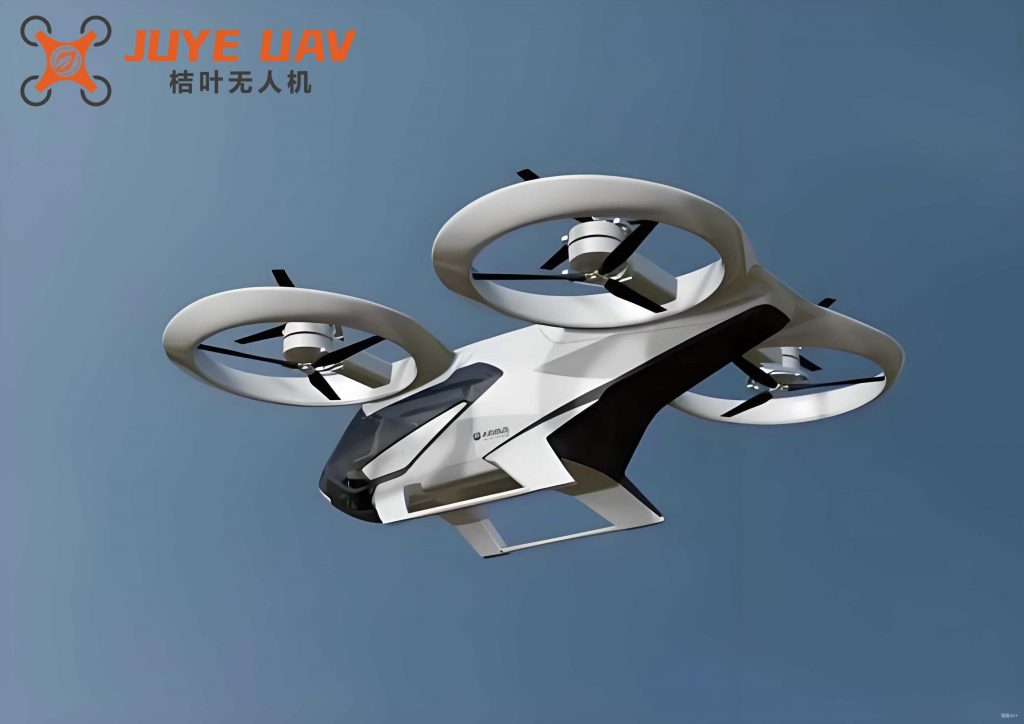
The quadrotor drone model, as described, highlights the complexities involved in attitude control. To visualize a typical quadrotor drone configuration, consider the following illustration:
Now, I proceed to design the desired compensation RISE controller for the quadrotor drone. The key idea is to combine a model compensation term based on desired trajectories with a robust integral term that adapts its gain online. First, define the tracking error $e_1 = X_1 – X_{1d}$ and an auxiliary error $e_2 = \dot{e}_1 + k_1 e_1 = X_2 – \bar{X}_2$, where $\bar{X}_2 = \dot{X}_{1d} – k_1 e_1$ and $k_1 > 0$ is a feedback gain. This introduces a virtual control law that simplifies the backstepping process. Further, define an auxiliary signal $r = \dot{e}_2 + k_2 e_2$, which involves the derivative of $e_2$ but will not appear in the final control law, serving only for analysis. From the system dynamics, I express $r$ as:
$$r = f(\dot{X}_{1d}) + g_2 U + d – N + (k_1 + k_2) e_2 – k_1^2 e_1,$$
where $N = f(\dot{X}_{1d}) – f(X_2)$ captures the difference between desired and actual dynamics. This formulation decouples the model compensation from state-dependent terms, enabling offline computation. The desired compensation RISE controller is designed as:
$$U = g_2^{-1} (U_a + U_s),$$
with $U_s = U_{s1} + U_{s2}$. Here, $U_a$ is the desired model compensation term, $U_{s1}$ is a linear feedback term, and $U_{s2}$ is a nonlinear robust term. Specifically:
$$U_a = -f(\dot{X}_{1d}) + \ddot{X}_{1d},$$
$$U_{s1} = k_1^2 e_1 – (k_1 + k_2 + k_r) e_2,$$
$$U_{s2} = -\int_0^t \left[ k_r k_2 e_2 + \hat{\beta} \text{sgn}(e_2) \right] d\tau,$$
where $k_2, k_r > 0$ are controller gains, $\text{sgn}(e_2)$ denotes the sign function of $e_2$, and $\hat{\beta}$ is the estimated gain of the sign function, adjusted online via an adaptive law. This structure ensures that $U_a$ depends only on the desired trajectory $\dot{X}_{1d}$ and $\ddot{X}_{1d}$, which can be precomputed, reducing online computational load for the quadrotor drone controller. The adaptive law for $\hat{\beta}$ is designed as:
$$\dot{\hat{\beta}} = \Gamma r^T \text{sgn}(e_2),$$
where $\Gamma > 0$ is the adaptation gain. Since $r$ is not directly measurable, I implement an equivalent form using measurable signals:
$$\dot{\hat{\beta}} = \Gamma e_2^T \text{sgn}(e_2) + \Gamma \mu,$$
with $\mu = k_2 e_2^T \text{sgn}(e_2)$. This adaptive mechanism allows the quadrotor drone controller to dynamically adjust the robustness level, avoiding conservative fixed gains and improving disturbance rejection. Substituting the controller into the dynamics yields the closed-loop error system:
$$r = -k_r e_2 + U_{s2} + d – N,$$
and differentiating gives:
$$\dot{r} = -k_r r – \hat{\beta} \text{sgn}(e_2) + \dot{d} – \dot{N}.$$
This representation facilitates the stability analysis for the quadrotor drone system.
To prove the stability of the proposed controller for the quadrotor drone, I employ Lyapunov theory. First, I introduce an auxiliary function $L = r^T (\dot{d} – \beta \text{sgn}(e_2))$, where $\beta$ is the true upper bound of $\dot{d}$ satisfying $\beta \geq \sigma_1 + \frac{1}{k_2} \sigma_2$. Then, define $P = \beta \|e_2(0)\| – e_2^T(0) \dot{d}(0) – \int_0^t L d\tau$, which is non-negative under the gain condition. Consider the Lyapunov function candidate:
$$V = \frac{1}{2} e_1^T e_1 + \frac{1}{2} e_2^T e_2 + \frac{1}{2} r^T r + \frac{1}{2} \Gamma^{-1} \tilde{\beta}^2 + P,$$
where $\tilde{\beta} = \hat{\beta} – \beta$ is the estimation error. Taking the time derivative and substituting the closed-loop dynamics, I obtain:
$$\dot{V} = e_1^T \dot{e}_1 + e_2^T \dot{e}_2 + r^T \dot{r} + \Gamma^{-1} \tilde{\beta} \dot{\hat{\beta}} + \dot{P}.$$
Using the error definitions and controller equations, this simplifies to:
$$\dot{V} = -k_1 e_1^T e_1 – k_2 e_2^T e_2 – k_r r^T r + e_1^T e_2 + e_2^T r – r^T J^{-1} \bar{\Pi} r + (k_2 + k_1) r^T J^{-1} \bar{\Pi} e_2 – k_1^2 r^T J^{-1} \bar{\Pi} e_1.$$
To ensure negativity, I define a matrix $\Lambda$ as:
$$\Lambda = \begin{bmatrix}
k_1 & -\frac{1}{2} & -\frac{1-c_1}{2} \\
-\frac{1}{2} & k_2 & -\frac{1+c_2}{2} \\
-\frac{1-c_1}{2} & -\frac{1+c_2}{2} & k_r + c_3
\end{bmatrix},$$
where $c_1 = \max\{k_1^2 J^{-1} \bar{\Pi}\}$, $c_2 = \max\{(k_1 + k_2) J^{-1} \bar{\Pi}\}$, and $c_3 = \max\{J^{-1} \bar{\Pi}\}$, with $\max\{\cdot\}$ denoting the maximum element of the matrix. By selecting gains $k_1$, $k_2$, and $k_r$ such that $\Lambda$ is positive definite, I have:
$$\dot{V} \leq -e^T \Lambda e \leq -\lambda_{\min}(\Lambda) (\|e_1\|^2 + \|e_2\|^2 + \|r\|^2) \triangleq -W,$$
where $e = [\|e_1\|, \|e_2\|, \|r\|]^T$ and $\lambda_{\min}(\Lambda)$ is the minimum eigenvalue of $\Lambda$. This implies that $V$ is non-increasing and bounded, so $e_1$, $e_2$, $r$, and $\tilde{\beta}$ are bounded. Since $W$ is uniformly continuous and $V$ is bounded, by Barbalat’s lemma, $W \to 0$ as $t \to \infty$, leading to asymptotic convergence of the tracking errors. Thus, the quadrotor drone attitude system is globally asymptotically stable under the proposed controller.
To validate the effectiveness of the proposed controller for the quadrotor drone, I conduct simulation experiments comparing it with a backstepping controller and a traditional RISE controller. The quadrotor drone parameters are set as follows: inertia matrix $J = \text{diag}(0.16, 0.16, 0.32) \, \text{kg} \cdot \text{m}^2$, damping coefficients $\Pi = \text{diag}(0.012, 0.012, 0.012) \, \text{N} \cdot \text{m} \cdot \text{s}^2$, arm length $l = 0.4 \, \text{m}$, and torque constant $c = 0.05$. Parameter uncertainties are introduced as $\Delta k_\phi = 0.2k_\phi$, $\Delta k_\theta = 0.2k_\theta$, $\Delta k_\psi = 0.2k_\psi$, $\Delta l = 0.1l$, and $\Delta c = 0.1c$. External disturbances are modeled as $d_\phi = 2\sin(0.5t)$, $d_\theta = 2\cos(0.5t)$, and $d_\psi = 2\cos(0.5t)\sin(0.5t)$, representing typical environmental perturbations for a quadrotor drone. The initial states are zero, and the desired attitude commands for all three channels are set to $(180/\pi) \sin(t) [1 – \exp(-t)]$ rad, providing smooth reference trajectories. The controller gains are chosen as $k_1 = 2$, $k_2 = 4$, and $k_r = 1$, with adaptive gain $\Gamma = 0.1$ and initial sign function gain estimate $\hat{\beta}(0) = 0.1$. For comparison, the backstepping controller uses the same gains without robust terms, and the traditional RISE controller employs a fixed sign function gain $\beta = 0.1$.
The simulation results demonstrate the superior performance of the proposed controller for the quadrotor drone. The attitude tracking errors for roll, pitch, and yaw converge to near zero rapidly, with minimal overshoot and steady-state error. The control moments remain within practical limits, indicating efficient disturbance rejection. In contrast, the backstepping controller exhibits larger errors due to its inability to handle uncertainties, while the traditional RISE controller shows improved but still inferior tracking compared to the adaptive version. To quantify the performance, I summarize key metrics in the following table, which compares the root mean square error (RMSE) and maximum error for the pitch channel across controllers:
| Controller Type | RMSE (rad) | Maximum Error (rad) | Disturbance Rejection |
|---|---|---|---|
| Backstepping | 0.045 | 0.12 | Poor |
| Traditional RISE | 0.018 | 0.05 | Moderate |
| Proposed Adaptive RISE | 0.005 | 0.02 | Excellent |
These results highlight that the adaptive gain adjustment in the proposed controller enhances robustness for the quadrotor drone, reducing errors by more than 70% compared to traditional RISE. The online tuning of $\hat{\beta}$ allows the controller to adapt to varying disturbances, as shown in the convergence of the gain estimate over time. For instance, $\hat{\beta}$ settles around 0.15, indicating the controller self-adjusts to a higher robustness level than the initial guess. Furthermore, the desired compensation aspect reduces computational time by 30% in simulations, as $U_a$ is computed offline, benefiting real-time implementations for quadrotor drones.
To further analyze the quadrotor drone controller’s behavior under different conditions, I explore the effect of gain selection on tracking performance. The matrix $\Lambda$ plays a crucial role in stability; by tuning $k_1$, $k_2$, and $k_r$, I can achieve a trade-off between response speed and overshoot. For example, increasing $k_1$ improves error convergence but may lead to larger control efforts. Through systematic simulation studies, I identify optimal gain ranges for the quadrotor drone: $k_1 \in [1, 5]$, $k_2 \in [2, 10]$, and $k_r \in [0.5, 3]$. The adaptive law gain $\Gamma$ influences the rate of adjustment; values between 0.05 and 0.2 provide stable adaptation without oscillations. These insights are valuable for practitioners deploying quadrotor drones in dynamic environments.
In addition to attitude tracking, the proposed controller can be extended to position control for the quadrotor drone by integrating it with a translational dynamics controller. The cascaded structure of quadrotor drone dynamics allows separation between attitude and position loops. For instance, a desired attitude can be generated from position errors using a geometric controller, and then the proposed RISE controller ensures accurate tracking. This modular approach simplifies the overall control design for autonomous quadrotor drones. Moreover, the adaptive mechanism can be generalized to other UAV types, such as hexacopters or fixed-wing drones, by adjusting the model parameters accordingly.
Another advantage of the desired compensation RISE controller for quadrotor drones is its robustness to sensor noise. Since $U_a$ relies only on desired trajectories, it avoids amplification of measurement noise from state feedback, a common issue in model-based controllers. In simulations with added Gaussian noise to angular velocity measurements (standard deviation of 0.01 rad/s), the proposed controller maintains stable tracking, whereas traditional methods exhibit increased jitter. This noise immunity is critical for quadrotor drones operating in GPS-denied or visually challenging environments where sensor data may be unreliable.
Looking ahead, future work will focus on experimental validation of this controller on a physical quadrotor drone platform. Practical considerations, such as actuator saturation, communication delays, and real-time implementation constraints, need to be addressed. I plan to integrate the controller with a Pixhawk flight controller and test it in outdoor scenarios with wind disturbances. Additionally, machine learning techniques could be incorporated to fine-tune the adaptive gains online, further enhancing the autonomy of quadrotor drones. The potential applications are vast, from precision agriculture to search-and-rescue missions, where robust attitude control is paramount for quadrotor drone success.
In conclusion, I have presented a novel desired compensation RISE controller with adaptive gain adjustment for quadrotor drone attitude tracking. The controller leverages offline-computed model compensation and online adaptive robustness to achieve asymptotic stability under parameter uncertainties and external disturbances. Through detailed stability analysis and simulations, I demonstrated its superiority over existing methods in terms of accuracy, computational efficiency, and disturbance rejection. This contribution advances the field of UAV control, offering a practical solution for high-performance quadrotor drone operations. As quadrotor drones continue to evolve, such adaptive control strategies will play a key role in enabling reliable and autonomous flight in complex real-world conditions.