
In recent years, I have witnessed a transformative shift in firefighting and rescue operations with the integration of unmanned aerial vehicles, commonly known as fire drones. From large-scale disasters to routine emergencies, these aerial platforms have proven invaluable, offering real-time data, enhanced situational awareness, and operational efficiency. My experience in the field has shown that fire drones are not just tools but strategic assets that can save lives and mitigate damage. This article delves into the current state, challenges, and future trajectories of fire drone applications in firefighting, emphasizing the need for technological advancements and multi-platform collaboration. I will explore various drone types, their limitations, and emerging trends, using tables and formulas to summarize key insights, while repeatedly highlighting the role of fire drones in reshaping rescue paradigms.
The adoption of fire drones in firefighting units has grown rapidly, but it is primarily dominated by multi-rotor models due to their ease of use and versatility. However, based on my field tests and observations, several critical issues hinder their full potential. To quantify these problems, I conducted a series of experiments focusing on endurance, operational range, payload capacity, and flight speed. The results, summarized in Table 1, reveal stark limitations. For instance, typical multi-rotor fire drones suffer from short flight times, often requiring frequent battery swaps, which disrupt continuous monitoring. In one test, a standard quadcopter fire drone managed only about 25 minutes of flight before needing recharge, with a charging time exceeding 60 minutes. This necessitates a complex logistics chain—to maintain uninterrupted surveillance, at least eight batteries and six chargers are required, based on a safety margin of 30% battery return. The operational range is equally restrictive; in open areas, signal loss occurred at distances around 1.7 km, severely limiting effectiveness in large-scale incidents like forest fires or floods. Payload capacity is another bottleneck; most fire drones can carry only 2-5 kg, leaving little room for advanced sensors or communication modules. For example, a common thermal imaging camera weighs nearly 1 kg, reducing endurance further. Flight speed for mapping tasks is slow, with maximum horizontal speeds around 22 m/s in sport mode, which delays rapid 3D modeling. These challenges underscore the urgent need for innovation in fire drone technology.
| Parameter | Test Value | Implication for Firefighting |
|---|---|---|
| Endurance Time | 25 min (per battery) | Frequent interruptions in surveillance |
| Charging Time | 60 min | High logistic overhead for continuous ops |
| Operational Range | ~1.7 km | Insufficient for large-area disasters |
| Payload Capacity | 2.7-5.5 kg | Limited sensor/equipment options |
| Max Horizontal Speed | 22.6 m/s | Slow mapping and response times |
| Signal Loss Distance | 1,687 m | Reduced control in remote zones |
To address these limitations, it is essential to understand the broader taxonomy of fire drones. Based on my research, drones can be categorized by their flight platforms, each with distinct aerodynamic principles and applications. Multi-rotor fire drones rely on multiple rotors for lift and control, enabling precise hovering and maneuverability, but at the cost of endurance. Fixed-wing fire drones use wings for lift, offering longer range and higher speeds, but require runways for takeoff and landing. Helicopter drones employ a main rotor for lift and a tail rotor for stability, providing vertical takeoff and landing (VTOL) with moderate payloads. Other platforms, like hybrids, are emerging. Table 2 compares these types, focusing on traits relevant to firefighting. The multi-rotor fire drone excels in tight spaces, while the fixed-wing fire drone covers vast areas efficiently. However, the hybrid models, such as compound-wing and tilt-rotor fire drones, combine the best of both worlds, promising to revolutionize fire rescue operations. I have seen how these classifications guide procurement decisions, but the future lies in specialized designs tailored to firefighting needs.
| Drone Type | Key Characteristics | Advantages for Firefighting | Disadvantages for Firefighting |
|---|---|---|---|
| Multi-Rotor Fire Drone | Vertical takeoff, hovering, agile | Easy to deploy, good for close-range reconnaissance | Short endurance, limited range and payload |
| Fixed-Wing Fire Drone | Wing-based lift, requires runway | Long range, high speed, ideal for large-area mapping | Complex launch/recovery, poor low-speed handling |
| Helicopter Fire Drone | Single main rotor, VTOL capable | VTOL with better endurance than multi-rotor | Mechanical complexity, higher maintenance |
| Compound-Wing Fire Drone | Hybrid of multi-rotor and fixed-wing | VTOL with extended range and speed | Heavier, more expensive |
| Tilt-Rotor Fire Drone | Rotors tilt for VTOL and forward flight | Efficient VTOL and high-speed cruise | Advanced tech, currently limited availability |
The evolution of fire drones is driven by two main directions: enhancing multi-rotor capabilities and refining fixed-wing accessibility. From my perspective, the most promising advancements include tethered drones, compound-wing drones, and tilt-rotor vertical takeoff and landing (VTOL) fixed-wing drones. Tethered fire drones address endurance issues by tethering to a ground-based power source, enabling 24/7 hover capabilities. The endurance time $T_t$ can be modeled as: $$T_t = \frac{P_{source}}{P_{drone}} \times \eta,$$ where $P_{source}$ is the ground power supply output, $P_{drone}$ is the drone’s power consumption, and $\eta$ is the efficiency factor (typically 0.8-0.9). For a typical system, with $P_{source} = 2000\,W$ and $P_{drone} = 500\,W$, $T_t$ approaches indefinite operation, revolutionizing persistent monitoring. Compound-wing fire drones integrate multi-rotor VTOL with fixed-wing efficiency, reducing runway dependence. Their flight range $R_c$ can be estimated using the Breguet range equation: $$R_c = \frac{L}{D} \times \frac{V}{g} \times \ln\left(\frac{W_{initial}}{W_{final}}\right),$$ where $L/D$ is the lift-to-drag ratio, $V$ is velocity, $g$ is gravity, and $W$ weights represent initial and final masses. This allows ranges exceeding 100 km, crucial for forest fire patrols. Tilt-rotor fire drones, though nascent, offer superior performance by tilting rotors from vertical to horizontal, minimizing drag. Their speed $V_t$ in fixed-wing mode is given by: $$V_t = \sqrt{\frac{2T}{\rho A C_D}},$$ where $T$ is thrust, $\rho$ is air density, $A$ is reference area, and $C_D$ is drag coefficient. I believe these technologies will define the next generation of fire drones, enabling faster response and greater coverage.
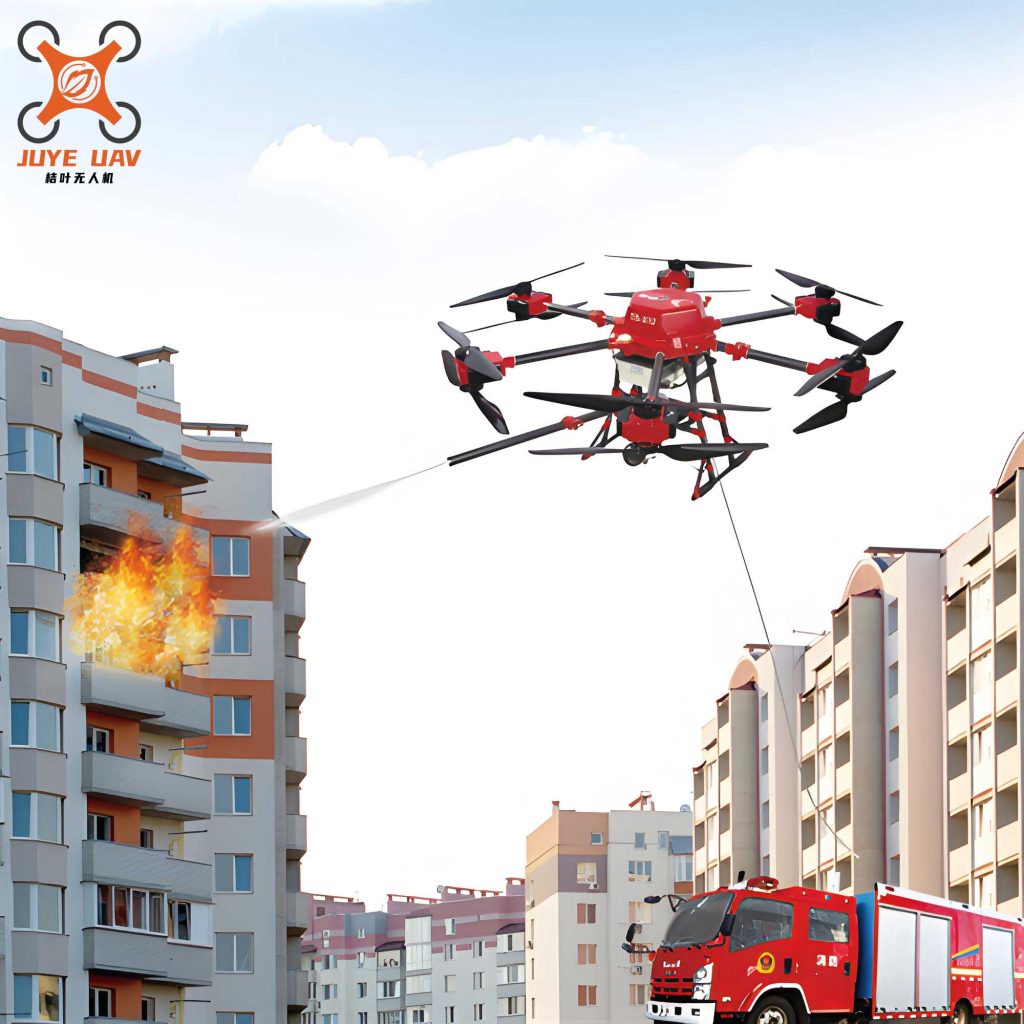
Looking ahead, the application of fire drones in firefighting and rescue will become more stratified, with different models assigned to specific roles based on their strengths. In my view, tilt-rotor and compound-wing fire drones will take on high-responsibility tasks due to their extended capabilities. For communication assurance, these fire drones can carry relay equipment to heights over 500 m, significantly expanding coverage. The communication range $D_{comm}$ can be approximated by: $$D_{comm} = \sqrt{2k h_t h_r},$$ where $k$ is the Earth’s radius factor (about 1.33 for standard atmosphere), $h_t$ is the transmitter height (drone altitude), and $h_r$ is the receiver height. For $h_t = 500\,m$ and $h_r = 2\,m$, $D_{comm} \approx 81\,km$, enabling robust networks in remote disaster zones. In forest fire scenarios, these fire drones equipped with infrared sensors can perform large-area thermal scans to detect hotspots, with detection probability $P_d$ modeled as: $$P_d = 1 – e^{-\lambda A},$$ where $\lambda$ is the sensor sensitivity and $A$ is the area covered. This enhances post-fire monitoring and prevents re-ignition. Tethered fire drones, on the other hand, will serve as guardians for command centers, providing unwavering support. Their ability to hover indefinitely makes them ideal for continuous video surveillance, with optical zoom capabilities allowing object detection up to 10 km away. For emergency lighting, a tethered fire drone with LED arrays can illuminate vast areas, with illuminance $E$ at ground level given by: $$E = \frac{I \cos(\theta)}{d^2},$$ where $I$ is luminous intensity, $\theta$ is the angle of incidence, and $d$ is the distance from the drone. In communication roles, tethered fire drones can host 4G/5G base stations, offering data rates up to 50 Mbps and serving hundreds of users simultaneously, as shown in Table 3. This versatility ensures that fire drones become integral to modern firefighting infrastructure.
| Fire Drone Type | Primary Applications | Key Performance Metrics | Example Use Case |
|---|---|---|---|
| Tilt-Rotor Fire Drone | Long-range reconnaissance, communication relay, large-area mapping | Range: >150 km, Speed: >80 km/h, Payload: >10 kg | Patrolling forest fire perimeters with IR cameras |
| Compound-Wing Fire Drone | Rapid response, disaster assessment, VTOL in confined spaces | Endurance: 2-4 hours, VTOL capability, Moderate payload | Earthquake zone 3D modeling for rescue planning |
| Tethered Fire Drone | Persistent surveillance, emergency lighting, communication hub | Hover time: 24+ hours, Height: 100-200 m, Power: Ground-fed | Flood disaster command center lighting and comms |
| Multi-Rotor Small Fire Drone | Close-range inspection, confined space ops, precise payload delivery | Agility: high, Endurance: 20-30 min, Payload: <2 kg | Searching rubble in urban collapse incidents |
| Quadcopter Light Fire Drone | Quick deployment, real-time video feed, training exercises | Cost-effective, Easy to operate, Portable | Routine fire scene monitoring and documentation |
In practice, I foresee a collaborative ecosystem where multiple fire drone types work in concert to address complex emergencies. For instance, during a major earthquake, tilt-rotor fire drones could rapidly map the entire affected region using photogrammetry, while multi-rotor small fire drones delve into collapsed structures for detailed inspection. The data fusion from these platforms can be optimized using algorithms like simultaneous localization and mapping (SLAM), represented by: $$\hat{x}_t = \arg\max_{x_t} P(x_t | z_{1:t}, u_{1:t}),$$ where $x_t$ is the state estimate, $z$ are observations, and $u$ are controls. This synergy enhances decision-making and resource allocation. Similarly, in flood responses, tethered fire drones provide stable communication links, while compound-wing fire drones assess dyke integrity over long stretches. The integration of fire drones with artificial intelligence will further boost capabilities, enabling autonomous patrols and anomaly detection. From my experience, training and standardization are crucial to harness this potential; fire departments must adopt protocols for fire drone operations, ensuring safety and interoperability. As technology advances, I believe fire drones will evolve beyond reconnaissance to active intervention, such as deploying extinguishing agents or delivering medical supplies, though payload limitations remain a hurdle. The continuous innovation in battery tech, materials, and sensors will drive this progress, making fire drones indispensable in the firefighter’s toolkit.
To conclude, the trajectory of fire drones in firefighting is marked by diversification and specialization. The limitations of current multi-rotor systems are being overcome through tethered solutions and hybrid designs like compound-wing and tilt-rotor fire drones. Each fire drone type brings unique advantages: tilt-rotor and compound-wing fire drones for extensive coverage, tethered fire drones for persistent presence, and multi-rotor fire drones for tactical precision. In my opinion, the future will see an integrated network of these aerial assets, communicating and coordinating seamlessly to save lives and protect property. As I reflect on my fieldwork, the transformative impact of fire drones is undeniable—they have reshaped how we perceive and respond to emergencies. Embracing this trend requires ongoing investment in research, training, and cross-platform collaboration. Ultimately, the goal is to create a resilient firefighting force where fire drones are not just tools but partners in rescue, embodying the promise of technology in service of humanity.